


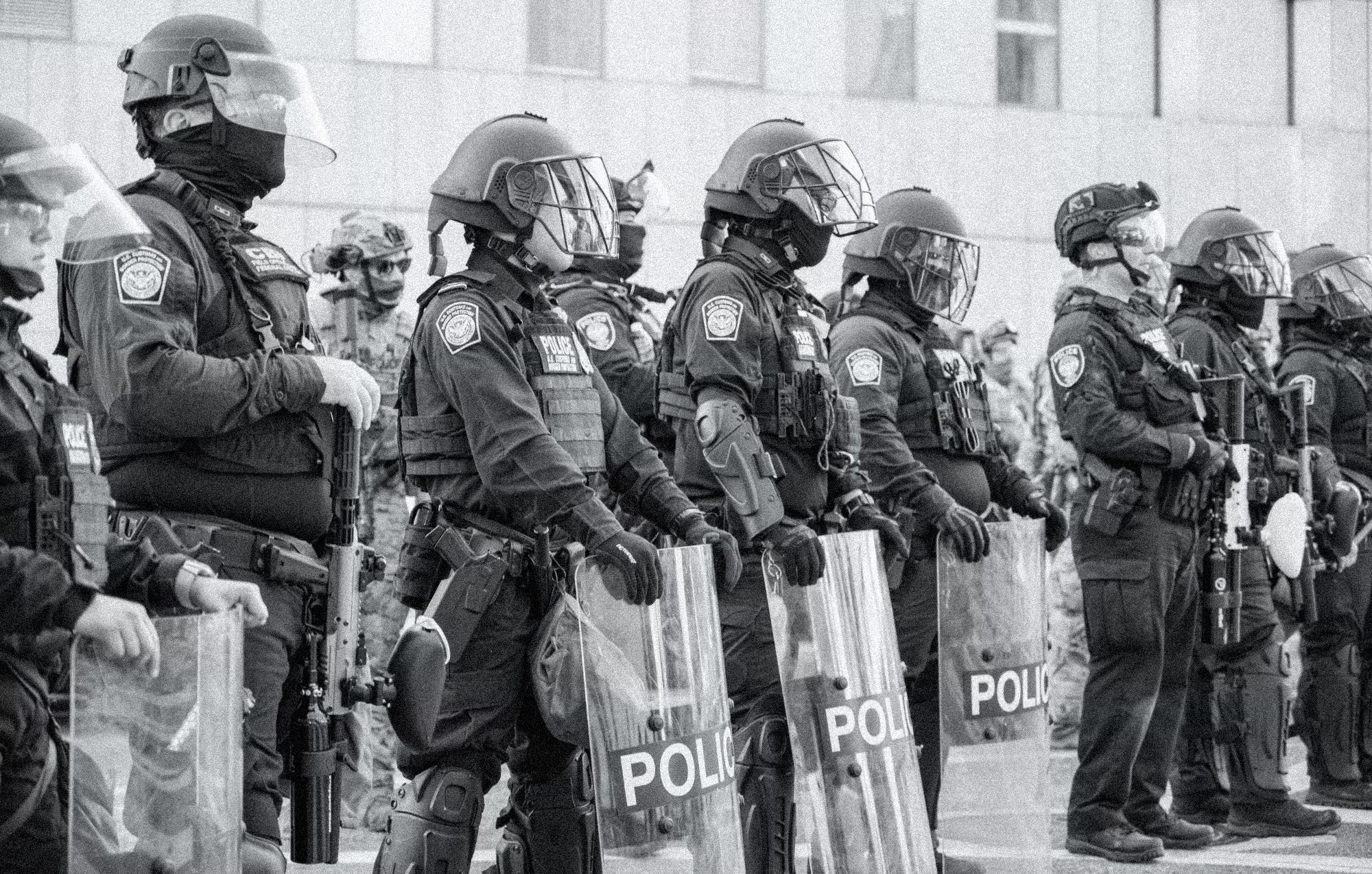
Contemporary debates over U.S. immigration policy are framed almost entirely in the language of pathology: cruelty, incompetence, authoritarian drift, constitutional erosion. These diagnoses are not wrong, but they describe merely surface phenomena while neglecting to account for the scope and intent of the policies, thus obscuring the form of power that generates them.
What was sold to voters as a program of robust law enforcement intended to restore order has become something wholly different: a campaign of ethnic cleansing. In international criminal law, ethnic cleansing denotes a purposeful policy of demographic engineering: the coercive removal of ethnically targeted populations from a territory through violence, terror, or the systematic destruction of legal personhood. Mass killing is not required. War is not required. Explicit racial law is not required. What is required is state intent to reshape population composition and the deployment of coercive power to make specific groups largely disappear.
The absence of formal ethnic categories does not negate the ethnic character of such a project. When a state systematically targets populations whose composition is overwhelmingly structured by race, it engages in ethnic governance regardless of the language it adopts. Immigration status, in this context, is a proxy classification system for ethnically patterned population removal. In particular, it is being used as a proxy for race and ethnicity, targeting Latinos most prominently, but also Middle Eastern, African, and other non-Anglo-Saxon groups.
Contemporary U.S. immigration policy exhibits every defining feature of this mode of state power. It is ideologically coherent around perceived demographic threat. It relies structurally on terror and spectacle as instruments of displacement. It manufactures illegality among targeted populations, using administrative law to strip millions of people of effective personhood, forcing exit through fear, precarity, and institutional suffocation—even as white Afrikaners are fast-tracked into the country through a specially created refugee program.
Ethnic cleansing is not simply a crime. It is a specific configuration of state power: one in which governing institutions designed are repurposed to purify; law becomes a weapon of demographic redesign; and political legitimacy is reconstructed around the permanent production of internal enemies. States that enter this mode do not merely violate rights, they reorganize the foundations of authority itself.
What follows is not an argument about immigration policy. It is a diagnosis of a regime transformation. It is an analysis of how a modern constitutional state crosses the threshold from governance to ethnonationalist engineering, from enforcement to purification, and from law as constraint to law as a weapon. This is not about abusive laws or harsh enforcement tactics; this is about a fundamental transformation of state power into a frightening cudgel for manufacturing a citizenry.
The Architect: Stephen Miller and the Prerogative State
Stephen Miller’s formal titles—deputy White House chief of staff for policy and homeland security adviser—obscure the reality of his role. Miller has become the chief ideologue and operational commander of a project aimed at the ethnic reengineering of the United States. His authority flows through ideological intimacy with the president and a shared commitment to an explicitly ethnonationalist vision of the country.
Miller is not a conventional immigration restrictionist concerned with labor markets or border management. His worldview is openly civilizational and racialized. He has repeatedly framed immigration from what he calls the “Third World” as a form of national contamination, describing non-European migration as a threat to American “culture” and “cohesion.” In this framework, immigrants from the Global South are not future Americans who can be integrated and can contribute positively to the nation. They are permanent outsiders whose presence degrades institutions, lowers trust, and corrodes the moral and biological foundations of the nation. America, in Miller’s imagination, is not a political community but a demographic one.

From this premise follows a radical conclusion: the core problem is not illegal immigration, but the existence of non-European populations themselves. Enforcement, therefore, cannot be limited to the undocumented. It must extend to legal residents, asylum seekers, and citizens*. The goal is not border control but demographic reversal—systematically shrinking the non-white population through removal, denaturalization, and the erosion of citizenship itself.
Miller’s power is correspondingly direct and operational. In May 2025, he personally issued ICE a daily arrest quota of 3,000, nearly triple previous levels. To meet this target, agents were instructed to abandon investigative priorities and instead conduct mass dragnet operations at churches, schools, and courthouses.
He has likewise pushed the Department of Justice to revive and expand denaturalization programs, ordering prosecutors to strip citizenship from naturalized Americans for trivial or decades-old paperwork discrepancies, and setting a quota for monthly denaturalizations.
When DHS Secretary Kristi Noem came under fire for lying about the killing of ICU nurse Alex Pretti, she defended herself in private conversations by saying that she did so at Miller’s direction. Miller, it appears, has so much informal power that Cabinet secretaries are his de facto subordinates.
Noem’s defense, framed as obedience to an unelected adviser, illustrates how informal channels of power have supplanted formal constraints. It marks the breakdown of the normative state—the familiar liberal order in which laws are general, procedures are transparent, rights are stable, and power is mediated through courts, statutes, and professional bureaucracies.
The prerogative state, by contrast, operates through discretionary power unconstrained by legal principle. Decisions are made ad hoc, targets are selected politically, and law becomes an instrument rather than a limit. Courts and due process survive only to the extent that they do not interfere with executive priorities.
Miller is not attempting to reform the normative state. He is systematically hollowing it out and replacing it with a prerogative one. Immigration judges have been purged and replaced with ideological loyalists. Defendants are increasingly transferred to distant detention facilities and hostile jurisdictions, severing them from counsel and community support, and rendering meaningful legal defense practically unattainable. Internal watchdogs and career civil servants are removed, sidelined, or forced into compliance through loyalty tests. Bureaucratic resistance is treated as sabotage. Law, when it cannot be weaponized, is treated as friction.
Such authoritarian drift is structurally necessary for Miller’s project. A liberal-democratic legal system cannot carry out ethnic purification at scale. Birthright citizenship, equal protection, and judicial review are existential obstacles to a program whose implicit goal is to make millions of people disappear from the national body. It could attempt to democratically limit the intake of racially disfavored groups. But that project would face obstacles, both moral and structural that would at least tame and temper if not thwart its objectives. The prerogative state is therefore not a temporary emergency mechanism. It is the only form of governance compatible with demographic engineering.

Miller’s ideology is coherent and explicit: The United States must be rescued from the consequences of racial pluralism. Assimilation is a myth. Institutions cannot transform people. Culture is biological. Corruption, disorder, and dysfunction are imported through bodies (although, ironically, not the most corrupt one at whose pleasure he serves), not behaviors. Restoration, therefore, requires subtraction—removing “Third World” populations until the country resembles an earlier, whiter, more homogeneous past.
What is unfolding is not immigration enforcement. It is a state project of ethnic rollback. The purpose is not to administer law but to override it. The aim is not security but purification. And the prerogative state is not a bug in this system—it is its essential operating system.
The Machinery of Removal
Public discourse treats ICE deportation operations as the core of contemporary immigration enforcement. This is a fundamental misreading of the campaign’s structure. Physical deportation is only one mechanism of removal, and not the primary one. The real objective is demographic elimination by any means available: expulsion, terror-induced flight, and administrative suffocation that renders legal existence impossible.
Arrest operations are designed less to remove people than to terrify those who remain. Masked agents in unmarked vehicles conduct raids at workplaces, schools, churches, and courthouses. The tactical signature resembles that of an occupying force: anonymity, unpredictability, and visible violence. The explicit goal, openly stated by administration officials, is “self-deportation”—to make the country so hostile that people flee rather than risk being hunted. As of January 2026, approximately two million have fled.
Detention facilities serve as instruments of psychological warfare. Detainees are transferred to remote compounds or high-security prisons designed to be degrading, isolating, and inescapable. The conditions are not incidental to the policy; they are the policy. Overcrowding, denial of medical care, and indefinite confinement are meant to be visible and discussed. The message is simple: this is what happens if you stay. The legal fiction of voluntary departure does not alter the structure of coercion. Terror deployed systematically is still state-directed removal.

For those who do not flee, detention has been repurposed into punitive coercion. The goal is not adjudication but exhaustion: to make detention so unbearable that detainees waive their legal rights in exchange for removal. This is “voluntary departure” extracted through duress. Federal judges have repeatedly ordered releases; ICE systematically ignores them. Federal Judge Patrick Schiltz compiled a list of 96 court orders defied by ICE since January 2026 in the state of Minnesota alone. The unavoidable conclusion is that judicial authority still exists on paper, but no longer constrains operational power. Law survives as theater while real authority operates elsewhere.
The most insidious campaign operates not through force but through paperwork. This is the strategy of manufactured illegality: stripping legal status from integrated residents in order to render them vulnerable. Pretextual determinations of improved conditions in countries like Haiti, Afghanistan, and Venezuela were hastily generated, and over a million legal immigrants were made illegal with the stroke of Kristi Noem’s pen, and over 500,000 humanitarian parolees were likewise stripped of their legal status.
The denaturalization campaign follows the same logic. Prosecutors have been instructed to pursue revocation of citizenship for trivial clerical discrepancies—missing signatures, translation errors, misfiled forms. Citizenship, once understood as permanent membership in a political community, is now treated as a provisional license subject to executive review. Legal existence itself becomes conditional.
A government concerned with law and order would not take extraordinary and pretextual steps to make illegal immigrants out of legal ones; but that is a logical and necessary step for a regime engaged in ethnic cleansing.
These are not separate policies. They are coordinated tactics within a single structure, and they can’t be deployed effectively in a nation where law constrains power. This is why a prerogative state is not incidental but necessary. A functioning legal system cannot execute demographic removal at scale. Courts would block mass revocations of status. Judges would demand release. Rights would attach. The only way to carry out this project is to operate outside the law while preserving the outward appearance that law still exists.
The result is a dual system: one order of legality for the protected majority, another for the targeted populations. While different forms of justice for disfavored groups is nothing new in America, Trump et al have have reorganized state power around demographic purification so that those targeted are cut off from access to the normative state altogether. That level of denial is unprecedented in post-Civil Rights America. History is clear that such a system does not remain confined to its initial victims. Once the law ceases to protect one population, it loses its ability to protect anyone who is targeted. Rights become contingent, and the arbitrary exercise of power becomes standard operating procedure.

The rule of law cannot survive selective suspension. It either constrains power universally or ceases to exist. A state that learns to remove people by terror, coercion, and paperwork does not stop with foreigners. It learns something far more dangerous: that law is not a limit on power, but a weapon that can be selectively wielded against anyone.
From Governance to Purification
Miller claims to be saving American civilization through demographic restoration. In reality, he is dismantling the very conditions under which civilization is possible. What he calls preservation is institutional liquidation: the systematic destruction of the rule-bound order that makes collective life governable rather than merely survivable.
This is not reform. It is institutional suicide in pursuit of an impossible—and undesirable—purity. The thing Miller claims to be defending—a cohesive, governable society—cannot survive the methods required to realize his vision. A fortress state may succeed in exclusion, but the society sealed inside it will be poorer, more fearful, more paranoid, and ultimately ungovernable. A population ruled by discretionary power does not become unified; it becomes brittle.
The classical world understood this dynamic with greater clarity than the modern one. In The Oresteia, Aeschylus stages the transformation of justice itself. The Furies—ancient embodiments of blood vengeance—are not destroyed. They are transformed into the Eumenides, given a place within the civic order, and subordinated to law. Personal retribution gives way to adjudication; terror is displaced by procedure; violence is absorbed into institutions that strip it of its private, retaliatory logic. Civilization begins not with the elimination of rage, but with its depersonalization.
What Miller and the prerogative state represent is the inverse of that civilizational achievement. They are not transforming the Furies; they are turning the Eumenides back into the Furies. They are dissolving the legal order that once absorbed vengeance and reconstituting politics as purification. Law no longer mediates conflict; it designates enemies. Courts no longer arbitrate; they ratify. The state ceases to be an impersonal structure and becomes an instrument of societal cleansing according to the ideological proclivities of those who hold power.
This is the real meaning of the prerogative state, a term originally coined to describe Nazi Germany but true of authoritarian regimes more broadly. It is not simply executive overreach. It is the resurrection of pre-legal power: a system in which authority no longer derives from rules, but from the capacity to declare who belongs and who does not. Governance is replaced by expulsion. Administration is replaced by removal. Politics is reduced to the management of internal enemies.

The ultimate question is not whether this campaign satisfies the definition of ethnic cleansing under international law. The evidence demonstrates that it does. The deeper question is whether Americans understand what submission to this project entails: the end of constitutional governance as a meaningful constraint on power, and its replacement with a system in which legality exists only at the pleasure of those who command the machinery of enforcement.
Once the prerogative state is normalized, there is no limiting principle left. The infrastructure built to remove Haitians and Venezuelans today will be repurposed tomorrow against whomever the regime designates as the next contaminant. Ethnic cleansing is classified as a crime against humanity not only because it destroys targeted populations, but because it transforms states into engines of discretionary violence—corrupting law itself into a weapon.
The United States is now crossing that threshold. Not as a metaphor or moral analogy. As a concrete structural transformation of state power. The Furies are no longer depersonalized. They have been invited back into the center of political life. They are running amok in neighborhoods across America, staining the pavement with blood. A society that abandons law in favor of purification does not preserve itself.
It disintegrates—and calls the wreckage salvation. That will be America’s future if it doesn’t reverse course.
*NOTE: An earlier version of this essay linked to a story about U.S.-born Sundas Naqvi allegedly being targeted by CBP agents. Since publication, new evidence has come to light disputing Naqvi’s account. We removed the link.
One Last Thing …
Just as we were putting the finishing touches on this piece, Cato Institute’s David J. Bier, a contributor at The UnPopulist, was being grilled by Louisiana Republican Sen. John Kennedy for using the term “ethnic cleansing” to describe the DHS’s goal to deport 100 million people from America. But Bier pointed out that deporting a third of the country with the goal of reducing its population is by definition ethnic cleansing. You can watch Bier’s masterful testimony here, but Kennedy’s inane questioning shows the depth of self-deceit Republicans are willing to engage in to avoid seeing what the administration is not even trying to hide.


© The UnPopulist, 2026
Follow us on Bluesky, Threads, YouTube, TikTok, Facebook, Instagram, and X.
We welcome your reactions and replies. Please adhere to our comments policy.

…and the disgusting fascists appear in the comments. Ranting and raving.
Thank you for this cogent essay.