


Dear Readers:
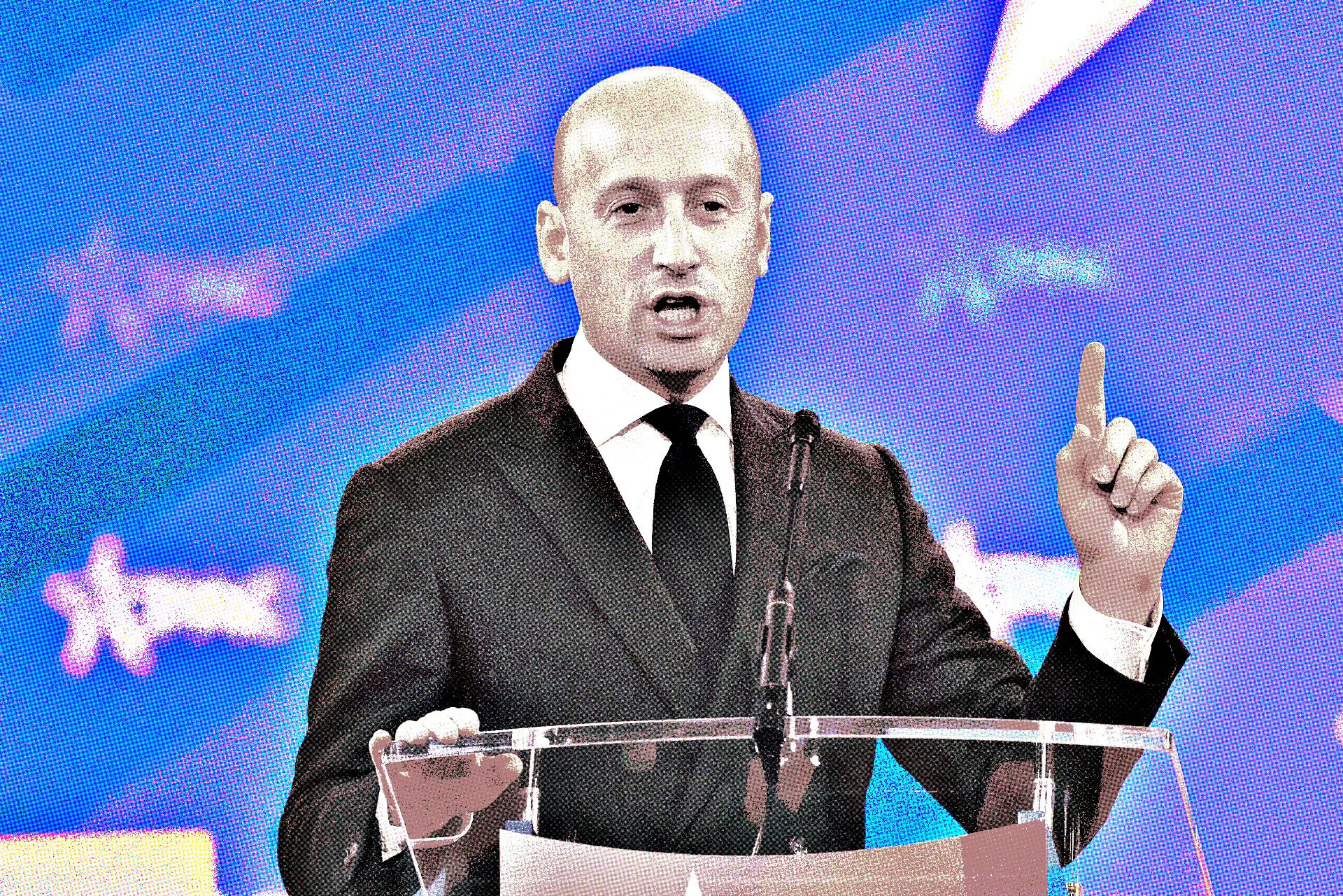
When the final book is written on the Trump administration, Stephen Miller may well go down as the most decisive driver of its agenda, the figure who did more than anyone else to shape not just Trump's immigration policy but other core areas of his populist-nationalist vision. Other MAGA masterminds, such as Russell Vought, are influential in remaking, err, gutting the executive branch. Miller is unique in that he is both a behind-the-scenes policy-maker and a public-facing agitator, relentlessly justifying the administration’s worst actions in an increasingly unhinged register on social media and in TV appearances.
That is why, today, we’re sharing with you the first installment of a two-part series on Miller written by author and journalist Greg Sargent, among the foremost chroniclers of this administration’s abuses. Originally published in The New Republic, Sargent’s piece is the most comprehensive examination yet of Miller’s ideological project—one that goes far beyond the scattershot coverage that his extremism typically receives. Given Miller’s extraordinary influence over the Trump administration’s campaign of terror against immigrants, understanding the full scope of his worldview has never been more urgent.
What makes this piece particularly striking is its use of a previously unpublished family history written by Miller’s own grandmother. The document tells the story of Miller’s Russian Jewish ancestors who fled persecution and pogroms, arriving at Ellis Island in 1903 to build new lives in America. Sargent uses this family narrative as a lens to examine the bitter irony at the heart of Miller’s career: The man whose ancestors fled persecution now oversees a draconian campaign to terrorize immigrants—wielding state power against the most vulnerable in a bitter repudiation of his own family’s history.
We’re republishing Sargent’s critical profile of Miller in two parts. Today’s installment traces Miller’s ancestry and his efforts to dismantle the post–World War II refugee and asylum system. Tomorrow’s installment, the second half of Sargent’s original essay, examines Miller’s broader campaign to remake American immigration law and the intellectual architecture underlying his vision.
Please read and share widely.
Berny Belvedere
Senior Editor

Stephen Miller’s ancestors first arrived in the United States in 1903. That’s when a man named Wolf Laib Glosser disembarked at Ellis Island after leaving behind his hometown in Antopol, a small town in the part of the czarist Russian empire that is now Belarus. Laib, who was fleeing a life marked by anti-Jewish pogroms and forced conscription, quickly set about trying to raise more money to bring over relatives.
“Wolf Laib found work in New York City peddling bananas and other fruit on street corners, and began sending small sums of money back to the family,” reads an unpublished book about the family that one of Stephen Miller’s relatives shared with The New Republic. The book—which tells the story of some of Miller’s ancestors’ immigration to the United States and their subsequent thriving here—was written by Miller’s grandmother, Ruth Glosser. Now that Miller has accumulated such extraordinary power over the future of our immigration system, it’s worth turning to this remarkable document, which we’re making available online for the first time.
From Persecuted to Persecutor
As the book recounts, Laib managed to bring over more family members in 1906, including a son, Sam Glosser. Over time, Laib—Miller’s great-great-grandfather—and his descendants built a successful haberdashery business in Johnstown, Pennsylvania, which evolved into a chain of supermarkets and department stores. Sam Glosser’s American-born son, Izzy, had two American children, David and Miriam Glosser—who were to become the uncle and mother of Stephen Miller.
This story, of course, tracks with that of countless others who arrived in the U.S. as part of the great migration, mostly from Southern and Eastern Europe, between the 1880s and the 1910s, which numbered as high as 20 million. As the book notes, they were out to “escape economic hardships and religious persecution” to build a “better life for themselves and their children.”
Yet at the time, many Americans didn’t think people like Miller’s ancestors were fit to become a part of the U.S. They were targeted by a virulent strain of nativism toward those from Southern and Eastern Europe that was largely about race—it was rooted in the “scientific racism” of the day. But it also involved a somewhat different claim: that the new arrivals suffered from a “social degeneracy” or “social inadequacy”—two typical phrases at the time—which rendered them a threat to the “civilization” the U.S. was in the process of becoming. In this telling, as prominent sociologist Edward Alsworth Ross declared in a 1914 broadside, these new immigrants were inferior to Americans who descended from the “pioneer breed” who’d given birth to the American nation. The new arrivals, Ross said, had “submerged” that ancestral connection to the “pioneer breed,” setting the nation on a path to the “extinction that surely awaits it.”

“There is little or no similarity between the clear-thinking, self-governing stocks that sired the American people and this stream of irresponsible and broken wreckage that is pouring into the lifeblood of America the social and political diseases of the Old World,” declared one congressman not long after. As historian Gary Gerstle, author of the great book American Crucible, noted in an email to me, many nativists at the time lamented the “civilizational vulnerability” of the U.S., believing that “white, Christian, and western European culture” stretching back to “ancient Greece and Rome” represented the “summit of human achievement” and the core of American civilization. This was under dire threat from “groups outside that culture” who were “unassimilable, with Jewish ranks full of Bolsheviks and Italian ranks full of anarchists.”
More than a century later, those diatribes about people like Miller’s ancestors are very similar to claims Miller makes today about the threat to “civilization” supposedly posed by those emigrating from Africa, Latin America, Asia, and elsewhere. To be sure, it is not a new move to bring up Miller’s ancestry in the context of his current nativism, and many aspects of Miller’s worldview are well-known in a scattershot way: his disdain for multiculturalism, his hatred of mass migration, his affinity with white nationalists.
But in a series of tweets, interviews in right-wing media, and statements made elsewhere, Miller has outlined something more comprehensive and sinister—an elaborate worldview that has escaped notice in the mainstream media. It centers immigrants as a threat to “civilization” in terms that echo the rhetoric of those determined to exclude people like his ancestors.
That larger worldview—and its intellectual roots—deserve more scrutiny. Given Miller’s extraordinary power—his near unfettered control over President Donald Trump’s massive ramp-up in immigration enforcement—a deeper understanding of Miller’s views is essential. It demonstrates in a more vivid way the true extremism of his anti-immigrant project—and why it poses a serious threat to the country and its future.
Miller’s Agenda: Fewer Refugees and a Whiter America
In that book about Miller’s ancestors, titled A Precious Legacy, there are wrenching passages about the Immigration Act of 1924. That law, which represented the culmination of all those aforementioned virulent sentiments about Southern and Eastern Europeans, adopted an immigration formula tied to the 1890 distribution of ethnicities in the U.S. This guaranteed that most of the 150,000 immigrants allowed entry each year would henceforth come from Northern and Western Europe, imposing tighter limits on those from Southern and Eastern Europe and elsewhere. The law’s primary aim was to slam the brakes on immigration by people like Miller’s ancestors.
Thanks to the 1924 act, the book notes, “the doors to free and open immigration here swung shut.” Fortunately, all of Wolf Laib’s immediate family made it to the U.S. by 1920, the book says, but many left behind did not fare well. “Those Jews who remained in Antopol were not so lucky,” ruefully recounts the book, which was first discussed in Hatemonger by journalist Jean Guerrero. It adds that most of those who remained in Wolf Laib’s town “were murdered by the Nazis.”

Strikingly, Miller has spoken positively about the 1924 law. “During the last period in which America was the undisputed global superpower—financially, culturally, militarily—immigration was net negative,” Miller tweeted in August. He’s referring to the period between the 1924 law and the 1965 Immigration and Nationality Act, which ended ethnic quotas for immigration created in 1924: In short, Miller is extolling the impacts of the 1924 measure. He was even more direct in 2015 emails to Breitbart obtained by the Southern Poverty Law Center. He repeatedly praised President Calvin Coolidge for signing that law, describing the act rhapsodically as Coolidge’s “heritage” and suggesting the country should act “like Coolidge did”; that is, either dramatically restrict immigration or impose new ethnic quotas on it.
None of this necessarily means Miller is unconcerned about the fate of those who met terrible ends due to their inability to immigrate. But Miller offered those quotes about that century-old law as a device to describe his present-day vision, and, in a very real sense, his true ideological project is to unmake the world the 1965 act created when it ended the ethnic quota system and opened the country to more immigration from all over the world.
Indeed, Miller’s grander aims are best understood as an effort to destroy the entire architecture of immigration and humanitarian resettlement put in place in the post–World War II era. The 1965 law’s end to ethnic quotas guaranteed that, henceforth, immigration slots would be doled out on a race-neutral basis. That and subsequent measures—which created the contemporary refugee and asylum system—drew heavily on the international human rights treaties that the U.S. and many countries signed on to after the war. Subsequent U.S. law has enshrined the right to seek refuge here and protections against getting sent home to face persecution or grave danger—and a set of values that, theoretically at least, has been to some degree a bipartisan consensus for decades.
Miller is, at bottom, trying to eradicate that set of obligations and values—to undo that larger consensus. To grasp this, you need to look at all the small things Miller is doing, which, taken together, all add up to one very big thing.
Take the administration’s handling of white South Africans. Officials recently announced that they will accept only 7,500 refugees this fiscal year—a dramatic reduction from 125,000 under President Joe Biden—and, critically, it reserved a majority of those slots for white Afrikaners, who are mostly descendants of Dutch and French settlers. This implements Trump’s 2025 executive order decreeing that they must be treated as a persecuted “ethnic minority.” He says they face white “genocide,” which has been roundly debunked by statistics and experts.

Yet the implementation of this has been corrupted, according to two former senior State Department officials who witnessed this firsthand.
Typically, such an announcement designating a group subject to persecution would be backed up by a serious State Department analysis—often from its Bureau of Population, Refugees, and Migration, or PRM—laying out a substantive case detailing this persecution. But after Trump’s executive order hit, PRM was not directed to work up any such analysis, the officials told me. “PRM was not asked for this,” one of the officials said.
Instead, word came down from State Department political appointees declaring that this had to happen simply because the order said so, the officials stated.
“We should have a process that has integrity in determining who among the world’s refugees are most in need of resettlement,” the second source said. “They blew right through that.” Asked for comment, another State Department official insisted that Afrikaner “refugees” meet “statutory requirements.”
Strikingly, the administration is also reportedly mulling proposals to prioritize far-right European political actors, who are supposedly being persecuted for anti-immigrant views, for refugee status. Let’s be clear: It is now apparently U.S. policy to favor whites in the doling out of refugee admissions.
What’s more, the slashing of annual refugee admissions from 125,000 to 7,500 itself represents an enormous retreat on the obligations that members of both parties have long felt toward those seeking refuge here. This comes even as the worldwide refugee population has about doubled in the last decade to over 40 million. Trump and Miller have also moved to end Temporary Protected Status, or TPS, for people here from at least eight countries, totaling over one million. That legal protection provides temporary sojourn to people fleeing some of the most horrific conditions on the planet: armed conflicts, natural and environmental disasters, large-scale civic breakdown. These are not undocumented immigrants. They are here lawfully, have work permits, and are integrating into U.S. communities. That’s all been cruelly wrenched out from under them.
Critically, in moving to end all these things, Miller is feverishly stamping out every single avenue for those fleeing horrific conditions to come here legally that he possibly can. Republican presidents have traditionally set refugee admissions levels much higher than Trump has in both his terms, and TPS was signed into law by a Republican president, George H.W. Bush. In functionally ending all this, Miller is breaking with a consensus that has largely been bipartisan for decades.
The Machinery of Mass Removal
Miller may also be restricting legal immigration in a broader, unnoticed sense. At my request, Migration Policy Institute analyst Julia Gelatt looked at data from the U.S. Citizenship and Immigration Services to determine current processing rates. She found that if you total up most applications for immigrating to the U.S.—from green cards to family reunification to naturalization to temporary visas and other forms of legal status—the number of denials is going up. Denials rose from around 274,000 during the last three months of Biden’s 2024 term to around 324,000 from April to June of 2025, a hike of about 50,000.

While acceptances are still much higher than denials, those acceptances have been declining, Gelatt found, leading her to conclude that USCIS is “approving fewer applications and denying more.” And as of early December, after an Afghan refugee allegedly shot two West Virginia National Guard members in Washington, Trump suspended all asylum applications and all immigration applications from 19 countries.
Miller’s obsession with sheer numbers—the amounts of various categories of immigrants who are either in the U.S. or trying to get here—borders on pathological. Take his handling of undocumented immigrants. Miller has repeatedly raged at Immigration and Customs Enforcement officials for arrest numbers he deems too low. Since the summer, arrests have hovered at around 1,000 daily. But he’s demanding 3,000 arrests per day, a pace of about one million people per year. To that end, The New York Times reports, the administration has already shifted thousands of federal law enforcement personnel into deportations, hampering critical efforts to combat serious crimes like child and drug trafficking. What’s more, ICE itself is arresting a lot of undocumented immigrants who are not dangerous criminals, diverting resources away from arresting the latter.
Here’s the thing: Miller’s mission of boosting deportation numbers of necessity requires arresting people who are not criminals or gang members—people who have jobs and have become integrated into U.S. communities—because there’s no other way to get the removals up. But it makes us less safe. Miller plainly places more importance on reducing the totals of people here—or trying to get here—than on removing people who pose any actual danger. He appears to be actively prioritizing shifting the ethnic mix of the country over public safety.

This essay first appeared in The New Republic. It is republished here with permission.
Follow us on Bluesky, Threads, YouTube, TikTok, Facebook, Instagram, and X.
We welcome your reactions and replies. Please adhere to our comments policy.

Miller is to Trump what Haldeman/Ehrlichman/Colson were to Nixon. The these men brought out the absolute worst in their employers, and played on their worst instincts. H/E/C all went to jail. Hopefully Miller will follow suit.
It is worth noting that the 1924 act did not set visa quotas for immigrants from within the Western Hemisphere. That doesn't mean there was unlimited immigration from, say, Mexico. But it did mean that the Latinos now being demonized would have been accorded greater migration privileges during Stephen Miller's golden age than he would like them to have today.
I also have the theory, and it is just a hypothesis, that something about growing up in the period with essentially no immigration--people born circa 1920-1950--warped how Americans viewed building and risk, sparking what Brink Lindsey has called the anti-Promethean backlash: https://vpostrel.substack.com/p/why-the-anti-promethean-backlash