


Revival is a theological term—it refers to a collective spiritual awakening, the kind that sweeps through churches and reverberates across public life. It’s a fundamentally religious aspiration. Were we to descend from the celestial to the earthly plane, from theological preoccupations to civic ones, a more apt concept might be renewal, revival’s less religiously inflected cousin. Revival is for things that have died; renewal is for things that are broken and need to be made new. Think reconstruction more than resurrection.
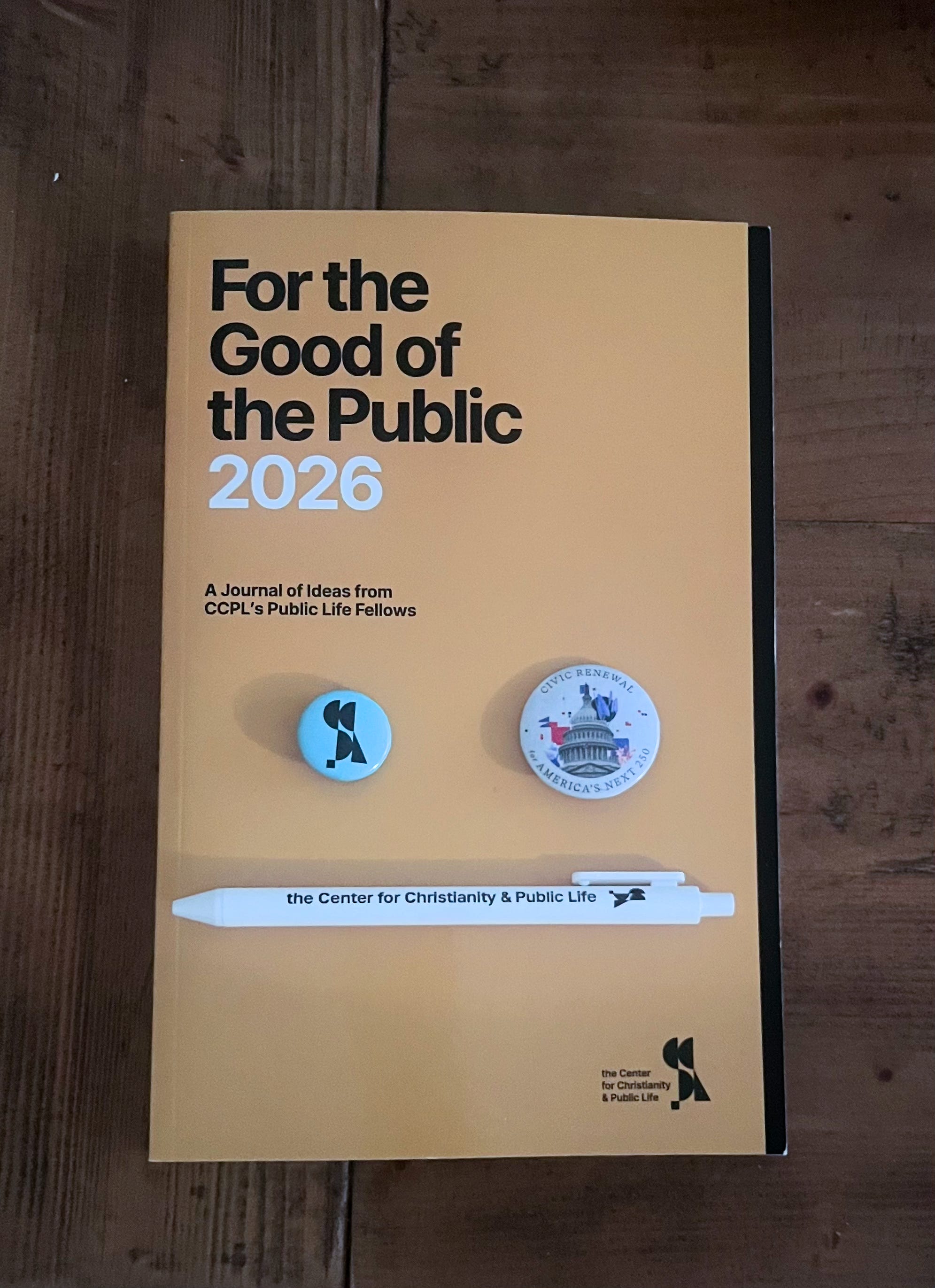
The Center for Christianity and Public Life (CCPL), founded four years ago by former Obama White House faith adviser Michael Wear to show how Christianity’s ideas, institutions, and people can contribute to a healthier politics for everyone, is all in on civic renewal. Its annual summit, held earlier this month in Washington, D.C., under the theme “For the Good of the Public,” sought to apply that civic renewal mandate to “America’s Next 250.” Like LibCon 2026, the annual flagship conference of our publisher, the Institute for the Study of Modern Authoritarianism, the summit used the 250th anniversary of history’s most successful experiment in liberal democracy to reflect on what it would take to ensure its health for the next 250.
As The UnPopulist’s regular readers know, the animating conviction of its Liberalism & Religion series is that there is no contradiction between a faith following its tenets and supporting the liberal social order—and that when religions, Christianity very much included, embody the values they share with liberalism, they strengthen both themselves and liberal democracy. After two days among the summit’s speakers—a mix of elected officials, Christian and other religious leaders, academics, journalists, and movement-builders—it was obvious to me that the center is working from the same premise.
Drawing on an American tradition eclectic enough to include John Quincy Adams, Abraham Lincoln, and Howard Thurman, Wear argued in his opening remarks that the American experiment has always depended on each generation choosing to sustain it. “Neither history nor God himself owes us civic renewal,” he said. “America is not guaranteed a next 250.” To the untrained ear, that may sound like Donald-driven despondency. But a longstanding Christian conviction is that no nation is guaranteed permanence, a tenet that comes in versions both serious (see: St. Augustine’s De Civitate Dei) and silly (see: your evangelical aunt’s angst on learning that “the United States of America is not in the book of Revelation!”). America, historical marvel that it is, is not invulnerable to the ill winds that have ravaged other world powers throughout time. As Shikha Dalmia also underscored in her LibCon opener this year, American exceptionalism does not mean that the country has any exceptional immunity to the virus of populist authoritarianism.
Under Donald Trump, much of the American church has gained a political ally at the risk of its soul—Mark 8:36 in concrete form. Wear didn’t call MAGA Christianity a disaster for country and faith in so many words, but his diagnosis landed in the same place. Our politicians, he said, have been “so forceful and purposeful in seeking to define reality according to their whims and preferences” that many of us have “bought into the content and the propaganda,” along with “the animosities of our day.” It’s a warning Wear also sounded on a LibCon panel last year: when religion hardens into an identity, it can no longer cultivate the virtue a self-governing people needs. His answer at the summit was Christ’s command to love our enemies, a teaching that has been “elided, rejected, or denigrated by the likes of Nietzsche, Schmitt, and Donald Trump.” Wear acknowledged that the past decade has scrambled our political coalitions and suggested that today’s opponents may be the allies a healthier politics needs tomorrow.
We’ve made this case before as well: ours is an age of political realignment. The central binary in American politics remains Team Red vs. Team Blue, but the liberal vs. illiberal fault line that has opened over the last decade cuts across it.
Character and the Rule of Law
No one at the summit embodied that fault line more vividly than Patrick Schiltz, a senior judge on the U.S. District Court for the District of Minnesota who served as its chief judge through Operation Metro Surge. A former Scalia clerk appointed by George W. Bush, Schiltz documented ICE’s violations of more than 200 court orders during the Trump administration’s immigration crackdown in the Twin Cities. For his efforts, he has been roundly attacked by MAGA. But Schiltz told his interlocutor, Cherie Harder, president of the Trinity Forum and herself a veteran of the George W. Bush White House, that the backlash did not deter him. As a believing Catholic, he knew his commitments wouldn’t neatly align with either side.
When Harder asked him how he found the courage to stand up to ICE’s legal defiance, Schiltz seemed genuinely puzzled. Why would doing his job faithfully be such a big deal? What sustains a liberal democracy, he said, is ordinary civic virtue. And “if you get to the point you need heroes” to do that, “it’s too late.”
Harder was right to ask about courage, though: the very Catholic moral tradition Schiltz hails from, whose heavy Thomistic shape flows from Aristotelian premises, gives moral exemplars a central role, since we learn virtue in part by watching those who already have it. (The message behind one of Christianity’s best-known cultural fads—the WWJD bracelet—springs from the same insight.) A free society may not be able to run on heroes, but it can hardly do without them as teachers!
That afternoon, FIRE’s Jeffrey Rosen, Yale Divinity School’s Jennifer Herdt, and Wheaton College’s Vince Bacote discussed how virtue gets internalized. Practices like humble introspection, deep reading, and moderation were singled out as particularly important. (For a “secular” twist on these spiritual disciplines, see Jonathan Rauch’s recent Zooming In with Alexandre Lefebvre.)
Bacote, who directs Wheaton’s Center for Applied Christian Ethics, has made a case for Christian political engagement that resists both withdrawal and partisan capture, and he has vocally taken the evangelical movement to task for its failures on race. In an offstage interview, he talked to me about what the word “evangelical” still means and whether it’s worth keeping. He says yes, for the reason the late civil rights leader John Perkins gave at Wheaton, evangelicalism’s flagship college, in 2018: the word’s root is evangel, the gospel, the organizing concept of historic Protestant Christianity, and that is not something to give away. Still, Bacote admits he holds back on the designation in some rooms, since using it would first require what he calls “the explainer.”
He also lamented that echo chambers cultivate not just an alternative reality but an alternative virtue: fidelity to one’s own side. In that inverted moral order, he said, the corresponding vice is daring “to actually even humanize people that don’t see the world the way that you do.”
Religion, Democracy, and Evangelicalism
On the summit’s second day, two sessions were especially in line with the premise of The UnPopulist’s Liberalism & Religion series. The New Yorker’s Emma Green moderated a conversation between Shadi Hamid, a Washington Post columnist and Muslim political scientist, and Matthew Kaemingk, an evangelical theologian. Their panel was titled after their new book, Can Religion Save Democracy? As Hamid put it: “You don’t have to be a believer in God to recognize that religion can have positive aspects, positive effects for society.”
Russell Moore, editor-at-large and columnist at Christianity Today, followed with what I thought was the summit’s most insightful address. Evangelicals, he argued, are called to be wayfarers, placing their trust in Christ rather than in influence and institutions. It’s a theme Moore has emphasized throughout the years. In his 2024 podcast with me, he noted that honoring a Christian vision of human dignity “requires a sense of freedom and pluralism.”
Collective Memory and Reconciliation
David Bailey, founder and chief vision officer of Arrabon, had opened that morning with a session on “Lift Every Voice and Sing,” the hymn first performed by 500 Black schoolchildren living under Jim Crow. Bailey, who grew up in Richmond, Virginia, urged the audience to be neither naive nor cynical about the nation’s past. “Hope does not merely imagine a better future,” he said. “Hope builds toward the better future it believes is possible.”
In the summit’s recording room, Bailey and I discussed how our screens are “shaping our imagination, shaping our outrage, discipling our emotions at a gut level,” and why Christian nationalism keeps finding its way into American churches. Bailey calls the use of violence to carry out God’s will “identity theft of the way of Jesus.” (On the summit’s final morning, Bailey also led attendees on a guided journey through the National Museum of African American History and Culture.)
Richmond came up again that afternoon, when its mayor, Danny Avula, sat down with Wear. Avula gave a moving account of one of his core initiatives: to help a city long known as the capital of the Confederacy and a center of the slave trade become known instead for healing and reconciliation. Part of that effort is a memorial built around the excavated remains of Lumpkin’s Slave Jail, the notorious holding pen known as the “Devil’s Half Acre.”
Nazanin Ash, CEO of Welcome.US, carried that same theme of healing to the topic of immigration. Welcoming newcomers, she suggested, could be a source of national unity: “Maybe it’s the key to our own national healing.” In a healthier era of American Christianity—when churches routinely took in refugee families—her organization’s model of pairing ordinary Americans with refugees for sponsorship would be widely embraced as a concrete fulfillment of the biblical mandate of hospitality. But today, with the faith’s public witness turned upside down, many professing Christians are among the loudest anti-immigrant maximalists.
Civic Renewal
The people CCPL draws take their obligations to their families, congregations, workplaces, and communities both seriously and joyfully. An aviator named Curtis shared more wisdom with me about raising adolescents than I have gotten from a dozen parenting podcasts. If America’s next 250 depends on people like these, it has a fighting chance.
The summit’s greatest strength was its moral and theological seriousness offered in a genuinely ecumenical and welcoming spirit. That last bit carries a cost, though. The conference leaned toward avoiding specific parties and figures. Apart from Wear’s keynote, conversations tended to stay at the level of principle. Someone who had slept through the past decade could have left thinking we are in an ordinary political season in which you take the good, rue the bad, and hope to do a little better next time. But we are emphatically not. The current president has tried to undo our electoral democracy, often in the name of Christian values and sometimes with the ardent support of the Christian right. The administration has presented its draconian immigration enforcement in the language of the prophets and as a fulfillment of biblical values. Few gatherings are better equipped than this one to name that for the perversion of the faith that it is.
Still, the center’s restraint rests on sound theological, cultural, and strategic grounds; an organization devoted to Christian formation has good reason to stay out of the partisan fray. My hope is that the convictions so clearly articulated on the stage find their way, through the people who heard them, into the judgments this moment demands.
Wear was right that neither history nor God owes us civic renewal. It has to be built by people who take their obligations seriously. And I met a good many of them at the summit. We’ll need every one of them for the work ahead.

© The UnPopulist, 2026
Follow us on Bluesky, Threads, YouTube, TikTok, Facebook, Instagram, and X.
We welcome your reactions and replies. Please adhere to our comments policy.
They can “grapple” all they like. But the fact is that organised religions have been and continue to be the curse of mankind down the ages. A blind, unfaltering faith in anything is a recipe for conflict, bigotry and the manipulation of the unthinking masses by predatory leaders. Witness Trump, the Ayatollahs, Wako, Texas. Amongst others.