

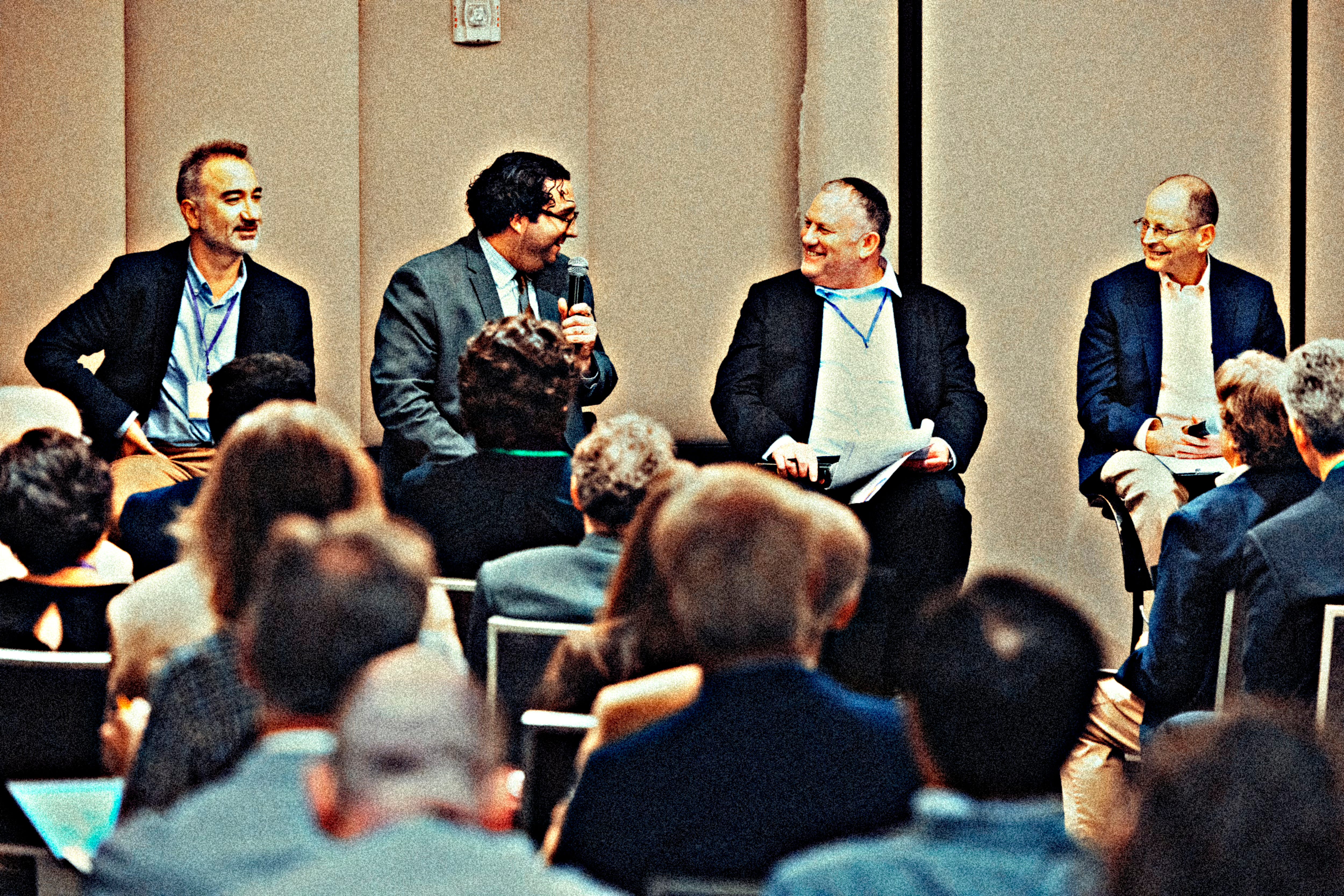
Today, we’re thrilled to share the full video and lightly edited transcript of LibCon2025’s breakout panel, “Restoring the Religion-Liberalism Partnership.” To explore other sessions from the last two ISMA conferences—LibCon2024 and LibCon2025—go here.

Marietta van der Tol: I’m delighted to introduce this panel on the religion and liberalism partnership. As many of you know, this relationship between religion and liberalism can be quite complicated and contested. One of the questions this panel will raise is: What, if any, are the particular commitments that religious traditions may have to make to liberal democracy?
Our panelists are Mustafa Akyol, a senior fellow with the Cato Institute based here in D.C.; Michael Wear, the president and CEO of the Center for Christianity and Public Life; and Gideon Sylvester, a scholar based in Jerusalem and originally from London. Finally, our moderator, Jonathan Rauch, is a senior fellow with Brookings. Now, everyone here has titles and affiliations and I would very much invite you to have a little look online for who they are and what they are doing in these particular institutions. But we want to get to the crux of the conversation. I’ll hand it over to Jonathan.
Jonathan Rauch: Thank you, Marietta. We are here to talk about restoring the religion-liberalism partnership. I thought I would begin by asking our panelists all the same question, just to get us started with a question that I warned our panelists that we could start with, which is: Do religious faiths generally and yours in particular owe anything to liberal democracy beyond compliance with the law? In other words, we all agree that there is an obligation to follow the law and the state. Is anything more required of faith by liberalism? Mustafa, why don’t you kick us off?
Mustafa Akyol: Thank you. Great question. Let me say a few things about my religion, Islam, and its relationship to liberalism. I think it’s fair to say that none of our great religious traditions—the big three [in the West] are Judaism, Christianity, and Islam—come from the liberal age. They’re thousands of years old—it was a different world where everybody thought that the blasphemers should be punished and there should be a divinely guided ruler of some sort. There are some proto-liberal ideas in most of them, like human dignity, that are about a higher law. Actually, religious thinkers worked through those proto-liberal ideas to offer new interpretations of religions that are compatible with liberalism. It’s fair to say it happened in Christianity, because of a terrible crisis in it. Christians got fed up killing and persecuting each other for a few centuries. And people like John Locke said, “You know, maybe toleration is a good thing and maybe government should not promote the ‘right religion’—just respect people’s natural rights and protect them. It happened in Christianity.
So I find it very interesting that early Enlightenment discussions … Jews if I’m not wrong saw that in Europe, and it promised them emancipation and equal rights and they adapted to that with the Enlightenment. In Islam, it’s a different story, as you can imagine. There are proto-liberal ideas in Islam, too. Actually, when Christianity was in its most oppressive phase, Islam looked more liberal by today’s terms. That’s why Jews migrated from Christendom into the lands of Islam several times—it was more tolerant.
Still, Islamic civilization had the idea that the ruler should be a Muslim ruler, maybe ideally a caliph, and that the sharia should rule. The sharia has some good things in it, like free markets, which we can emphasize today, but also rule of law. Blasphemers and apostates are given the death penalty, and the true religion should be supreme over the others, although they are tolerated (except for atheism).
So can we also have this liberal synthesis within Islam? That’s been discussed among Muslims for the past two centuries. There is a movement called Islamic liberalism. I’m working on it and trying to advance it. But there’s an additional tension. In Christianity, liberalism grew within Christianity as an answer to its problems. Jews found that, within Christendom, it would help them with equal rights and save them from a lot of persecutions. For Islam, it’s coming from an outside civilization; it has promises, it sounds good, and you aspire to it—but it’s the same civilization that has colonized, occupied, bombed, and [inflicted] endless wars on you.

So there is a tension because of the geopolitical issue. For liberalism to go forward in the Muslim world, we need two things in the West. First, keep liberalism safe and sound because it’s not just staying there. It may have a lot of challenges. Second, liberalism should not be combined with imperialistic designs and liberalism cannot be used as a justification for that. The more we keep liberalism principled as the doctrine of universal human rights, not the rights of one people over the other people, it will have more universal appeal. That’s true for Islamic civilization. That’s true for the other civilizations who are grappling with similar issues.
“So can we also have this liberal synthesis within Islam? That’s been discussed among Muslims for the past two centuries. There is a movement called Islamic liberalism. I’m working on it and trying to advance it. But there’s an additional tension. In Christianity, liberalism grew within Christianity as an answer to its problems. Jews found that, within Christendom, it would help them with equal rights and save them from a lot of persecutions. For Islam, it’s coming from an outside civilization; it has promises, it sounds good, and you aspire to it—but it’s the same civilization that has colonized, occupied, bombed, and [inflicted] endless wars on you. So there is a tension because of the geopolitical issue.” — Mustafa Akyol
Rauch: Before we go to Rabbi Sylvester, I think you just told us a bit about what liberalism should do for Muslims. Could you switch that around and just tell us a bit more about what you think the Islamic faith owes liberalism, if anything?
Akyol: Ask not what your religion ... Sorry. Very good question. I think in Islam you definitely need a reformation in Islamic jurisprudence—the interpretation of religious law, and to some extent theology—to be compatible with liberalism. Because, in Islam, like in other illiberal religious doctrines, there is the idea that the people with the true religion should be supreme, and that they should spread the faith and they should tolerate others in a good way—by medieval standards—but still not equal rights. Also, men have more rights than women. So there’s a hierarchical notion of rights. I think one of the great inventions of liberalism was to say people’s rights are not based on their theological doctrines. It might be a heretic. It might be an infidel. But he’s your equal, he’s an equal citizen. That legal transformation has happened in some Muslim majority societies. There are Muslim majority societies today that are liberal democracies. One is actually Bosnia, which you just heard about. But in terms of Islamic doctrine and teaching, if you look at the classical teachings, Muslims are still supreme, apostasy is not allowed, and blasphemy is a crime. So those things need to be worked out and I’m working on that particular issue.
What I find fascinating in Christianity is that, looking from outside, Christians have a very long history of illiberalism, right? Some illiberal ideas are coming back in Christianity and that’s fascinating. I see people defending integralism, which we call Islamism in our part of the world—a religious state promoting the true religion. I think we need a conversation across the traditions, saying why these ideas are not good. I would love to convince the integralists that Islamism doesn’t really work well. We tried it in Iran—I mean, I didn’t, but some people did. The Taliban really is not a great model, and [we shouldn’t] go for that again after the better synthesis in the West.
Rauch: I’m going to stay with you just for one more brief question, and go out on a bit of a limb here. After the 9/11 attacks—when you all were 10 years old—a friend told me that in the aftermath he read the Quran from cover to cover. (This is someone also acquainted with the Jewish and Christian Bibles). I asked him if it was true, as some people said at the time, that Islam was in some fundamental way illiberal. His response, which I always remembered, was that there is a lot of illiberal stuff in all of these holy books, but if you’re an illiberal person Islam gives you more to work with. Do you think there’s anything to that?
Akyol: I don’t agree. I mean, it’s a fact that the Muslim world today is less liberal than the Christian majority world, at least the West. It’s a fact because things have happened, a lot of changes have happened. If you just look at the doctrine itself, if you just compare the scriptures—I like the New Testament; it’s probably the most peaceful among those—if you compare the Quran with what Christians call the Old Testament, well, there are pretty violent passages in both of those. The question is how do you interpret them?
There are some passages about war between Prophet Muhammad and the pagans of Mecca; there are some passages about the conquest of Jericho in the Old Testament. Pretty harsh stuff. Do you think this is a commandment for today, or this is just ancient history which just happened there, and today you’re living in a different world? Well, Muslim answers vary. ISIS or al-Qaida think these are commandments for today and they quote them, they amplify them. That’s what they’re obsessed about. But a lot of Muslims, the majority probably, will say, “Well, they’re just things that happened there. It’s just not affecting our lives today.” These violent extremist groups—9/11 things like that, ISIS, al-Qaida, Hamas—they use religious arguments. This is true, and they should be countered on that.

But we should not forget they also come out of political conflicts. If they were not there, maybe there would be a socialist group or communist group doing that sort of violence.
We should also understand the political roots of some of the seemingly religious violence. But I think we should also not over-religionize everything that sometimes could be more political.
“Some illiberal ideas are coming back in Christianity and that’s fascinating. I see people defending integralism, which we call Islamism in our part of the world—a religious state promoting the true religion. I think we need a conversation across the traditions, saying why these ideas are not good. I would love to convince the integralists that Islamism doesn’t really work well. We tried it in Iran—I mean, I didn’t, but some people did. The Taliban really is not a great model, and [we shouldn’t] go for that again after the better synthesis in the West.” — Mustafa Akyol
Rauch: Thank you. Brother Sylvester, do religious faith generally and Judaism in particular owe anything to liberal democracy beyond compliance with the law?
Gideon Sylvester: Thank you. Before I answer the question, I’d like to slightly take issue with something that Mustafa said, and that’s before we get on to the present Middle East crisis. You spoke about Judaism kind of discovering liberalism in the 19th century. I would suggest, very much based on my teacher Lord Sacks … I think he would trace the origins of liberalism very much to the Bible. These are ideas that we have from the very beginning. And when I say the very beginning, I mean the idea that, in the Bible, humanity is created in the image of God; the idea that every single person of every single religion, gender, shape, and form, every single one of them is created in the image of God and therefore has infinite sanctity. And that idea, I think, lies at the basis of liberalism: respecting every single human being. That is central to Jewish belief. It extends in every single possible way through our tradition. It extends in the fact that Judaism had protections for women, perhaps not exactly what we would do today, but certainly the concepts, the roots, are all very much there.
[Judaism also has] he idea of the culture of debate—a page of Talmud is full of different opinions and they’re all preserved whether they make it to become law or not. We preserve every possible opinion. Just one example, which I find very beloved: Thousands of years ago, when Jews at least theoretically had the death penalty—and it was only theoretical because the rabbis say that if a court sentenced someone to death once in 70 years, it was called a bloodthirsty court, so it really didn’t happen—even in that, even in the laws of jurisprudence, there’s a gorgeous idea that if all the judges in a court case finds a unanimous verdict that someone is guilty and deserving of the death penalty, the law is that they must be acquitted. If all the judges find them guilty unanimously, they must be acquitted because that means that the judges did not think about it carefully enough. There’s no such thing as a verdict without dissent. I think that’s a gorgeous idea, and it kind of matches the Jewish people because we’re an extremely argumentative people. So that’s just by way of a slight disagreement.
To answer the question, I think Jews are very conscious of our obligation. The word “owe” is a little uncomfortable for me, because “owe” implies a debt and I’m not sure whether we have a debt any more than anybody else does. But Jews do feel very serious obligations to the countries in which we live. There’s a very strong concept starting from the prophet Jeremiah—so we’re back thousands of years ago—that Jews should pray for the state in which they find themselves. When they go into exile in Babylon, they have to pray for the for the country. The rabbis actually have a concept which is pretty Hobbesian, which is you have to pray for the country because otherwise everyone would eat each other alive. And to this day that’s what we do.

I was recently in England, just after the queen died, and I heard this rabbi get up in synagogue and say, “May he who blessed our fathers, Abraham, Isaac, and Jacob, bless our most sovereign lady, Queen Charles.” Which was a tad surprising, but actually in every synagogue across the world, a prayer is said for the government very publicly every single Saturday morning. In England, it’s for the royal family. In America, it’s for the president. In Israel, it’s said for the government.
“Lord Sacks [Jewish theologian] I think he would trace the origins of liberalism very much to the Bible. These are ideas that we have from the very beginning. And when I say the very beginning, I mean the idea that, in the Bible, humanity is created in the image of God; the idea that every single person of every single religion, gender, shape, and form, every single one of them is created in the image of God and therefore has infinite sanctity. And that idea, I think, lies at the basis of liberalism: respecting every single human being. That is central to Jewish belief.” — Gideon Sylverster
Rauch: Outside of Israel where there’s an obvious relationship, is this because of teaching of Scripture or is this because of Jews’ need to fit in?
Sylvester: It’s absolutely teaching of Scripture. It comes from Jeremiah. That’s where the idea comes from. Apart from just that obligation of loyalty to the state, I think religions have an obligation to be proactive in seeking peace and making the world a better place through religion. One example I would give would be from my teacher Rabbi Michael Melchior, who is Israel’s deputy foreign secretary, and my boss and very good friend. He loves to tell the story of how, in 1998, there was a case where a Russian immigrant to Israel in Hebron started distributing pictures of Muhammad with a pig’s head on it, with images of a pig’s head. And it created the most terrible furor, naturally. The Muslim people in Hebron were deeply angry and insulted and hurt, and quite rightly so. And he heard from his Muslim friends that the imams were preparing to give some quite incendiary sermons in the mosques that Friday morning. Even though Netanyahu—who was then the prime minister—and the president had both condemned what had happened, that had not been enough to assuage the anger. And Rabbi Melchior went round to the homes of the chief rabbis and he said to the chief rabbis, “No one trusts our politicians—surprise, surprise—but maybe people will be more impressed by religious leaders.” And there and then they got in the car, and they drove to Hebron and they met the Muslim leadership of Hebron and explained to them very clearly that this goes against all Jewish teaching. The Muslim leadership understood and accepted and agreed, and terrible violence was averted. There’s much more to say about this point, but I think the point is that religion has a role to bring love and goodness to the world. And so we have to go further than just loyalty. We have to go towards making this world into a better place.
“But Jews do feel very serious obligations to the countries in which we live. There’s a very strong concept starting from the prophet Jeremiah—so we’re back thousands of years ago—that Jews should pray for the state in which they find themselves. When they go into exile in Babylon, they have to pray for the for the country. The rabbis actually have a concept which is pretty Hobbesian, which is you have to pray for the country because otherwise everyone would eat each other alive. And to this day that’s what we do.” — Gideon Sylvester
Rauch: That’s lovely, and even I can’t argue with you.
I’m especially proud to call Michael Wear a personal friend and someone who has helped me immeasurably in my own travels to understand Christianity in recent years, and appreciate better its important role as an underpinning of liberalism in the United States. I warmly recommend his book, The Spirit of Our Politics: Spiritual Formation and the Renovation of Public Life, and Michael is very much in the center of this debate right now. Michael, do religious faiths generally and Christianity in particular owe anything to liberal democracy beyond compliance with the law, and if so, what?
Michael Wear: I think about this in a few categories. I, too, sort of bristled at the particular wording of the question, but then I calmed down and thought about it, and I actually do think there are some categories to think about here. The first is the broad theological impulses of the faith that might not dogmatically require any obligation to liberal democracy except for circumstances of time and place. So, you’re absolutely right, in Jeremiah, “Seek the peace and prosperity of the city to which I have carried you into exile, pray to the Lord for it, for if it prospers you too will prosper.” I think of the Apostle Paul’s admonition in Galatians to bear one another’s burdens. And by that, with no real reflection on status or power, there’s just this admonition to bear one another’s burdens in community. That’s one way to think about the project of self-governance—there is this ethic of neighbor love. There’s an obligation there, particularly for those who live in a liberal democracy.

Second, there are some scriptural admonitions that I think do approach dogma. I think the admonition to pray for those in authority is certainly one of those. Chris Butler—the director of Christian civic formation at the Center for Christianity and Public Life—argues that in Romans 13, when Paul is talking about Christians’ obligation to authority, he says that in a liberal democracy this has interesting implications because in a really profound way the authority is us, the people. So there’s a scriptural admonition that applies. Oliver O’Donovan suggests that liberal democracy bears the crater marks of Christianity. So I do think there’s an intellectual lineage here that others have spoken to.
And then the last place I’d point people to is one of the most profound modern workings-out of what Christians owe liberal democracy. My favorite part of King’s “Letter from Birmingham Jail” is probably everybody else’s least favorite, and it’s these four paragraphs where he is just very painstakingly walking through the logic—citing Ignatius—why he is willing to accept jail time for the violation of the law, which he respects generally, for the purpose of objecting to what he thinks is an unjust law. You just read it and it’s so nuanced, and there are so many easy ways out that he could take, but there is a real sort of obligation he has to be a good-faith participant in the government in which he’s been placed, which is really remarkable.
“In Romans 13, when Paul is talking about Christians’ obligation to authority, he says that in a liberal democracy this has interesting implications because in a really profound way the authority is us, the people. So there’s a scriptural admonition that applies. Oliver O’Donovan suggests that liberal democracy bears the crater marks of Christianity. So I do think there’s an intellectual lineage here that others have spoken to.” — Micheal Wear
Rauch: We often call him Dr. King and neglect the “Reverend” part of his title—the Reverend Dr. King.
I wrote this book on Christianity and democracy, and it argues that there is an implicit but very important civic theology in Christianity based on the principles of “don’t be afraid, imitate Jesus, and forgive each other.” And I was on Andrew Sullivan’s podcast with the book, and he was incredulous, actually, at the idea that Jesus or Christianity implied any particular political or civic theology. He said Jesus explicitly distances himself from the state: “Render unto Caesar what Caesar’s, unto God what is God’s.” How could I claim Jesus for some sort of political theology? I’m cheating here—I read your book of course. But I know you disagree with Mr. Sullivan.
Wear: To an extent, yes. T. S. Eliot wrote, “The folly of the human endeavor is to think that we could find a system so perfect that people no longer have to be good.” I think this is the primary conceit at the heart of our politics—that we could impose goodness on ourselves through the right sort of levers, the right procedures, so that we won’t need to will to be good ourselves. Instead, I think it’s more right to say that if people are good, any number of systems—not all, to be certain—could work, and then we’re free to find the better and the best.
That being said, I agree with my friend that there are perhaps other forms of government that could strive towards a basis of individual rights, respect for human dignity, law fairly applied—but those are inherent to good governance and governance that aligns with the Christian view of the human person. So I’m kind of in the middle.

I think we have, in our politics a lot today, what C. S. Lewis called using God’s name in vain. Lewis said the real temptation when you combine faith and politics is to proclaim “God hath said” when he hasn’t spoken. So, I’m very careful about doing that, and I think once you start claiming God is in favor of liberal democracy, the freedom to proclaim God in favor of a whole range of illiberal things becomes pretty easy. But I agree with O’Donovan that liberal democracy bears the crater marks of Christianity, and that’s something we need to pay attention to.
Rauch: What a lovely phrase. So, you all know where I’m going next, because it’s so obvious and builds on this, which is John Adams. He is not the only Founder who emphasized the importance of religion as a substructure, a substrate for our constitutional process—but Adams probably put it most potently when he said: “Our Constitution was made only for a moral and religious people”—he didn’t say “Christian”; he said “moral and religious people”—”it is wholly inadequate to the government of any other.” Was he right?
“T. S. Eliot wrote, ‘The folly of the human endeavor is to think that we could find a system so perfect that people no longer have to be good.’ I think this is the primary conceit at the heart of our politics—that we could impose goodness on ourselves through the right sort of levers, the right procedures, so that we won’t need to will to be good ourselves. Instead, I think it’s more right to say that if people are good, any number of systems—not all, to be certain—could work, and then we’re free to find the better and the best. That being said, I agree with my friend that there are perhaps other forms of government that could strive towards a basis of individual rights, respect for human dignity, law fairly applied—but those are inherent to good governance and governance that aligns with the Christian view of the human person.” — Micheal Wear
Wear: This insight is at the very heart of my book. I’ve argued that the state of our politics is in large measure a reflection of the state of ourselves, and that the kind of people we are has much to do with the kind of politics we have. If we are liberal democrats, this has to be built into the assessment that this is the beauty and weakness of democracy: that it can’t quite get around the kind of people we are. If it could, it wouldn’t be democracy. There is a sort of a threshold, and it is very difficult to have a politics that is healthier than the people who make it up.
We’ll probably get into this as the conversation proceeds, but I think modern conceptions of liberal democracy let themselves off the hook for civic character. They say, “that’s not our job.” There’s been a very technocratic approach to liberal democracy that is hollowed out from any sense that moral knowledge is a category of knowledge that has to be contended with, and has to be discussed, and is open to be discussed publicly as something you could really know about, even if we don’t want to offer—especially at the level of government—any final assessments. Instead, this idea that in order to have a thriving liberal democracy even the subject has to be removed from respectable discourse, I think, has led to a power-driven, nihilistic form of politics that we’re seeing today.
Rauch: So I’m going to go with: yes, in an important sense, Adams is hitting on something.
“If we are liberal democrats, this has to be built into the assessment that this is the beauty and weakness of democracy: that it can’t quite get around the kind of people we are. If it could, it wouldn’t be democracy. There is a sort of a threshold, and it is very difficult to have a politics that is healthier than the people who make it up … I think modern conceptions of liberal democracy let themselves off the hook for civic character.” — Micheal Wear
Akyol: Absolutely. One thing—we don’t disagree, I think—Rabbi Gideon and I said: there are proto-liberal ideas in our religious traditions. Definitely [the idea of] humans being created in the image of God; in Islam, God created Adam as a khalifah, which is a vicegerent of God on earth. So there are those ideas. But putting them into a political theory, and taking human dignity as the foundation of a political order with equal rights for all and limited government and all that, that’s a modern development. So our religious traditions are cherishing it, adopting it, sometimes opposing it. In Islam we definitely have those conversations. So I don’t think we disagree.
On Adams, the Constitution itself is not religious but the people are—the Constitution or the Declaration refers to the creator, but it’s not beginning with the Holy Trinity, or Prophet Muhammad and the Quran, or anything like that. What is the Constitution then based on? A concept of natural rights. That’s very liberal, this limited government, natural rights given by the creator to every human being regardless of their religion and hopefully race, too; it wasn’t in the beginning, but luckily, we got there, too. That’s a very interesting synthesis in human history: Here is a government that is not explicitly religious but appreciates the role of religion in civil society to foster virtue.

As someone who is not yet an American, but just a mortal with a green cared—but I appreciate this American experiment, because it shows how a secular liberal government works at peace with religion, even thrives thanks to religion. And religion is at peace with this. Not that religion wants a theocratic state to put the infidels into their place—they’re also happy with this because they understand that this helps them. This experiment is important to sustain and multiply, because other experiments are not great. We’ve seen theocratic experiments—they’re out there still. Some people want to revive them, even in these lands. And then there are anti-religious secular experiments, that religion is a threat, it’s an obstacle to progress even in a civil society, we should eradicate it. This is what China thinks, and puts Uyghurs into camps for fasting in Ramadan. Even some European secularist examples have a taste of that.
So I think the American tradition of religion functioning in civil society, cultivating virtue, and the government works on a neutral, natural rights basis. I think that’s a precious experiment in human history, and I hope we keep it because there are a lot of forces against that these days.
Sylvester: I come from two countries, neither of which have constitutions: Britain and Israel. So I’m at a slight disadvantage. But I would say when it comes to limited power, the Bible certainly knows about limited power. In the Bible there are kings, and the Bible explicitly limits their powers; it limits what they can own, and it limits what they can do. We also have the model, throughout the Bible, when there were kings, of a prophet critiquing the king and of punishments for kings for not doing the right thing. So I think limited power is there.
We’ve heard a tremendous amount over the last two days critiquing your government, and I’m really grateful to hear it because it’s made me think in different ways about my own government and its problems. It’s stretched my mind and opened my heart. I’m not going to go into whether the government’s evil, but I think the situation creates a space for religion. If your panel is about religion in the liberal world, I think it really creates a very important opening for religion to do what it does best. And that means, first of all, delivering ethical messages. I think all our religions have very clear and very strong and very important ethical messages, and they may be thousands and thousands of years old but they are as relevant today as ever. “Thou shalt not murder” is still important, and still tragically relevant. So that’s number one, to give ethical messages. That’s what religion is there to do.
Number two, in a time where I think all of us are feeling quite rocked by the changes in society, I think religion with its ancient traditions gives us a real sense of stability which I think we really need. Because of our traditions, everyone knows who they are and what God wants from them. I think we’re all in need of that, in a world where we feel quite shaken up by the pace of change.

The third thing which is really crucial that religion does is provide a vision for the future. In Judaism, the concept of Messiah is very much there. When I was a little kid, I always thought it was a sort of magical “history is going to end nicely, and it all ended happily ever after” kind of idea. But I think Rabbi Sacks points out very beautifully, and very strongly, that the concept of Messiah is a sustained protest on the world as it is, and a declaration of the world how it should be. In believing that the world will one day be a place of peace and a place of compassion and a place of kindness, the Messianic idea in religion is a really important one, because it sets forward hope and it sets forward a goal. That’s something that religion can really give us, and it we need it sorely.
“I think it [the topic of the panel] really creates a very important opening for religion to do what it does best. And that means, first of all, delivering ethical messages. I think all our religions have very clear and very strong and very important ethical messages, and they may be thousands and thousands of years old but they are as relevant today as ever. “Thou shalt not murder” is still important, and still tragically relevant. So that’s number one, to give ethical messages. That’s what religion is there to do.” — Gideon Sylvester
Rauch: John Adams is three for three on this panel, but we can make it four for four. I was on a journey; I’m still an atheist … I’m a Jew, but I’m a bad Jew—that’s a technical term. But 20 years ago I celebrated secularization. I thought it would make society more peaceful because religion is so divisive and dogmatic. And I was wrong. I came to think that Adams was right, that liberalism floats on a substrate of things that it cannot bring by itself.
Wear: On the other hand, on the secularization piece, I think the consequences are profound and sweeping. They go from Bob Putnam’s social capital, communitarian losses; they go to Ram Cnaan at UPenn … if you think of congregations as having a sort of halo effect, Ram’s done great work on measuring the economic utility of having a congregation of any kind, of any religion, in a community. There is strong evidence that charitable giving is linked to religiosity. We already talked about moral and ethical implications—Philip Gorski has a book, American Covenant, about the loss of a shared moral language and tying that to increasing polarization, that you’re going to become more polarized when you don’t have a shared moral vocabulary. In the American context, that came from a sort of civic religion that drew on Christian and Jewish scriptures, but wasn’t doctrinal in that way.

So I think the potential losses are profound. I think the secularists’ hope with a lot of these things [is that] something will fill the vacuum. I’ve done a lot of work in social service provision and would always hear, ‘Well, yeah, religious groups are doing that now, but if they back out, someone else will fill in.” I think that’s a lot to assume; I’m not sure I’m too eager to test out that theory. Perhaps, but we shouldn’t think that the transition will happen or is happening smoothly. Clearly, it’s not happening smoothly.
Rauch: People talk about the transition to artificial intelligence as a big one. I personally think that the global experiment in secularization, a world in which religion plays a different and much more subsidiary role, is a social experiment of that magnitude. And we’re just at the front end of it.
Wear: I will just add, we’re not seeing secularization globally. In fact, you could tell a story that if you’re thinking globally, secularization is not the future. In the liberal world there’s also been—in Britain, in the U.S.—interesting signs of at least a plateauing. Given the exceptionalism of America in this regard, it’s low relative to our history.
But I would also argue in a society that’s stratifying in so many ways, I would love to hear any suggestions about anything that continues to be a throughline as [notable as the] percentage of the American people as attending congregational worship. What else do American people do at such a high rate, even if it’s much lower than it was 30 years ago? And you here how the center of social community are shifting to the barber shop or kid’s baseball but I’m just not sure about that.
Akyol: Just one thing, one not-so-visible aspect of secularization could be the decline of religion as faith and spirituality, but replacing that with religious identity and religious nationalism. There are people who say, “I’m atheist, but I’m a Christian crusader against immigrants” or stuff like that. That’s not the Christianity we would like to see—but it is a form now that’s out there. We have our versions of that, too.
Rauch: Yes, we didn’t have time to get deep into religious nationalism, but what all scholars who look at it say is that it’s not in fact generally religious—it’s a political ideology.
Audience Question: Two things. One is, I think that John Adams might be a little bit of an exception among the Founders. If you look at Ben Franklin, George Washington … George Washington clearly wanted to create a nation with citizens of virtue. But what he meant by that, in my understanding, is far more the examples of the Stoic Romans, Cato and that crowd, and John Locke. And there was very little religion involved there, and Washington was very quickly disabused of it, and it faded. You seem to be opposed to secularization, but don’t you think that MAGA is at its heart driven by evangelicalism?
Wear: No, I don’t. I think a certain portion of religious America, primarily white evangelicals—you could speak of evangelicalism broadly—voted for Trump at comparable rates that they voted for Mitt Romney and John McCain and George W. Bush. So I think you could make an argument, as Damon Linker has, about the role of a certain kind of religious conservatism in the Republican Party overall.

But I think identifying MAGA and Donald Trump specifically with any sort of … do I think religion’s a part of the political story? Is it a constituency? Did the Trump campaign become exceptionally more sophisticated following the loss in 2020 to how they were going to handle religion in 2024? Yes. But when we live in a country that is profoundly religious, and tens of millions of religious people voted for Harris and Biden and Barack Obama, I think we need to be really careful about ascribing too much to religion itself.
Rauch: There’s a wonderful book on this exact question by Russell Moore, who is himself a leading Christian figure. It’s called Losing Our Religion, and his thesis—which is more subtle than what I’m about to say—is that MAGA is a kind of pagan religion which has captured the banner of Christianity, but that it is in fact a paganization of Christianity.
Audience Question: My question is for Michael. You quoted C. S. Lewis. In the book The Screwtape Letters one devil is giving admonition to a junior devil about how to handle his charge—he said that you need to make sure that your charge pursues Christianity not because it is true or because it’s good, but because it can achieve certain sorts of social goods, it’s good for society. Elsewhere he says Christianity needs to be about people being heavenly-minded; if they’re too earthly-minded, that’s where Christianity runs into trouble. So my question is: Do you agree with that diagnosis for what ails Christianity today? And can that go some way to explaining the phenomenon that you see?
“He’s [Erdoğan] the kind of populist leader who wins elections by saying, ‘God is on my side, and the true believers should vote for me,’ and he’s uplifted that camp against the other guys—who were illiberal in their own ways, by the way, so that’s a part of the dilemma. Now, one unforeseen consequence of this Islamic populism is that it triggered an unforeseen level of secularization in Turkish society. President Erdoğan promotes Islam all the time, builds more mosques everywhere in the country than ever, but there’s a new movement of deism among the youth. People are fed up with religion because it’s associated with the government, and the government is not very popular in a very large swathe of the population. So I think wise religious leaders—Muslim or Christian or any other religion—should understand that populist leaders who just use their Bible or Quran in the rallies to get the votes might be harming the hearts of believers that might not be on your political camp, and they might be losing the faith or just losing respect to it, precisely because of that.” — Mustafa Akyol
Wear: I wrote for Yuval [Levin] in National Affairs on something called the disappearance of moral knowledge. It is a core concern of mine that is tied to this conversation about liberal democracy. If liberal democracy requires the belief that the things of religion have nothing to do with reality itself, then that’s going to cause profound political friction and it’s going to force what my former boss, Barack Obama, called a practical absurdity. He gave a speech in 2006 in which he said, “The law is by definition a codification of morality.”

So to say that you are going to remove any consideration of morality—and for many Americans that’s faith, that goes back to democracy as a reflection of people—is a practical absurdity. You’re forcing, in my language, a division of the soul. So yes, to the previous question, this idea that you can pursue a politics that is of a character that does not reflect kindness, gentleness, love, in pursuit of Christian ends, is a kind of realpolitik that I think Christianity prohibits. So I think it’s the right question, that is very much roiling under the surface of what’s happening in Christianity in America.
Audience Question: I want to go back to the first question [about] what religion owes to liberal democracy. I’m curious, as you were saying that MAGA is perhaps a pagan force costumed as Christianity, does religion owe our democracy more pushback? Are you satisfied with the level of pushback and explanation? Because people in my world believe that what they are seeing is Christianity. And I find that almost as disturbing as the idea that Trump is a Democrat.
Akyol: I’m originally from Türkiye, and it’s a very advanced form of authoritarian populism. Hopefully, it’s not going to go that far here, but it can, I’ve seen it. And of course the main actor is Erdoğan, the Turkish president, who’s been in power for 25 years now almost. He’s the kind of populist leader who wins elections by saying, “God is on my side, and the true believers should vote for me,” and he’s uplifted that camp against the other guys—who were illiberal in their own ways, by the way, so that’s a part of the dilemma. Now, one unforeseen consequence of this Islamic populism is that it triggered an unforeseen level of secularization in Turkish society. President Erdoğan promotes Islam all the time, builds more mosques everywhere in the country than ever, but there’s a new movement of deism among the youth. People are fed up with religion because it’s associated with the government, and the government is not very popular in a very large swathe of the population.
So I think wise religious leaders—Muslim or Christian or any other religion—should understand that populist leaders who just use their Bible or Quran in the rallies to get the votes might be harming the hearts of believers that might not be on your political camp, and they might be losing the faith or just losing respect to it, precisely because of that. So, if somebody is worried about the future of his religion, rather than scoring points against the other side, I think they should see that dichotomy.
Wear: I’ll just quickly say two things. One, for so many center—and center-right and even conservatives, the resistance is not allowing the altar to be used as a political podium, and their tradition, their history, is to not be grafted into partisan debate. Now, we could we could argue about that, challenge that, but that’s an important dynamic.

The other thing I’d say is, in the week that Trump was inaugurated, there was one person in this country who had anything worthy, notable, substantive to say. It was very hard to find a Democratic elected official—who’s supposed to be leading the charge—who had something really potent to say. People were scattered. They didn’t know what to do. The corporations were on our side last time—now, even they’re showing up at the inauguration. And it took a little woman, Bishop Budde, at the Washington National Cathedral, and all of a sudden, ‘Oh, there is something that could be said in this moment!” She was drawing from sources that went beyond whatever the short-term political calculus was. She didn’t have to look to the Democratic candidates’ platform or what the talking point was to come up with some kind of rhetoric. She was drawing from a deeper well.
I do think we would always love to see more [pushback], but I’d also be cognizant of the particular context in which you’re seeing people operate, and understanding that they may be pushing back in ways that are very salient to their own.
“The week that Trump was inaugurated, there was one person in this country who had anything worthy, notable, substantive to say. It was very hard to find a Democratic elected official—who’s supposed to be leading the charge—who had something really potent to say. People were scattered. They didn’t know what to do. The corporations were on our side last time—now, even they’re showing up at the inauguration. And it took a little woman, Bishop Budde, at the Washington National Cathedral, and all of a sudden, ‘Oh, there is something that could be said in this moment!” She was drawing from sources that went beyond whatever the short-term political calculus was. She didn’t have to look to the Democratic candidates’ platform or what the talking point was to come up with some kind of rhetoric. She was drawing from a deeper well.” — Michael Wear
Sylvester: I’m neither American or a Christian but that won’t stop me. Just to reiterate, the tradition of criticizing the government is very strong in the Bible and in our tradition and prophets; to stand up to King David and stand up to King Solomon and to all of the kings of Israel. To give one positive example, which you might not like, last week the chief rabbi of England, Rabbi Mirvis, led a demonstration on Downing Street in which he firmly rebuked the prime minister of England, Sir Kier Starmer, for his pathetic failure to stand up for the hostages that have been seized by Hamas. And I thought that it was an extraordinary moment for British Jewry, because British Jewry is normally very nervous and cowers and is scared of its position. This was a complete departure from the past, and all credit to Chief Rabbi Mirvis for standing up and saying what needed to be said.
Audience Question: One of the things that I struggle with as a fairly new Christian, actually, is there’s a lot of talk about how there’s liberal elements in our faith, but there’s also illiberal elements, right? So, looking at Paul, there’s a lot of stuff in there, ingrained, about gender roles, and Protestants need to accept that as the word of God. There’s biblical headship, which is then used as an excuse for men to abuse their wives, and we can’t have female priests because you know, “I don’t let a woman have instruction over a man.” And there’s so much polarization within Christianity, there’s liberal churches and conservative churches and so on. So, to what degree should we as liberal Christians focus purely on this idea of “give us the religious freedom to practice our faith in peace, we won’t interfere with you guys” versus reforming within our own churches, our own communities to make it more liberal?
Wear: Obviously this great diversity in American Christianity, all of the doctrinal lines that you mentioned, have very robust denominational approaches that differ in profound ways that are thriving in America. I am not someone who thinks the church is either modernizing or it’s dead. That’s not my approach, but there is something to be said for the plurality within Christianity.
Audience Question: I think I fall into the same category as you, as “bad Jew.” It does matter to me, but I also am a believer in liberal democracy. And particularly with issues as hot as the Middle East, I struggle with balancing my belief in Judaism and its importance to me, but also my conviction that in order for liberal democracy to work [I need] to suspend aspects of myself, to participate in a conversation.

How do you balance your religious inclinations with your political beliefs, even if they’re not necessarily at odds? Which voice do you speak first in, in a political disagreement? Is it your religious one, is it your political one?
Sylvester: When I first came to Israel I spent four years working for human rights organizations which were extremely left-wing, and I kind of put myself in that camp. And I discovered that I was wrong, and I discovered that there was immense dishonesty and manipulation and brutal unfairness to Israel in that world. That taught me a couple of powerful lessons. Number one was that that wasn’t the place where I should be, which was difficult for me. I sacrificed a lot of friends to be part of that world, and I sacrificed a lot of friends to leave that world. It taught me lessons of humility, and I think that’s a huge thing at the moment. In other words, over and over again, I found that Israel has been accused of all sorts of things throughout my life. The “Jenin massacre” was one of the most famous examples, where the entire world has been convinced that Israel is doing very evil things and it turned out that it was not true at all. That doesn’t mean that Israel doesn’t make serious mistakes and does things that that are wrong—I’m sure it does. But it does mean that I watch the news with immense humility, and I’m not prepared to judge Israel badly. I see it doing some very beautiful things—it’s an amazing country, a wonderful country. It’s very clearly a democracy. When I go into my local shopping mall, my bags are checked by an Arab security guard, which for the first time is a little surprising to me. Arabs sit on the high court. They put prime ministers of Israel into prison.
So it is complicated, and I’m not a great fan of my government at all. I have demonstrated against it for various reasons, but at the moment my feeling is, in response to your question, if I’m really honest: We’ve been under existential threat from seven countries. Israel has faced seven countries lobbing missiles at us. I have spent the last year and a half running for cover into … I don’t have an area shelter. My son was in the city of Sderot—Hamas stood outside his building and within seconds he could have been taken down into those tunnels. So I think there’s an element also of self-protection. I really feel that Israel needs to stand very, very, very strong against such an incredible … seven groups trying … not because they have a territorial dispute with us. If there was a territorial dispute, it would be settled, I think, relatively quickly. The greatest minds in the world would try to do that. This is an existential statement of, “We wish to wipe Israel off the face of the earth.” We hear from Hamas again and again: “We will repeat Oct. 7 again and again, and every time we have the opportunity, we will come in and rape and murder and kidnap your people.” That’s a terrifying thought.

And if Israel is standing strong against that, I’m incredibly grateful to the soldiers who defend me, and I bow my head before them, and before my neighbors who’ve lost their kids in that battle to defend us. And thank God I haven’t. But it’s a perpetual worry.
Rauch: We are out of time. We could easily take another hour on this subject. It’s so rich. I think one of the things that we’re seeing in this room is a reignition of interest, in the liberal world, in religion; a deepening understanding of its importance. I know that I neglected it for almost the entirety of my career, and I deeply regret that now. And I am deeply thankful to all of our panelists for being with us today.
© The UnPopulist, 2026
Follow us on Bluesky, Threads, YouTube, TikTok, Facebook, Instagram, and X.
We welcome your reactions and replies. Please adhere to our comments policy.
Religion owes it to liberalism to tend their OWN garden.
Liberalism owes it to religion to stay out of their garden.
I cannot speak for Islam or Judaism but I can give my opinion about Christianity or more accurately "Jesusism."
Spinoza did a great job of calling Jewish dogma into question and providing one of the earliest attempts deconstructing the irrationality of "revealed" religion. A similar process took place with Christian biblical criticism. Protestantism launched demystification, then came demythization, and finally deconstruction.
Islam may avoid this because while Jewish and Christian sources have gone through significant redaction and editing the Quran was born whole sprung from the head of Mohamad like Athena sprung from the head of Zeus. The Qurans preliterate sources are borrowed from literature and its whole body is the composition pretty much unchanged and unedited from the moment the Prophet put down his pen.
The truth is that one can only speculate what Jesus said and did and what he didn't say or do. It is clear that he never intended to found a church as we know it today. His moral teachings were all bracketed by his own apocalyptic expectations which have gone unfulfilled.
Even when Paul and other Hellenized Jews revised the Jesus experience in order to give it a sustainable future at no point did they see or anticipate that they would be living in a world where people could vote and in essence become the collective sovereign of their nations. Political powerlessness and the possibility of peaceful coexistence until the apocalypse was the most for which they could hope. Until Constantine ruined it all for everyone. The Church became politics everywhere all the time.
Even some parts Buddhism and Hinduism are feeding the nationalist and fundamentalist fevers of Judaism, Christianity and Islam.
Liberalism (for the most part) has stayed out of the gardens of religion but it seems the gardeners of religion want more acreage to cultivate. Can a tolerant and pluralistic liberalism stand in the face of aggressively intolerant religiosity? Isn't it up to the more rational minds in religion to help stem the tide of chauvinism amongst their adherents?
I think Adams is both right and wrong when he said the Constitution will only serve for a moral and religious people. We can see what happens when there is no morality in the government and the secular Left cannot invoke it. But it is the Religious Right who are the loudest in their protestations of morality, and they are the biggest supporters of Trump's corruption. So clearly religion in and of itself is not a guarantor of morality.