


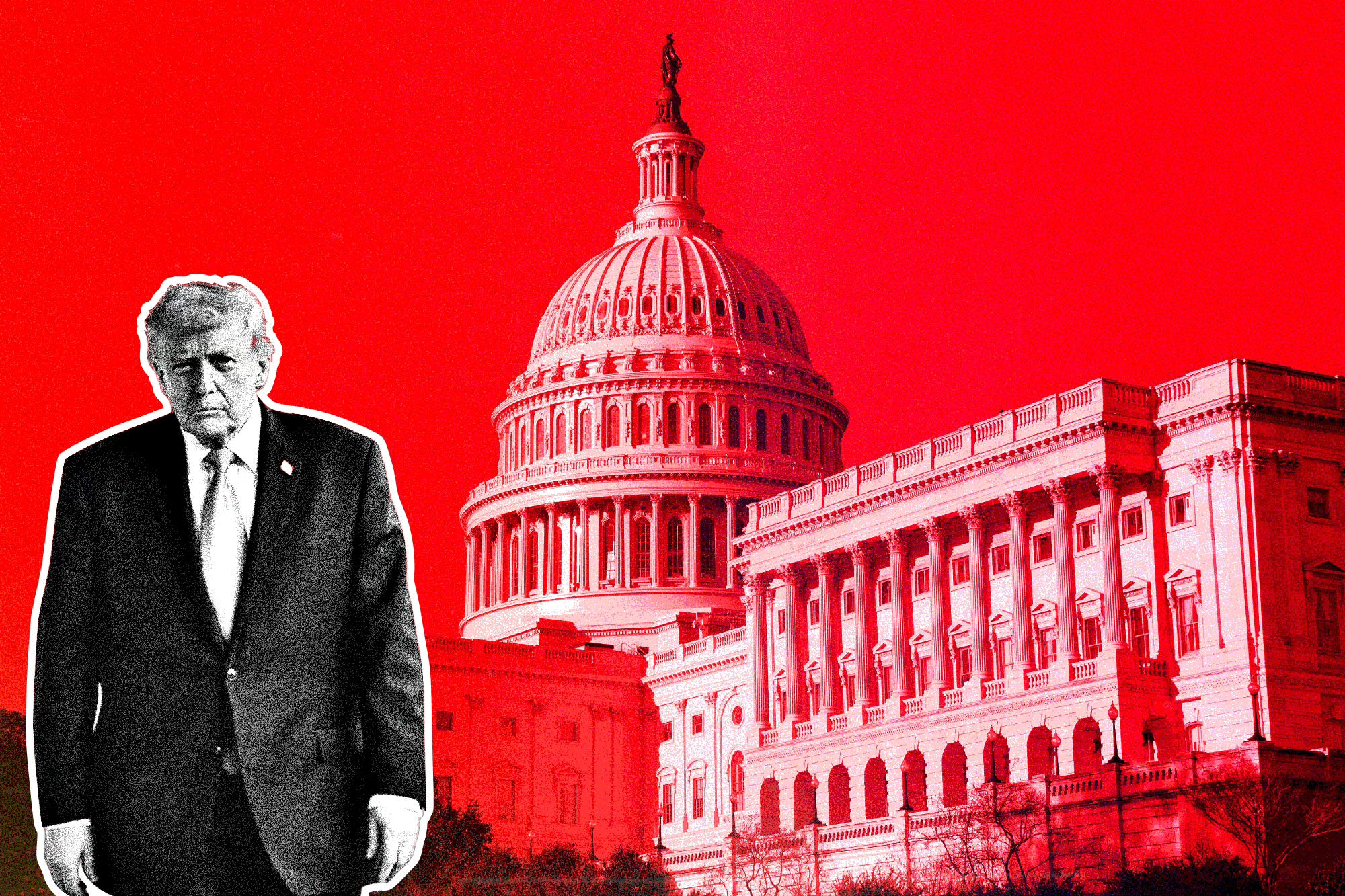
On Tuesday morning, the president of the United States threatened to massacre millions of people to open up a shipping lane. “A whole civilization will die tonight, never to be brought back again. I don’t want that to happen, but it probably will.” The world has become inured to Trump’s bluster, so many people treated this monstrous threat as a bluff—yet another entry in the growing list of TACO (“Trump always chickens out”) moments.
That’s the wrong way to look at it. What Trump’s statement revealed was not just a negotiating tactic but something more disturbing: a president who recognizes no legal, constitutional, or moral limits on his conduct. He is unfit for office and should be removed immediately. Not because of this one threat alone—but because there is a pattern that has become impossible to ignore.
Trump’s Civilizational Threat
Two implications of Trump’s statement are difficult to avoid. First, this was a nuclear threat. Only nuclear weapons have the destructive capacity to wipe out a “whole civilization” in a single night; there is no other way to accomplish this goal. He wasn’t threatening to launch a long and arduous military campaign, allowing for the discrimination between combatant and civilian. He was threatening to inflict apocalyptic devastation on the whole country all at once.
Second, Trump’s rhetoric was genocidal. The definition of genocide outlined in the Genocide Convention (which was ratified by the U.S. Senate) encompasses “acts committed with intent to destroy, in whole or in part, a national, ethnical, racial or religious group.” Intent is one of the most difficult elements of genocide to prove, but if Trump had followed through, his own words would condemn him. His statement wasn’t just a declaration of intent to destroy a particular group—it was a threat to kill every member of diverse national, ethnic, racial, and religious groups as part of a larger cultural whole. Trump promised that the civilization belonging to these groups was “never to be brought back again.”

Ten hours after Trump issued his threat, he announced that a Pakistani-brokered two-week ceasefire would take immediate effect. Oil prices plunged, stocks rose, and Trump’s defenders crowed about the “art of the deal.” Even objective observers gave Trump credit. The New York Times’ David Sanger observed that his “tactic of escalating his rhetoric to astronomical levels certainly helped him find an offramp he had been seeking for weeks.” Katherine Mangu-Ward, the editor-in-chief of Reason magazine, dismissed Trump’s threat to kill millions of people as “some colorful language” and preemptively declared that “no one seems to have the stomach” for an impeachment fight.
This is how the ratchet of normalization works—Trump makes the unthinkable thinkable, and when the worst-case scenario doesn’t come to pass, we all breathe a collective sigh of relief. But it’s time to stop seeking refuge in the familiarity of this pattern. Trump threatened to commit genocide in the context of an illegal war. It would be fantastically irresponsible to retreat to comfortable rationalizations about “TACO” or how Trump should be taken “seriously” instead of “literally.” We can’t be expected to know the inner workings of Trump’s mind, but even if he was faking it, the terror for Iranians of the mere hint of nuclear annihilation was all too real. That matters.
It’s true that the most parsimonious explanation for Trump’s Tuesday statement is that he’s a reckless actor who didn’t consider the full implications of what he was saying. Would he actually nuke Tehran? Could he really try to extinguish a “whole civilization”? These questions have no completely reliable answers—which is itself the problem. He has long adopted maximalist negotiating positions in search of better deals. But the past few months have shown that it has never been more dangerous to concoct benign explanations for his behavior. Since the overthrow of Venezuelan dictator Nicolás Maduro in January, Trump has become increasingly unconstrained. He recently declared that the only limits on his power are “my own morality” and “my own mind. It’s the only thing that can stop me.” He said, “I don’t need international law.” And he also doesn’t respect American law, as he has repeatedly demonstrated.
Unchecked, Unauthorized, Unbound
Article I, section 8 of the Constitution grants Congress the sole authority to declare war. While the president is Commander in Chief of the armed forces and has some limited authority to authorize military actions, it’s extremely difficult to find a legal justification for Trump’s war in Iran. For example, the Trump administration has argued that Iran was planning to launch imminent attacks on the United States, but it produced no evidence for this claim. The admission came from Secretary of State Marco Rubio himself: the United States struck preemptively. This was not because Iran had attacked or was about to, but because Israel was planning to strike and American officials feared Iranian retaliation against U.S. forces. There was no imminent threat to the American homeland. There was no attack to respond to. Washington simply got there first without exploring alternative defensive measures to protect its troops on overseas bases.

Trump had an opportunity to present his case for attacking Iran during his State of the Union address, delivered just four days before he launched the war, but he declined to do so. He could have asked Congress for a joint resolution to authorize the war, but he did not.
In an address on March 31, Trump claimed that the nuclear deal negotiated by the Obama administration—which Trump shredded during his first term—would have “led to a colossal arsenal of massive nuclear weapons for Iran. They would have had them years ago, and they would have used them. It would have been a different world. There would have been no Middle East, no Israel right now, in my opinion, in the opinion of a lot of great experts.” Which experts would those be? Although he declared that the United States “obliterated” the Iranian nuclear weapons program last summer, he said Iran was on the verge of building a “nuclear weapon like nobody has ever seen before.” He said Tehran “would soon have had missiles that could reach the American homeland, Europe, and virtually any other place on earth.” The intelligence community reported that Iran did not have missiles capable of reaching the United States.
When the Bush administration justified the Iraq War with faulty intelligence about weapons of mass destruction, it was an epoch-defining scandal. But when Trump lies about Iran’s capabilities to sell a destructive war of choice, we barely notice. This numbing of our collective critical faculties and indifference toward democratic procedure and the rule of law is a disastrous precedent that should no longer be allowed to stand. At this stage, impeachment is not merely about accountability for a rogue president, but an assertion of our own moral limits—a reminder to ourselves that some things should still remain beyond the pale.
No Plan, No Endgame
It’s clear that Trump expected the war to be brief and relatively painless, like the bombing of Iranian nuclear sites last summer or the Maduro operation. His national security team didn’t expect Iran to close the Strait of Hormuz, and Trump has constructed an echo chamber within the executive branch that makes it impossible for dissenting voices to get through. Trump’s rationale for the war has shifted by the day. He called upon the Iranian people to overthrow their government, then demanded total surrender. Having launched the war to eliminate Iran’s nuclear program, he now says “I don’t care” about the country’s stockpile of enriched uranium because it’s “so far underground.” In other words, he was threatening to nuke Iran and commit genocide for a non-threat?

Trump says Iran’s new peace plan is a “workable basis on which to negotiate,” even though it reads as a maximalist wishlist. Tehran has maintained its control over the Strait of Hormuz (which it is using to stop oil shipments in retaliation of Israel’s attack on Lebanon after the ceasefire was announced) while demanding guaranteed uranium enrichment, removal of all primary and secondary sanctions, elimination of all U.N. and International Atomic Energy Agency (IAEA) resolutions targeting Iran, war reparations, withdrawal of all U.S. forces from the region, and a ceasefire across all fronts—including Israel’s war with Hezbollah in Lebanon. Trump’s willingness to accept these conditions as the basis of ongoing negotiations demonstrates that he has reversed his core war aims in a matter of days. In other words, he’s improvising. He never had a plan for a war that didn’t magically end with the toppling of the Iranian regime overnight.
That itself ought to be impeachable.
But consider the foreign policy implications of a president who has shredded his own credibility. If Trump were to threaten China with a massive retaliation in the event of an invasion of Taiwan, would Beijing take him seriously, literally, or neither?
Those mindlessly crediting Trump’s ability to successfully negotiate an “offramp” with “escalating” rhetoric send him exactly the wrong message: genocidal threats are effective, so use them more frequently. This message will only encourage Trump to take the world to the brink over and over again with no certainty that we’ll be able to pull him back. This doesn’t just make those abroad whom Trump is threatening helpless, but Americans too. He is acting in their name—yet they are unable to stop him.
A president who deploys the threat of civilizational destruction as a negotiating tactic—and is rewarded for it—is exactly the sort of ruler the removal mechanisms were designed to address. That the worst didn’t happen this time is not an argument for patience. It is an argument for urgency. At this stage, it is a matter of Americans taking back control of their own fate—as well as the fate of all those whose lives Trump treats as a bargaining chip.

Dozens of members of Congress have called upon the Cabinet to invoke the 25th Amendment to remove him from office. We should harbor no illusions about whether any effort to remove Trump is politically feasible. Even if his Cabinet determined that he’s unfit to serve—an unlikely outcome given the loyalties Trump has cultivated within the executive branch—two-thirds of the House and Senate would have to override him if he disputed this conclusion. This is an even higher burden than impeachment, which only requires a simple majority in the House to impeach and a two-thirds majority in the Senate to convict.
Still, calling for Trump’s removal is the right thing to do. This is not the time to worry about the political optics of invoking the 25th or pushing for impeachment. The attempt alone sends a message and establishes some limits, and reining in a dangerous president isn’t just a political choice—it’s a constitutional obligation.
As Trump’s approval rating plummets and a midterm rout looks increasingly likely, he will likely get more desperate. His actions first in Venezuela and then in Iran show that his conduct abroad is getting more erratic and extreme and he’ll go to any lengths—including threatening genocide and a nuclear holocaust—to exert power in the areas where he still wields it. Now is the time to stop this madness. The longer we wait, the more normal it becomes.

© The UnPopulist, 2026
Follow us on Bluesky, Threads, YouTube, TikTok, Facebook, Instagram, and X.
We welcome your reactions and replies. Please adhere to our comments policy.

I've been saying exactly this. It is the duty of congress. There doesn't need to be dithering and political hand-wringing. It a constitutional duty to IMPEACH.
The GOP just blocked a War Powers Act resolution to stop threats of collective punishment by ending Iranian civilization. Trump’s threats, intentionally or not, are likely what prevented the legal approval the military needed to launch such a large scale attack on Iran. So, while Hegseth and Netanyahu may be working to reset stated goals in order to get legal blessings to destroy a civilization, why would you want Democrats to focus on the presently impossible task of impeachment when they should be relentlessly linking the GOP with this nearly total strategic failure in foreign policy and un-American threats to commit crimes against humanity?