


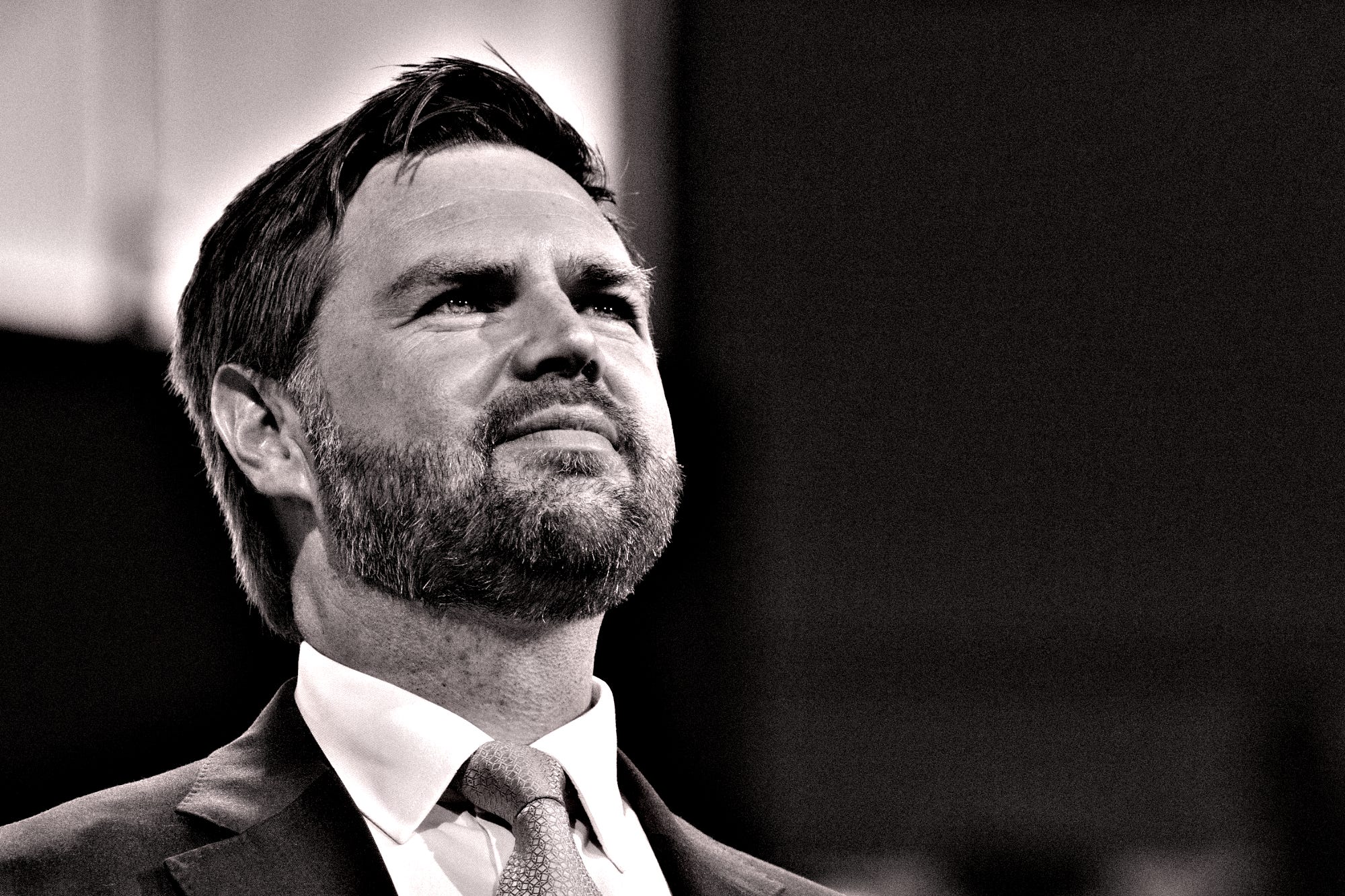
Last week’s Republican gathering in Dallas was billed as a “Trumpapalooza,” a bow to President Trump’s keynote and closing speeches and his desire to tie congressional Republicans’ 2026 electoral fortunes more closely to his own. In the end, however, the event was also viewed as something else: a coming out party for JD Vance’s 2028 presidential campaign, launched by the vice president’s passionate speech on the eve of the closing day.
The transition may have been unanticipated, but it was fitting. Data from a recent survey by The UnPopulist’s parent organization, the Institute for the Study of Modern Authoritarianism, suggests that if Vance does enter the presidential race, he would likely draw special strength from the voting cohort that the ISMA poll classifies as “populists” among Trump’s supporters. The vice president’s rhetoric in Dallas suggests that he understands this and is seeking this cohort’s approval as he eyes the 2028 Republican primaries.
Trump Populists’ Move Toward Vance
ISMA’s nationwide survey, fielded by the online polling firm YouGov in late June, classified respondents as “populist” or “nonpopulist” supporters of their preferred presidential candidate based on how many of the four populist attitudes tested by the survey they expressed. Those who showed at least three of the attitudes were categorized as “populist,” and the survey found that populists comprised 25% of those who said they voted for Donald Trump in 2024.

While this was a significant decline from the 36% who qualified as populist among people who said they would vote for Trump in an August 2024 ISMA survey, Trump’s populists, at 25%, are still a substantial segment of his support. More importantly for JD Vance, they may be an even bigger part of his own support.
Consider our June survey’s early effort to gauge the candidate field for the 2028 presidential election. We asked respondents whom they might vote for among seven possible Republican candidates and seven possible Democratic candidates. The question appears below, with the candidates listed from most favored to least. Vance appears at the top of the list, followed by 2024 Democratic candidate Kamala Harris, and Secretary of State Marco Rubio.
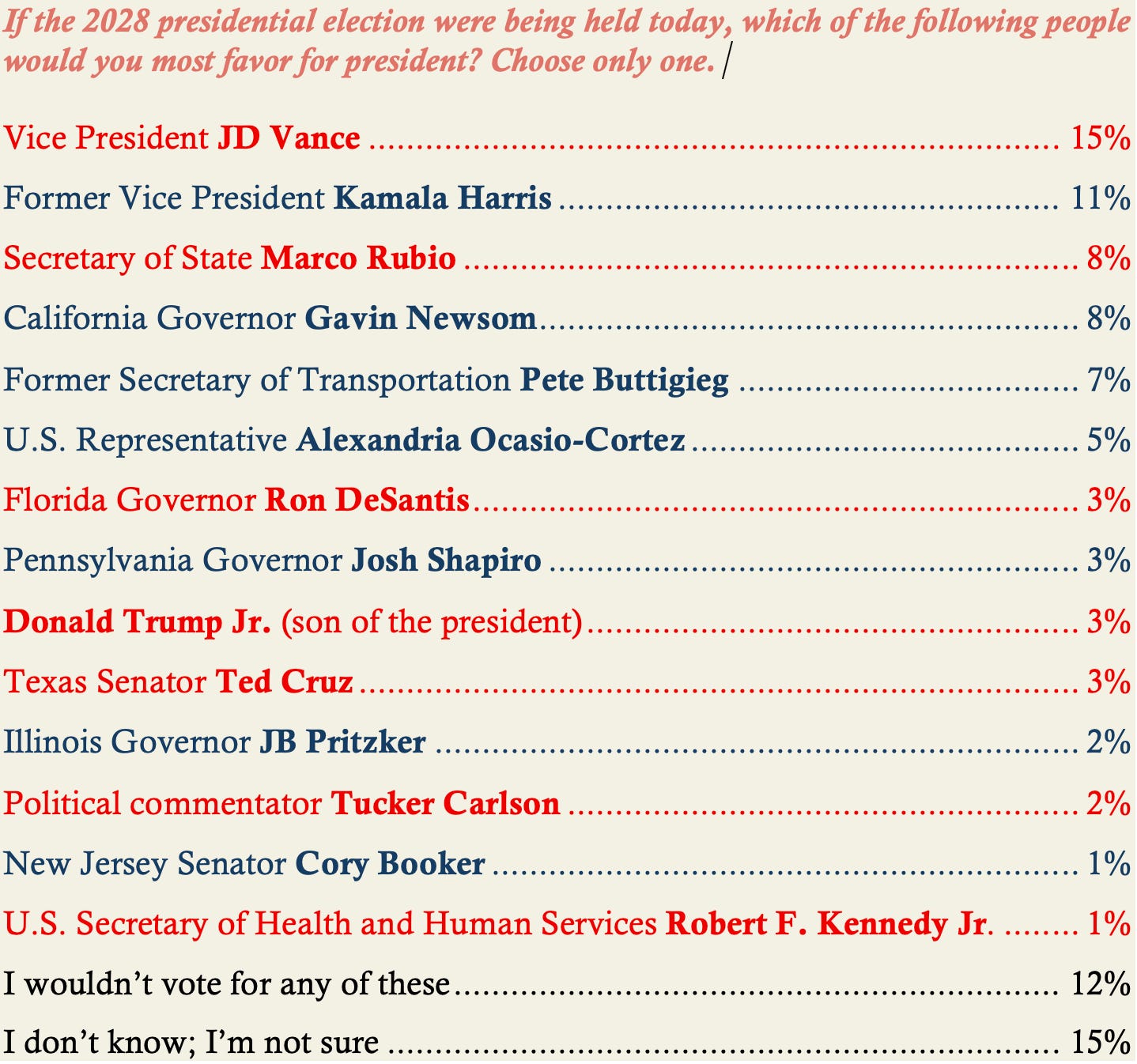
Obviously, the answers here have limited predictive value. The election is more than two years away, and voters will never see this long, mixed and speculative list of Republican and Democratic candidates on a ballot. Moreover, few Americans have pondered which presidential candidate they’d vote for. “I don’t know; I’m not sure” was as popular a choice as Vance.
Just as importantly, few Americans know all the names on the list. Thus, candidate choices this far in advance of an election are often driven by name recognition. Not coincidentally, a sitting vice president, a former vice president, and the U.S. secretary of state top the current list.

Still, the survey results indicate more is at work.
Vance has often appealed to Trump’s populist base since joining Trump on the 2024 presidential ticket, and that appeal seems to be paying off. As shown in the table below, over half of the Trump populists (53%) are now supporting Vance against a field of six other Republican candidates (none of the Trump populists chose a Democrat). This is more than twice Trump populists’ 25% support for Marco Rubio, the next-closest candidate. And while Vance hasn’t garnered the same backing from Trump nonpopulists, he remains materially ahead of Rubio among them as well, at 32% to Rubio’s 20%.
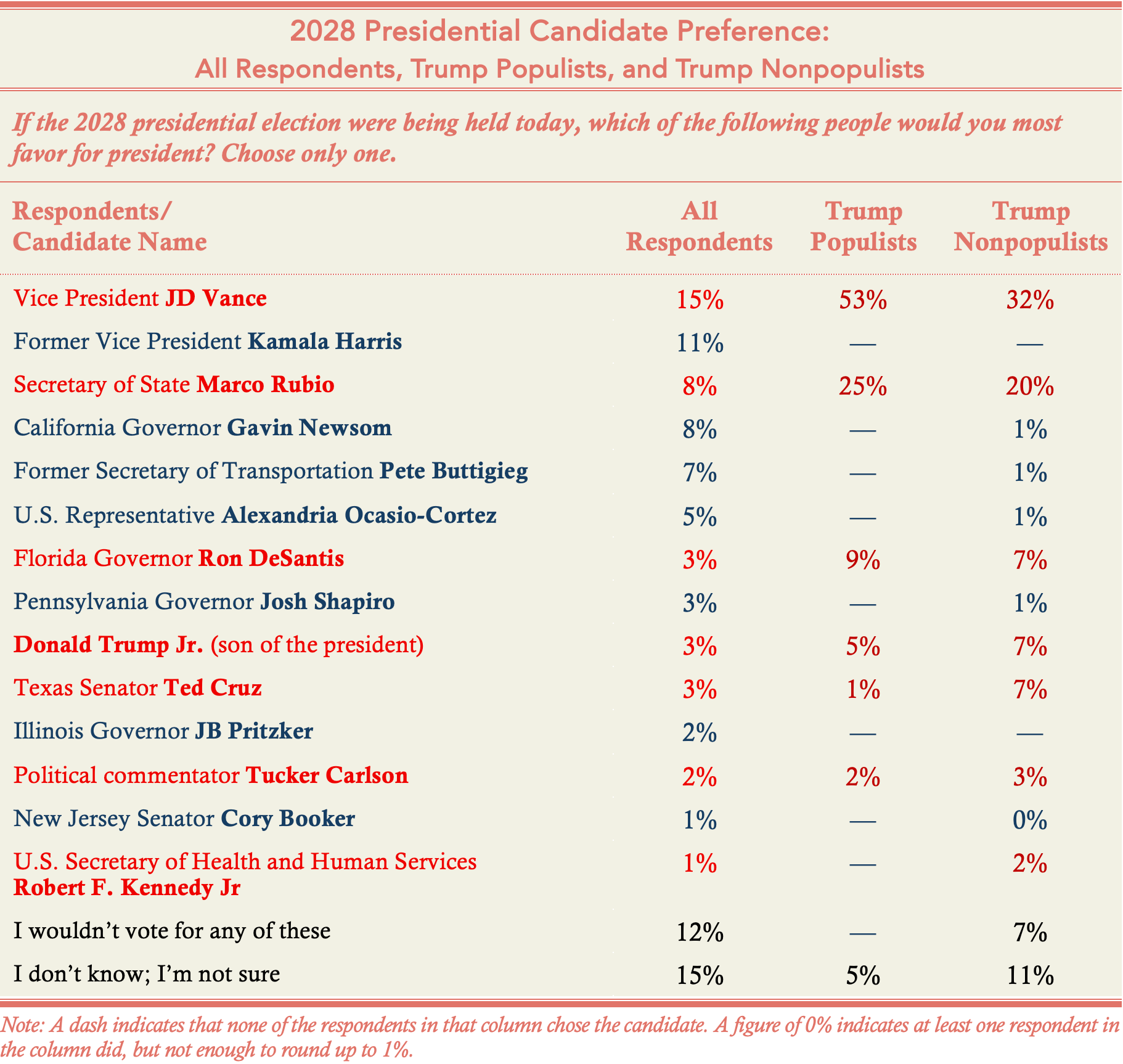
Having picked up more than 50% of Trump populists’ support despite a field of 13 other candidates, Vance received disproportionate backing from them—29% of his total. He also received solid support from the three-fold larger group of Trump nonpopulists (53% of his total). Also, interestingly, the remaining 18% of his backing in the survey came from respondents who did not vote for Trump in 2024. These were exclusively 2024 nonvoters or Robert F. Kennedy Jr. voters, and nearly all of them were “working class”—i.e., not college graduates.

In fact, the profile of Vance’s voters suggested that his strengths very much resemble Trump’s. In our survey question this time pitting Vance against 13 other candidates, he won plurality support in the same demographics that Trump won against other candidates in our 2024 survey: Men, whites, married people, the working class, people over 45 years old, people of middle income, people in the Northeast and Midwest, and people in towns and rural areas. Moreover, Vance also won among upper income voters, Southerners, and suburbanites.
A ‘Postliberal’ Populist
Vance has benefited from the name recognition granted by his high rank in government, but that political advantage is offset by a Trump presidency whose popularity has plummeted, especially after the Iran War—a problem that the president’s often erratic behavior may make worse over the next two years, saddling Vance with a deeply tarnished legacy.
Moreover, if, as ISMA’s recent survey suggests, some of Trump’s earlier populist supporters have begun to tire of Trump’s populist approach, Vance’s embrace of that approach may sour them on him as well. Indeed, ISMA’s “Trump populists” are Trump populists in the sense that they either feel a special connection with Trump and his agenda or are more willing to grant Trump latitude to circumvent checks on presidential power. It’s not clear that with Vance, they would feel the same.
Still, for classical liberals opposed to a continuation of Donald Trump’s illiberal populism, Vance’s courting of Trump populists, his early acceptance among them, and his nascent lead with Trump’s constituencies isn’t encouraging. ISMA’s August 2024 survey suggested populists were more likely than other Americans to vote, and Trump populists in this survey appear similarly inclined. Compared to Trump nonpopulists and especially to other Americans, they were more likely to say that they would definitely vote in the upcoming congressional elections and that they were closely following congressional elections news. They were also more likely to have voted in the 2020 presidential election. Although more research is needed, Trump populists’ profile suggest they are likely to be 2028 primary voters. If so, they may well help Vance become the Republican presidential nominee.

And it’s worth remembering Vance’s political trajectory. Initially a Trump critic, he later not only came to terms with Trump as a politician, but now hopes to extend the arc of Trumpism from a barnstorming phenomenon into a broader postliberal ethos. Even early in his career, he argued that Republicans who gain control of Congress or the presidency “need to be really ruthless when it comes to the exercise of power.” He now calls himself a postliberal, and in Dallas last week, he repeatedly followed the classic populist script of seeking popularity by dividing people, not uniting them, leveling politically shrewd and sweeping criticisms of Democrats as “crazies” and “the party of hatred.” His questioning last year of legal due-process procedures that might not “allow us to deport at least a few million people per year” is likely, according to our survey, to appeal most to Trump populists, a striking 100% of whom approved—90% of them strongly—how the Trump administration is handling the arrest and deportation of people it suspects of living in the United States illegally.
In the end, Vance may not be able to pull off a postliberal revolution, but he is underway, and he knows what he is about.

© The UnPopulist, 2026
Follow us on Bluesky, Threads, YouTube, TikTok, Facebook, Instagram, and X.
We welcome your reactions and replies. Please adhere to our comments policy.
I’m increasingly thinking that one of the major challenges with today’s liberal democracies is that nobody who is qualified to be the chief executive is willing to do it.