


The populist base anchoring President Donald Trump’s political movement has declined substantially over the past 23 months, according to a late-June survey conducted by the Institute for the Study of Modern Authoritarianism, publisher of The UnPopulist.
ISMA’s survey, fielded to 1,000 respondents through the online research group YouGov, was designed to measure the prevalence of four populist attitudes:
feeling an unusually strong personal connection with the candidate or candidate’s agenda;
a strong cynicism toward society’s elites;
negative feelings toward perceived social outgroups;
a willingness to allow their preferred choice for president to override legal limits to achieve political goals.
Under ISMA’s model, “populists” are those showing at least three of these four indicators.
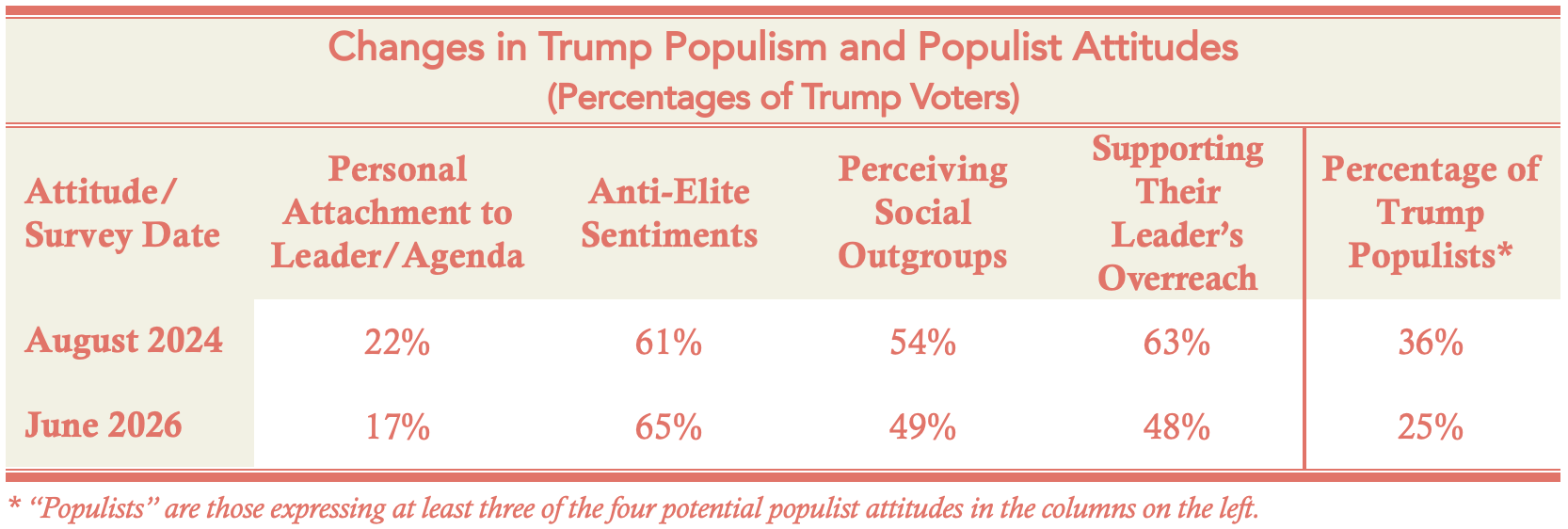
In August 2024, an earlier ISMA survey used this model to estimate that 36% of Trump’s intended voters at the time were political populists. But ISMA calculates that among the people who say they voted for him, only 25% are now populists—a decrease of nearly one-third. (Notably, the survey also found that the percentage of populists among Kamala Harris voters was 15%, the same as it found in August 2024.)
Compared to that earlier survey, Trump voters are generally—though not uniformly—less likely to express the four potential populist attitudes the survey measures. An analysis of the data from the two surveys also suggests that a leading driver in the relative decline of Trump populists was his voters’ decreased willingness to endorse his extralegal use of presidential power to achieve his goals. Likely secondary drivers were the relative decrease in the number of Trump voters inclined to exclude various U.S. social groups, along with a decrease in the percentage showing a strong sense of attachment to the president and his goals.
That said, it is also evident from the survey that substantial levels of populist sentiments persist among Trump’s base. Moreover, an enduring cohort of the president’s followers both value his agenda and see him as uniquely connected to them, a feeling that, the data suggest, may predispose them to retain the other populist attitudes they hold.
Thus, the survey’s findings do not show that the apparent reduction in populism among Donald Trump’s voters is permanent or inexorable. Rather, they show that the populism backing the president is itself not permanent or inexorable—that it is not somehow self-perpetuating or inevitably ratcheting up.
Changes in the Four Populist Attitudes Among Trump Voters
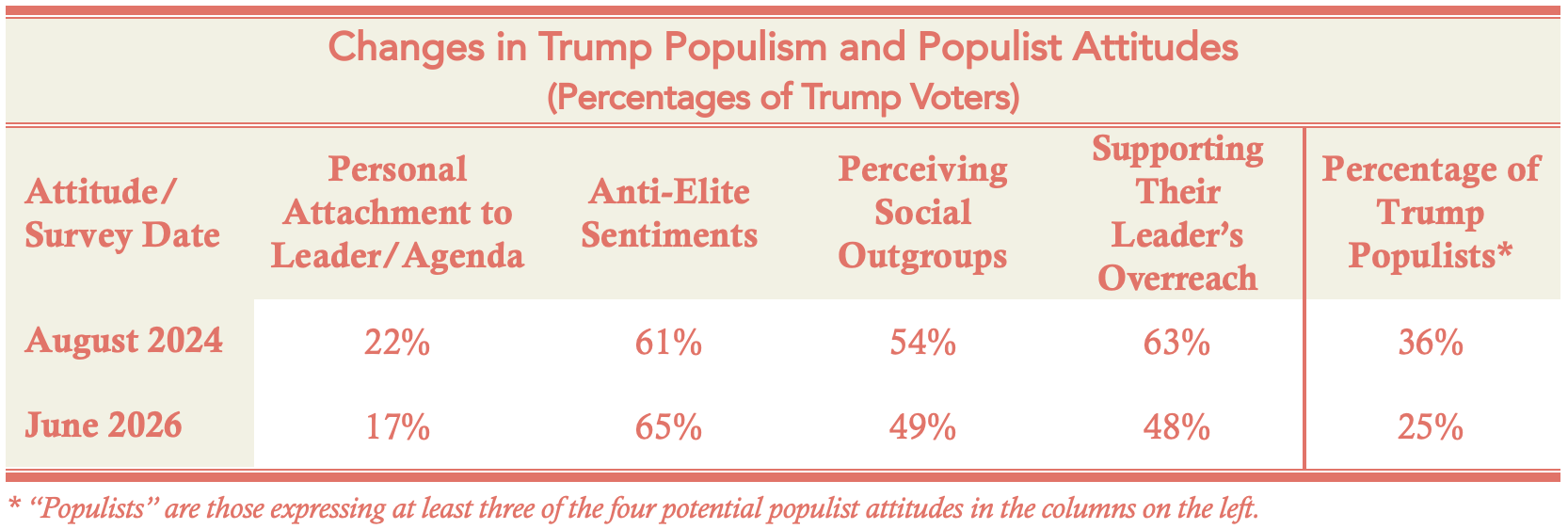
The table below shows the percentages of Trump voters exhibiting each of the four populist attitudes in the 2024 and 2026 surveys. Note that the percentages have fallen in three areas since August 2024. There was a decline from 22% to 17% in the percentage of Trump voters feeling a uniquely strong connection to Trump and his agenda; a decrease from 54% to 49% in the percentage expressing negative feelings toward one or more social groups in America they viewed as unfairly advantaged and unable to be part of the American community; and a drop from 63% to 48% in the percentage approving of his use of extralegal means as president to achieve his political goals—the largest decline of the three. Only in cynicism toward American elites did the percentage of Trump voters evincing a potential populist attitude increase, from 61% to 65%.
Less Tolerance for Trumpist Excesses, Varied Views on the Rest of America
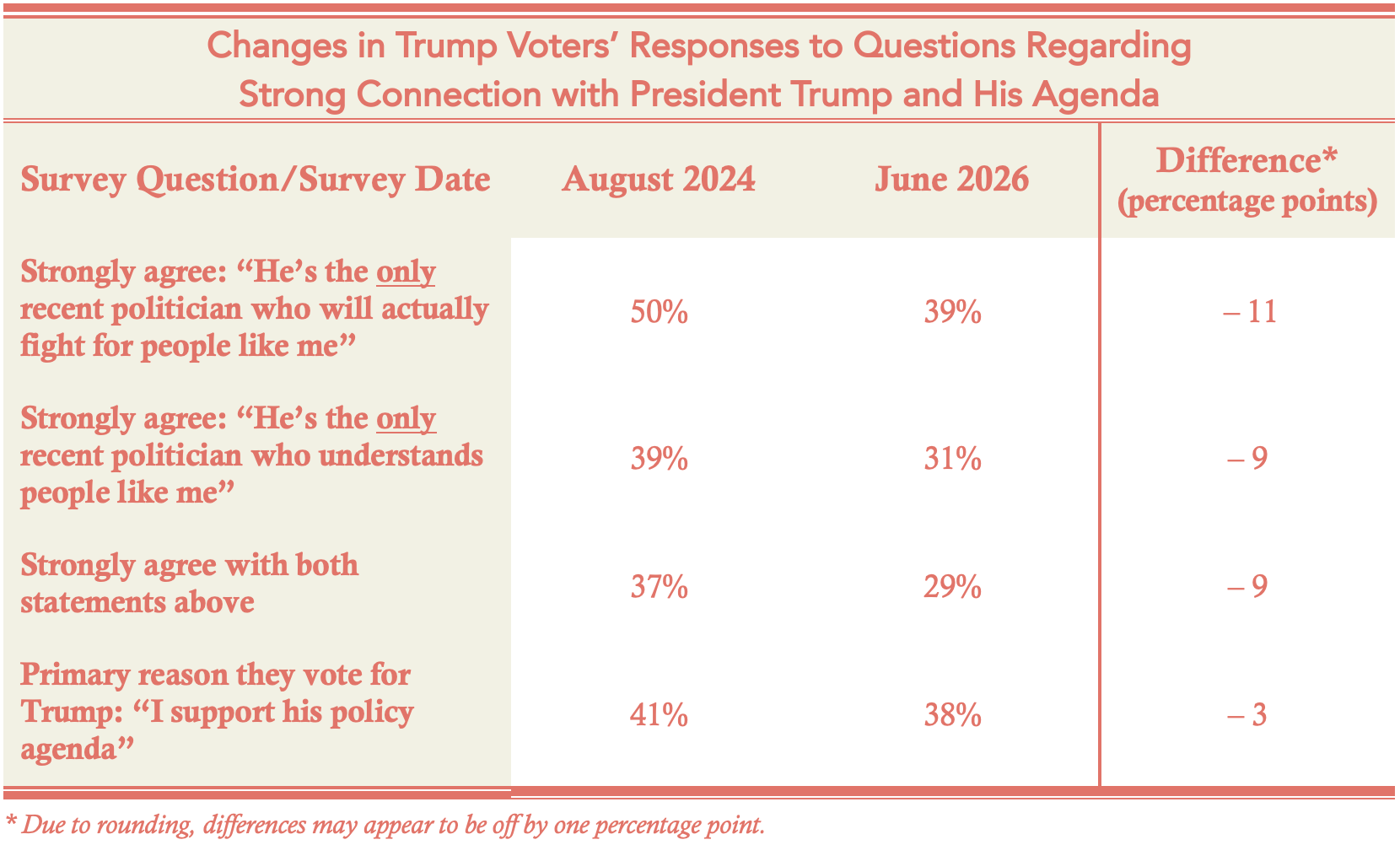
Looking at the survey questions involved in measuring each of these attitudes provides more detail. For instance, we see that the strong sense of personal identification with Trump and his agenda—the first potential populist attitude—fell on a few key questions. The percentage of his voters who strongly agreed with the statement, “He’s the only recent politician who will actually fight for people like me” declined by 11 percentage points, from 50% to 39% (see table below). In addition, the percentage who strongly agreed with the statement, “He’s the only recent politician who understands people like me” fell by 9 percentage points, from 39% to 31%. The percentage who strongly agreed with both the previous statements likewise fell by 9 percentage points, from 37% to 29%. The numbers were more stable regarding his agenda, but there was still a 3 percentage-point decline in those saying their primary reason for voting for him is their support for his policy agenda (41% to 38%).
The survey questions likewise provide more specificity about the substantial drop, from 63% to 48%, in Trump voters’ willingness to approve his exceeding the legal limits on presidential power—i.e., the fourth attitude in the table above. One question measuring this willingness, prefaced by questions about the opposing party “twist[ing] the law” for partisan purposes, asked whether the respondent trusted “Donald Trump as president to decide when to follow the law and when to ignore it to achieve justice.” In the August 2024 survey, 55% of Trump voters agreed that they did, a figure that has now fallen to 46%. Another pair of questions tested whether Trump voters were more disposed to approve of Donald Trump issuing executive orders to circumvent his political opponents in Congress than they were a generic president of their own party. Here their greater tolerance for Trump fell by almost half, from 21% in 2024 to 11% in 2026.
Now we turn back to the third attitude, which concerns “social outgroups.” Here, for reasons that will become clear, less can be said about the specific source of the decline from 54% to 49%. This potential populist attitude, summarized as “perceiving social outgroups,” entails having three views of a particular group (or groups) in the country:
feeling negatively about them,
seeing them as advantaged by government elites,
saying they can’t be “true members of the national community.”
The attitude was tested with respect to 12 groups: Evangelical Christians, Muslims, Jews, legal immigrants, illegal immigrants, Whites, Blacks, Hispanics, gays and lesbians, transgender people, men, and women. Respondents who express all three views about one or more groups qualify as potential populists on this dimension.
In most cases, only a small percentage of Trump voters held these views about a particular group, and the percentage didn’t change much from survey to survey. Indeed, with eight of the groups, less than 5% of Trump voters held these views in 2024 and 2026, and the changes between the two surveys were less than 2 percentage points. With one of the remaining four groups, gays and lesbians, 12% of Trump voters exhibited outgroup sentiments, up less than 2 percentage points from 11% in 2024 (see table below). Among the final three groups, the percentage of Trump voters exhibiting outgroup feelings rose from 19% to 25% toward transgender people and by 15% to 26% toward Muslims (the largest rise during that period), but it fell by more than 2 percentage points, from 48% to 46%, toward illegal immigrants.
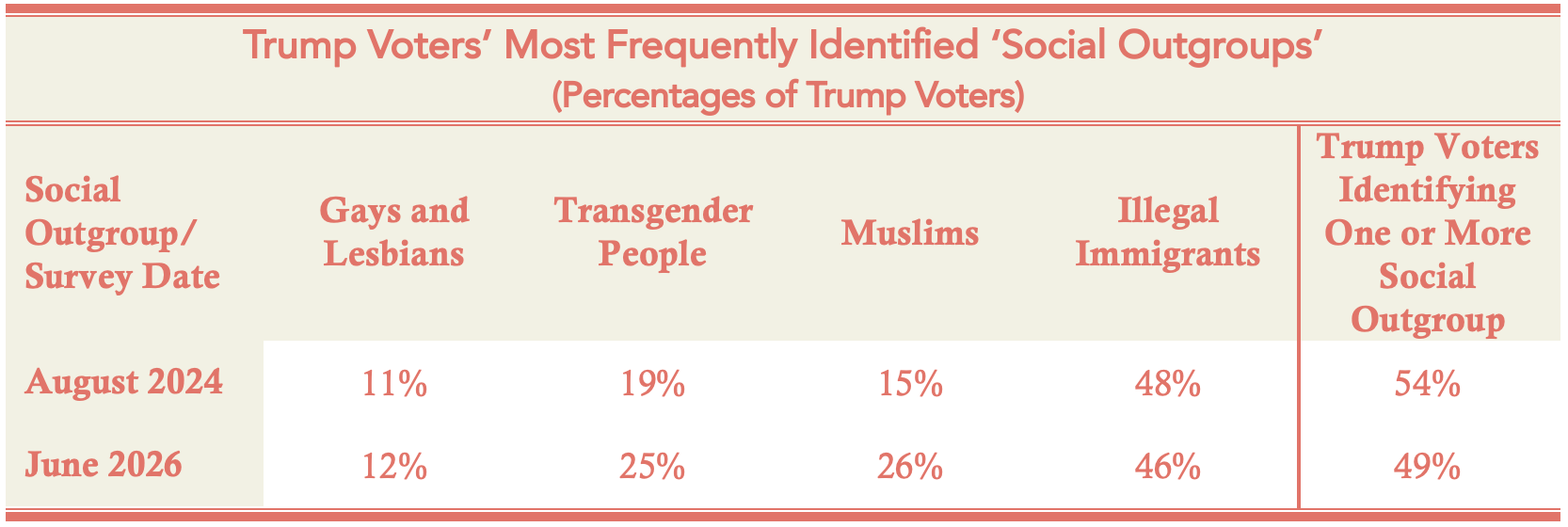
Unlike the previous two potential populist attitudes, the overall outcome for the “social outgroup” attitude isn’t clearly linked to the results of the individual questions associated with it. Despite two categories going up noticeably (amid small changes elsewhere), there was a decrease of more than 4 percentage points overall in the Trump voters exhibiting this attitude.
One reason for the disconnect is that our overall percentages for this third populist attitude focus on the number of potential populists, while the group-by-group figures for Muslims, transgender people, and so on record the number of outgroup attitudes the potential populists express. One person might express several outgroup attitudes toward different groups. If this respondent added, say, Muslims to his list of outgroups in 2026, while another respondent dropped their only outgroup attitude toward Muslims in 2026, our measure of Muslim outgroup attitudes would remain the same, even as the number of potential populists on this measure decreased by one.
The multitude of possible shifts in respondents’ attitudes toward 12 different groups complicates the picture even more, as does the fact that different respondents took the surveys in 2024 and 2026. That said, this exercise serves as a useful reminder: Even if the number of populists declines, the populist attitudes themselves may stay the same or even increase. Muslims and transgender people, for instance, saw substantially higher negativity over the same period.
Indeed, we encounter a similar issue in looking at the potential populist attitude of distrust toward the country’s elites. In the survey, we watched for respondents’ strong agreement with the statement that a particular class of elites has “often harmed the interests of Americans like me in pursuit of their own selfish interests.”
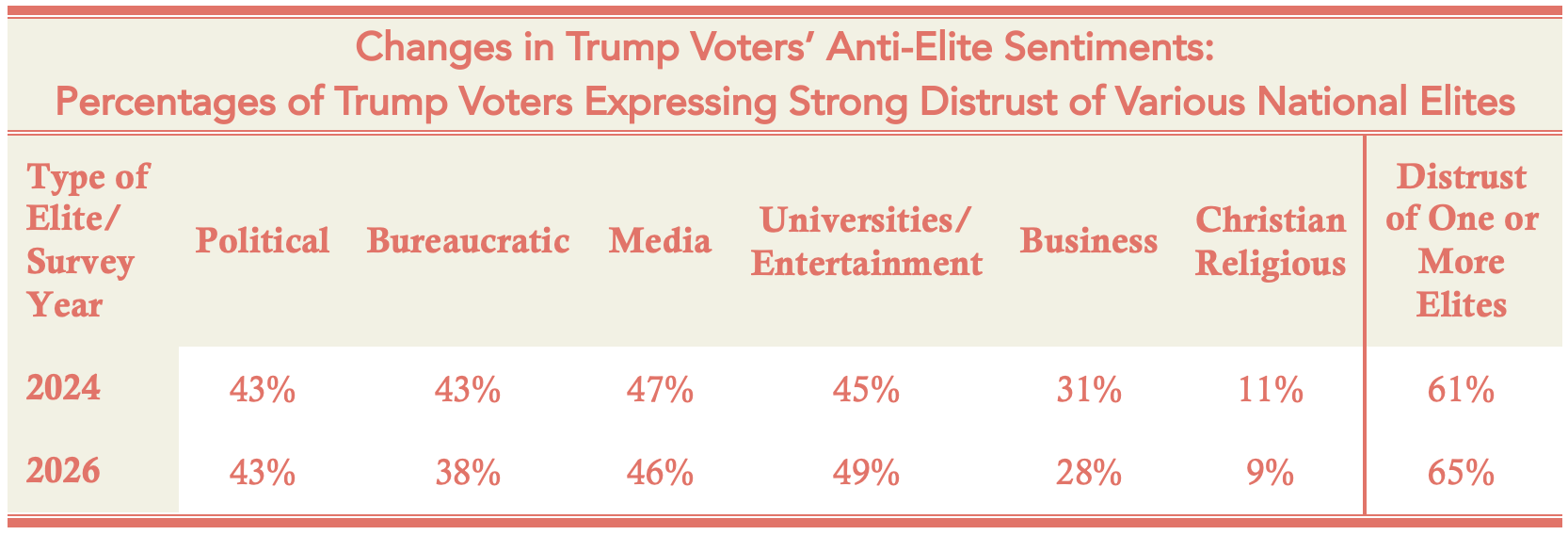
We tested this statement for six elites: America’s “political elites among its national elected officials,” “bureaucratic elites among the unelected officials in the federal government,” “cultural elites in the media,” “cultural elites in universities and the entertainment industry,” “business elites in finance and industry,” and “Christian religious elites.” The table below summarizes the results, with the final column showing how many Trump voters displayed the potential populist attitude of anti-elitism toward at least one group.
Here we see that Trump voters’ concerns are highest for media and university/entertainment elites. With media elites, their views have basically stayed the same, as have their views of national political elites. In three other cases—bureaucratic elites, business elites, and to a lesser extent, Christian elites—the percentages of Trump voters panning the elites has modestly declined. Only in the case of university/entertainment elites has the percentage criticizing the elites noticeably risen, yet the overall result is an increase of 4 percentage points in the number of Trump voters expressing a cynical view of at least one group of American elites.
Tracking the Decrease in Trump Populism
We now return to the table we considered at the beginning of the essay. Because different people took the survey in 2026 than in 2024, we can’t track with certainty exactly whose attitudes shifted and how they did so. But when we compare the data from both surveys, interesting patterns emerge.
To drill down more precisely on just where the changes occurred between the two surveys, we divided the respondents in each survey into 16 categories based on the combination of the four populist attitudes they expressed. These categories ranged all the way from exhibiting none of the attitudes to exhibiting all four. This allowed us to compare the percentages of respondents exhibiting each possible combination of attitudes in 2024 to the percentages doing so in 2026, and to trace which combinations increased and which declined.
One group stood out: The Trump voters who expressed all but the first populist attitude of close attachment to Trump and his agenda. This group was populist on our index because its members exhibited the other three attitudes. Last time, it was not only the largest group of Trump populists; it was also the largest of the groups among all 16 categories of Trump voters.
Spectacularly, this did not last. This time, respondents with this combination of populist attitudes had dropped by almost 7 percentage points as a share of Trump voters—a percentage decline of almost 38%—to become only the fourth-largest group among the 16. Conspicuously, the group that was now the largest, having grown by almost 7 percentage points as a share of Trump voters, were those who showed only the second (anti-elite sentiments) and third populist attitudes (antipathy to social outgroups)—not the first of strong attachment, and not the fourth of explicitly approving Trump’s exceeding limits on his presidential authority to achieve his goals.
Indeed, considering this and the other shifts in the data, the large and widespread decline in the fourth populist attitude (supporting their leader’s overreach) appears to have hit Trump’s largest contingent of populists hard. While the data also suggests that some Trump populism fell due to the more modest declines in the third and the first populist attitudes shown in the table, it doesn’t appear those decreases had a similar impact on his populist coalition.
Strong personal attachment to Trump and his agenda, the first populist attitude, did decrease somewhat by 2026, but in an unusual way. It was the only attitude to gain market share among Trump populists from 2024 to 2026, largely because the other attitudes among populists decreased more quickly, leaving it as a larger piece of a smaller pie.
Moreover, it is the only populist attitude among Trump voters that is distributed like an upside-down pyramid: It is more likely to be found in people with more of the other attitudes than it is with people who have fewer. Put another way, people appear more likely to retain their other populist views when that first populist attitude of strong parasocial attachment to the president is present. After all, as discussed above, it was precisely the large populist contingent without that attitude that declined most after 2024, apparently because many in that contingent lost confidence in Trump’s ability to wield extralegal executive authority effectively.
Indeed, lacking that personal attachment to the president, they may have been more prepared to question the president’s aggressive and controversial use of executive authority since returning to office—levying tariffs, initiating military action, and signing a sweeping range of executive orders, some later ruled unconstitutional. The results of these actions have often been unpopular, and based on our survey and others, it appears that not only his critics are doubting his judgment now.
Endurance and Example
In 2024, with Trump’s improbable third nomination as the Republican presidential candidate and his subsequent victory, there was a general political consensus that populism was now an enduring feature of the American political landscape. And indeed, it would be wrong to assume that the thinning we detect among Trump’s most ardent supporters will continue unabated, and that he (or they) cannot reverse its course.
About one in six of his voters still identify strongly with him and his presidency and seem likelier than most to retain their populist zeal. His populist followers, according to our survey, approve the idea, 51% to 29%, of his running for a third term. In other words, despite Trump voters’ substantial decrease in support of his overriding legal limits on his power to achieve political goals, his populist adherents retain a defiant support for a major breach of clearly defined constitutional limits on President Trump’s executive power.
But ISMA’s new survey provides clear signs that the size and contours of the president’s populist terrain are not permanent and stable. The data suggest that he can overplay his hand, that his political charisma can flag, and that his voters—including many of his ardent supporters—can temper their populist enthusiasms when the outcomes they seek aren’t realized. Edmund Burke once wrote that, “Example is the school of mankind,” and the examples of the past two years appear to have had an effect. Notably, the president’s nonpopulist voters—now 75% of his coalition—oppose his running for a third term, 57% to 26%, with a 40% plurality strongly disapproving.
Such a stark division among Trump’s supporters on a major issue concerning Donald Trump himself was harder to imagine when ISMA’s first full-scale survey entered the field 23 months ago. But ISMA’s latest survey suggests that populist attitudes, despite their prominence on the political landscape, share something in common with other political attitudes: a susceptibility to erosion and change.

© The UnPopulist, 2026
Follow us on Bluesky, Threads, YouTube, TikTok, Facebook, Instagram, and X.
We welcome your reactions and replies. Please adhere to our comments policy.
Thanks for doing this. I thought about it all day, and what stuck with me is that so many American's still have the populist characteristics you studied. I'm stunned. It really puts a pin on how angry and afraid millions of American's are. And how politicians have found a way to use that fear.
I am thinking that some of his base are experiencing Trump Fatigue Syndrome because he is just replaying the his greatest hits from 2020.
The really great bands reinvent themselves embracing new musical trends as they create new material.
Trump has exhausted whatever it was that first generated excitement. His fans may be have started to lose interest. They are an easily distracted audience.