


On Friday, six weeks into a partial government shutdown, President Trump issued a memorandum directing the Department of Homeland Security to pay Transportation Security Administration employees using funds with “a reasonable and logical nexus to TSA operations.” According to DHS, workers could begin seeing deposits as soon as today.
As confirmed by Senate Majority Leader John Thune, the plan (not articulated in the memo itself) would draw on Section 90007 of last year’s “One Big Beautiful Bill Act.” At the time, critics derided this $10 billion provision as a slush fund given its unusually broad grant of discretion to the DHS secretary; unlike most appropriations, it was not marked for any particular agency or project.
Still, using this provision to pay TSA agents is blatantly illegal: The law did explicitly stipulate one thing—that the funds be used for “activities in support of the Department of Homeland Security’s mission to safeguard the borders of the United States.” The TSA has nothing to do with border security.
The TSA screens passengers at domestic airports as well as international ones, without distinction. It only screens people who are departing, not arriving. Its agents are not law enforcement officers. They do not handle visas, administer customs duties, prevent smuggling, or check immigration status. The agency’s sole purpose is the physical security of airplanes.
However essential it may be to ensure no impermissibly large bottles of shampoo make it onto a flight from Little Rock to Omaha, it is not “safeguard[ing] the borders.”
The administration’s theory is that protecting the border and screening passengers at airports share a sufficient national security connection to make border funds available for TSA payroll. But this is not a creative legal interpretation navigating genuine ambiguity. It is a straightforward violation of a principle so fundamental—namely, only the elected legislature has the power of the purse—it was already taken for granted by the time it was written into the Constitution.
What the Law Actually Says
The relevant statute Trump’s order violates is 31 U.S.C. 1301(a), which the memo itself cites: “Appropriations shall be applied only to the objects for which the appropriations were made except as otherwise provided by law.” The directive then proceeds to command exactly what that law forbids. Border security funds are not TSA payroll funds. Not under any reasonable reading of Section 90007, which means not under the Appropriations Clause.

No declared emergency or asserted “nexus” can make spending legal without a congressional appropriation. The closely related Antideficiency Act goes further: It is a federal crime, punishable by up to two years in prison, for any officer or employee of the United States to authorize or incur expenditures exceeding the amount available in an appropriation.
This is not an obscure technicality. It is the statutory backbone of the constitutional power of the purse, codified precisely to prevent executives from spending money that has not been authorized by Congress. Trump is ordering, quite openly, DHS to commit a felony.
The memo insists, as these missives from the Oval Office always do, that it “shall be implemented consistent with applicable law.” This is boilerplate of a particularly cynical kind, a pro forma disclaimer attached to an order that is, on its face, inconsistent with applicable law.
Congress does sometimes allow the executive branch to reallocate funds across accounts, under defined circumstances. In his first term, Trump diverted billions in Pentagon funds to build the border wall after Congress declined, arguing that the wall fell under a transfer authority for military construction projects (that is, buildings on bases and the like). The courts ruled against that theory; the Supreme Court reversed only on narrow procedural grounds after the issue was moot under the Biden administration. Nixon’s impoundments, the Ukraine funding freeze of 2019, and various other executive spending controversies share a common structure: a president either refusing to spend money Congress has appropriated, or moving funds between accounts, using at least arguable statutory transfer or delaying authority.
Trump’s TSA memo fits neither category. There is no plausible statutory transfer authority here, and the administration does not cite one. Section 90007 funds border security, and TSA is not a border security agency by any definition. This is not about refusing to spend or redirecting existing funds by stretching the law. It is spending money Congress has simply never authorized for this purpose, in the middle of an active appropriations standoff, specifically to neutralize the leverage the shutdown gives Congress. That is a difference in kind, not just degree.
None of this is ambiguous. Bobby Kogan of the Center for American Progress put it plainly: the order is not legal but, he added, “that’s not going to stop them.” That, in a sentence, describes the Trump administration’s relationship to law generally.
Invoking a border security appropriation to fund the TSA is not aggressive interpretation or a creative solution. It is the absence of interpretation, a raw assertion that the written text of the law simply doesn’t matter.
Constitutional Bedrock
The principle that the executive cannot tax or spend public money without legislative authorization is not a debatable bureaucratic rule of modern government. It is the deepest foundation of the entire Anglo-American constitutional tradition. It emerged from centuries of conflict between English monarchs and Parliament over exactly this question: Who controls the treasury?

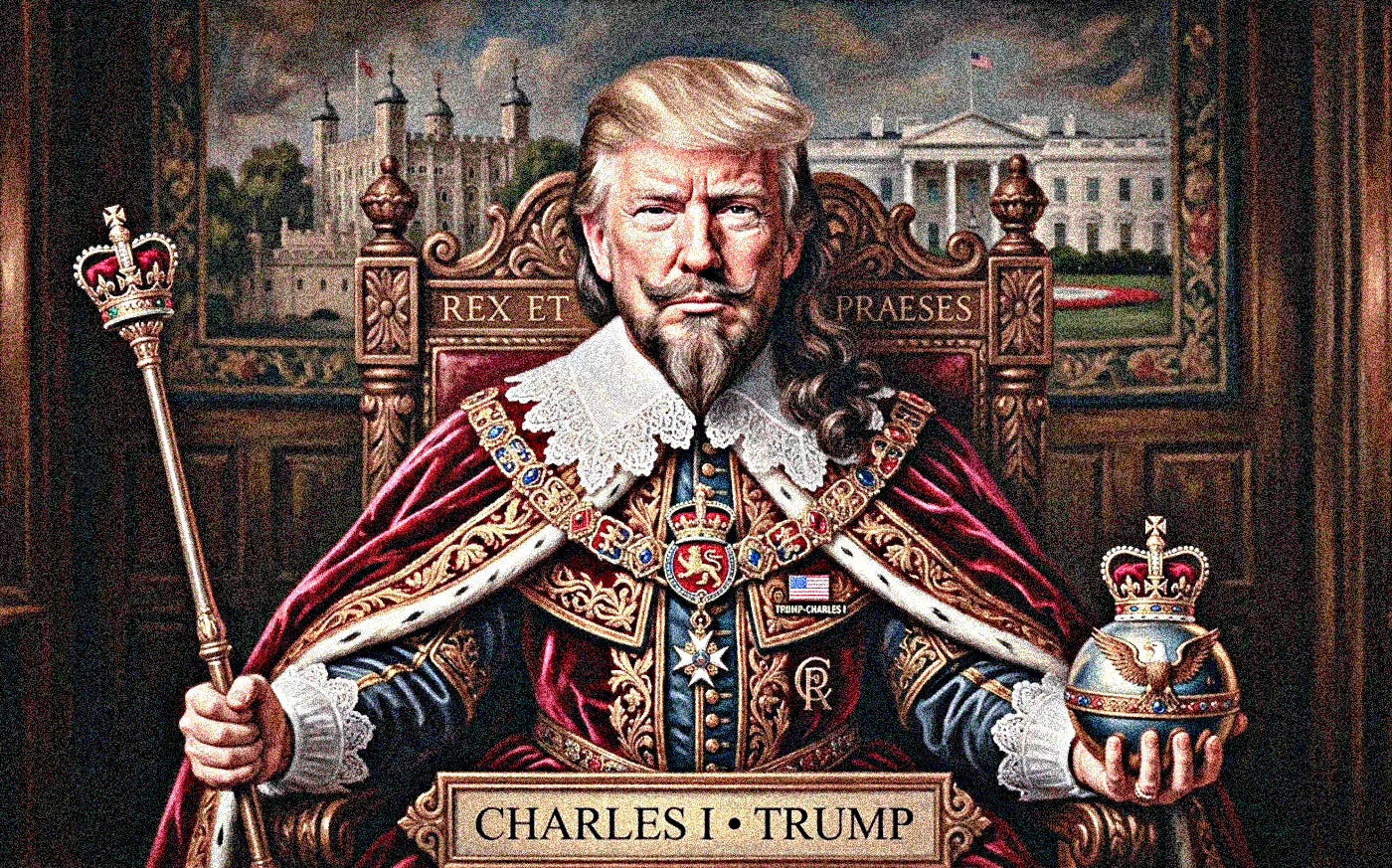
Charles I attempted to govern without Parliament from 1629 to 1640, raising revenue through instruments that Parliament had not sanctioned. Parliament’s response, ultimately, was civil war and the execution of the king. After the Restoration of the monarchy in 1660 and then the Glorious Revolution of 1688, a definitive constitutional settlement made parliamentary control of the purse strings the cornerstone of English governance.
The lesson was absorbed deeply by the political tradition that produced the American Revolution. When the Framers gathered in Philadelphia in 1787, they did not need to debate at length whether the executive should control spending. From Magna Carta’s origins in 13th-century baronial resistance; the tumults of the civil wars in the 17th century; a century of Whig constitutional theory; their own fight against “taxation without representation,” they all already knew that putting the power of the purse in legislative hands was the single most important structural guarantee for a free system of government. An executive who controls both the sword and the treasury is, for all practical purposes, an autocrat.
The result is Article I, Section 9, Clause 7: “No Money shall be drawn from the Treasury, but in Consequence of Appropriations made by Law.” This is not a default rule subject to emergency overrides. It is not a preference amenable to presidential determination. It is an absolute command, one of the most unqualified in the entire document. The text admits of no exceptions. Congress appropriates. The executive spends what Congress has appropriated. That is the whole of it. Presidents have stretched and abused this principle, but never before so openly defied it, claiming their own policy judgement can supersede congressional authority.
The Framers understood that the power of the purse is not merely one check among many. It is the check from which all others derive their force. The reason is straightforward: the government cannot act without money. An executive who controls spending controls policy, regardless of what any statute or constitutional provision says on paper. A legislature that holds the purse can starve any initiative it opposes, compel accountability for any abuse, and ultimately subordinate executive ambition to the deliberate judgment of the people’s representatives.
James Madison put it plainly in Federalist No. 58: “This power over the purse may, in fact, be regarded as the most complete and effectual weapon with which any constitution can arm the immediate representatives of the people, for obtaining a redress of every grievance, and for carrying into effect every just and salutary measure.”
In this context, the point is not theoretical. The shutdown did not begin because of congressional indifference to airport security. It began because DHS, under Kristi Noem, presided over a year of escalating ICE and CBP misconduct: warrantless raids, masked and unidentified agents, detained U.S. citizens, and a pattern of use-of-force incidents culminating in the killing of two Americans in the streets of Minneapolis. Democrats conditioned DHS funding on basic accountability reforms: judicial warrants, visible identification, body cameras, a use-of-force code of conduct. Republicans rejected them. Funding lapsed February 14. (The funding for ICE and CBP payroll has continued under the obscene amounts of money shoveled to it under the One Big Beautiful Bill Act, but only for law enforcement officers and not for other employees or DHS more generally.)

Congress withheld the checkbook, in other words, to demand accountability and adherence to the rule of law by an out-of-control executive branch. Ultimately, Congress needs to claw back the money Republicans have handed to these draconian agencies. But for now, Congress is trying to ensure that this funding is not used to abuse the constitutional rights of Americans.
The Noem controversies also produced a direct illustration of the power of the purse in action. After two days of congressional hearings in which she refused to apologize for calling the Good and Pretti killings “domestic terrorism,” and in which a $220 million self-promotional advertising contract came to light, Trump fired her. By spending money Congress never authorized in order to pay TSA workers and thus neutralize this legislative leverage, Trump is now openly dismantling the very mechanism the Constitution gives Congress to enforce its will. If he gets his way this time, he will feel even less need to kick out the next Noem in the face of public outrage.
Money Is Power
Government shutdowns are disruptive and often blame-laden affairs, but they are the direct result of the constitutional design: when the two political branches cannot agree (or Congress can’t muster two-thirds votes to override a veto) on appropriations, the money stops. That is not a flaw in the system. It is the system working as designed, preserving the primacy of Congress over the public fisc, and thus ultimately over the power to govern.
What Trump has done is to declare, in effect, that this mechanism does not apply to him when he finds it inconvenient. The memo frames its action as an “emergency,” but there is no emergency exception to the Constitution. Even the broad and oft-abused laws granting the president emergency powers do not encompass anything like this, which is why Trump’s order does not cite them.
The whole purpose of the Appropriations Clause is to prevent the executive from making these determinations unilaterally. If the president could decide that money appropriated for one purpose has a sufficient “nexus” to another and proceed accordingly, the power of the purse would be meaningless. The executive could always find a plausible connection between any two government activities. Border security and aviation security are both, after all, security. Homeland Security and the State Department both deal with foreign threats. The Pentagon and FEMA both respond to disasters. Follow this logic to its conclusion and Congress’s role in the budget becomes entirely advisory—and the president is freed to accept or ignore its stipulations based on his own assessment of operational necessity. Basically, the president gets a blank check to use the money Congress hands him any which way he wants.
This might not be an issue the courts can solve. When the injury is being done to Congress as an institution and to taxpayers as a whole, it is inherently problematic on standing doctrine for any individual to sue when. But the lack of judicial remedy does not make it legal. Rather, it is another case where it is Congress’s duty to use the tools at its disposal to defend its constitutional prerogatives.
A Congress that cannot control spending is not a legislature in any meaningful sense. It is a ceremonial body, a sham assembly, an impotent gaggle. A president who can spend money that has not been appropriated is not an executive operating within a constitutional system, he is a dictator.

© The UnPopulist, 2026
Follow us on Bluesky, Threads, YouTube, TikTok, Facebook, Instagram, and X.
We welcome your reactions and replies. Please adhere to our comments policy.
Yeah but … he does stuff because he knows no one will stop him. Who is going to sue to stop TSA workers from getting their fully earned wages? And getting the airports unsnarled? Nobody wants to be that guy, and Trump isn’t constrained by the law intrinsically.
I am conflicted here, wanting to see the TSOs get paid (and wondering why it took the President so long to exercise this option) but concerned with Trump's continuing power grabs. Your points are well thought out.