


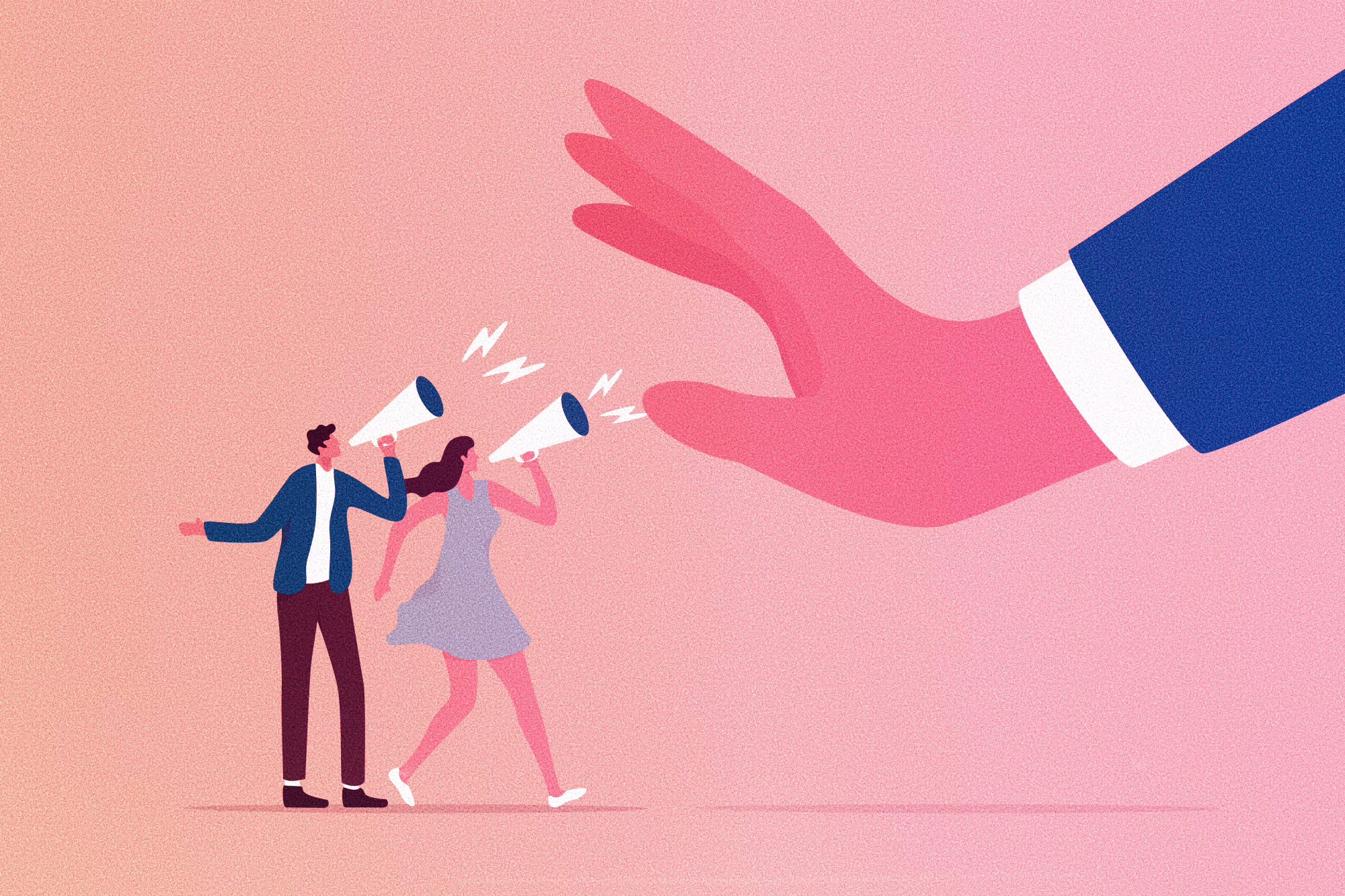
I’m a long-time critic of the modern concept of “free speech culture”—the culturally pervasive notion that supporting freedom of speech requires me not just to refrain from official censorship, but to avoid a wide array of expression that might chill, deter, or punish other people’s speech. The legal view of free speech protects an unpopular speaker from being jailed or (successfully) sued; “free speech culture,” by contrast, is a social norm that discourages me from calling for that person to be fired, shunned, socially sanctioned, or criticized to a degree that is, by some poorly defined measure, excessive.
Don’t misconstrue this as the idea that cultural norms genuinely supportive of free speech are a problem; on the contrary, such norms are most welcome, and even vital. The problem, rather, is that the particular model of “free speech culture” that has emerged has substantially contributed to an intellectual framework that the Trump administration and other bad actors have used to engage in official government censorship to an unprecedented degree. As Katherine Stewart argued in The UnPopulist, Trump’s return to office engendered “a banner year for state-sponsored censorship in the name of ‘free speech.’”
That’s what makes “free speech culture” a mockery of its own name.
Here’s what this approach to free speech gets so wrong.
The First Speaker Problem
“Free speech culture” tends to pick a speaker, treat that person’s speech as the speech that should concern us, and then apply a set of cultural norms and questions only to the responses to that speech. This is what I call the First Speaker problem.
Imagine that a speaker came to your university to argue that no professor should be allowed to teach “gender ideology” and that the school’s curriculum should be examined for “anti-American” and “pro-communist” content. Imagine further that a group of students protest the speaker’s invitation, call for the speaker to be disinvited, shun and decry the student group that invited the speaker, and protest loudly outside the speech, shouting insults and abuse at attendees.

“Free speech culture” analyzes this situation by asking:
Do the actions of these protestors encourage or discourage speech?
Would such protests deter others from speaking?
Do these protests make students who agree with the speaker less likely to speak up?
Would these protest tactics, if widely repeated, result in more speech or less?
Do these protests support an idealized view of civilized debate and discourse?
Are the students’ reactions disproportionate?
Do they seek to impose “real-world” consequences on someone who is only offering a viewpoint?
But “free speech culture,” as typically used in America, crucially does not ask those questions of the person who has been chosen as the “first speaker”—only those responding to speech. Hence, the speaker in this hypothetical—who is in favor of official state censorship—gets treated as the free speech culture hero, and the students protesting the speaker get treated as the free speech villains.
This incoherence stems from the fact that, within a “free speech culture” framework, selecting the “first speaker” is often an arbitrary exercise. Our speaker came to campus to denounce “gender ideology” because professors and students engaged in protected speech about “gender ideology.” Why aren’t they the “first speaker”? Why isn’t the professor teaching “communist” ideology the “first speaker”? And why isn’t the speaker calling for their censorship violating the social norms of “free speech culture”?
The answer is primarily stylistic and cultural. “Free speech culture” means that you can chill and deter speech, call for censorship, disproportionately abuse other people, even call for violence—so long as you do it in certain ritualized and stylized ways that people who were on the debate team like. If you dehumanize fellow Americans from a lectern or in a moderated debate or as a contributing writer to a magazine, that promotes free speech culture. However, if you denounce the speaker in a social media post, or protest outside, or write a letter to the dean, that harms free speech culture.
‘Free Speech Culture’ Marginalizes the Interests of Dissenters
The flip side of irrationally preferring the “first speaker” is irrationally diminishing the speech interests of dissenters.

“Free speech culture” has a natural tendency to discount the speech rights and interests of people who criticize speech. It treats those interests as having no weight. Take the editorial board of The New York Times, which famously and fatuously proclaimed a “fundamental right” to speak “without fear of being shamed or shunned.” But this right requires believing that the shamers and shunners don’t have the same rights.
‘Free Speech Culture’ Promotes Ignorance of Free Speech Rights
The “free speech culture” movement also promotes civic ignorance. How? Its adherents tend to suggest a false equivalence between being punished by the government and being socially punished by peers, promoting the increasingly widespread view that criticism is a form of censorship that violates the rights of the target of censorship. But criticism, denunciation, shunning, and calling for consequences against a speaker are not government censorship; rather, they represent some other speaker’s freedom of speech and association.
Getting this right is critical. In fact, consciously and explicitly pointing out the difference between free speech rights protecting you legally and social norms protecting you socially goes a long way to promote civic education. By contrast, treating individual speech and government censorship as equivalent promotes ignorance.
Hand-waving the difference also promotes ignorance, as the Harper’s Letter does when it states, “The restriction of debate, whether by a repressive government or an intolerant society, invariably hurts those who lack power and makes everyone less capable of democratic participation.” One of those things is not like the other, and the difference is fundamental to ordered liberty.
‘Free Speech Culture’ Prefers the Powerful to the Powerless
“Free speech culture” has a natural tendency to prefer the interests of more powerful, famous, wealthy people with bigger platforms over the interests of more powerless, obscure, poor people without big platforms. If people who give speeches and participate in debates are inherently heroes and people who “excessively” criticize them or call them to be deplatformed or punished are inherently villains, then the heroes are going to be professional pundits and politicians and other prominent folks. And the villains are going to be students and people whose platform is a hand-lettered sign or a shout at a protest or a screed on a social media account.

The Harper’s Letter addressed the vulnerabilities of editors, journalists, professors, researchers, and “heads of organizations.” That focus is a natural element of “free speech culture” because those are the people we listen to and perhaps admire, and the people who draw attention when they’re fired or deplatformed. We don’t tend to notice a minimum wage worker fired for a bumper sticker.
This distorts our understanding of who poses the biggest threat to our actual, tangible freedom of speech. Some of the people currently using or applauding official government censorship to deport students for writing op-eds, fire professors for insufficiently mournful tweets about Charlie Kirk, and restrict college curriculums by force of law were very much in favor of “free speech culture” and loud critics of “cancel culture.” They spoke behind lecterns and debated through moderators and wrote op-eds, so they were not treated as a genuine threat to “free speech culture.” At the same time, university students were relentlessly portrayed as the greatest threat to free speech culture. (There were, of course, welcome exceptions to this troubling trend.)
I’m not denying that students can be illiberal, censorial, close-minded assholes who think they should be able to dictate what you say or who you listen to. They can be! Nor should we tolerate actions that cross the line into attempting to physically shut down speech events that some group of students dislike, such as when a controversial speaker is blockaded from entering a building. The line can be fuzzy between merely contentious heckling and obstructing an event to the point of shutting it down. Often the distinction will depend on the context and scale; it’s a mistake to conflate all hecklers with an attempted “heckler’s veto”—although campus authorities shouldn’t be afraid to take action when genuinely necessary.
But the “free speech culture” ethos has relentlessly sought to portray relatively powerless people like students as the prime threat to free speech in America. How’s that working out?
‘Free Speech Culture’s’ Vulnerability to Bad Faith and Manipulation
The ethos of “free speech culture” is extremely vulnerable to manipulation and bad faith. In part, that’s a function of its vagueness and philosophical incoherence. “Cancel culture” is rarely defined at all and the “criticism is censorship” mindset allows powerful people to portray classic American protest as some sort of rights violation. Donald Trump decried “cancel culture” as “totalitarian” despite his own censorial record—an instance of this framework enabling a genuine enemy of free speech being able to pose as its defender (see also: Elon Musk).

Moreover, part of “free speech culture” is presuming that our interlocutors are speaking and acting in good faith even if they are manifestly not. We are reaping the consequences of treating bad faith as good faith and hypocrisy as sincerity.
When the American Civil Liberties Union fought successfully for the rights of Nazis to march at Skokie, it did not convene a public meeting to ask the Nazis to explain why the Jews were so bad, and it did not portray the Nazis as heroic warriors for free expression. That would have been unserious: the Nazis, given their way, would have suppressed many people’s speech. Rather, the ACLU’s stance was simply that the First Amendment doesn’t permit censoring the Nazis.
The “free speech culture” ethos, by contrast, has a tendency to go well beyond arguing that bigoted, totalitarian people shouldn’t be officially censored. Rather, it encourages treating people as “free speech heroes” so long as they are struggling for their own right to speak, irrespective of what they would do to other people’s rights. That’s how people nominally in favor of liberty can repeatedly platform and promote bad faith actors like the Manhattan Institute’s culture warrior Chris Rufo, who says rather explicitly that he wants to use propaganda and media manipulation and government force to censor ideas in academia.
Or take Amy Wax, a loathsome bigot who thinks America would be better if my children—born in Asia, American citizens since we adopted them as infants—weren’t here. FIRE believes—correctly—that when Wax’s university seeks to discipline her for speech, it must obey its own rules and carefully consider the values of academic freedom and due process. FIRE also says, again correctly, that as far as it is concerned, “her viewpoint is beside the point.” But then it goes further and offers her a platform to promote her views. That’s a “free speech culture” ethos move.
“Free speech culture” becomes bad and unserious when it starts telling us that speech is morally neutral, that we should not make value judgments against it, and that there is no moral component to promoting it. I am committed to the defense of the legal right to speak, but the defense of speech does not require us to refrain from speaking frankly about moral truths. Giving Wax a platform to be a bigot is morally distinguishable from saying she should be free to be a bigot. “The only immoral thing you can say is that someone else’s speech is immoral” is not an ethos worthy of respect.
‘Free Speech Culture’ Makes the Free Speech Bargain Look Unpalatable
All of these problems combine to do something very dangerous: they suggest to Americans (and particularly young Americans) that free speech is bullshit.
Every generation of Americans must come to terms with the fundamental bargain of free speech: we agree not to use the mechanism of the state to punish speech we don’t like, and to talk back instead. This is not the default human view. The default view is, “Let’s use power to promote speech we like and punish the speech we hate.”

It’s a tough sell to move people away from that, and plenty of us still don’t accept that bargain. But if a critical mass of people don’t accept it, then it stops working. Free speech is Tinker Bell: if enough kids don’t clap, she dies. Or as Learned Hand put it more poetically: “liberty lies in the hearts of men and women; when it dies there, no constitution, no law, no court can even do much to help it.”
“Free speech culture,” as practiced in America, makes this deal seem like a scam. It tells students that “free speech” entails that:
When someone comes to their campus to say bigoted and evil things, that’s a good thing; and when they (students) use their only remedy—more speech—in the wrong way, that’s bad.
They should be more worried about prominent podcasters’ speech being chilled than their speech being chilled.
It’s their fault that government force is being used to deport and expel and censor them, because they dissented wrong.
Others have the right to denigrate them, but they have some ill-defined obligation not to respond too hard.
They’re wrong and illiberal to notice that people using government force to censor them were previously calling them illiberal and censorial.
If this just meant that people would reject the deal of “free speech culture,” I wouldn’t particularly care. But the deal people reject is respect for legal norms of free speech. The norm that suffers is the one against government censorship. When enough people think that all of free speech—including free speech law—is bullshit, then free speech rights won’t be enforced. That’s the path we’re on, and in my view, the ethos of “free speech culture” shares the blame.

An earlier version of this article was first published in Ken White’s newsletter, The Popehat Report. It is republished here with permission.
Follow us on Bluesky, Threads, YouTube, TikTok, Facebook, Instagram, and X.
We welcome your reactions and replies. Please adhere to our comments policy.

“ which you quite clearly take personally”
Well, yes, Greg, I do. Aside from my children being Asian-American, many of my friends, colleagues, and fellow Americans are Asian-American. I do take personally the assertion that they’re bad for America.
Don’t you? Seeing the assertion that they’re bad for America as some anodyne opinion like “I don’t like pistachio” strikes me as odd. Leaving that aside, is there something bad, or blameworthy, about finding that opinion repugnant, and saying so?
If taking it personally is bad, I am happy to be bad.
“ What I don’t agree with is that there is any affirmative duty to refuse to allow those views to be aired in a setting like FIRE’s online faculty webinar. The only “test” you’ve listed here is that, according to your moral compass, Wax’s views are so bold that treating her free speech rights as morally neutral is “unserious.” No slippery slope there.”
There’s a little bit of misdirection there. FIRE is making a choice about the use of its own TV show. FIRE chooses who it invites and what the topics will be. FIRE is not “refusing to allow those views to be aired” on somebody else’s show. FIRE is not saying Amy Wax shouldn’t be allowed to eat at Arby’s, FIRE is inviting her to dinner at FIRE’s house.
If I invite Nick Fuentes onto my podcast to talk about how Jews are the enemies of Western Civilization, is that morally neutral? I would say no.
“ Nowhere has FIRE asserted that Prof. Wax’s views are morally neutral. What they have asserted is that her right to speak them and defend them is. That they have “platformed” her is their absolute right, just as it is everyone else’s right to refuse to read or listen to it, to attempt to vilify it, to doxx it, etc. You can decide that their choice represents a moral failing of such magnitude that you’ll never give them another dime. By all means, call out the immorality! But it makes their framework “unserious” in your view only because they’ve chosen to treat her differently than you would. Frankly, I think their framework is more rigorous than your own: it does not depend on a definition of morality.”
I didn’t suggest that FIRE did call Amy Wax’s views morally neutral. Nor did I question FIRE”s right to platform her, obviously. I suggested FIRE treats inviting Amy Wax on her show and giving her a platform to broadcast her views to a wider audience - and lending its imprimatur to her in a way that defending her rights does not - is morally neutral, and that that’s unserious.
The war on Free Speech is occurring because the first thing a kidnapper does is gag the victim so that they cannot sound the alarm. Give up your free speech at your peril. Once they are able to silence you, the game is over. The loss of all of your other freedoms will fall like dominos after. Anyone that advocates to censor you, or to unmask your anonymity is your adversary. Treat them like one - no matter what else they say.
But why is it so vital and necessary for the combined monolithic apparatus of government, corporations, and NGOs, to brute force censor everyone while decimating the careers and reputations of the dissenters? Here is why:
The reason the First Amendment is prime directive order 1, is because it is the most important freedom we have for the same reason it is the first target an adversary subverts, disrupts, and destroys during a crime, a war, or a takeover—preventing a target from assembling, communicating, and organizing a response to an assault grants an enormous advantage to the aggressors.
"If freedom of speech is taken away, then dumb and silent will be led, like sheep to the slaughter." —George Washington