


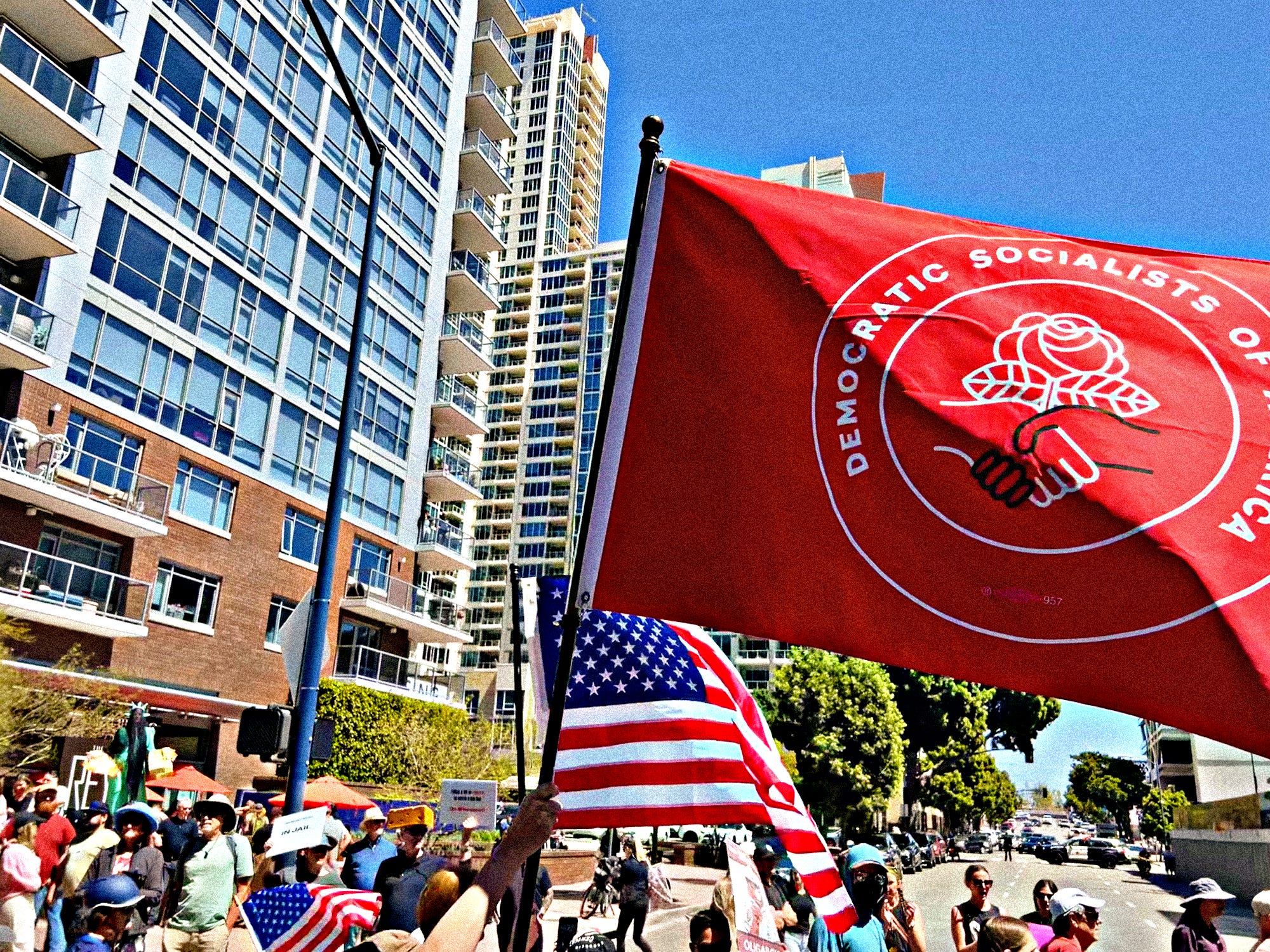
The national political program of the Democratic Socialists of America (DSA) is in some ways a modern document, with references to climate change, data centers, and other contemporary issues. But in a more fundamental sense, the program is antique. It’s a dusty relic from the beginning of the 20th century, when socialism hadn’t yet been tried in dozens of countries before failing in each one. It’s a document frozen in time, trumpeting defunct ideas like nationalizing the country’s largest corporations and industries. It calls for destroying the “entire global system of capital.”
Interest in the DSA has surged over the past year, thanks in no small part to Zohran Mamdani’s mayoral win in New York City and a series of upsets by DSA-backed candidates in primary races around the country. But as the DSA grows in prominence, so does the importance of its official program, the document that lays out its philosophical and political commitments. Had the DSA stayed a marginal outfit, that document might have remained an internal matter. Instead, it now risks steering the Trump opposition movement toward extreme and unpopular positions, weakening the prospects for renewal—and even reconstruction—that the country so desperately needs. Perhaps most damagingly, the DSA’s official program hands the MAGA propaganda machine a potent weapon to deploy against the anti-Trump coalition as a whole.
Trump has already noticed. At the GOP’s midterm convention in Dallas on Sept. 9, he told the crowd that “the Democrat establishment has been overthrown and replaced by crazed lunatics and radicals. They call themselves Democrat Socialists”—then read almost verbatim from the DSA’s own program: They vow to “abolish prisons, abolish the United States Supreme Court, abolish the United States Senate.” Every item on that list is on the DSA’s own website.
My assessment of the DSA’s program is not kind. But neither is it a final verdict on the movement writ large. Dissecting the illiberality of that program casts no skepticism on voters who may not be familiar with its official platform and are drawn to DSA-aligned candidates because they’re challenging MAGA authoritarianism and speaking up for persecuted groups more forcefully and directly than establishment Democratic politicians. Nor does this assessment assume the program predicts the governing agenda of any given DSA candidate. What follows is simply a look at what the DSA’s own program says—and the great distance between it and the liberal politics this country so badly needs right now.
Against the Market Economy
Socialism is a slippery word, so it’s important to make a distinction at the outset. The DSA is not calling for anything like the importation of Western European social democracy to the United States. American socialists often point to countries like Denmark, Sweden, or Finland that provide universal health care and large social safety nets to their citizens as examples of how well socialism works in the real world. But those countries have free-market systems with strong private property rights, contract enforcement, and thriving capitalist economies. They are home to several major global corporations, such as Novo Nordisk and Maersk (Denmark), Spotify (Sweden), and Nokia (Finland).

Contrary to common misconceptions, the United States isn’t much of an outlier in public social spending as a share of GDP—it spends around 20%, less than France and Germany but more than the Netherlands and Australia. If the DSA wanted the United States to spend 30% of GDP on social programs rather than 20%, it wouldn’t be calling for Americans to “imagine the end of capitalism.” It would be advocating a significant shift in public policy, not a revolution. The key difference between a progressive supporter of European-style social democracy and a socialist is captured in this sentence from the DSA program: “Some of these demands may be won under our current system, but we know complete victory will require building a new society from the ground up.” The DSA’s platform is written for people who want to destroy capitalism, not expand the safety net within it.
The program is also opaque about how its central economic demands would actually work. It never says how “public ownership” of the largest corporations and “essential industries” would happen—through purchase, seizure, or some other transfer of control? Which companies would qualify as “essential”? The DSA demands a massive restructuring of the United States’ political, legal, and economic system with absolutely no idea how this would come about.
Against the American Constitutional Order
The program doesn’t just call for ending capitalism, it wants to demolish the foundation of American liberalism. “We are workers fighting to transform society,” the DSA program declares, and its stated aim is “to win the battle for democracy, draft a new constitution, and create a democratic socialist republic.” You can’t draft a new constitution without shredding the old one. By the program’s own measure, success would mean a socialist government seizing control of the private sector, throwing out the Constitution, and remaking American society from scratch. This ambition is not just illiberal but also detached from political reality. The Constitution is the foundation of American law, built on precedents established over two and a half centuries, and the idea that a “socialist republic” can simply replace it with a structure of its own is fanatical and unworkable.

The program spells out this vision in its call for a “Working-Class Democracy,” which would functionally dissolve two of the three branches of government—the presidency and the Supreme Court—into appendages of Congress.
That directive to fold the country’s three-branch government into a unicameral leviathan would undo the Framers’ most deliberate choices. An executive and judiciary answerable to a Congress with no second chamber would effectively collapse the separation of powers the Constitution was built around—a plan DSA co-chair Megan Romer affirmed on Fox News in July. It would replace an unchecked president with an unchecked Congress.
Against the Free World
The DSA promises that its vision “pushes further than historic social democracy and leaves behind authoritarian visions of socialism in the dustbin of history.” This is a laughable claim coming from an organization that recently published a commemoration of Fidel Castro, the longtime Cuban communist dictator, honoring his “historic significance.” The DSA described “Fidel” as “an organizer, a fighter” who “endures as a stalwart symbol of anti-imperialist struggle and self-determination for the Global South.” The statement found no space to mention Castro’s brutal repression of the Cuban people: the curtailment of free speech and civil society, mass surveillance and arbitrary detention, the absence of judicial independence or a free press, the seizure of private property and businesses without compensation, and the torture and imprisonment of dissidents. If the DSA wants to leave authoritarian visions of socialism behind, it could start by refusing to honor vicious autocratic regimes that use the rhetoric of human equality and anti-imperialism to suffocate their own societies and remain in power.
The DSA’s official statements defend monstrous dictatorships like Iran, Venezuela, and even North Korea—its “Korea Solidarity” statement calls for lifting U.S. sanctions on Pyongyang, which would help “counter imperialist narratives,” all without a word about the regime’s labor camps, its famines, or its total absence of free expression. The only politician who would perhaps be simpatico with this would be … Donald Trump!

The same instinct shaped its response to the largest conflict in Europe since World War II: days before Russia invaded Ukraine in 2022, the DSA’s International Committee blamed the crisis on NATO expansion and dismissed the 2014 Maidan Revolution as a “U.S.-backed coup,” without once mentioning the Russian troops already massed on Ukraine’s border. After the invasion, the DSA’s national leadership called it “illegal,” but the statement still closed by reaffirming “our call for the U.S. to withdraw from NATO and to end the imperialist expansionism that set the stage for this conflict.”
A Gift to MAGA
DSA-aligned candidates run for office on the Democratic ballot line. Voters see a “D” next to their names, which means the Democratic Party’s brand is attached to them whether the party likes it or not. But the DSA itself doesn’t return the favor: “As democratic socialists, we refuse to be limited by the Democratic and Republican factions of the ruling class,” the organization says, and it explicitly calls for building a “new working-class political party” instead. That’s understandable—if its ideology were basically interchangeable with standard Democratic Party politics, there would be no justification for its existence. The political problem for the anti-Trump cause, though, is that this arrangement runs in one direction only. The DSA gets the practical benefits of the Democratic line (ballot access, name recognition, the assumption of legitimacy that comes with a major-party label) without accepting any obligation to the party itself—or even calling itself part of it. Its candidates’ obligations run to the organization instead: the DSA’s endorsement rules require them to act as “socialist organizers first, and legislators second” and to actively recruit for the DSA while in office. That one-sided arrangement is exactly what leaves Democrats exposed: they can’t credibly say “the DSA doesn’t speak for us” when DSA candidates are, as far as the ballot is concerned, running as Democrats.
Some Democrats, like Rahm Emanuel, resist their party’s inclusion of the DSA: “I don’t consider the Democratic Socialists are part of the Democratic Party,” he recently said. “The Democratic Party is not open to being taken over.” Gavin Newsom, on the other hand, believes the DSA’s energy is an asset the party should use. But DSA candidates haven’t proven they can win general elections outside deep-blue districts. New York Mayor Zohran Mamdani, who identifies as DSA, might have cross-political purchase—but it’s an open question if he could get elected outside of New York. In any case, he’s a generational political talent, so it’s impossible to make generalizations from his electoral success (he also ran against a uniquely terrible opponent in Andrew Cuomo). Mamdani also urges other Democrats to embrace “pothole politics” and focus on everyday, quality-of-life issues of voters. Arguably, his cross-political popularity might be the result of his moderated politics.

The assumption that Americans are fired up about socialism has little real-world backing: support for capitalism has slipped amid inflation, AI anxiety, and Trump’s corruption, but Gallup still finds Americans hold a far lower opinion of socialism than capitalism.
There’s little risk that the DSA will actually take over the party as MAGA did with the GOP. But as Trump’s own speech in Dallas already showed, that won’t stop MAGA from smearing the party as an extension of the DSA anyway, and the program makes that easy, since Trump could read straight from the DSA’s website. American socialists like to argue that their policies would be wildly popular if they could just break through the propaganda of the “capitalist class.” As the title of a recent essay in Jacobin put it: “Trump Attacks Socialism Because He Knows Americans Want It.” But many of the policies listed above are extremely unpopular. The DSA wants to abolish—not merely defund—the police. Even at the height of the protests over the George Floyd killing in the summer of 2020, just 15% of Americans (and 22% of Black Americans) said they supported that goal.
Trump spent most of the second half of his speech in Dallas tarnishing the entire Democratic Party as interchangeable with the DSA. This is cynical nonsense, and his effort to present mainstream candidates like James Talarico as “radical left lunatics” is absurd. But the program gives him something real to point to, and so do candidates who run on it, like Darializa Avila Chevalier, the DSA-backed, Mamdani-endorsed New York congressional candidate with a long record of bizarre statements that provide plenty of grist for MAGA propaganda. Chevalier once boasted about using an American flag to wipe her hands, which isn’t the sort of rhetoric that will endear her or the DSA to voters around the country.
Democrats often complain about infighting on the left and argue the party must widen its tent, but figures like Chevalier and organizations like the DSA actually shrink it: they turn off mainstream voters, undermine the anti-Trump coalition’s claim to uphold liberal values, and shift the conversation away from Trump’s disastrous approval ratings toward a movement that legitimately strikes many Americans as weird and menacing. The Democratic Party is the anti-Trump coalition’s single largest vehicle for beating Trump, and handing MAGA ammunition against it is a huge mistake.

Trump’s effort to paint mainstream Democrats as a bunch of communists is desperate, and the polls suggest that the Republicans will suffer a major defeat in November. But this could lead to bigger problems for the party down the road, as the Democrats may conclude that a sweeping midterm victory vindicates the swing toward more radical DSA-aligned politics. Democrats must compete for the voters the DSA has energized, but they can’t do so by handing more influence to an organization that wants to throw out the Constitution, publishes heartfelt odes to “Fidel,” and plans to do away with capitalism. That’s a great way to turn off far more voters than they attract.

© The UnPopulist, 2026
Follow us on Bluesky, Threads, YouTube, TikTok, Facebook, Instagram, and X.
We welcome your reactions and replies. Please adhere to our comments policy.

Happy seeing other liberals notice their abhorrent position on Ukraine. I have written about it in detail, and if we skip the details its really just Russian propaganda. With more and more instances of authoritarian countries utilizing sharp power, I wouldn't be surprised if their ties to Russia become public in a few years.
I am never quite sure just how many of the politicians who are DSA members, or who are not DSA members but are chummy with the DSA and accept its support, are actually closely aligned with the full DSA platform. Some might be playing a game of bait and switch with voters, selling them social democracy while secretly hoping to appropriate the means of production, which wouldn't surprise me. Perhaps others are just opportunists using the DSA's resources, but never really intending to try to carry out socialist policies?
Btw, when the DSA says they just want to nationalize a few major industries, I would recommend that you do not believe they would just stop there. Their antipathy to private enterprise is manifest in various other statements of theirs about capitalism, one of which you cite.