


With Democrats seemingly poised to take back control of Congress in next month’s midterm elections, it’s time to start looking at the next question: What will they do with it?
Will they use a new majority to rein in executive power—not just to oppose what Donald Trump is doing now, but to prevent similar abuses by future presidents? Will they make this an Article I election, fought over the constitutional powers of Congress and its ability to check the president? And which Democrats are openly campaigning on that?
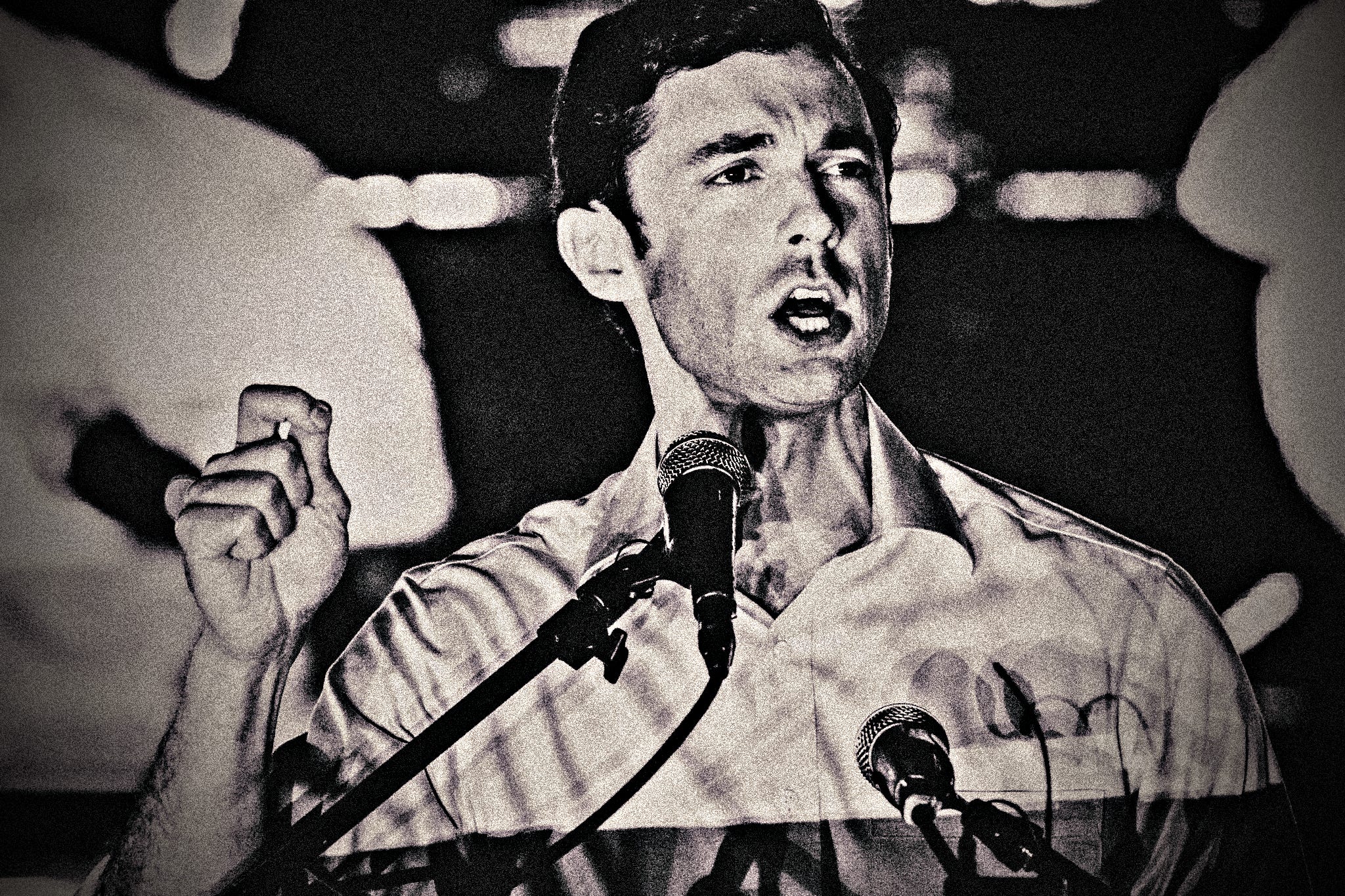
That question comes to the forefront after Georgia Sen. Jon Ossoff’s fiery performance at a debate last week against Georgia Rep. Mike Collins. Ossoff hammered Collins on his ties to white supremacists, saying that if the civil rights movement were happening today, “Mike Collins would be grabbing a billy club.” It was a refreshingly clear condemnation of the resurgence of racism in the Republican Party, and Collins is a particularly clear case.
But from the standpoint of restoring the constitutional balance of powers, the more revealing exchange was when Collins insisted that Trump “had every right” to launch the war on Iran without the approval of Congress and defended tariffs the Supreme Court has already struck down as unconstitutional. Ossoff then branded Collins a “Trump-puppet election denier,” a jab at the way Collins has helped cede Congress’s powers to the executive.
This is a theme Ossoff has been highlighting on the campaign trail for months, and more Democrats need to put it front and center in their campaigns, and in their agenda.
Who Imprints the ‘Fabric of America’?
Why should Democrats be campaigning to undo Trump’s expansion and exploitation of presidential power? Partly because conservatives are betting they won’t.

In response to a Washington Post overview of various Democratic proposals to limit presidential power, Heritage Action Executive Vice President Tiffany Justice—yes, a co-founder of the pro-censorship Moms for Liberty, now working with the same organization that gave us Project 2025, Trump’s blueprint for an authoritarian takeover—scoffed, “I don’t think Democrats would ever limit the power of a Democratic president.”
Trumpists are hoping these powers will remain in place no matter what happens so that a future right-wing president can deploy them again. As Trump’s Communications Director Steven Cheung boasted in February, Trump’s approach to executive power “will be imprinted upon the fabric of America and will be felt by every other White House that comes after him.”
Conservatives may be right to bet on that. After all, some Democrats are not averse to using the ring of power for good. There is an important debate about how Democrats can be assertive enough to roll back Trump’s abuses of power and undo his damage to the system, without adopting and ratifying those very abuses. New York Rep. Alexandria Ocasio-Cortez represents the middle of that debate, saying, “We need to put a lot of guardrails back in place” while also insisting that Democrats shouldn’t “handcuff themselves” and should “use the tools of the office that have been provided for and allowed” by Trump and the current Congress and Supreme Court.
Other Democrats, traumatized by seeing their warnings go unheeded in 2024, have decided that these constitutional concerns are not winners at the ballot box, so they should focus exclusively on the economy and “affordability.” Of course, Democrats should be hammering Republicans on affordability. With gas and diesel prices soaring as a direct result of a failed war started by Trump alone, they would be foolish not to hang that around his neck. But if they focus only on affordability and ignore the constitutional issues, they won’t be ready to act on them when they get a majority.

Moreover, there is a lot of reason to believe that this conventional wisdom is wrong. The constitutional issues really are popular, and Trump’s abuses of power are unpopular. A recent poll shows majority support for Congress to cut off funding for a war started by the president without congressional authorization. This is consistent with polls at the beginning of his second term showing that executive power grabs weren’t popular even then. And while soaring gas prices helped tank Trump’s approval ratings over the summer, it’s worth remembering that the other two times his approval ratings have sunk near this level were after he called Nazis “very fine people” in 2017 and after his insurrection attempt on Jan. 6, 2021. In this term, his polls started tanking after federal immigration agents killed two U.S. citizens in Minneapolis in January. On all those occasions, the public reacted specifically against Trump’s attacks on our constitutional order.
All of this suggests that Democrats should be preparing to rein in presidential power—as a matter of principle, as a precaution against the future, and as an issue that can win them popular support.
But who is doing that?
The ‘Solid D’ Reformers
I do not doubt there are many Democrats who will go along with restraining executive power if these reforms are proposed. But who is taking the lead in setting this agenda and making the case for it?
The Washington Post’s overview mentions several Democratic proposals. Maryland Rep. Jamie Raskin is talking about “reconstruction,” a callback to the big constitutional reforms of the post-Civil War Reconstruction Congress (a term also favored by The UnPopulist). Along with California Sen. Adam Schiff, Raskin has introduced a bill that would strengthen civil service rules that protect the independence of the federal bureaucracy, ban presidential self-pardons, and attempt to strengthen congressional authority over spending.

Meanwhile, Connecticut Sen. Chris Murphy has introduced the No Political Enemies Act (NOPE Act). To curb politically motivated prosecutions, NOPE would:
shift the burden to the government to justify itself once a defendant presents substantial evidence that its case was driven by protected speech or association
require the government to pay legal fees for defendants who prevail and show they were targeted for protected speech
let victims sue the federal officials responsible
Washington Rep. Suzan DelBene and Virginia Rep. Don Beyer have targeted the president’s emergency powers with a bill that would require congressional approval when he invokes a “national emergency” to impose tariffs. The Supreme Court struck down Trump’s emergency tariffs in February, a year after he first imposed them, but he promptly imposed new tariffs under a different law, which shows why Congress can’t leave this issue to be dragged out in the courts.
Yet there is a pattern you might notice about these proposals. Murphy and Schiff are not up for reelection this year. Raskin, DelBene, and Beyer—and many others who are backing these proposals—are in safe Democratic districts that are even safer than usual this year. If you want to predict how loud a politician is about proposing bold restraints on executive power, look at who is in the “Solid D” column in the Cook Political Report.
In short, Democrats in competitive races are playing it safe and sticking to the conventional wisdom about affordability and gas prices, while Democrats in safe seats are more likely to talk about big reforms.
‘This Is the Opportunity That We Have’
There is one notable exception: Ossoff, who is running for reelection in Georgia.

Ossoff is not fully a departure from this trend in two respects. First, his seat is still relatively safe, rated “Likely D”—but then again, he’s in Georgia, a conservative-leaning state no Democrat can take for granted.
Second, he has sponsored no specific proposals for policy reforms. Instead, he has made inveighing against Trump’s personal corruption and abuses of power a running theme of his speeches. He has criticized Trump for cashing in on his office with cryptocurrency schemes, for the government-backed deals that enrich his sons, and for his attempt to interfere with the election process in Georgia.
Ossoff has called for a restoration of checks and balances. At a rally this summer, he told voters that the issues in this election are “deeper than the ordinary conflict of policy and ideas between two political parties.” He urged them to
rebuke these presidential abuses so decisively that we don’t just restore checks and balances for the next few years, we send a message so that no president in either party will try anything like this again for centuries, for centuries. That’s the opportunity that we have.
This is exactly the right message and agenda. This is what we need.
The most interesting thing about Ossoff is that he is considered a moderate senator who was expected to tack to the center in a reelection campaign. Vice President JD Vance even predicted last year that Ossoff would begin praising Trump’s agenda. Instead, Ossoff has employed fiery invective against Trump’s abuses to gain support across the board. It’s a message that can unite and energize Democrats across their internal progressive-versus-moderate divide, while also appealing to independents and disgruntled Republicans. He has demonstrated that a campaign against Trump’s abuse of power has broad appeal.
Most interesting of all is that Ossoff was already being widely talked about as a possible Democratic presidential candidate for 2028, even before his recent debate performance. This shows that campaigning against abuses of executive power can become an established lane for ambitious politicians wanting a shot at being elected to wield executive power.
The Boys from Brazil
We are still at the early stages. There are not yet enough specific proposals, and there is a good argument that some of the purely statutory fixes that have been proposed aren’t enough. We may also require constitutional amendments to rein in executive power. But campaigning now on limits to presidential power will at least begin to commit opposition politicians to a reform agenda.
That’s important, because experts, intellectuals, and opinion writers can come up with great reform ideas, but ultimately they make a difference only when actual officeholders see a political interest in championing these ideas—and then translate them into real legislation once they’re in office.

Democrats should heed the warning from the recent election in Brazil, where Flávio Bolsonaro, the son of a former president convicted of plotting a coup, might well be poised to win the presidency. It is a reminder that even as the voters reject Donald Trump, they might swing back again toward a future strongman leader with the same agenda. Democrats need to think ahead and place firm limits on presidential power while they can, making it harder for successors to do what Trump is doing now—even if that means rejecting the temptation to use these illegitimate powers for their own agenda.
The next few elections need to be Article I elections. This is the article in the Constitution that establishes the power and authority of Congress to check the executive branch—powers that have been allowed to atrophy over many decades. We need members of Congress who will prioritize efforts to reassert these checks and use their majority in Congress to reclaim their powers.
Ossoff has crafted the right message for Democratic politicians to use, and we need more of them to follow that lead.

© The UnPopulist, 2026
Follow us on Bluesky, Threads, YouTube, TikTok, Facebook, Instagram, and X.
We welcome your reactions and replies. Please adhere to our comments policy.
"After all, some Democrats are not averse to using the ring of power for good." hyperlink leads to Lord of the Rings, specifically to Boromir's speech on the use of the One Ring. Didn't know you guys in the US had the son of Gondor among Democrats, but hell yeah! Just don't give him the ring, of course
I expect president Ossoff to veto legislation limiting executive power, just like Biden did.
Cynical, yes, but can you blame me?