


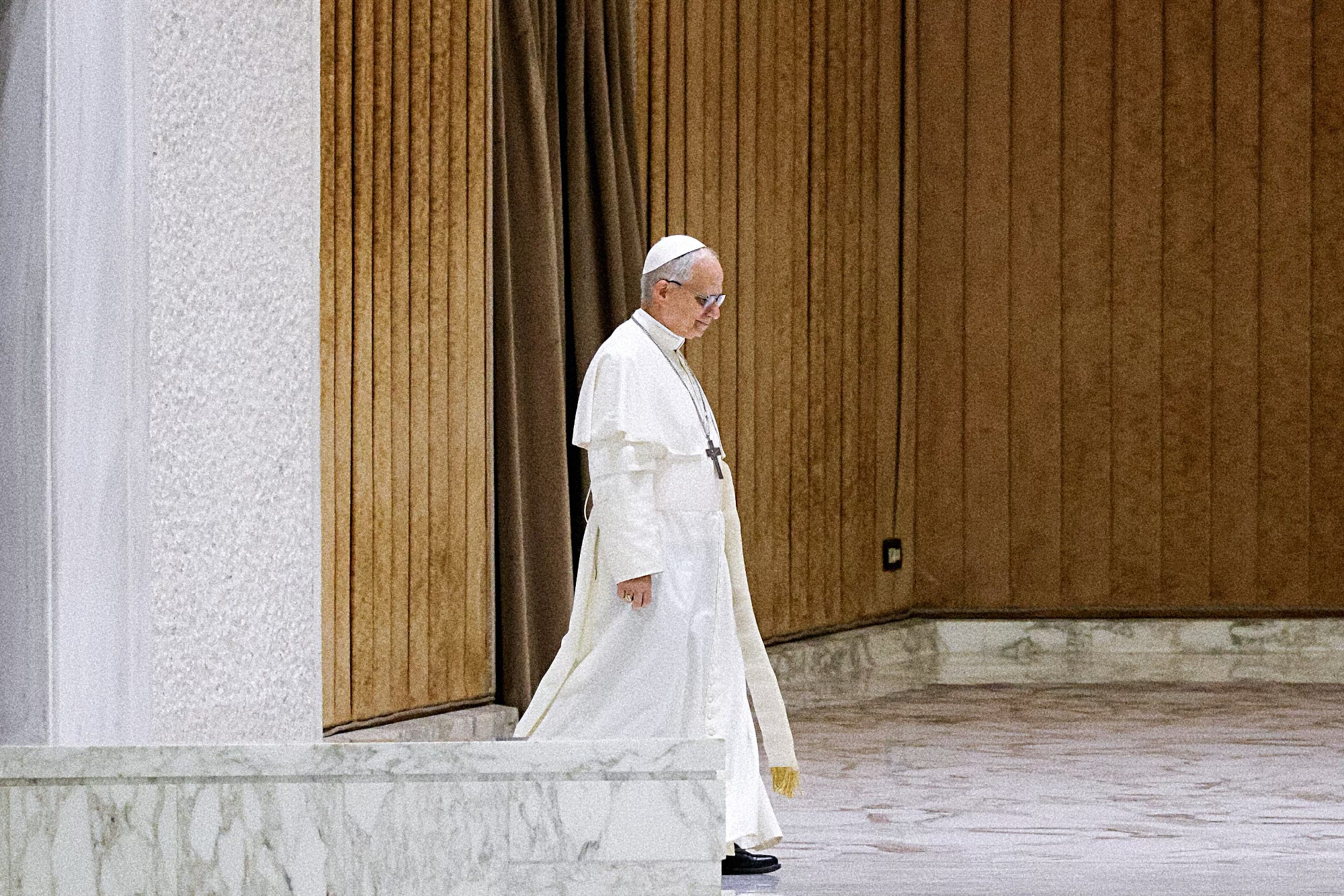
For the first time in history, the pope is American—and he is rightly appalled by what his countrymen in the White House are doing. Pope Leo XIV—born Robert Prevost on the South Side of Chicago—has called for peace, as popes often do. After he denounced a “delusion of omnipotence” following Trump’s unhinged, disproportionate, and indiscriminate threat to Iran, President Trump responded by posting an AI-generated image of himself as Jesus and attacking the pontiff as “WEAK on crime, and terrible for Foreign Policy.” Although there is plenty of room in the church for prudential disagreement about the war (though not Trump’s indiscriminate threats), Vice President JD Vance—a Catholic convert—went so far as to instruct the pope to “stick to matters of morality,” apparently unaware, or unconcerned, that war (and the treatment of migrants) are precisely that.
This is not a minor ecclesiastical spat, and it is not primarily about Trump, whose relationship to Christianity has always been transactional. It is more about Vance and the enabling role he is playing in this administration. He came to the Catholic faith voluntarily as an adult, and now invokes its theological vocabulary only when it serves him, prompting a rare public rebuke by two popes on the content of his own faith.
Careless Catholicism
“For what?” That’s how Vance responded when asked whether he owed the family of Alex Pretti—the nurse killed by federal agents at a Minnesota protest earlier this year—an apology for reposting Stephen Miller’s unconscionable smear of Pretti as “a would-be assassin” who had “tried to murder federal law enforcement.” Even as the administration’s narrative collapsed under the weight of video evidence, Vance saw no need to apologize, dismissing Pretti as “a guy who showed up with ill intent to an ICE protest.”
“I don’t really care.” That’s how Vance answered a question about refugees. It’s also how he described his attitude toward Ukrainians, telling Steve Bannon, “I don’t really care what happens to Ukraine, one way or the other.”

If there is anything that defines Vance’s public persona, it is this attitude of cynical indifference to anything that is not of obvious benefit to his base. This goes along with a tendency to see the world in zero-sum terms: immigrants, he says, take homes that belong to Americans and foreign aid takes dollars that belong at home. As Andy Craig observed in a prior profile of Vance in these pages, his conception of politics is explicitly Schmittian—a conflict between friends and enemies rather than a cooperative enterprise among people with competing interests. Perhaps most concerningly, he appears to believe that the suffering of people beyond our borders—even in cases where the suffering is to some appreciable degree caused by the actions of his own administration—is simply not his problem.
This callousness is at odds with much of America. The death of Alex Pretti struck many as a tragedy caused by the administration’s draconian immigration enforcement—a PBS News/NPR/Marist poll found that 65% of Americans believed ICE went too far—and public outcry compelled Trump to at least embrace a less performatively cruel approach.
But the American public is not the only audience that has noticed. Vance is also out of step with his own church—whose last two leaders have spoken out on Ukraine, on immigration, and on the dignity of every person his administration has chosen to disregard. On Ukraine, both popes advocated for the Ukrainian people in their plight against an unjust aggressor. Pope Francis called Russia’s invasion a “painful and shameful occasion for all of humanity” and expressed “solidarity with the martyred Ukrainian people.” Pope Leo, speaking before his election, described Russia’s act as “a true invasion, imperialist in nature, where Russia seeks to conquer territory for reasons of power.” As pope, Leo renewed his appeals for peace in Ukraine, insisting that the international community must not look away from the suffering caused by war.

The divergence between Vance’s posture and the church’s teaching is perhaps sharpest on immigration. Last November, Pope Leo endorsed a statement by the United States Conference of Catholic Bishops, hardly a far-left voice, expressing that they were “disturbed” by a climate of fear surrounding immigration enforcement, and affirming that human dignity and national security are not in conflict. The USCCB has also filed an amicus brief opposing the administration’s position on birthright citizenship, grounding its argument in the theological dignity of all persons. These are not the interventions of a church dabbling in politics; they are the application of principles the church has long stood for—principles Vance claims as his own inheritance. Yes, there is room for disagreement about their application (one need not oppose stricter border security or enforcement), but any faithful application should plausibly respect these principles. Vance’s nativist rhetoric, and lack of concern for migrants, is difficult to square with them.
Out of Order
The public record is clear. But the theological case against Vance goes deeper.
Elie Wiesel is often credited with the observation that the opposite of love is not hate but indifference. Indifference is clearly not morally neutral. To respond with indifference when love and concern are due is a sign that something has gone wrong—whether it’s a voluntary fault and thus immoral, or something involuntary and inculpable. But indifference in such cases is never something to praise or, worse, advocate for. Yet that is just what Vance consistently does. He is not alone in this. A growing current on the right has explicitly reframed indifference as a virtue—denouncing empathy toward immigrants, refugees, and foreign peoples as “suicidal,” manipulative, or simply naive.
When Vance invoked the theological principle of ordo amoris—“the order of love”—to justify his indifference to those outside his base, the response from his own church was notable. Then-Cardinal Prevost reposted two articles rebuking his interpretation, including one under the headline “JD Vance is wrong: Jesus doesn’t ask us to rank our love for others.” Pope Francis, in a letter to U.S. bishops, rejected what he saw as an implausible application of the principle. Months later, just before the pope’s passing, Vance visited Francis on Easter Sunday. Days after that, he presented the newly elected Leo XIV—the first Augustinian pope in history—with two works by St. Augustine: The City of God and On Christian Doctrine.
The idea of an “ordered love” is uncontroversial within Catholicism, with love of God taking priority and generally greater obligations to those closest to us. We owe more of our personal time, energy, and resources to our children than we do to a stranger. But the challenge of the Gospel is to extend our charity as far as possible. To the question “who is my neighbor?” Jesus famously challenges his disciples to be a neighbor to others—presumably as much as one can. To appeal to ordo amoris as justification for a self-centered, or even nationalistic, indifference to foreigners is to get a key aspect of the faith deeply wrong.

The context matters, too; this wasn’t some abstract philosophical point Vance was making. His invocation of ordo amoris came at a time when the Trump administration had frozen PEPFAR funding for Africans—including women and children—who needed HIV therapy, disrupting care for millions before partially reversing course under political pressure; it was also in the process of stripping legal status from refugees across the country.
Vance’s indifference is also at odds with another pillar of Catholic social teaching: solidarity, or social love. In this tradition, solidarity is articulated as a response to the interconnectedness and interdependence of all human persons, generating moral obligations to all others. Pope Francis stressed the connection between solidarity and Catholic “incarnational” theology. Gaudium et Spes, the Second Vatican Council’s Pastoral Constitution, teaches that “a special obligation binds us to make ourselves the neighbor of every person without exception and of actively helping him when he comes across our path, whether he be an old person abandoned by all, a foreign laborer unjustly looked down upon, a refugee, or a stateless person.” It is difficult to see how Vance’s indifference coheres with this principle.
Faithful Catholics have wide latitude for applying principles like solidarity, subsidiarity, justice, and the common good to specific political policies. Some favor strong welfare states; others prefer voluntary charities and freer markets. Popes, bishops, priests, and laity frequently—and legitimately—debate these matters. But Vance’s indifference goes beyond any of those disagreements. Contrary to Vance’s claims, Pope Leo wasn’t attempting a political refutation—the pope’s rejection of this indifferent outlook to migrants wasn’t some sort of encroachment into the policy space. Pope Leo was rebuking literal bad faith.
What Catholic Teaching Demands
What makes this moment historically distinctive is not simply that a pope is criticizing an American politician. What sets it apart is that the critic is himself an American—one who grew up in Chicago, who knows this culture from the inside, and who cannot be dismissed as a distant voice failing to understand the complexities of American life. When Leo says the church stands with migrants, he is saying it in the same cultural idiom as the people he is addressing. Vance has no buffer to hide behind—no distance, no language barrier, no claim that the pope simply doesn’t understand America.
That matters because the Catholic tradition, properly understood, contains intellectual resources that are not merely critical of the Vance worldview but the source of a genuine alternative to it. The concept of solidarity is not a soft sentiment; in Catholic social teaching it is a structural claim about the moral weight of human interdependence. The principle of subsidiarity insists that problems be solved at the most local level that they can be effectively handled—but it does not license indifference to suffering that local communities cannot address alone. The tradition’s account of human dignity, sharpened at the Second Vatican Council in direct response to the totalitarianisms of the 20th century, undergirds the very liberal democratic commitments that Vance and his allies seem increasingly willing to treat as optional. Vance did not have to become Catholic. He chose to. That choice carries obligations—not just to the parts of the tradition that are useful to him, but to all of it.

The theological case against Vance’s indifference is not a close call. There is no serious Catholic debate about whether we should support Ukraine’s sovereignty or condemn Russia’s aggression. Given the publicly known facts, there is no serious debate about whether Pretti’s killing was unjustified. About these and other matters, JD Vance should know better. Although the Iran War is more complicated (and a discussion for another time), indiscriminate threats are not.
So, Vice President Vance, you asked, “For what?” Why should you care? If nothing else, for your own soul.

© The UnPopulist, 2026
Follow us on Bluesky, Threads, YouTube, TikTok, Facebook, Instagram, and X.
We welcome your reactions and replies. Please adhere to our comments policy.

A wonderful reflection with some theological depth--- not well articulated in the mainstream media.
The thing that I have known of Catholic politicians during my life time has been their reticence to weigh in on matters of theology because they know that they are not in a position to argue especially with the magisterium of the Church. When they have (apparently) disagreed with Church teaching they have tended to remain silent and justified their differences on social and legal grounds. Only Justice Alito has tried to elevate his theological ignorance into law and the result was underwhelming and unpersuasive. The rest of the Catholic justices have upheld capital punishment in spite of the Church's loud pronouncements because they have understood that they are there to look at laws of the government as they are not as any one of them might wish them to be.
Poor JD Vance is not just wrong but entirely out of his depth. He is willing to expose himself as a shallow. As a convert he should have also known that Catholics owe "religious submission of will and intellect" to the ordinary (noninfallible) teaching authority of the Pope. He does not need to praise but he also does not have the standing to debate the issue. Any doubts he has should be discussed between his confessor and not FOXNews hosts. Especially when he does so to defend those making outrageous claims like the President he serves.
This is a scandal for the Church community and a grotesque display of arrogance.
The first amendment to the USA constitution in its very first line states that congress may make no law establishing a religion . Therefore , what the Pope , or any minister of any religion has to say is meaningless. No religion controls the USA . Every citizen has the free exercise to worship any supernatural being that he or she wishes too but that is all. No religion rules in the USA rules .
So who cares what the pope says ? Catholicism , christianity , Judaism Hinduism nor the muslims has no say in what course the USA government pursues .