


Indian Prime Minister Narendra Modi is having a difficult year. He seemed to have consolidated unshakeable control over the world’s largest democracy through a combination of slogans designed to rile up the dominant Hindu majority against Muslims and other minorities, and allegations of corruption and tax evasion against opposition leaders. Even the slowing economy, high unemployment and inflation didn’t make any serious dent in his hold on power.
Over the last 10 days, however, he—and the country—has been jolted by a massive youth movement that is accusing his government of fixing elections through voter list manipulation; it is demanding accountability and insisting on its democratic rights.
Using a cocktail of nonviolent techniques reminiscent of Mahatma Gandhi’s Quit India movement against British colonialists, a Gen Z movement has gripped the country. It has used mass mobilization, loud slogans, civil disobedience, and courting arrest to expose the violent authoritarianism that lurks beneath Modi’s aura of a benevolent and competent strongman. The big difference from Gandhi’s time: digital-age memes, viral videos and flash-mob-style protests.
You could call the protesting youth the “Gen Z Gandhians.”
Revealing the True Face of Authoritarianism
Their immediate demand is the resignation of the Chief Election Commissioner of India, a constitutionally independent post held by Gyanesh Kumar, a career bureaucrat considered close to Modi’s Bharatiya Janata Party. Activists and the opposition want him to quit over widespread irregularities in the revision of voter rolls that he oversaw.

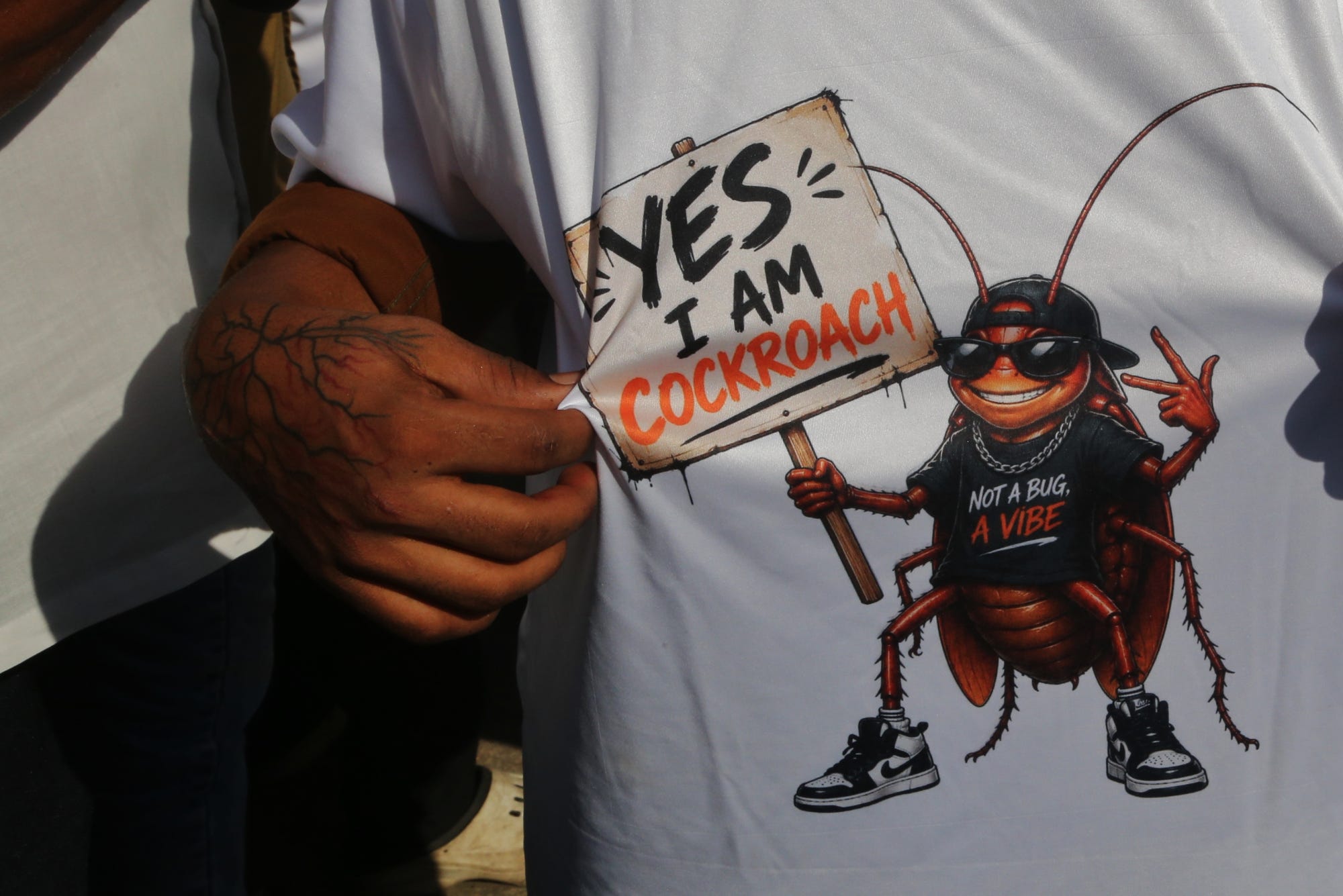
The protests were launched by a group that calls itself the Cockroach Janata Party (CJP)—a dark, satirical parody of the ruling party’s name that also mocks a judge’s insult—and have mobilized various shades of armchair activists, academics, liberal Bollywood actors and singers who had previously stayed on the sidelines, unsure or fearing reprisals. Now they have lost their hesitation or fear. But even more significantly, many middle-class Indians, long considered Modi cheerleaders, are now cheering on the protests.
As the demonstrations spread to Delhi from the other parts of the country, the Modi government deployed an estimated 20,000 police, paramilitary troops in military fatigues and plainclothes agents to thwart the CJP. On the pretext of riot-prevention, this mini-army erected iron barricades and openly warned people to stay away from the protests. About 50 subway stations in the capital were shut down to keep people from gathering. The Internet was jammed in central areas for hours. In short, the capital city was placed under a veritable lockdown.
There’s more.
CJP leaders returning to Delhi from Mumbai to lead the protests were accosted by authorities inside their aircraft before they could exit. Dhruv Rathee, a YouTuber with 33 million subscribers who had flown in from Germany to support the CJP, was literally “kidnapped” at 7 a.m. from his bedroom at his parents’ home and taken into detention so that he couldn’t get to the protest site.
Such heavy-handed state action backfired spectacularly. The leaders picked up in aircraft immediately shot a video of themselves taunting the police, cheerfully courting arrest in Gandhian style.
Far from dampening the zeal of the restless youth, the posts energized them. Young people swarmed New Delhi’s central business district and nearby areas with sling-bags, anti-government placards, and water bottles. They argued with police officers, shouting slogans, jumping barricades, and lying down on the streets. Hundreds of activists were whisked off in prison-like vans to unknown destinations and held without charges before the Supreme Court ordered their release. India’s constitution guarantees the right to peaceful protest, but authorities often invoke exceptional provisions for riot prevention and “public order” to ban public gatherings.

Mainstream TV channels, widely regarded as lapdogs of the regime because they depend on ads from the government, the ruling party, and state-owned companies, tried to keep a straight face as they covered the demonstrations. They avoided showing visuals of widespread protests and gave prominence to pro-government narratives even as protesters openly condemned the nation’s election chief and, by extension, Modi and his tough interior minister Amit Shah. But YouTubers, Instagram influencers, and boutique news outlets did not hold back. They captured it all, sending stark images and videos of police violence and arrests in real time, putting to shame any high-rating reality TV show.
For their trouble, they too faced a crackdown. Journalists were herded into police vans without notice or reason. Vigilante goons, claiming to support the government and the Election Commission, also roughed up journalists and beat up protesters unimpeded.
In a desperate, last-ditch effort to thwart the protests, the government stripped Jantar Mantar, an 18th-century astronomical observatory near the national parliament and in the heart of the city, of its three-decade-old status as a designated protest site. It has “designated” three other spots, but they are miles from parliament and the other government offices whose proximity gave the protests visibility. Undeterred, two CJP leaders deliberately courted arrest at Jantar Mantar a day later, marching in to drape the site with the Indian flag as a symbol of democracy. They were hauled away, prompting Abhijeet Dipke to launch new Tiranga—named after India’s tri-colored flag—protests today, leading to his arrest yet again.
The prime minister’s actions are being called an “Undeclared Emergency”—a reference to the dark 21-month period beginning in 1975 when the then prime minister Indira Gandhi suspended civil rights and jailed journalists and opposition leaders on the grounds that they were threatening national security.
One CJP leader called it “the State vs its Citizens.” And he has a point: the state is challenging the most basic democratic right of citizens—to vote and pick their own rulers.
Cockroaches Demanding Their Right to Vote
The immediate trigger of the protests was accusations that Kumar, the election commission chief, had illicitly delisted voters as part of a Special Intensive Revision (SIR) of the electoral rolls. The SIR was supposed to be routine housekeeping: weed out voters who have died or migrated and add new ones. But unlike the decennial census, which comes after elaborate preparations, this year’s SIR was an opaque, quick-fix operation.

It began in the three eastern states of Bihar, West Bengal, and Assam, landing like a political ambush. All three have sizeable Muslim populations and are located near India’s border with Bangladesh, a staple of the BJP’s anti-“infiltration” rhetoric. On the pretext of rooting out illegal migrants, the commission imposed short deadlines and complicated new forms that left poor voters confused. One form asked voters to identify parents or ancestors to link them to the last revision of the rolls in 2002. Any form that came in late or contained a “logical discrepancy” gave the commission discretionary power to delete or delay the voter. That included arbitrary judgments about age gaps and spelling mismatches! Political agents were allowed to strike off big groups of voters on the ground that they were no longer present. The voters were left to prove their eligibility through a bureaucratized judicial appeal process. Meanwhile, software, introduced quietly, put supervision of the voter lists in federal hands under the election commission, taking authority away from local officials.
The result: More than 10 million voters were deleted in just two states, and many who were eligible could not be reinstated in time to vote. The BJP and its allies went on to win both: Bengal, which had been an opposition bastion for decades, and Bihar, where the BJP had reduced its coalition ally to junior status. Opposition parties see an attempt to disenfranchise poor and Muslim voters considered likely to vote against the BJP. Rahul Gandhi, who leads the Congress Party in parliament, quickly accused the election office of “vote chori” (vote theft).
Then the SIR went national, and about 130 million voters across the country showed up on the suspect list. Even highly educated and celebrity citizens were left groping in the dark about how the process works. Sympathy finally started building for opposition parties campaigning against electoral irregularities.
The stakes are high because India runs a “first past the post” system, in which candidates often win multi-cornered contests by narrow margins. Some analysts, using traditional psephological swing models, argue that the deleted millions let the BJP win close races in some constituencies and pad its margins in others.

Even inside the commission, the process was deeply controversial, as an exposé by the Indian Express, a newspaper known for investigative journalism, revealed. Two of the three commissioners objected on the record at least 14 times, noting that the changes to the voter registration form were “irregular” and questioning the centralization of the voter database. But, it seems, they were steamrolled.
The Supreme Court is hearing several petitions against the SIR, with the modified forms as a key issue.
Gen Z Political Rock Stars
Ironically, Chief Justice Surya Kant, who is presiding over those hearings, is the one who sparked the Cockroach movement in the first place.
In May, Kant remarked during a hearing that certain unemployed youth and online critics were like “cockroaches and parasites” who attack institutions. He later said he was speaking of those who hold fake degrees.
Gandhi famously began his fight against colonial rule after a white railway official in South Africa ordered him out of a first-class carriage even though he held a ticket for it. Similarly, Kant’s remark outraged Abhijeet Dipke, a master’s student in communications at Boston University, who almost overnight assembled an online movement of millions of Gen Z youth to form the Cockroach Janata Party. The CJP now has more than 25 million followers on Instagram.
Significantly, Dipke belongs to the Dalit community of traditional farm-hands, cleaners and other menial workers, considered the lowest in a centuries-old Hindu caste-based social hierarchy. India’s other founding father, Bhim Rao Ambedkar, was also a Dalit leader who studied economics at Columbia. He was inspired by African American activism while in the United States. Ambedkar’s three-point call for Dalit empowerment (Educate, Agitate, Organize!) drew on the thinking of Booker T. Washington.

Ambedkar was the chairman of the committee that drafted India’s democratic republican Constitution adopted in 1950. If Gandhi is the “Father of the Nation,” Ambedkar is the “Father of the Constitution.”
The bearded Dipke arrived back home in India this year, symbolically waving a copy of Ambedkar’s autobiography at the airport.
Dipke’s fellow CJP leader is Ashutosh Ranka, a former McKinsey consultant, and the two have been joined by investigative legal journalist Saurav Das.
The CJP later found an ally in Neha Bora, a feisty PhD student at Jawaharlal Nehru University—India’s Berkeley—which is derided or celebrated, depending on one’s vantage point, as a hotbed of political activism. She is the president of the left-leaning All India Students Association.
These four youngsters, vociferously criticizing and mocking the Modi government, have become something of a political rock band for Gen Z. They also have the backing of Rathee, the 32-year-old YouTuber “abducted” from his parents’ home.
One reason the movement has struck such a chord is that the core CJP leadership of Dipke, Ranka, and Das describes itself as a pressure group that is simply demanding democratic rights and good governance, not as a political party. Hence, the trio can’t be accused of political ambition and can speak to the government’s failures and transgressions without coming across as partisan. Of course, the BJP is trying to depict them as stooges of opposition parties led by the Congress party, but those attacks are not landing.
The CJP’s positioning has already yielded success.
Weeks after being formed, the CJP staged a seven-week-long sit-in near Jantar Mantar. It demanded—and secured—the resignation of education minister Dharmendra Pradhan after tens of thousands of youngsters clashed with police over a leak of questions for a state-managed competitive examination for admissions to medical schools. Having tasted blood, it is now gunning for the exit of the election chief.
The Indestructible Cockroaches
The CJP leaders have injected a jolt of energy into flailing and failing opposition leaders—including Rahul Gandhi of the Congress Party—who are riding piggyback on the CJP. For 12 years now, they have been unable to unseat Modi and the BJP or put them on the defensive in any meaningful way, despite massive abuses of power and policy debacles such as the demonetization of high-value currency notes that failed to suck out black money as intended.

Rahul’s accusations of election stealing were going nowhere until fresh evidence of vote rigging prompted the CJP leaders to embrace the cause.
The CJP activists merrily call themselves cockroaches in everyday conversation, turning the charge that they are pests on its head. Their use of Gandhian methods would have sounded anachronistic and impossible merely a year ago. But coming in a Gen Z package, these tactics are resonating.
The happy warriors of the Cockroach movement are teaching India that safeguarding basic civil rights guaranteed under the Constitution requires eternal vigilance—a lesson that their elders have sadly forgotten.

© The UnPopulist, 2026
Follow us on Bluesky, Threads, YouTube, TikTok, Facebook, Instagram, and X.
We welcome your reactions and replies. Please adhere to our comments policy.
