


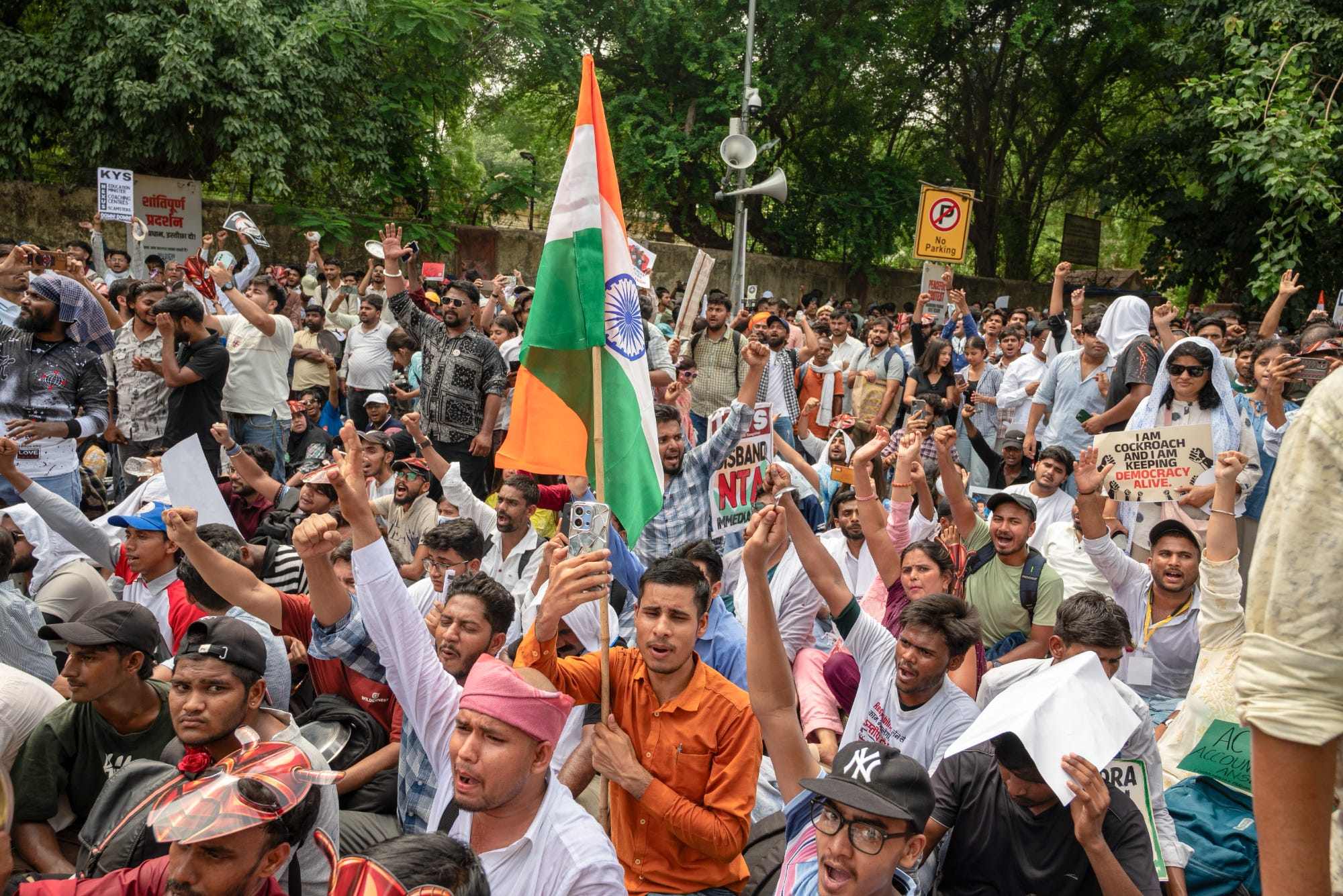
India’s beleaguered democracy is having a bit of a moment as the country’s strongman leader Narendra Modi has been forced to bend to a Gen Z movement, in a rare concession to popular mood. The student movement, which began with a sarcastic meme on social media, has clearly dented Modi’s aura and invigorated democratic forces, but it may not hinder India’s descent into illiberalism under him.
The so-called “cockroach movement” began with an online meme fest that snowballed into a full-fledged mass movement resonating across India. It was triggered by a throwaway comment by the chief justice equating jobless youth to “cockroaches” and “parasites.” An Indian student—at Boston University—responded with a satirical “Cockroach Janta Party” meme representing the “voice of the lazy and unemployed.” It blew up, accumulating 19 million Instagram followers in less than a week, more than Modi’s ruling Bharatiya Janata Party (BJP). The movement’s single-point demand was the resignation of the education minister over the leak of an entrance exam for admission to undergraduate medical and allied courses. Around 2.5 million students take this highly competitive exam that offers a ticket to financial security. The leak caused the exam to be canceled after the students took it, triggering several suicides and widespread outrage.
The government tried to brazen it out by slandering protesters as foreign-aided subversives and using strongarm methods. But it snowballed into a popular movement the likes of which India has not seen in recent years, as the space for dissent has considerably shrunk under Modi. The designated protest site in New Delhi, the capital of India, saw crowds swelling every day for weeks while social media flooded with posts by people from all walks of life supporting the students and venting their rage at the myriad instances of misgovernance—all of which India’s Modi-friendly establishment media tends to hide.
Hunger strikes by student activists and a well-known educator added to the movement’s momentum. Hundreds of thousands of people, mainly students, joined the protest spontaneously as it spread across the country. In a final crackdown, police brutality was unleashed with baton charge, tear gas, and pellet guns to prevent the students from reaching the Parliament with their demands. But the protesters reassembled the following day.
Eventually, the government was forced to concede defeat this weekend—and the minister resigned.
Simmering Discontent That Boiled Over
The immediate trigger for the student movement was a wave of leaked exam papers, the product of the government’s administrative incompetence. The poor state of public education in India has meant high household expenditure on private education. However, a stagnating economy and a rise in the number of educated youth means greater competition for jobs. But competitive examinations for both government jobs and professional degrees have been increasingly implicated in cheating scandals. There have been some 70 instances of exam-paper leaks in the past seven years, affecting some 17 million students.

Education is no longer seen as a safe investment—the financial burden endured to educate children no longer guarantees a ticket to upward mobility, as education has traditionally done in India. According to Pratap Bhanu Mehta, India’s leading public intellectual, elections and exams are the two things that have traditionally been considered India’s “fairest forms of procedural legitimation.” The collapse in trust in the exam system is “tantamount to collapse in trust in the system as a whole.”
High levels of unemployment have added to the trust deficit. Higher education no longer improves the scope of employment. In fact, it does the opposite. Nearly 70% of India’s unemployed youth are graduates, the percentage doubling in the last two decades. About five million graduates join the workforce every year, of which about half find jobs, and of them, only a minuscule find salaried jobs with basic employment benefits. The chief justice’s statement calling struggling youth cockroaches added insult to injury, especially since these youth—and others suffering chronic misgovernance—have few avenues to voice their anger in a totalizing polity with a controlled media.
India ranks a lowly 157 out of 180 countries in the 2026 World Press Freedom Index, behind the central Asian dictatorships of Tajikistan, Kazakhstan, Uzbekistan, and Kyrgyzstan. India’s captured mainstream media, especially its embarrassingly pliant news channels, have been at the receiving end of the students’ rage throughout the movement. Journalists have been booed and chased out by angry protesters at protest sites, while social media has seen a profusion of memes and posts ridiculing the media, along with calls for its boycott. Cockroaches have damaged not just Modi’s aura but what remains of the media’s credibility as well.
The anger at the media is an extension of the crisis of representation that Indians feel in the claustrophobia of the country’s post-truth polity. Signs of democracy failure are everywhere yet the television shows are about Modi’s greatness. His party meanwhile goes from strength to strength, untouched by its government’s failures. For the youth, this has created a resigned disconnect with politics, including the severely diminished opposition parties. The more election victories Modi stacks up despite the mounting hardships of lived experience, the more distrust he generates in the system.
Noticeably, the cockroach movement comes on the heels of a series of state elections in which the ruling BJP pulled off historic wins (not unlike Hungary’s anti-government O1G meme movement that gained pace after Viktor Orbán’s landslide 2018 victory secured him a third straight term). With its latest electoral triumph, the BJP now controls 22 of India’s 28 states. Its recent successes have come on the heels of a controversial voter identification drive—through a captured Election Commission—that has disenfranchised millions of people and reconfigured the electoral list in favor of Modi’s party.

The inevitability of Modi’s success in a thoroughly rigged election system has added to the disconnect and collapse of trust. Not only have the youth become disconnected from politics, but Indian politics itself has become disconnected from society. Pre-poll surveys have for years been showing that the main voter priorities are jobs and inflation, yet the issues that invariably end up defining election campaigns are those of Hindu domination, anti-Muslim scaremongering, Modi’s greatness, and contrived outrages. The BJP’s narrative control through the captured media, the party’s unlimited resources minted on the back of executive power, and the emotive appeal of its polarizing identity politics have allowed the party to crowd out the substantive issues of survival and sustenance.
Disconnect of this nature has resulted in the loss of trust in politicians and governments worldwide. In many democracies, like Nepal, it has manifested in violent Gen Z movements toppling the government. In other democracies, it is reflected in reduced voter turnout and plummeting party memberships. In others still, like in the U.K., it’s manifested in voter migration from mainstream parties to parties like the Greens and Reform in search of authentic representation.
The malaise at the heart of this is the hollowing out of mass parties, eroding their capacity for connecting citizens to political processes. As parties become ever more dependent on big money and their mobilizing units such as unions and associations wither, politics increasingly moves from volunteer-driven social activism to expert-managed campaigns driven by data analytics, PR strategies, and digital marketing.
Party Disconnect and the Crisis of Representation
Popular withdrawal from political life has intensified as elections have come to resemble corporate marketing campaigns by organizations competing for public office rather than ideological battles. Once embedded in society, politics feels increasingly distant and elite-captured as parties function less as social organizations and more as appendages of the state. As Peter Mair argues in Ruling the Void: The Hollowing of Western Democracy, political parties have become so disconnected from society that they no longer seem capable of sustaining democracy in its present form.

As parties decay, so does the quality of public representatives and political leaders who are no longer socialized through party constituents and collectives. The laughable incompetence of much of India’s ruling classes—cutting across parties—makes politics feel even more remote and unreal, and an object of derision for its restless youth. At the height of the cockroach movement, the country’s finance minister reached out to protesters with a video in which she said the exam-paper leaks had actually helped many students by giving them more time to prepare better and do well at the retest.
These pathologies have become universal, but are magnified in India by the advanced stage of its democratic decay and the uniquely undemocratic traits baked into the country’s party system. Highly centralized and lacking intra-party elections, Indian parties have long privileged loyalty to the leader over competence, breeding kakistocracy and engendering voter apathy.
The BJP might appear to have bucked the trend of voter disengagement by using emotive cultural appeals. But the use of hate to override all social cleavages and governance demands, while giving it a distinctive ideological advantage over other parties, also worsens voter apathy. The constant dog-whistling and incitements begin to grate when they are used to drown out more pressing bread-and-butter issues. The resultant anger boiled over into the cockroach movement.
The perpetual gramophoning of an alternative reality of progress and prosperity by a captured media feels like a cruel joke in the face of the grim realities of daily life. India’s economic growth is collapsing, the currency is in free fall, foreign investors are stampeding out, hunger is growing, more people are dying without medical care than before, public examinations are unraveling, and graduates are struggling to find jobs. But these seldom make primetime television, where government spin—and hate campaigns—rule.
If the loyal media misrepresents the state of affairs, the loyal opposition—out of power and money and organizationally depleted—is incapable of representing citizen angst. Unable to challenge the legitimacy of a captured system, they have made peace with the power asymmetry of a skewed playing field, foreclosing the prospect of any electoral correction. This lack of a viable political alternative has only added to the crisis of representation fueling the mass movement.

Not only is the opposition no longer capable of winning—at least of late, following the BJP’s recent spate of wins in state elections—but several opposition legislators have crossed over to join the governing party or broken away from their own parties to form blocs aligned with the BJP, deepening its hegemony over power. Many of the students interviewed at the protest sites said they were worried about the unchecked power of one party and person. “There is nobody left in Parliament to raise their voice against the PM,” said one. In his state, he told online magazine Scroll, all parties are becoming a part of the ruling BJP. “If there will be just one party, that will be a dictatorship.”
What Next?
The youth movement has created room for an alternative imagination of national politics that seemed depressingly monochromatic even a month ago. National and international headlines on the event like “India’s Cockroach Janta party protest victory signals trouble ahead for Modi,” “Cockroaches 1, Modi 0: India’s remarkable protests,” and “The unmaking of Brand Modi: How ’56-inch chested’ PM bowed to youth power” speak to this upbeat mood.
The optimism is not misplaced. India’s youth made clear that they were not buying the propaganda, hadn’t bought into the anti-Islam hate that the BJP has been peddling, and were not impressed by the strongman’s projections of greatness. “This generation was 3-13 yrs in 2014 [when Modi rose to national power]. Despite the prevailing culture of fascism of which communal bigotry is an intrinsic part, the young have refused to wear Brown Shirts. India has resilience and its idea is alive,” one retired lieutenant-general posted on X. In the words of a columnist moved by the protests, “Something in the pharaonic facade of this government has cracked.”
These are not minor sources of hope in a country that has gone from being the world’s largest democracy to being labeled an “electoral autocracy” and “one of the worst autocratizers” in a decade, with rising risks for its minorities driven by the toxic majoritarian politics of its governing party.
Yet, it may be too early to celebrate. Modi has been here before; he has bided his time, and emerged stronger and more virulent every time.
Similar headlines were written when he lost absolute majority in Parliament for the first time as the party’s tally dipped in the 2024 national election. Pundits then, like now, boldly predicted the strongman would have to ease his grip and moderate his Hindu supremacist policies. Things only got worse.

Five years ago, Modi bowed to farmers after year-long protests and took back the three laws his party had railroaded in Parliament, again raising similar hopes that died soon enough. Even before that, in 2015, political pressure forced him to go back on his plan to make land acquisition laws easier for businesses. Each time, he rode out the temporary setback and rebounded with even more force.
Attempts are already on to spin this movement as a conspiracy by internal enemies—Muslims and leftists are the usual suspects—with the help of external forces supposedly out to destabilize India. Muslim protesters are being systematically targeted. Police are also threatening to arrest communist student leaders. Police detentions and vigilante attacks on students participating in the movement are being reported from several states despite the government’s earlier promise that there would be no action against the protesters. Facial recognition techniques are being used for surveillance of the protesters. The BJP has begun a social media campaign trivializing the protest, and social media platforms have been asked to remove anti-Modi posts flagged by Delhi police.
The government’s pet anchors have even been floating the idea that this was all a conspiracy by U.S. intelligence agencies. Modi similarly spun the nationwide movement against a dubious citizenship verification drive—explicitly aimed at disenfranchising Muslims—as a jihadi conspiracy. A riot in Delhi in 2020 helped him drive a religious wedge into what was a non-sectarian civil rights movement then.
Overall, there is little sign that the government has accepted the movement as a learning point, much less shown any interest in taking steps to allay youth dissatisfaction. That would imply acceptance of government failures. Rather, the administrative and propaganda machine has been geared to tarnish the movement and restore Modi’s image.
Given the intensity of the outburst against Modi just witnessed on Indian streets, that might seem like a tall order at the moment, but unfortunately for Indian democracy, not entirely impossible when this moment passes. For, though this is a big moment for India, it is still that, a moment.

© The UnPopulist, 2026
Follow us on Bluesky, Threads, YouTube, TikTok, Facebook, Instagram, and X.
We welcome your reactions and replies. Please adhere to our comments policy.

This was an interesting read, especially the points about how younger generations are shaping public discussions and online conversations. I also find that having reliable information available can make it easier to research topics and verify details, such as https://columbiacountycourt.org when looking into local legal information. Clear and accessible resources can make research much more straightforward. Overall, a thought-provoking post with some useful observations.
This post offers an interesting perspective and raises some points worth considering about how people respond to changing social trends. I especially liked the discussion around generational attitudes and public reactions. For those interested in checking local property details, https://clevelandcountyassessors.org can also be a useful resource for finding relevant information. Overall, a thought-provoking read with several ideas that invite further discussion.