


We all know the famous opening lines. All men created equal. Unalienable rights. Consent of the governed. But these are just the first half of a sentence, albeit a run-on sentence. The conclusion of that sentence is just as important, and far less familiar.
When a government becomes destructive of those ends, the Declaration proclaims, the people may alter or abolish it, “to institute new Government, laying its foundation on such principles and organizing its powers in such form, as to them shall seem most likely to effect their Safety and Happiness.”
That clause is easy to miss, sitting where it does. Ahead of it are the lines we read aloud every Fourth of July. Behind it comes the indictment of George III: the subversion of fundamental rights, the standing armies kept among us in peacetime, the military set above the civil power, the judges made dependent on his will alone, et cetera. We have had grim reason to quote that list of late, under a president who seems to treat it like a to-do list, with uncanny precision sometimes.
The creed and the charges both get their due. The instruction between them does not, but it should. It is the most practical part of the document, declared to simultaneously be a “right” and a “duty.” The Declaration is not content to justify tearing a bad government down. It assigns a second and harder task: to build a better one, deliberately, on chosen principles and in a considered form. Overthrowing the old is the easy part, building something new is the real difficulty.

This is the part revolutions usually get wrong. France went from storming the Bastille to crowning Napoleon within a generation. Russia traded the czars for totalitarianism. England overthrew the Stuarts, then restored them, then overthrew them again. Hatred of a despot can unite a people, but deciding what to erect in his place divides them. And that decision, not the toppling, is what tells you whether the whole thing was worth it.
The Founders did not make that mistake, though they made plenty of others. Independence was declared in a single afternoon in 1776. Building a lasting government to replace British rule took 13 more years, half of them after the war had ended. The new system was not up and running until 1789, when a president was inaugurated and the First Congress met under the newly ratified Constitution.
The interval was no triumphal procession. It was a slog of state constitutions drafted and discarded, of riots and tumults, of the Articles of Confederation failing in slow motion. The Constitutional Convention’s draft was useless until it had been carried back into the states and argued through, ratified against serious and able opposition. The work was the arguing. It was a fight over what principles a government should rest on and how to arrange its powers.
Nor did they get it all right. They built a presidency several of them feared. In Philadelphia, Edmund Randolph called it the “foetus of monarchy,” and Charles Pinckney warned it would become a monarchy “of the worst kind, to wit an elective one.” They were overruled, in part because George Washington sat in the room and everyone assumed the office was being cut to his measure.

Their mechanism for selecting a president did not survive its second contact with a contested election. The Constitution was initially so lacking in protections for individual rights that, to secure its ratification, what became the first 10 amendments had to be promised. And of course, they also wrote protections for slavery into the same charter that opened with a paean to the “blessings of liberty.” The idea that women, too, were created equal did not even enter into the equation.
The Founders were not oracles. They were capable people solving hard problems under pressure, and they made immense leaps in our understanding of government and political philosophy. But some of their answers were wrong. Treating their work as revisable, as the perpetual task of a self-governing people to make and remake our institutions, honors their creation more than treating it as holy writ.
Their most dramatic failure took a civil war to correct. In the aftermath, the leading figures of Reconstruction would not simply restore the Union as it had been. They rebuilt it instead, with three amendments and a host of new laws that rewrote the relationship of citizen, state, and nation. Their work has been aptly termed a second founding, with its own principles and its own reorganized powers. It came because the first arrangement had produced a catastrophe, and simply returning to the status quo ante was insufficient.
Now the same task falls to us.
The deeper trouble we face is not the aging man in the White House. Demagogues and populists, would-be tyrants and their amoral enablers, will always exist. The Framers knew this, and tried their best to channel competing interests into a system of checks and balances. But nothing is perfect, and the guardrails eventually failed. The old order has shown it can be captured by a president who treats his oath as a rote formality, not a solemn promise. The systems carefully designed to prevent any concentration of lawless, arbitrary power started creaking from the weaknesses and imperfections in their foundations.

When the danger passes, as one-man cults of personality eventually do, the reflex will be to exhale and put the old machinery back. That would be a mistake. Removing the man does not repair what produced him. To rebuild the system unchanged is to choose the arrangement that had major vulnerabilities.
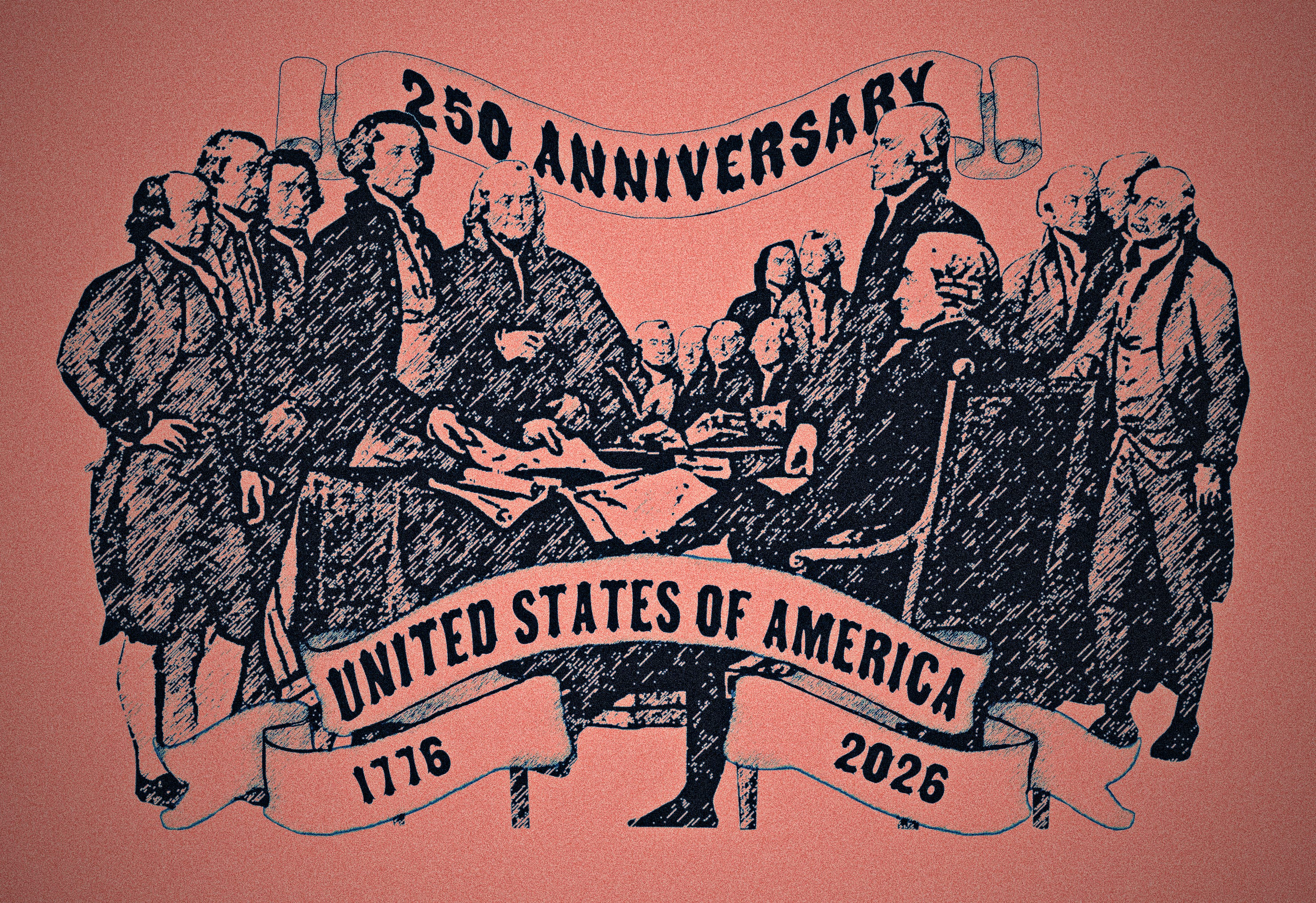
On this quarter-millennium anniversary, the Declaration presents us with the same questions its authors grappled with in the years that followed 1776. What principles? That public power is held in trust, not as personal property. That no office sits above the law. That legitimacy flows from the broad consent of the governed, not from a faction clever enough to game the system. That government must be truly representative of the people, in all their diversity of beliefs and interests.
Why did the old order fail? Here we have to be honest about what broke. The presidency, swollen past the point any oath can restrain. The limitations that turned out to be mere customs, easily discarded. An electoral system which pitted us into “the alternate domination of one faction over another,” as Washington put it in his farewell warning.
And what better arrangement? Here is the difficult task of both finding the right answers and building consensus. An executive that can be checked in fact—and not only on paper. Real accountability to the rule of law. The three branches of government put into their proper places, where nobody holds unchecked power. Elections that convey the will of the people in all its nuances and contradictions, neither empowering nor suppressing any particular factions with unrepresentative results. A system that encourages the give and take of coalitions and compromise, rather than perpetually entrenching a broken and unpopular two-party binary. Finding the forms most likely, in the Declaration’s words, to secure the ends the whole thing exists for: our future safety and happiness.

There will be, as there should be, much debate over the details. This is healthy and necessary. There will be no philosopher king decreeing the new system from on high. It’s up to us, and all the messy, frustrating democratic process that entails. But the essential goal is one we have in common, and the worst thing we could do is walk away from the task, surrendering to a nihilistic sense of futility.
None of this will be easy to get right, and working out the answers is itself part of the job, not a box to check beforehand. But the ideas are not lacking. Reformers across the spectrum have spent years proposing and contesting fixes like these. We are working to document and hash them out here, our own modest contribution to the Reconstruction Agenda, as are many others. The problem was never a shortage of proposals. It is the slow, contentious work of arguing them out and agreeing on enough to act.
That is where the real danger lies. Not in another strongman immediately seizing the wreckage, but in the opposite. A victorious coalition splinters the moment the pressure is off, turns to infighting and the settling of scores, and lets the chance slip by. That is exactly how the old machinery slides back into place: not because anyone chooses it, but because reversion is the path of least resistance when no one can agree on anything better. Structural reform is hardest to agree on once the emergency has passed, when everyone is exhausted and eager to get back to normalcy. That fractious aftermath is where high-minded ideals about building a new order for the ages usually go to die.
The Founders did their building in the thick of exactly that kind of squabbling, and so did the Reconstruction Congress. Both forged enough consensus, through all the rancor, to build something better than what fell. We will get the same narrow opening before long, and likely only briefly. The goal has been on the page for 250 years, in the oft-forgotten half-sentence we rarely finish. On this, the most auspicious and bittersweet of anniversaries, we would do well to remember the full measure of our national mission statement.

© The UnPopulist, 2026
Follow us on Bluesky, Threads, YouTube, TikTok, Facebook, Instagram, and X.
We welcome your reactions and replies. Please adhere to our comments policy.
Its second founding would be the 1830s. The results of the Civil War did lead to some centralizations, but not anywhere as much as we're taught they and did and more importantly the basic institutional designs and systemic-paradigm of the group of groups knowns as the jacksonians persisted in the NE, Mid West, and West persisted until after WW2 and didnt go away over night (in fact, we retain much of it, its just largely nullified)
When you write "That government must be truly representative of the people, in all their diversity of beliefs and interests."
Yes. this is true. And it requires, among other things, substantial legal/regulatory variability and policy variability, even down to the local level. We used to have it and theres no reason we cant today. China has actually had since the early 1980s (Xi and Co have been trying hard to undo this and centralize things, we’ll see if they succeed, pushback seems to be forming)
As late as the 1930s both the Democratic and Republican Parties were still decentralized, publicly accessible and internally contestable mass member party and the country it operated in was still a widely and deeply federated system with legal/regulatory variability, policy variability, local governments were still the biggest fiscal actors, the economy was still one structurally biased towards being one dominated by geographically dispersed and redundant diversified mid sized firms, banking/finance was still structurally locally anchored and relative to today quite pluralized, education was decentralized, etc.
This didnt end over night, there was a multidecadal transformation phase following WW2. And now we've reached, and have for decades at this point, a place where are relatively deeply centralized, standardized, and our governmental-corporate-financial institutional spaces are quite decision making exclusionary
Great article. Only quibble is this line: "That government must be truly representative of the people, in all their diversity of beliefs and interests."
This sentiment may be fine at local/state levels of governance, but a federal government that has the purpose of serving the greater good of the country (needs of the people) cannot also serve the will of the people (wants of the people).
We are too large and diverse of a country to have full representation of everybody's interest vested in a single, centralized authority. A government of this nature that tries to serve everybody's interests will end up serving nobody and be in constant conflict.