


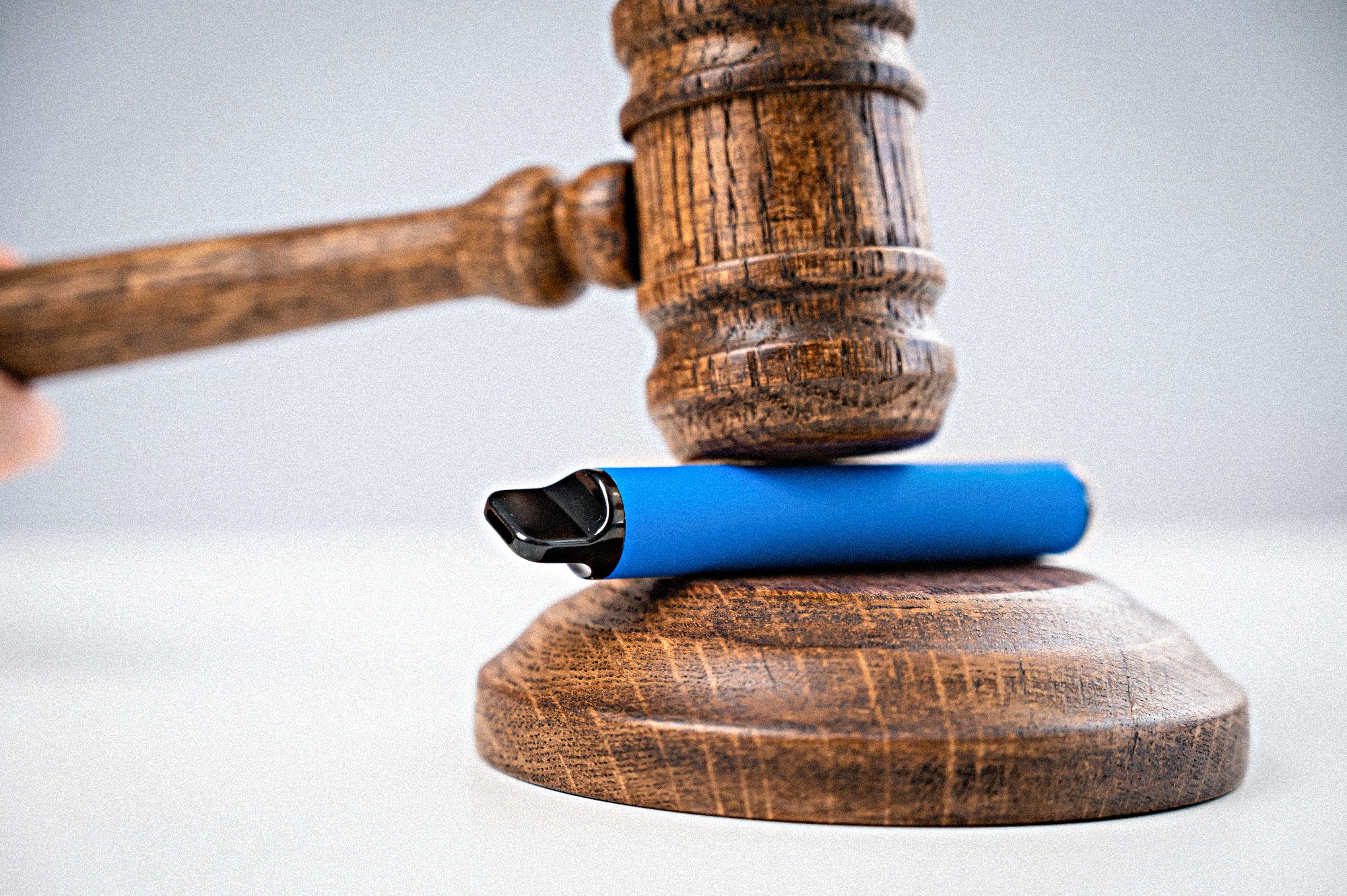
For the first time earlier this month, the Food and Drug Administration authorized sales of e-cigarettes in flavors other than tobacco and menthol. Marty Makary, President Trump’s FDA commissioner, opposed the move and tendered his resignation. Health and Human Services spokesperson Rich Danker followed Makary out the door. Pressure to authorize the products reportedly came directly from the White House—with both President Trump and the HHS Secretary Robert F. Kennedy Jr. expressing support for vaping.
For advocates of tobacco harm reduction, this controversial policy is actually a baby step in the right direction. But because the administration went about it in a high-handed way and for corrupt reasons, it may end up doing serious reputational damage to the worthy goal of liberalizing vaping laws.
Democratic politicians haven’t covered themselves in glory either. They leapt at the opportunity to disparage the decision. “Tanning beds and fruit-flavored vapes somehow fit into this regime’s ‘Make America Healthy Again’ agenda, but vaccines, Tylenol, and anti-depressants are the problem?” Sen. Mazie Hirono of Hawaii offered on Bluesky. “The ‘MAHA’ party just ensured a new generation of kids gets addicted to nicotine,” added Senate Minority Leader Chuck Schumer. The press office account for California Gov. Gavin Newsom was even more colorful: “Nothing says ‘Make America Healthy Again’ like marketing cotton-candy flavored nicotine to middle schoolers. When he’s not busy cutting off penises from dead animals, RFK Jr. is busy being a total MAHA fraud!”
A lot of this is just partisan point-scoring, but as discourse about a matter vital to public health, it leaves much to be desired. Youth vaping is, in fact, way down from its peak in 2019. Meanwhile, more than 400,000 Americans still die prematurely every year due to smoking conventional cigarettes—roughly 1,200 people a day. That’s more than the total deaths from every homicide, car accident, and drug overdose combined. Legalizing safer nicotine products that can displace consumption of cigarettes, whether by helping smokers quit or by preventing them from ever taking up the habit in the first place, is an idea that at least merits serious consideration.

You wouldn’t know it from listening to Democratic politicians, but unlike other items on the MAHA agenda, tobacco harm reduction has a robust academic case behind it. For example, one study modeling 360 different scenarios concluded that vaping led to positive outcomes in 99% of them, ranging from 143,000 to 65 million life-years saved in the United States through the end of the century.
In 2021, 15 past presidents of the Society for Research on Nicotine and Tobacco urged greater support for tobacco harm reduction, noting that “the singular focus of U.S. policies on decreasing youth vaping may well have reduced vaping’s potential contribution to reducing adult smoking.” Forbidding the sale of flavored vapes is an example of such policies. Other research examining the effects of local bans concludes that they have a mixed impact. They do appear to reduce vaping, but at the price of increasing use of far more dangerous cigarettes, potentially offsetting intended gains in health.
None of this is to say that experts are united behind tobacco harm reduction. The field of tobacco control is bitterly divided, with plenty of academics arguing for a more prohibitionist approach. But this is a genuine debate that, unlike politicians scoring points on Bluesky, takes real-world trade-offs seriously.
With that in mind, it’s worth noting that, for now, the FDA’s changes are quite modest. After the authorization of blueberry and mango flavors from e-cigarette maker Glas, the number of e-cigarette models legally sold in the United States reaches a grand total of 45. The Glas products implement a new age-gating technology that requires users to verify their age with government ID and pair the devices with a smartphone to make the e-cigarettes operable. One can imagine minors finding ways around these safeguards, but it’s more likely they would simply use any of the thousands of other unregulated vapes that the FDA has proven ineffectual at keeping off the market.

Of potentially greater significance is a new policy formalizing discretionary enforcement to allow many flavored e-cigarettes to remain on the market while the FDA reviews their applications. While this is a notable change in policy, in practice it’s an admission that the illicit market for flavored vapes is thriving while the agency drags its feet on processing millions of applications. Nearly all of the flavored e-cigarettes sold in the United States are technically illegal, but you would have no problem finding them. As with many other drugs, enforcing prohibition of nicotine products is easier said than done.
Legalizing two flavored e-cigarettes is thus an important symbolic change, but vaping advocates may come to regret the way it came about. In public perception, this aspect of tobacco harm reduction is now indelibly tied to the second Trump administration’s slapdash, conspiratorial, and corrupt approach to public health.
Reporting from The New York Times reveals that the tobacco company Reynolds American made a $5 million contribution to Trump’s super PAC Maga, Inc., at the end of April. Trump himself had lunch with nicotine industry lobbyists and executives at one of his Florida golf clubs, during which he reportedly called Kennedy to complain about the FDA’s regulation of e-cigarettes. Less than a week later, the agency announced its decision to keep flavored vapes on the market, blindsiding officials at the agency and prompting Makary’s resignation in protest. Whatever the merits of the FDA’s new approach, this is certainly no way to make credible health policy.
It’s a drastic step down even from the first Trump administration when the FDA was led by Dr. Scott Gottlieb, a respected technocrat described by Vox as “the one Trump official everybody seems to like.” Gottlieb also delayed enforcement of regulations against e-cigarettes and expressed support for their role in tobacco harm reduction, but he did so as part of a larger plan to discourage smoking and provide an off-ramp to safer products. While not everyone was won over by the plan, it was coherent, explicable, and reasonably evidence-based.

The current administration offers none of those strengths: no coherent framework, no career staff buy-in, and no credible public rationale beyond donor access and the preferences of a president who views vaping primarily as a voting issue. Kennedy, for his part, is most notorious for his opposition to vaccines, but also for his suggestions that: Tylenol causes autism; HIV doesn’t cause AIDS; COVID may have been engineered to target specific ethnic groups, among other fringe positions. Early in his tenure he made a televised appearance at a Steak ’n Shake to tout the benefits of French fries cooked in beef tallow. Advocates who have been working for years to make a credible case for tobacco harm reduction should not be thrilled that Kennedy has now become a vocal defender of e-cigarettes.
Kennedy’s public defenses of vaping offer, unsurprisingly, a mixed bag of plausibility. He has correctly noted that vaping is substantially preferable to smoking. Less coherently, he has testified that the FDA is “doing everything we can now to approve American vapes” so that they can crack down more aggressively on e-cigarettes from China. He has also cited research suggesting that nicotine may have health benefits like preventing dementia, at best an extremely speculative rationale for encouraging their use.
Trump himself shows few signs of understanding the case for tobacco harm reduction, viewing it as a transaction to win votes from vapers. Pressuring the FDA from the top down to authorize flavored e-cigarettes and foisting unexpected policy changes on the agency, spurring the resignation of officials in protest, is sure to undermine the public’s trust in the decision. Likewise, Trump’s boundless capacity for corruption inevitably prompted suspicion right off the bat that his palms were greased, speculation since confirmed by the Times’s reporting.
As someone who has long advocated for tobacco harm reduction, I view even this month’s supposedly good news with a tragic cast. The legitimate case for safer nicotine products is being undermined by what Matthew Yglesias termed the “crank realignment” in American politics, in which Democrats have become more aligned with educated professionals while the GOP became “much more accepting of cranks and know-nothings.” (Trump and Kennedy are notably both former Democrats who attained political power by becoming Republicans.)
What ultimately makes this an epistemic disaster for everyone is the fact that, as Yglesias points out, even when Republicans “hit on something that works, they don’t dare talk about it or build compelling narratives around it.”

Liberalizing the FDA’s approach to flavored e-cigarettes is a perfect example. It’s a good idea that could be capably defended by credible experts, but such people have been exiled from the administration in favor of wildly unreliable charlatans like RFK.
The millions of Americans who die from smoking cigarettes deserve better advocates than the Democrats who unthinkingly denigrate safer alternatives. They also deserve much better than the likes of Trump, whose tendency to poison everything he touches extends even to the rare issue he gets half right.
On a recent evening in Portland, a progressive chatting with me casually equated legalizing flavored e-cigarettes with opposition to vaccines. She was wrong on the merits, but I understood where she was coming from. Making a public case for vaping requires that the people in power be viewed as trustworthy, smart, and guided by real evidence. Instead, we got Trump and RFK.

© The UnPopulist, 2026
Follow us on Bluesky, Threads, YouTube, TikTok, Facebook, Instagram, and X.
We welcome your reactions and replies. Please adhere to our comments policy.

Actually, I think Democrats shouldn't waste time on the issue. Democrats should walk away from the "War on Vice" and all of the various manifestations of Nanny State power for which they have become famous. It is one of the most politically unpopular things that makes the Democratic brand toxic to many Americans. Making the deregulation of things that ought not to be regulated in the first place, regardless of the motives for the deregulation, is opposed to liberty and reason. People simply do not need or want the state to save them from themselves. It also inhibits the market from the discipline of financial consequences that might actually curb the unwanted behavior.
They say John Boehner used to pass out checks from Big Tobacco on the floor of the House to those voting against tobacco regulation. Is that any less corrupt than what the Trump administration is doing?
Jacob, I understand your point, I also dislike Trump and MAGA, but disagree with your forecasts. I would have hoped that Trump would have conducted an even more aggressive campaign against the Democrat dominated prohibitionist alignment. Instead, Trump proceeded clumsily on the whole issue that lead to Makary's resignation, as a disoriented bull in a China shop. This is Trump's ways and demeanor in everything. However, the Democrats prohibitionist alignment at some point will have to take a hard political blow. They are causing much harm, even if their ways are different from Tump's caveman attitudes. OK, Trump met industry lobbyists, fine, just like Democrat politicians and the NYT meet lobbyists and PR people from Bloomberg's corporation and Pharma. Everybody is in bed with someone. Trump just did the political maneuvering all politicians do. US public sees tobacco industry as top evil that perpetually stains anybody touching it, while it perceives the tobacco control technocracy and Bloomberg NGOs as "good guys". This is carrying to 2026 a perception that was valid in 30-40 years ago and is now obsolete. Tobacco industry is as corrupt and manipulative as many other industries and as government bureaucracies (not to mention Bloomberg Corp), This obsolete perception must be challenged and smashed, too bad Trump is not smart enough to do it. . Meanwhile, millions smoke and face preventable premature disease and death