


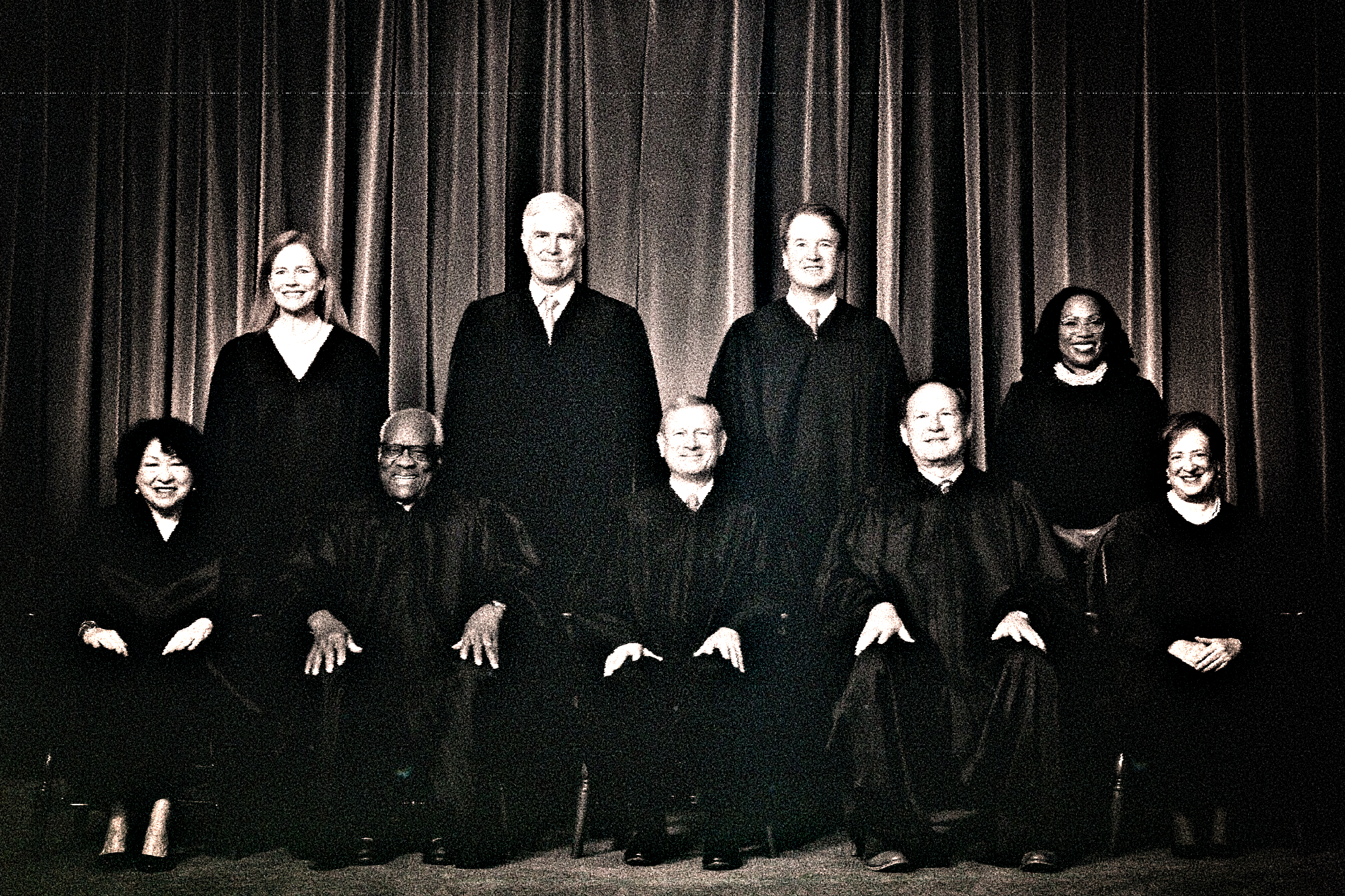
Dear Readers:
We have been running a broad discussion about Supreme Court reforms as part of our Reconstruction Agenda.
Our senior editor Andy Craig made a reluctant case for court expansion as an immediate necessity—but tied it to pursuing a later constitutional amendment that would fix the court at nine justices with staggered 18-year terms. We promised critical responses to Andy’s proposal, and, true to our word, we published the first one by Ilya Somin of the libertarian Cato Institute. His objection was that Andy’s criticisms of the Roberts Court were overstated, given that the court has shown itself perfectly capable of standing up to this president’s power grabs. Therefore, court packing is a remedy worse than the disease.
Our more progressive friends Justin Florence and Erica Newland of Protect Democracy disagree with Somin’s assessment of the Roberts Court. They consider it genuinely anti-democratic. Justin moderated a panel at our recent LibCon, but he and Erica contend that court reforms shouldn’t narrowly focus on expansion. They offer a long menu of options for Congress to step in and check what they consider to be this court’s power-aggrandizing moves.
Facilitating good-faith discussion within the anti-authoritarian coalition, including with people whose premises we do not always share, is what The UnPopulist strives to do.
Andy, in due course, will respond with his own thoughts. So stay tuned for a fascinating and thorough airing of this important question that is no doubt going to dominate our political conversation in years to come.
Shikha Dalmia
Editor-in-Chief

At LibCon2026’s “Checking the Imperial Presidency” panel two weeks ago, the panelists reacted vociferously to a question about expanding the Supreme Court. Supporters of court expansion see it as a suitable response to the court’s anti-democratic rulings; the panelists unanimously insisted that expansion would put the nail in our democracy’s coffin by triggering a tit-for-tat downward spiral. (The UnPopulist’s Andy Craig has offered a proposal for a court expansion that would repudiate the current court’s majority while offering an off-ramp of a constitutional amendment.)
And just like that, what could have been a serious conversation about the Supreme Court’s role in democratic backsliding and how to respond got buried in an internecine dispute.
That’s not to blame the panelists: If anyone’s to blame, it’s the moderator. Which is to say, we should look in the mirror. One of us (Justin) moderated that panel; the other (Erica) helped prep for it. And in hindsight, here’s what we wish we could have injected into the conversation:
This panel’s name—Checking the Imperial Presidency—elides an important partner in Trump’s project to transform our democracy into a more authoritarian form of government: the Supreme Court, which under John Roberts has acted as Trump’s consigliere. Through parallel abuses of power, Trump and the court have launched a two-branch doom loop, with mutually reinforcing moves to enhance their own power, render themselves unaccountable, entrench an imperial presidency and uncheckable court, and sideline the people’s representatives in Congress.
We cannot rebuild our democracy and the rule-of-law—including constraining the imperial presidency—without solving the problem of the Roberts Court.
But how to do that?
As at the panel, the conversation often jumps straight to court expansion, whose perils and promises have been extensively debated. So too with term limits, which is a somewhat less controversial idea.
But those reforms need not be the only options on the table.
There are a range of reforms that Congress can enact to take back power from the Supreme Court (and the presidency). And indeed, the problem of the Supreme Court in our democracy extends beyond which justices control the court. The system of checks and balances does not exempt the Supreme Court, and Congress has the tools to check the court just as the court has tools to check Congress.
But first, let’s examine the stakes: why it’s not enough to talk about the imperial presidency anymore. We need to talk about the two-branch doom loop and the mutually reinforcing, self-aggrandizing moves from Trump and the court.
The Trump Presidency and the Roberts Court: A Vicious Cycle for Democratic Backsliding
Trump’s arsenal of power-grabbing moves is well-known, the Supreme Court’s less so. Often those who claim that the court’s record is not facilitating democratic backsliding point to its pushback on particularly egregious—and obvious—Trump excesses such as abusing emergency powers to impose tariffs. But it is worth taking a more comprehensive look at its record, including at some of its lesser-known rulings, to get a fuller picture. The court does not have to be the president’s “puppet” for their commitments to align and facilitate a destructive cycle.
1. Like Trump, the court has operated in secrecy and stonewalled oversight, treating transparency to Congress and the American people as a threat to be neutralized. The court has shielded itself from transparency, through refusing to explain the basic reasoning of its momentous rulings on the emergency shadow docket. It has stonewalled congressional oversight on matters ranging from cybersecurity practices to corruption among the justices. And it has reinforced the secrecy of the Trump administration, making it harder for Congress to investigate Trump and protecting him from the oversight associated with criminal prosecution.
2. Like Trump, the court has declared that laws preventing corruption don’t apply to it. Supreme Court justices have flouted the ethical constraints that bind every other federal judge, accepting millions in undisclosed gifts and travel from parties with interests before the court, refusing to recuse in the face of clear conflicts of interest, and resisting for years the adoption of any binding ethics code. In so doing, they appear to have violated federal laws—all while suggesting that Congress cannot regulate to prevent their corruption. And the court’s decisions gutting corruption laws, creating presidential immunity, and curtailing congressional oversight of the White House have enabled the Trump administration’s corruption.
3. Like Trump, the court has exploited emergency authorities to expand its power. The Roberts Court has weaponized its emergency or “shadow docket,” granting last-minute stays that effectively decide major policy questions about how our government works and the scope of people’s rights without full briefing, argument, or reasoned opinion. This has made it difficult for lower courts to even know what rule they are supposed to follow when a case is sent back down, to the open frustration of judges. The Roberts Court’s decision not to pause the Trump “emergency” tariffs demonstrates its use of its emergency authorities to reinforce the president’s emergency authorities, even when it ultimately holds the presidential acts unconstitutional.
4. Like Trump, the Supreme Court has consolidated complete power over its own branch. The Roberts Court has reserved to itself the power to issue universal injunctions, while—at the behest of the Trump administration—moving aggressively to curtail the power of federal district courts to do so. That, combined with its enthusiasm for the shadow docket, further consolidates power in this single court, rather than the federal judiciary as a whole. And the court has blessed the Trump administration’s strong unitary executive view that the president is the executive branch (l’état c’est moi) in order to claim control over the DOJ, gut independent agencies, fire inspectors general, and purge the civil service.
5. Like Trump, the court has manufactured false “facts” to enable it to achieve its desired outcomes. The court has consistently made up “facts” of its own. Even those less perturbed by the outcome of some rulings should be troubled by the court’s methods, which violate the principle that the court is supposed to be deciding legal questions, not doing its own fact-finding. In Dobbs, it “misrepresent[ed]” history. In Shelby County, it overrode the findings of more than 20 congressional hearings and 15,000 pages of documents with its own vibes-based assessment of racial discrimination in covered jurisdictions. And in Kennedy v. Bremerton School District (the football team prayer case), the court hallucinated its own record. The Roberts Court, at the same time, has often ratified the Trump administration’s objectively false claims.
6. Like Trump, the court has manipulated the rules of democratic participation to entrench partisan power and avoid democratic accountability. The Roberts Court has consistently acted to entrench the power of the Republican Party. It has, for example, gamed the “Purcell principle” for maximum partisan advantage (this is the general rule that federal courts should refrain from altering election rules on the eve of an election to avoid confusing voters and burdening administrators); gutted the Voting Rights Act to the advantage of its partisan allies; and protected the Republican presidential candidate from laws enacted by Congress. In the presidential immunity case, the court deployed the rhetoric of presidential maximalism while denying the sitting Democratic administration the very authorities, conclusive and preclusive power to make prosecutorial decisions, that it insisted President Trump had every right to claim.
7. Like Trump, the court has dispensed with (ignored) laws it dislikes, rather than faithfully executing or applying them. Under the cover of “constitutional avoidance,” the Roberts Court has repeatedly rewritten statutes to achieve its preferred policy outcomes. Its approach to statutory interpretation appears inconsistent and hypocritical. The court’s amorphous “we know it when we see it” standard resembles its own policymaking more than a court announcing legal rules. For example, the court held that a decision by the Department of Education to cancel student loans presented a “major question” that only Congress could weigh in on but that dismantling the entire department did not.
8. Like Trump, the court has arrogated to itself the power to set the national policy agenda. The Roberts Court has used its agenda-setting power to facilitate many of Trump’s executive power grabs and separately to upset congressional compromises on health care, consumer protection, agency structure, voting rights, civil service protection, and campaign finance.
9. Like Trump, the court has sought to have the last word, so no democratic response can dislodge them. The court has structured its most consequential decisions to foreclose response: striking down campaign finance laws, statutes structuring government agencies, and voting rights protections on grounds that make legislative correction practically impossible. For example, its decision striking down part of the Voting Rights Act in Shelby County was followed immediately by a wave of restrictive state voting laws, entrenching political power before Congress could respond. Cases that are nominally about statutory interpretation and thus deference to Congress often operate in the political reality that congressional response is unlikely and can take many years if it comes at all.
The Trump administration and the Supreme Court have thus each used the other to ratify, reinforce, and accelerate its assaults on our republican form of government and Congress’s authority.
In one variation of this cycle, Trump has been the first mover, embracing a radical approach to his own power; the court has then validated, extended, and constitutionalized these moves, and Trump has taken the new runway and pushed even further. For example, in Trump v. United States, Trump made an unprecedented claim to absolute immunity from federal criminal prosecution for many official actions; the court granted the immunity and called it constitutional law, in part basing this immunity on presidential control over the DOJ and thus the president’s need to be free from any interference in his commands to subordinates. Then, the second Trump administration took advantage of the court’s blessing to fully weaponize the DOJ and engage in extreme abuses of power.
Other times, the court moves first, imposing its own partisan-entrenching policy preferences. Trump then pushes to further Republicans’ partisan advantage, and the court ratifies the move. The attack on voting protections has followed this model: Shelby County and Rucho closed off protections for voting rights and against gerrymandering. Trump then pushed for mid-cycle extreme gerrymandering and for gutting the rest of the VRA, and the court granted this wish and wrote it into law.
Taken together, these power-aggrandizing moves from Trump and the Roberts Court create a doom loop that is on the precipice of enshrining authoritarianism into our Constitution.
Congress Can Check the Court Just Like It Can Check the Presidency
The conventional wisdom about Supreme Court reform is stuck in a rut. Most reform advocates focus either on ethics or on changing the court’s composition through term limits or expansion. But the problem is not just who sits on the court, or whose money they take in their extracurricular activities. It is how much power the court exercises, with how little accountability, over how wide a range of questions. Without structural constraints on what any court can do, any reform will just be a band-aid.
What follows is a different approach: a menu of possible reforms aimed at disempowering the Supreme Court as an institution—constraining how it acts, requiring it to show its work, forcing it to share power with the rest of the federal judiciary, and giving Congress meaningful tools to respond. None of these reforms is exotic or unprecedented. (Professors Daphna Renan and Niko Bowie’s forthcoming book gives numerous examples of when Congress has turned to these types of solutions in American history.) Most have analogues in the tools Congress should use to check the executive branch. Readers may find some more compelling than others. They do not all need to be adopted. But some combination of them would restore the court to its proper role as one participant in constitutional governance rather than its unelected sovereign. Enacting these reforms without more will not be the end of the process. The Supreme Court will surely try to fight back by ignoring or invalidating them, at least to some extent. And Congress will need to use the full scope of its authorities in response.
But they’re a necessary starting point to escape the two-branch doom loop.
Reform the shadow docket. The Roberts Court has remade vast areas of American law—abortion access, immigration enforcement, environmental regulation, election rules—not through the deliberate process of full briefing, argument, and reasoned opinion, but through unsigned emergency orders issued in the middle of the night with no explanation and no accountability. These orders are analogous to executive rulemaking, but unlike agency rules they require no notice, no comment, no reasoning, and no disclosure of who voted for what. Congress should require written opinions for any stay of lower court proceedings, signed by at least five justices; impose mandatory waiting periods before emergency orders take effect other than in true emergency situations (such as an immediately pending execution of capital punishment); and mandate public disclosure of how each justice voted. This is not a radical constraint on judicial power—it is the same transparency and procedural discipline Congress has long required of executive agencies under the Administrative Procedure Act. If agencies must explain their emergency actions, so must the court. Alexander Hamilton’s famous observation that the judiciary is the “least dangerous” branch was premised on a court’s need to explain its reasoning, which goes out the window when the court simply refuses to do so.
Require evidence-based adversarial fact-finding. One of the Roberts Court’s most insidious practices is making up facts. In case after case, these are not legal conclusions—they are factual claims about the world, and they are being made by the institution with the least procedural accountability of any factfinder in the legal system. The court does this even though, outside of rare original jurisdiction cases, the court’s appellate function is supposed to be deciding questions of law. Developing the factual record is supposed to happen at the trial court level, and the Supreme Court’s contortions to get around this are increasingly strained. Congress should require that any factual proposition—case specific, social-scientific, economic, or historical— that is material to striking down a statute be developed through adversarial proceedings at the district court level, with expert witnesses subject to scrutiny and cross-examination, and reviewed by the Supreme Court only for the traditional standard of a facially obvious “clear error.” The same Congress that requires agencies to base major rules on substantial evidence developed through open adversarial processes can require the same of the court.
Require the court to show its legal work. When a federal agency acts, it must identify its legal authority, explain why it chose the action it took, and address contrary evidence in the record—or a court will reverse it. This is the Chenery principle, one of administrative law’s foundational constraints on executive power, and the Roberts Court has applied it enthusiastically when it suits its desired outcomes. It does not apply this to itself. The court routinely invalidates or rewrites statutes without explaining why no narrower reading was available, which constitutional provision it is applying, or how its interpretation squares with the historical evidence it claims to rely on. Congress should require, as a condition of invalidating federal legislation, that the court’s opinion do each of these things. This reform does not tell the court how to rule—it tells the court to explain its rulings with the same rigor it demands of every other government actor.
Hold justices to the professional employment standards that govern modern workplaces. In addition to deciding cases, Supreme Court justices are bosses. But unlike most other attorneys and government officials, they supervise employees free of the constraints of employment laws, and they run hiring processes that are notorious for identifying politically aligned and politically engaged law clerks who serve for one year and then are dependent on “their” justice as they embark on their careers. Whatever arguments support ideologically aligned hiring for some jobs in Congress and the executive branch wilt at the courthouse doors. If justices are to be something other than politicians in robes, the workplaces they run need to reflect that. Options for regularizing the workplace include making Supreme Court clerks the equivalent of short-term Schedule A executive branch employees (the line-level attorneys at the Solicitor General’s Office, Civil Appellate, and the Office of Legal Counsel are typically Schedule A), with associated rights against workplace discrimination; creating a pool of clerks that rotate through the different justices’ chambers (analogous in some ways to the Supreme Court’s cert pool); or reducing the number of clerks that each justice can hire while bulking up the staff attorney pool at the court. Congress could also potentially require the hiring clerks to be conducted more at the court-wide level, under a standardized process, and less by individual justices.
End the corruption and make ethics rules enforceable. Supreme Court justices have accepted millions in undisclosed gifts and travel from parties with interests before the court, refused to recuse in the face of clear conflicts of interest, and for years resisted any binding ethics code—all while justices have suggested that Congress cannot regulate to prevent their corruption. Every other federal judge is subject to the Code of Conduct for United States Judges and enforceable recusal standards. The Supreme Court’s exemption from those norms is not required by the Constitution or by any serious theory of judicial independence. It is an anomaly the justices created for themselves. Congress should establish mandatory recusal standards enforceable by a panel of senior circuit judges, require financial disclosure at parity with lower federal court judges, and create a formal mechanism for parties to seek recusal with written rulings. The same Ethics in Government Act logic that applies to executive branch officials applies here. The court is not above the law it administers. Even if justices aren’t literally selling their votes in individual cases, the purpose of recusal and binding ethics codes is to protect public confidence by avoiding improper influence or even the appearance of conflicts of interest. Flouting these standards has seriously undermined the court’s credibility.
Require broader consensus before the court can erase an Act of Congress. Right now, a bare five-justice majority can permanently nullify legislation enacted by overwhelming democratic majorities—the Voting Rights Act, the Affordable Care Act, campaign finance law. It can also effectively amend the Constitution by declaring new constitutional rules that it then applies to laws Congress has previously enacted. The Constitution already recognizes that some actions are too consequential for bare majorities: two-thirds of the Senate must ratify a treaty, two-thirds of both chambers must override a veto, two-thirds must convict an impeached official. And amending the Constitution requires ratification by three-quarters of the states. The same logic applies to judicial amendment of the Constitution or nullification of democratically enacted law. Congress should require a super-majority of six or seven justices to agree before it invalidates a federal statute.
Channel cases to appropriate courts. Congress could direct that certain categories of high-stakes constitutional litigation—challenges to the structure, spending, and staffing of the federal government; suits seeking to invalidate an Act of Congress; and disputes over voting and elections—be heard in the first instance by specialized three-judge panels rather than single district judges. This is not a novel mechanism: Congress has long required three-judge district courts for redistricting and other voting-rights cases, most recently in the Electoral Count Reform Act of 2022, precisely because of their importance and time sensitivity. That existing framework could be extended to cases challenging the basic architecture of federal governance. As for the path beyond the three-judge panel, Congress retains the choice: it could preserve the Supreme Court’s ultimate appellate jurisdiction over these channeled cases, or it could instead make the panel’s judgment final for a defined category of claims, exercising its Article III, Section 2 authority to except certain classes of cases from the court’s appellate jurisdiction altogether. This is the “jurisdiction stripping” approach, Congress has done it before, and the court has affirmed this congressional power. Another approach would be to set a narrow time window within which courts can review the constitutionality of legislation, so that if the court strikes it down Congress can quickly respond.
Give Congress a meaningful voice in constitutional interpretation. The Roberts Court has structured its most consequential decisions to foreclose democratic response—striking down voting rights protections, campaign finance laws, and agency structures on grounds that make legislative correction practically impossible, then watching as the political beneficiaries of those rulings consolidated power before Congress could act. A partial solution is fast-track voting procedures for Congress to respond to statutory decisions by the court and clarify what it meant the statute to do. But even on constitutional decisions to invalidate statutes, Congress could have a real opportunity. One approach would provide that if consecutive Congresses re-enact a statute the court has struck down, with an intervening election, that re-enactment is protected from judicial review. That would ensure there is a sustained majority backing Congress’s constitutional view, and limit situations where Congress has the last word in a moment of political passions. (This could be modeled after the law for, e.g., amending the Virginia Constitution.) Another variation, modeled on the Canadian “Notwithstanding Clause,” would allow a super-majority of Congress to re-enact a statute the court has struck down. Judicial review would remain a genuine check—the court’s ruling would stand unless Congress mounted a demanding supermajority response. In either variation, constitutional meaning would become a dialogue rather than a judicial monologue, and Congress would recover the ability to respond to constitutional decisions about the laws it enacts.
None of these reforms eliminates judicial review entirely. None eliminates judicial independence. None engages in partisan power plays. None threatens the ability of individuals to vindicate their rights in court. None requires a constitutional amendment. What they share is a recognition that the Roberts Court’s power is not self-executing or constitutionally required at its current scale—it is a product of choices the Roberts Court itself has made and that the Constitution leaves to Congress to revise. The solution to a court that has accumulated too much power is the same as the solution to a presidency that does the same: Congress, doing its constitutional job.
© The UnPopulist, 2026
Follow us on Bluesky, Threads, YouTube, TikTok, Facebook, Instagram, and X.
We welcome your reactions and replies. Please adhere to our comments policy.


Kevin Jr. McMahon, "A Supreme Court Unlike Any Other..." https://press.uchicago.edu/ucp/books/book/chicago/S/bo211872635.html
A data-rich examination of the US Supreme Court’s unprecedented detachment from the democratic processes that buttress its legitimacy.
America is NOT a democracy. It's a constitutional republic. This distinction is not a technicality, it's the difference between freedom and tyranny.
Voting is democratic and it has an import role to play, but it's not the principle that the courts are betraying. The principle is the protection of individual rights, which is what the Constitution is designed to protect. Indeed, a crucial function of the courts is to limit majority-will -- limit democracy -- by overriding Congress when they pass popular legislation that violates the Constitution.