


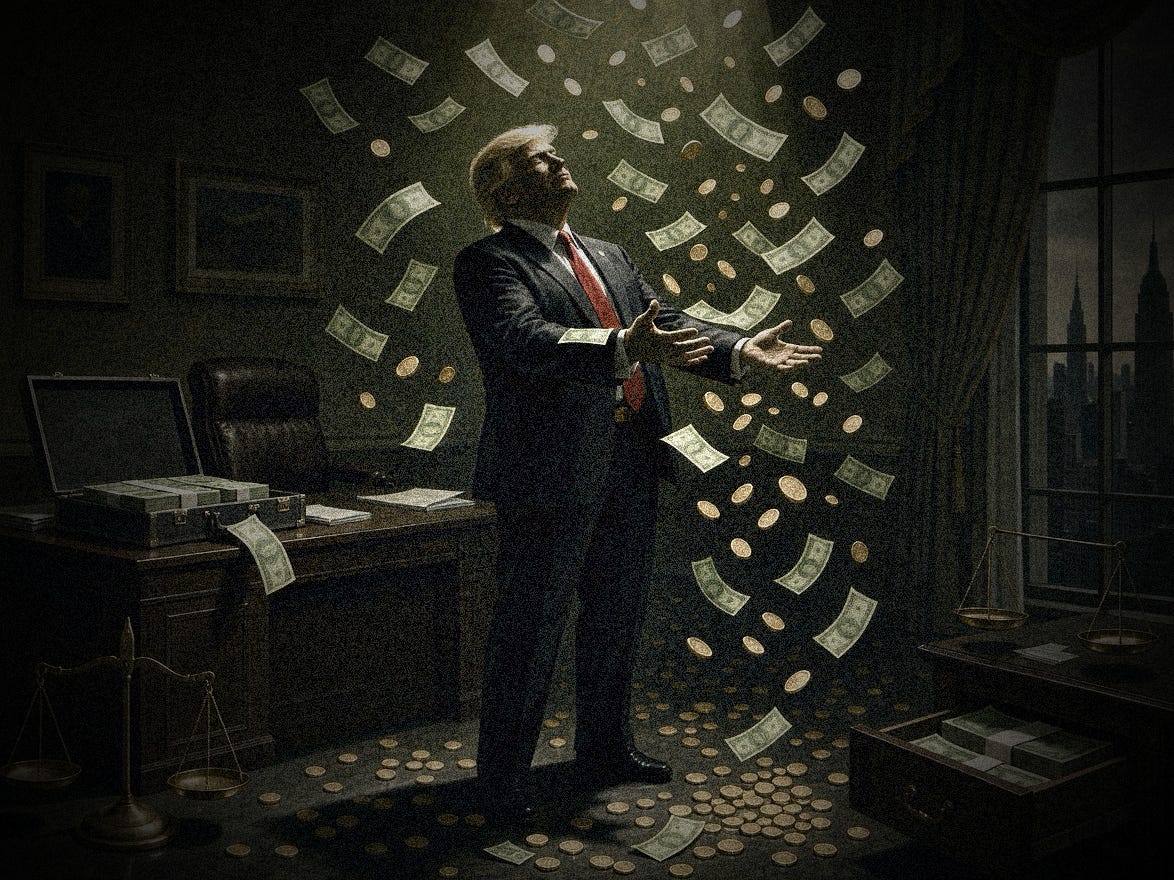
Democratic candidates spent much of the midterm campaign talking themselves into a false choice over whether to focus on “affordability” or on the abuse of executive power. Yet in its final days, the election has come to center on an issue that combines the two: the spectacular corruption of the Trump administration.
Many Democrats are adopting this as a closing message on the campaign trail, with Sen. Jon Ossoff declaring, “It’s the most corrupt administration of all time, and everybody knows it. And while the crook president and his crook family rake in billions from all over the world, you pay more for everything.”
Politicians in tight races may be focusing on this theme simply because it polls well, and they are promising that reining in corruption will make prices drop. That is not as directly true as they imagine, and it will take other reforms to make key goods more affordable. Yet the issue of corruption highlights a deeper connection between authoritarian politics and authoritarian economics.
A Culture of Corruption
This election’s focus on corruption has been encouraged by a series of late-breaking revelations about the sheer scale and brazenness of the cash grabs by Trump and his appointees.
The Wall Street Journal recently reported text messages in which Kimberly Guilfoyle, the former fiancée of Donald Trump Jr., who was made U.S. ambassador to Greece, was shaking down a businessman for $100,000 to pay her credit card bills, offering him special access to the Trump administration. (He passed on the offer and instead leaked her requests to the press.) In other recordings, she boasted of gifts and luxury trips given to her by Greek businessmen in exchange for favors.
This is small change compared to former Trump lawyer Alina Habba. While she was still serving in the Department of Justice as a U.S. attorney, Habba signed a deal with Venezuelan billionaire Julio Herrera Velutini that guarantees her $50 million in income from a company that seems to have been created solely for that purpose. Weeks later, while Habba was still a “special government employee” working as a senior adviser to then-Attorney General Pam Bondi, Trump pardoned Herrera in a bribery case.

Fifty million dollars is a spectacular price for a Trump pardon. They have been effectively for sale since early in this term, but the going rate before this was only $1 million.
But if the latest reports are true, the prize for corruption may have to go to Trump’s son-in-law Jared Kushner. According to a new book excerpted in Vanity Fair, Kushner’s phone was hacked by Russian intelligence, then leaked by an informant to Dutch intelligence, which discovered that Kushner had access to several billion-dollar funds created for him by top officials in Saudi Arabia and the United Arab Emirates during Trump’s first term, while Kushner was serving as an informal “special envoy” to the Mideast. Those cozy financial connections have continued as Kushner serves in the same role in Trump’s second term, while he also negotiates with Russia and brokers oil deals that benefit his friends.
This orgy of official corruption has even flashed into internecine battles within Trumpworld over who gets how much of the loot, including a whole soap opera in which Habba has accused Ric Grenell, Trump’s stooge in charge of the Kennedy Center, of stealing $6 million given to the center by her husband, Turkish billionaire Turhan Mildon.
There are many more cases. The Trump family’s cryptocurrency ventures have become a convenient channel for anyone who wants to put money straight into the president’s wallet. Trump’s border czar Tom Homan was caught pocketing $50,000 in cash to rig contracts, and the DOJ dropped the case. Then-Secretary of Homeland Security Kristi Noem had the government buy $400 million in overpriced luxury jets from a crony. And these are just the ones we know about. When corruption is allowed to spread, it becomes like cockroaches: For every one you see, you can assume there are many more.
The Economics of Authoritarianism
These cases are a window into the economics of authoritarianism.
Authoritarianism is never just a political system. It is also an economic system, built on corruption. Corruption is both a means and an end for the regime. For a lot of the people who jump on the bandwagon of an authoritarian regime, the whole purpose of grabbing power is to get rich from insider deals. But this also serves a practical purpose for the strongman, who consolidates his regime by feeding his supporters and starving his opponents.
Trump’s new oil deal with the Venezuelan dictatorship is a microcosm of this. Under a secret agreement obtained by ProPublica, Venezuela is coerced into selling its oil to the U.S. at a steep discount, by way of an opaque private company run by a shady Trump crony: Venezuelan oligarch Alejandro Betancourt, whom one diplomat describes as a “totemic, emblematic corrupt figure.” The most revealing part of ProPublica’s report is how other, more established oil firms were cut out of the deal:
[F]irms struggled to get more than “lip service” meetings in Washington and Caracas, according to media reports and people familiar with the deal. “NABEP [Betancourt’s firm] was given priority,” one person said. “Exxon, Conoco, and the others were treated as second class.”
The point is not just to grab cash from this specific deal. The point is to establish an economic system of patronage. Everyone now understands that if you want to get ahead, if you want wealth and success, you need a political sponsor inside the regime. In return, your sponsor gets from you a cut of every deal, along with political support in the form of campaign donations, public endorsements, and goodies to dole out to voters—in this case, a promise of cheap gasoline—to keep him in office.

Consider the deal in which Paramount Skydance, a media conglomerate backed by Trump-connected tech billionaire Larry Ellison and his son, bought out Warner Bros. Discovery. The Ellisons had to fight off a rival offer from Netflix, and according to new information from a former Warner board member, they did it by getting Trump administration regulators to promise to block Netflix’s offer. “They [Netflix] were right on the verge of pressing on and were told by the administration that they had no chance of getting regulatory approval from the US.” It’s not like this was subtle and hidden. This new report just confirms what the Ellisons and administration officials had been boasting about all along.
Here we have an administration abusing its regulatory power to throw a merger to one buyer while blocking another, with the prospect that the new owners of Warner’s subsidiaries, including CNN, will give the regime more favorable coverage, as they have already done after acquiring CBS. That’s the patronage system in action.
Here’s another example of how it works. A report on 1789 Capital, the venture fund in which Donald Trump Jr. is a partner, describes how defense companies feel obliged to let the Trumps in on their deals:
To some companies, accepting even a dollop of 1789’s money represents an insurance policy against Trumpian rage. … The question, one executive told me Monday, is: “Do I let these guys on my cap table now in the event something random comes up and I need Trump universe aligned? Or does that hurt me later if Dems take back power?”
The economic impact of corruption on the average person does not come just from the direct loss of the money being siphoned off, but also from the kind of economy it creates. Corruption creates massive inefficiencies, in which political sponsors take a cut at every point leading to both a misuse and misallocation of resources. An emblematic example was the disastrous Reflecting Pool renovation at the Lincoln Memorial, which had to be redone after Trump handed an incompetent and inexperienced crony $14.7 million for a job he himself had promised would cost under $2 million.

In the whole economy, capital is misallocated because deals aren’t based on their economic soundness but on whether the right palms have been greased. One example is a bizarre new company that has raised hundreds of millions of dollars on a promise to breed genetically engineered dogs for police and military work. But as TechCrunch reports, the super-dogs “do not exist yet,” the genetic technology is speculative, and the company has no signed customers. Yet it is already valued at more than a billion dollars. Why? Because the company is connected to Palmer Luckey, a Silicon Valley insider turned defense contractor whose firm, Anduril, is financially backed by Donald Trump Jr. The company’s idea may or may not work, but investors will pour in because the firm has the inside track on a pile of government contracts.
The economics of right-wing authoritarianism is not a free market, nor is it socialism. It is a return to what came before capitalism: feudalism and aristocracy, with its network of patronage built around the political power of men from established families.
The Roots of Corruption
The neo-feudal economics of patronage is all made possible by the systematic expansion and abuse of executive power. Trump acts as if being president means that the entire U.S. government is his personal property, from the White House to the military, to be used for his own personal gain. This example spreads out to everyone holding a lesser office, and they all depend on the president to shield them from accountability to the public. The Trump administration has admitted as much by repeatedly floating the idea of blanket pardons for its officials at all levels, an admission that they are going to need pardons, that they remain loyal to him because of the immunity he grants them.
Yet this gives Democrats an opportunity precisely suited to the power they will have if they retake a majority in Congress. A promise of pardons can stop the federal prosecution of corruption, but it cannot keep Congress from investigating and holding hearings to expose one of these schemes after another. This is what Ossoff has been promising: “If you’re involved in any of this, next year, you’ll be raising your right hand and swearing to tell the truth, the whole truth, and nothing but the truth, so help you God in front of the United States Congress.” A congressional majority battling with a hostile president may not easily be able to pass big legislation—but no one can stop it from holding hearings to expose massive corruption.
We can’t fully shut down the patronage economy of authoritarianism without big reforms that will rein in the power of the executive and lift the presumption of presidential impunity. Years of hearings to expose the unprecedented scale and cancerous omnipresence of this administration’s corruption—showing us again and again how insiders got rich while average voters struggled to fill their gas tanks—can provide precisely the public anger and political capital to demand those reforms and rally a majority to push them through.

© The UnPopulist, 2026
Follow us on Bluesky, Threads, YouTube, TikTok, Facebook, Instagram, and X.
We welcome your reactions and replies. Please adhere to our comments policy.
The fight against systems of impunity is the unifying theme. Corruption for profit or perversion must result in jail time. The Epstein class and grifters overlap significantly.