


Book Review
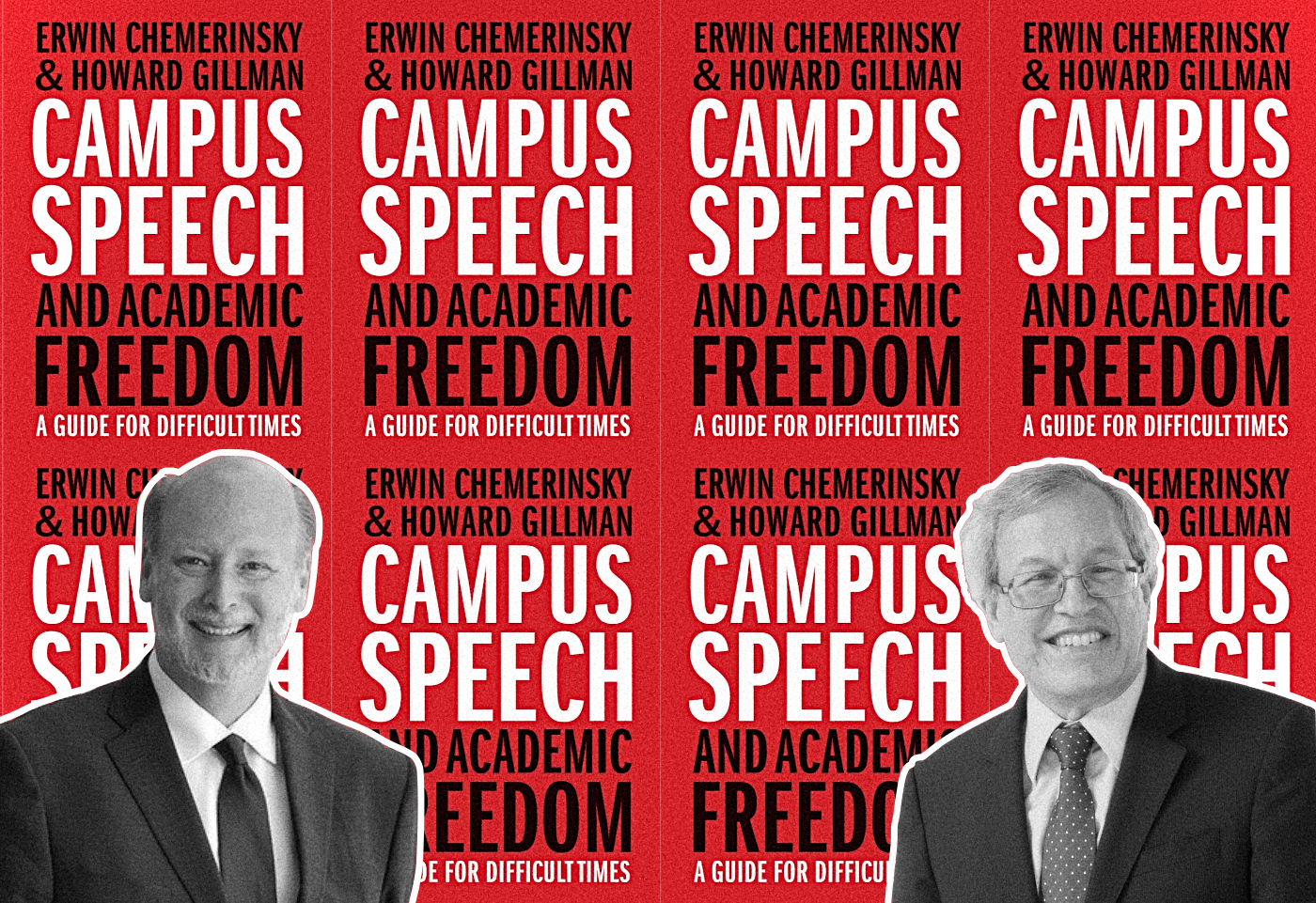
Erwin Chemerinsky, dean of Berkeley Law, and Howard Gillman, chancellor of UC-Irvine, published their first book, Free Speech on Campus, in 2017. Today, as their new work Campus Speech and Academic Freedom: A Guide for Difficult Times circulates, they hold the same jobs. But American universities aren’t so steady.
Early in their first book, Chemerinsky and Gillman compared the controversies of the moment to 1960s campus fights, which often pitted speech-suppressing administrators against speech-loving students. Now, they point out, it is often students themselves who demand the suppression of offensive speech, whether the speaker is a fellow student, a professor, or a visiting lecturer. In the latter category, 2017 featured several serious disruptions and cancellations and, rarely, violence.
Chemerinsky and Gillman praised these students for trying to protect others from the harm of hateful speech, but they feared that “a generation that [had] not itself struggled against censorship” didn’t realize that such censorship had “been used primarily against ... those protesting for positive change.” Their overall argument was optimistic: colleges could address hateful speech without compromising free speech or academic freedom. But it came with a warning: the power you want wielded against your enemies can be wielded against you.
Today, as the right leans into its power to suppress speech, that warning seems prescient. The Foundation for Individual Rights and Expression (FIRE) maintains a database of attempts to punish or censor scholars. Of 239 cases since the beginning of 2025, the pressure to punish came “from the left” in just 12. Another nine cases were not political. In the remaining 218, pressure came from the right (I’ve left out hundreds of cases associated with the U.S. Naval Academy library purge). Even in 2020, the peak of left-wing campus censoriousness, attempts to target scholars were fewer—159—and less lopsided. Pressure came from the right in more than a quarter of those cases.
Another difference between then and now, as FIRE president Greg Lukianoff points out, is that politicians are leading attacks on faculty speech. In 2025, FIRE recorded more politician-involved cases than in the previous 25 years combined. These politicians aren’t limiting themselves to tweets and phone calls: red state legislatures have sought, with some success, to regulate the teaching of “divisive concepts,” eliminate tenure, dictate curricula in detail, and facilitate snitching and surveillance. The Trump administration has used Title VI of the Civil Rights Act, which prohibits discrimination based on race, color, or national origin, including some forms of antisemitic discrimination, in programs receiving federal funds, to bring prestigious universities to heel.
“Official state censorship” threatens liberty more than student activists and campus bureaucrats do, and Chemerinsky and Gillman consider these developments “the biggest threat to free speech and academic freedom since the McCarthy era.”
The right’s lawlessness is part of the problem. Although it invoked Title VI to cut billions in funding for universities, Chemerinsky and Gillman observe, the administration ignored the law’s requirements, such as “notice, hearing, [and] finding of facts.” Chemerinsky, an attorney as well as a scholar, has participated in the resulting legal fight. But this book is not about resistance. It is about the principles and practical considerations higher education leaders must understand as they try to preserve free speech and academic freedom, and to keep their campuses safe and free of discrimination in a deeply polarized environment.

Those principles and practical considerations are as follows:
First, “all ideas and views can be expressed on a campus.” The First Amendment binds only public universities, but private universities should bind themselves to this “basic premise of open inquiry.”
Second, universities must restrict some speech, such as incitement and harassment. These terms, however, should be narrowly construed, as the Supreme Court has construed them. For example, to constitute incitement, speech must be both intended and likely to cause “imminent illegal activity.” Simply calling the Democratic or Republican Party “anti-American,” for instance, might encourage political violence, but if that were treated as incitement, then merely hyperbolic (or not-so-hyperbolic) political speech could be suppressed.
Third, campuses can “impose reasonable time, place, and manner restrictions on expressive activities.” They can, for example, forbid the use of amplified sound near classrooms during classroom hours. But such restrictions must “serve an important purpose,” “leave open adequate alternatives,” and, typically, avoid discriminating based on a speaker’s message.
Fourth, universities should understand that academic freedom and freedom of speech are not identical. When they teach and conduct research, professors must “act in ways that reflect high standards of professional competence and ethics.” For example, professors “cannot interject non-germane material into the classroom in order to indulge their ... political ... views.”

Some campuses need a refresher course in these ideas. When Vanderbilt University recently announced a formal investigation into allegations that a “member of the faculty shared offensive content,” it undermined the premise that all ideas can be expressed on campus. The content in question was a partisan take on the Israel-Palestinian conflict, which a mathematics professor had worked into a math problem. That may be a textbook example of interjecting non-germane material into the classroom to indulge one’s political views. But Vanderbilt framed its investigation around offensiveness, not professional ethics—and offensiveness is not itself grounds for investigation.
The View From Inside
Chemerinsky and Gillman’s principles will not surprise readers of their first book, since they haven’t changed. But the co-authors now think that they made “many issues sound simpler than the situations schools have actually faced” since. They visit or revisit, in a detailed and nuanced way, a number of issues, including encampments, diversity statements, institutional neutrality, government demands that universities shutter DEI offices, and a university’s obligations under Title VI.
Such problems, they acknowledge, often lack neat solutions. It is distressing to learn, for instance, that as universities are struggling to meet their obligations to address antisemitic harassment, the law doesn’t clearly say what harassment is or what a college must do to combat it. But by enunciating general principles, practicing them on numerous examples, and pointing to relevant case law, Chemerinsky and Gillman educate our judgment.
Some readers might want more of a fighting book. What good is getting right with the law, or even with higher principles, when you confront an administration that cares about neither and that has, as the legal scholar Jack Goldsmith says, “endless tools” to inflict pain? But Chemerinsky and Gillman are right to focus on internal matters. Universities should defend their rights in the court of public opinion and in actual courts, but they have more control over the inside than the outside. Their best prospect for improving their diminished public standing is self-improvement.
For that, there is room. Chemerinsky and Gillman know that public support for education depends on “the quality and importance of the work being done by faculty members, including the embrace of diverse viewpoints.” They highlight a 2024 University of Michigan report that both “conservatives and liberals worried that the climate of opinion at UM was overwhelmingly liberal.” Many respondents were “concerned about the lack of diversity of thought in syllabi and class discussion.” Many experienced “homogeneity of opinion” and worried about “informal peer pressure, ridicule, and the possibility of ‘cancellation.’”

Chemerinsky and Gillman are right that heavy-handed efforts to impose political diversity on campus—such as the effort currently underway in Indiana—are a cure worse than the disease. But apart from reaffirming the value of free speech, they say almost nothing about how campuses might address their intellectual uniformity.
That may be because they don’t think our campuses are that uniform. Students, they recall, “were largely unified” during the 1960s and 1970s, particularly regarding Vietnam. In contrast, the “Israeli invasion of Gaza [has] deeply divided students and faculty.” But, as the historian Lauren Shepherd’s account of the development of the student right suggests, the 1960s campus left faced “an apathetic campus majority,” a “boisterous antiliberal assault” from a weaker but active campus right, and considerable faculty disapproval. I doubt that our campuses are more divided today. But even if Chemerinsky and Gillman are right that they are somewhat more divided, there is evidence from the political scientist Samuel Abrams that faculty today are much more progressive and more distant politically from the general public than they were in the 1960s. Our problem may be less about the intractability of today’s campus conflicts than about the gap between progressive universities, particularly elite ones, and a much more conservative American public.
If so, some of Chemerinsky and Gillman’s advice may make matters worse. Although they urge caution in adopting institutional positions on controversial matters, they also urge leaders to promulgate their university’s values. By this they do not mean simply the values connected to free inquiry; they also say universities should “assert a commitment to the values of DEI.” They might also speak out, as in the case of the police killing of George Floyd, to confirm community commitments during crises.
Institutional Voice, Public Obligation
Gillman’s own statement on George Floyd, offered in the book as a positive example, deserves scrutiny. Gillman explained that the “unrest” unfolding across the country reflected “the crisis of our society,” which had one core cause: “anti-Blackness.” Consequently, the university had to devote itself to getting “educated about anti-Blackness” and taking “steps to dismantle anti-Black sentiment.”
Was Gillman right that George Floyd’s killing was best understood in race rather than class terms? Was he right that police brutality in general is about race? Was he right, amid COVID and signs of political turmoil throughout the West, that the American race problem was the core of our crisis? Was he right to think that the kinds of programming the university had in mind—they would soon include a “cluster hiring” program named after the Black Lives Matter movement—were well-calculated to address the crisis? We don’t need to answer these questions to notice that Gillman, under the guise of communicating community values, eschewed reflection in favor of moralizing dressed in academic language. The problem is “anti-Blackness”; the solution is to “dismantle” it.

Backlash, by itself, is not a dealbreaker. Universities risk backlash when they support scholars who raise controversial issues in their classrooms, follow evidence where it leads, and publish unsettling results. The trouble is that universities have built their case for academic freedom—as Chemerinsky and Gillman sometimes acknowledge—on providing “conclusions gained by a scholar’s method and a scholar’s spirit.” The “community values” required to support that enterprise, inside and outside the university, are fragile. They are undermined by defining universities in terms of progressive conclusions not gained by a scholar’s method or a scholar’s spirit.
None of this justifies the conservative movement’s efforts to substitute its own values for progressive values on campus or to demonize DEI programming altogether. But those who consider the conservative cure worse than the disease owe us better cures.

© The UnPopulist, 2026
Follow us on Bluesky, Threads, YouTube, TikTok, Facebook, Instagram, and X.
We welcome your reactions and replies. Please adhere to our comments policy.


Since you are a conservative, see if this analogy appeals to you.
Suppose that you started a book club, but the Trump administration wrote a report that said that the nation's book clubs are a problem. They are not fulfilling their "compact with America" and so, from now on, at least 40% of the books in every book club must be approved by the administration. Also, if the book club hires staff, we want those names.
a) Should you acknowledge that the nation's book clubs need to change?
b) Should you admit that, indeed, some of the books you've been reading are bad?
c) Should you pre-adjust the books that you read to avoid the "backlash" you refer to above?
Or, should you tell the Federal Government that the books you read and the staff that you hire are none of their business unless you violate some federal law?
I'm sorry to have to say this, but IMO, what the authors are doing, and what you are doing is your review is "Obeying in Advance" (Tim Snyder, On Tyranny).