


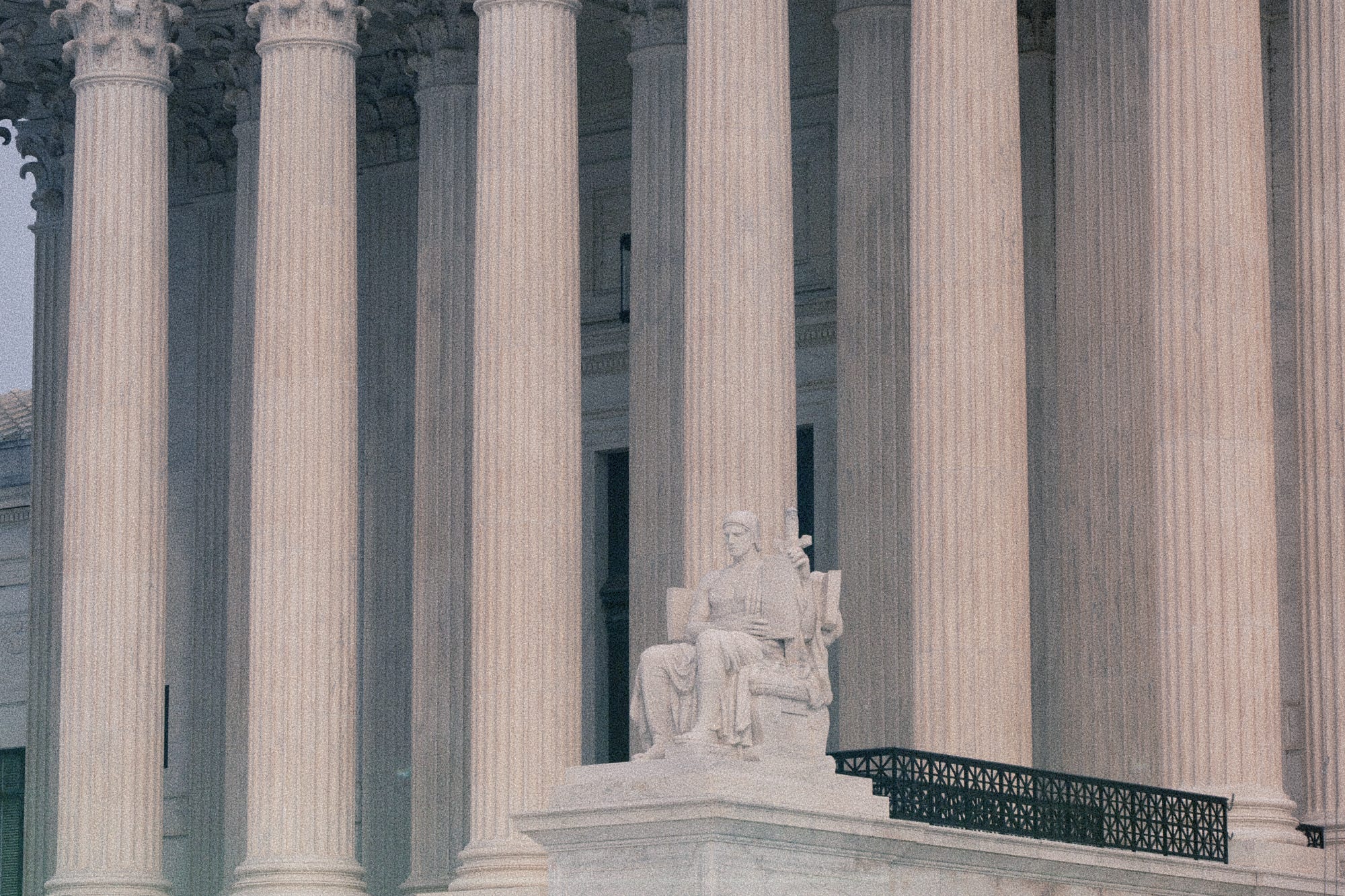
The Supreme Court’s much anticipated birthright citizenship ruling Trump v. Barbara came down this week, and by a hair—with five votes—the court managed to avoid upturning the very first sentence of the 14th Amendment and subjecting potentially millions of Americans to involuntary expatriation. That sentence reads: “All persons born or naturalized in the United States, and subject to the jurisdiction thereof, are citizens of the United States and of the State wherein they reside.” The entire fight is over five of those words: “subject to the jurisdiction thereof.” But avoid upturning it they did, and—however narrowly—the most important part of the legacy of Reconstruction still stands. Trump’s executive order, issued on the first day of his second term, decreed that children born in the United States to undocumented immigrants—or to parents present only temporarily—are not citizens. Five justices have now rejected that policy as unconstitutional.
I had predicted a 7-2 case, as had many others after oral arguments. I’m particularly surprised and disappointed by Justices Kavanaugh and (especially) Gorsuch, but five votes will at least stave off the immediate crisis. The Roberts Court’s near-total disregard for precedent (as illustrated by its casual discarding of Humphrey’s Executor, the 1935 precedent shielding independent agencies from at-will presidential removal, only the day before) suggests that birthright citizenship is still in critical condition: the loss of a single justice in the majority could reverse the holding.
The opinions are worth walking through one by one, because together they reveal something bigger than this case: how little the professed “originalism” of the court’s conservatives actually constrains them when the history is inconvenient. Here’s my rundown of the six (!) opinions in the case.
Chief Justice Roberts: Getting the Basics Right
The chief justice, writing for the court, achieved a competent version of standard originalism. Heavily relying on historical sources and historically informed amicus briefs, the chief points out—correctly—that the English common law rule that shaped the background of U.S. citizenship law treated all kinds of temporary visitors and even persons subject to expulsion as nonetheless capable of producing British children if those children were born within the territory. (Anthony Michael Kreis has recently written a comprehensive account of the development of this principle that is worth your time.) Roberts also correctly points out that the most natural reading of the word “jurisdiction,” being subject to the laws of the United States, is that the framers of the Amendment meant what they said.

Contra the dissenters, especially Thomas and Alito, Roberts appears to implicitly recognize that if—as Thomas and Alito insisted—the framers of the Amendment were fixated on ideas like domicile and allegiance, meaning where a family had made its permanent home and where its loyalty lay, they could have used those words. And he recognizes, as I pointed out in The UnPopulist back when this whole mess began, that the handful of traditionally recognized exceptions to the birthright principle are all cases where the United States did not, or could not, extend the full coverage of its laws to a person—as, for example, foreign ambassadors who have diplomatic immunity. In other words, this applies to people who are genuinely outside U.S. jurisdiction, immune from or beyond the reach of at least some American laws.
The signal virtue of Roberts’s opinion is simplicity in two respects. First, the opinion rightly treats the case as a simple one: Did the framers mean what they said or didn’t they? Second, he recognizes that simplicity was also a deciding principle for the rule that they adopted: in order to foreclose the possibility of another Dred Scott, which had stripped citizenship of not just slaves but all Black Americans, it was critical to adopt a principle that didn’t require some uncertain judicial analysis (like who was “domiciled” where) but that permitted categorical application. Dred Scott had been possible only because the Constitution left citizenship undefined, and the framers meant to leave judges no room to improvise again. The birthright principle that American citizenship attaches to anybody born subject to American law is just such a rule, and it is what the framers adopted. Whether someone is born subject to American law is a simple fact; where their parents’ true home and loyalties lay is a lawyer’s argument waiting to happen.
Justice Jackson: The Only One Who Understands Reconstruction
The vice in Chief Justice Roberts’s opinion is that it is stuck in the standard rut of conservative originalists, who, when they disagree—as they did in this case—throw selective citations to history at one another, without serious thought as to whose voices ought to count for what, and why.
Justice Jackson’s concurrence corrects that. Her opinion adds the real historical context: prior to the enactment of the 14th Amendment, the citizenship of Black Americans—and not just in the South, but in the free North as well—had been pervasively called into question by more than just Dred Scott. Of particular importance, free states that had originally enfranchised free Black Americans and treated them as citizens often passed antebellum legislation stripping those rights. At the same time, Southern states, long before Dred Scott, enacted the infamous “Negro Seamen” laws that barred free Black sailors from their ports and often imprisoned them, denying that those sailors were entitled to the same right to travel within the United States and participate in commerce as white citizens.

In response, Black Americans developed a rich discourse about why they were entitled to citizenship and a universalistic vision of the multiracial, inclusive, democracy that included them as citizens. As Jackson emphasizes, they did not advance a narrower theory applicable only to themselves, but rather a general principle extending to all. One would have thought that an originalist understanding of the meaning of the constitutional provision that guaranteed Black citizenship would have paid at least some attention to what its Black advocates had said at the time, but only Justice Jackson took the trouble to do that work. And the framers did not ignore that discourse: as Jackson shows, they wrote its universal vision into the Constitution.
Justice Kavanaugh: An Unnecessary Present for Donald Trump
Justice Kavanaugh was a dissenter in all but name: on the crucial question of whether the 14th Amendment protects birthright citizenship, he said not necessarily. But he voted with the majority because he believed that the president alone lacks the power to decide what to replace it with. In his view, the protection lives in the citizenship statute, not the Constitution, meaning Congress could take it away tomorrow.
His opinion has two notable features. First, President Trump seems to want to pretend that Kavanaugh wrote the majority opinion, immediately claiming on Truth Social, contrary to the actual majority opinion, that Congress has the power to change birthright citizenship. In fact, five justices explicitly rejected this position. Second, the logic of Kavanaugh’s opinion—which claims that the “unifying principle” of the longstanding exception to birthright citizenship “is that the parents in all of those varied circumstances were not U.S. citizens and were citizens of other nations, whether tribal or foreign,” would actually go even further than Trump’s executive order. In principle this would also permit Congress to strip citizenship from, for example, children of green card holders. That is more than even the theory’s own academic champions have proposed.
Justices Thomas and Gorsuch: Domicile Confusion
Clarence Thomas wrote the longest (and somewhat repetitive) dissent, but the nub of it is that when the framers of the 14th Amendment said “jurisdiction,” they really meant (but somehow didn’t think to say) “domicile.” Domicile, roughly, is where you have made your permanent home. This means that children of temporary visitors, who haven’t moved into the United States with the intent to remain, don’t count. (Think tourists and students.) And notice that this is not a modest carve-out but a different test altogether: not whether a child is born under American law, but whether her parents have settled here for good. In a footnote, Thomas acknowledges that this opens a lot of confusion about children of undocumented immigrants who have moved here for good, and thus would seem to be domiciled—and so, on Thomas’s own theory, their children would be entitled to citizenship, the very result he voted against. Rather than solving this contradiction, Thomas vaguely gestures to commentary suggesting that they somehow would be unable to acquire domicile, because unlawful status inherently precludes it.

Justice Gorsuch wrote a separate opinion, in addition to joining Thomas, to briefly make the last point from Thomas more explicit. He, too, endorses the domicile theory, but observes in the text rather than in a footnote that there are many undocumented people who have been here a long time with the evident intent to remain permanently, and the logic of their position seems to suggest that their children ought to be entitled to citizenship. He does not embrace that result—he dissented—but at least he says the quiet part out loud.
Thomas’s long historical excursus boils down to one claim: that in early America, domicile functioned as the next best thing to citizenship—settle here with the intent to stay, and you were treated as one of us. If that were true, reading the 14th Amendment’s “jurisdiction” as code for domicile would at least be plausible. But it is not true. Brooklyn College’s Anna O. Law has just published a book showing numerous ways in which antebellum states regulated immigration and membership, contrary to Thomas’s seeming vision of a world in which people could change their civic membership just by moving house. For a federal example, remember that the 1798 Alien Enemies Act let the president summarily expel any foreigner from a hostile nation unless he was “actually naturalized.” Not domiciled, but naturalized as a citizen. Citizenship, not domicile, was the line that mattered, the opposite of what Thomas needs. The framers knew that world and precisely to overcome its shortcomings and confusion, they anchored citizenship in something simpler: birth within the reach of American law.
Justice Alito: Incoherence
And then there’s Alito. He simply buys all of the debunked historical myths. He endorses—again, clearly contrary to the evidence—the idea that there were no immigration restrictions in the antebellum period. That myth does real work: it lets restrictionists claim the framers could not have contemplated illegal immigration at all. He also swallows the confused idea that the exclusion of Native Americans from birthright citizenship was some kind of aberration, when in reality many Native Americans at the time and for decades thereafter did not want citizenship and would have understood forcing it on them as an affront to their sovereign nations.
Interestingly, Alito’s and Thomas’s opinions are almost completely at cross-purposes when discussing the pre-1868 system. Alito at one point refers to “the ability to settle” as among the “rights traditionally associated with citizenship,” quite the opposite of Thomas’s vision of people settling left and right regardless of formal naturalization. Alito also interprets Elk v. Wilkins, the case identifying that Native Americans weren’t covered by the birthright clause, as excluding Mr. Elk from citizenship even though he had “taken up residence”—that is, become domiciled—“among the general public” (though the case doesn’t tell us where Mr. Elk’s parents lived or the status of his children). For Thomas, domicile evidently drove citizenship. For Alito, citizenship evidently comes first and domicile cannot change a person’s status. In short, the two dissents cannot both be right.

Perhaps most troubling in Alito’s opinion is a passage toward the end where he suggests that any person who is born with foreign citizenship is “subject to a foreign power” and hence not “subject to the jurisdiction” of the United States for the purpose of birthright citizenship. He explicitly cites Mexico, El Salvador, and Guatemala as countries that grant citizenship to the children of citizens who are born abroad (as most nations do), and concludes that children of undocumented immigrants from those countries would, for that reason, not be entitled to birthright citizenship.
That view is inexcusably terrible for multiple reasons. First, it makes U.S. citizenship dependent on the law of foreign nations: if Mexico or Guatemala changes its citizenship by descent law, then on Alito’s account the status of the children of Mexican or Guatemalan undocumented immigrants changes. Making American citizenship contingent on the ever-shifting, often ambiguous nationality laws of nearly 200 other countries would be wildly impractical, and nothing in the 14th Amendment suggests it.
Second, just like Kavanaugh’s, this argument cannot be cabined to undocumented people; the children of lawful permanent residents may also get citizenship in their parents’ home countries, and if Alito is to be believed that entitles the U.S. government to exile them too. And this is no edge case: most countries, including the United States in most cases, extend citizenship to their citizens’ children born abroad. Alito’s theory would thus exclude not a stray handful but the vast bulk of children born here to legal immigrants.
Third, it implicitly draws on longstanding bigoted slurs about divided or contingent loyalties that have long been applied to both Jews and Catholics and also drove the infamous internment of Japanese Americans during World War II. The logic is identical but somehow worse: a tie the child never chose—a citizenship conferred by some foreign government at birth—converted into proof of divided allegiance. While I don’t believe that Justice Alito subscribes to any of these hateful views, it is particularly disappointing that he apparently cannot recognize that he is promoting the same ideologies that drive them.
The Un-Originalists
At the end of the day, the right result prevailed in this case, however narrowly. But that four justices voted to nullify a long-settled, black-letter, fundamental constitutional right is still deeply disturbing. It is an invitation to try again next time, perhaps enlisting Congress in the attempt rather than by presidential decree. And it reveals the grim reality of the professed “originalism” of some, if not all, of the conservatives on the Roberts Court. The actual history, text, original understanding are not a guide for them. They are a pretense, a way to rationalize desired political outcomes. If the history is with them, all the better. But when it is not, and in this case it overwhelmingly was not, cherry-picking, willful distortion, and outright falsehoods can always be mustered.

© The UnPopulist, 2026
Follow us on Bluesky, Threads, YouTube, TikTok, Facebook, Instagram, and X.
We welcome your reactions and replies. Please adhere to our comments policy.

I know i'm making a second comment but, back when I was a conservative, I could never think that someone born here would be denied citizenship.
It buggles me to why any conservative would harm the constitution in this way. It scares me to my core that this was a close decision.
And it's very clear that trump is awful. He ended a road to citizenship through military service.