


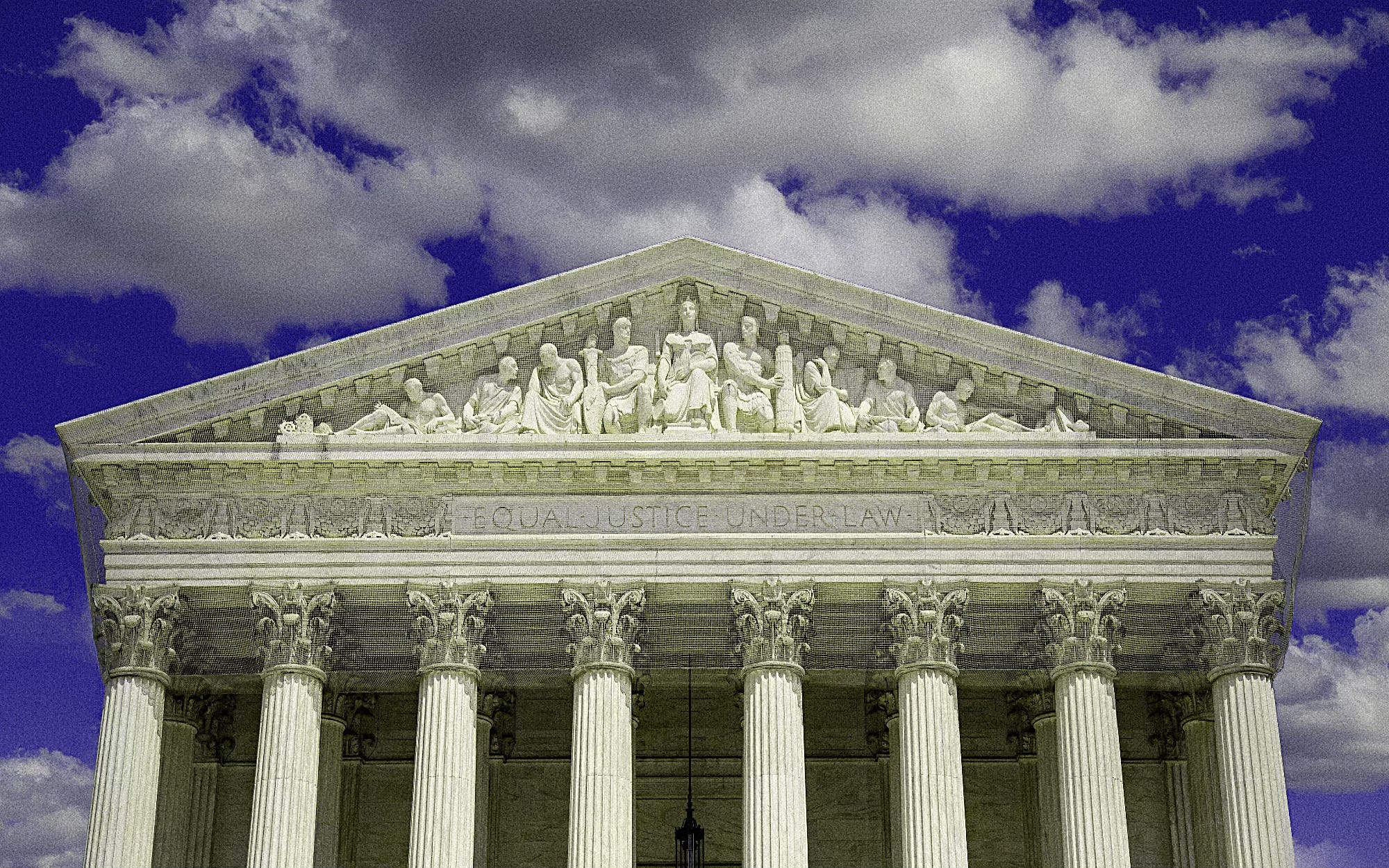
On Wednesday, the Supreme Court will hear oral arguments in Trump v. Barbara—the case that will finally decide whether Donald Trump’s executive order stripping birthright citizenship from U.S.-born children of undocumented immigrants is constitutional. Every court to consider the question has said it isn’t, and the order has never gone into effect. But the administration has pressed on, and now the merits are before the justices.
The legal arguments marshaled in the order’s defense—that undocumented immigrants’ children fail to meet the “subject to the jurisdiction” standard, that birthright citizenship requires a form of allegiance their parents cannot confer, that unauthorized immigration constitutes an “invasion” triggering a constitutional exception—have the superficial appearance of constitutional reasoning. But each one collapses under scrutiny.
What Does the Constitution Say?
The 14th Amendment, adopted in 1868, could not be clearer: “All persons born or naturalized in the United States, and subject to the jurisdiction thereof, are citizens of the United States and of the State wherein they reside.”
This describes the concept of jus soli (birthplace) citizenship, one of the two main categories of citizenship worldwide. Jus soli citizenship arises from a long Anglo-European tradition, though today it is most prevalent in the Americas. The other major category is jus sanguinis: citizenship by blood (descent).
These are not mutually exclusive—many countries, including the U.S., adopt elements of both jus soli and jus sanguinis. The U.S. grants citizenship to children born in the country (jus soli—14th Amendment) and to some children born of U.S. parents abroad (jus sanguinis—by statute).
Historic Exceptions
There are, however, some long-established exceptions to the jus soli rule that the 14th Amendment’s “subject to the jurisdiction” language captures. As the Supreme Court explained in United States v. Wong Kim Ark (1898), two of those exceptions—the children of foreign diplomats and military invaders—go back at least to 17th-century England.

The reason the children of diplomats and military invaders don’t qualify for birthright citizenship is because they’re not “subject to the jurisdiction thereof”—they’re quite literally outside the law of the United States. Diplomats enjoy immunity from laws, which is why American cities are missing millions of dollars from uncollectable parking fines from them. As for invaders, their entire presence is aimed at denying and destroying the jurisdiction of the United States—which is why the government is allowed to shoot them without due process. Importantly, the English precedent that U.S. v. Wong Kim Ark drew on understood even transient sojourners (like tourists) to “owe temporary allegiance to the Crown” such that their children would acquire citizenship if born in the territory.
In the American context, we have two additional longstanding exceptions. Native Americans are granted birthright citizenship by statute, not by the Constitution, because of their unique history as members of nations with competing sovereign claims over the same territory. In the original Constitution, some laws—particularly with respect to taxation—didn’t apply to Native Americans. In that sense, they were similar to diplomats as partially outside the “jurisdiction” of our laws—in the conventional legal meaning of the term. Section 2 of the 14th Amendment recognizes this with a specific reference to “Indians not taxed.”
Finally, in the so-called Insular Cases, like Downes v. Bidwell, the Supreme Court made a distinction between the core parts of the U.S. (like the 50 states) and the unincorporated territories, which don’t count as full-fledged U.S. soil for constitutional purposes. That means, for example, that those born in places like American Samoa are also outside the birthright citizenship clause. It’s important to notice, however, that this has nothing to do with the “subject to the jurisdiction thereof” language of the 14th Amendment that is at issue in the present litigation. Rather, the Insular Cases interpreted the scope of “the United States.” Their holdings are straightforwardly irrelevant to the question of whether or not a child of an undocumented immigrant or temporary visitor born within the 50 U.S. states is a citizen.
None of those exceptions apply to U.S.-born children of undocumented immigrants within the 50 states who, unlike diplomats, are fully subject to U.S. law and file taxes and, yes, pay parking tickets like the rest of us.
The ‘Allegiance’ Argument
Very few serious legal theorists dispute this interpretation of the 14th Amendment. The administration’s case rests not on novel scholarship but on repurposing existing precedents—most prominently Elk v. Wilkins (1884), the 19th-century case about Native American tribal citizenship discussed below—to construct an argument that John Eastman, the disgraced insurrectionist and mastermind of the fake elector scheme, had already made infamous.

Eastman offered two related arguments.
The first was to construe the 14th Amendment’s “subject to the jurisdiction” clause in a way that would rule out U.S.-born children of undocumented immigrants from qualifying. He distinguished between two senses of “jurisdiction”: partial and complete. As Eastman saw it, in the partial, more limited reading of “subject to the jurisdiction,” a person’s presence “within the territory of a sovereign” makes them subject to the “jurisdiction of that sovereign’s laws.” But “subject to the jurisdiction” in Eastman’s preferred, more complete sense, by contrast, requires allegiance to the sovereign on top of that.
Eastman maintained that just like the U.S.-born children of indigenous Americans who belong to a Native Nation or tribe, and like the U.S.-born children of foreign emissaries, the U.S.-born children of undocumented immigrants cannot give full allegiance to the United States by virtue of their parents owing their allegiance to a separate nation or foreign power. According to Eastman, when undocumented immigrants have a child in the U.S., that child can only qualify as being “subject to the jurisdiction” of the United States in the partial, limited sense, not in what he took to be the 14th Amendment’s more complete sense, which disqualifies from citizenship anyone maintaining allegiance to another sovereign.
But this interpretation is dubious under both a textualist and jurisprudential approach.
Under a textualist reading of the Constitution, which relies on the plain meanings of terms and one that conservatives hitherto have favored, “jurisdiction” is different than “allegiance.” They plainly have different meanings—and even Eastman, who argued that the 14th Amendment’s “subject to the jurisdiction” clause is intended in an allegiance-obliging sense, acknowledged that the word “jurisdiction” can be used in a way that doesn’t intend or require strong allegiance. But even beyond a textualist approach and drawing on precedent and historical tradition instead, the Supreme Court in Wong Kim Ark relied on the concept of “temporary allegiance,” which is owed by any person that happens to be in the territory. This is a concept that has been part of the law for centuries, and it entails that a person who is on U.S. soil, regardless of the circumstances, owes allegiance to the U.S., unless they fall into one of the traditional exceptions.
What’s more, given that U.S. law since the 1967 Afroyim v. Rusk case has acknowledged the existence of dual citizenship—and hence dual “allegiance”—having such an allegiance cannot be grounds for denying anyone citizenship. That case explicitly noted that the Department of State couldn’t involuntarily denaturalize a citizen for voting in an Israeli election, as Afroyim, the plaintiff had done, which indirectly repudiates Eastman’s preferred gloss on “subject to the jurisdiction” as being intended in a “total and exclusive” sense.
Moreover, U.S.-born children of undocumented immigrants may not actually have dual allegiance: they may not be citizens of the country their parents come from. That all depends on the origin country’s law, which may or may not grant citizenship by descent. If Eastman’s argument purports to be about the allegiance of the child rather than the parents, it seems to make U.S. citizenship conditional on the laws of other countries. Even the losing argument in Afroyim v. Rusk didn’t go that far: the government had proposed to take away Afroyim’s citizenship for an intentional, adult, political act in a foreign country. Trump proposes to take away the citizenship of children who have never voted in a foreign election or anything like it on the basis of pure speculation about their foreign allegiance.
Citizenship and Consent
The second Eastman argument is that citizens have to consent to the inclusion of others within their civic body, and because undocumented immigrants are here without authorization, the American people don’t consent to the citizenship of their children. For Eastman, the consent argument is a necessary supplement to the allegiance argument—without it, he has no explanation for why the children of immigrants with green cards wouldn’t also lose their citizenship, since the “allegiances” of those parents and their children would be the same regardless of immigration status. The consent argument serves to distinguish between children of documented and of undocumented immigrants. However, just like with the allegiance argument, there are many problems with the consent argument.

For starters, just who is supposed to be giving this consent, and to what, and in what form? When a child is born in the U.S., there is no consent step—citizenship is acquired automatically. This is the case for the children of undocumented immigrants, green card holders, H-1B visa holders, tourists, naturalized and even native-born U.S. citizens. There is no act of consent outside the legal system that is required to confer citizenship on U.S.-born children.
Can we instead establish consent by looking inside our legal system? It certainly makes sense to look to a country’s laws to identify what its people have consented to. This, in fact, is a crucial part of Eastman’s argument: he’s arguing that because undocumented individuals are in violation of our immigration laws, it means they fail to obtain our consent. But his argument rests on a fatal equivocation between consent to an undocumented individual’s presence in our jurisdiction and consent to the citizenship of their child.
We should be clear about the implications of this argument: If “consent” means “consent to the presence of the person in the jurisdiction,” and if Eastman is allowed to transmute the lack of consent toward the parents’ actions to a lack of consent toward the child’s citizenship status, this would make a subset of U.S.-born individuals ineligible for citizenship based on disfavored actions of their parents. Those who advance this argument are essentially claiming that because the American people didn’t consent to the presence of the undocumented parents, their children must be punished with loss of citizenship (and potential statelessness). But the children violated no law and did not enter the U.S. without authorization (or “consent”). One of the basic principles of American individual liberty is that degraded legal status isn’t heritable. Consider the prohibition in the Constitution on punishing treason through what is known as “corruption of blood,” that is, barring the convicted from transferring their property to their descendants.
That provision reflects the core distinction between a feudal society and a liberal republic like the United States: legal benefits or disabilities in the United States are consequences of one’s personal acts, not the acts or status of one’s parents (see also the Titles of Nobility Clause). The one case where the Founders failed to respect that basic distinction is, of course, their greatest evil: the children of enslaved mothers were themselves enslaved.
Apropos of slavery, making the right of citizenship of some individuals depend on the consent of the others was precisely what the 14th Amendment rejected. There’s a grim racist history to the “consent” argument. Recall that during and after the Civil War, many whites wanted to deport the Freedpeople. Black abolitionists and Freedpeople had to insist on their own citizenship and their right to remain in the U.S. According to a contemporary account of a debate between Frederick Douglass and President Andrew Johnson in 1866, Johnson specifically advanced the “consent” argument against including Freedpeople as citizens with full rights, such as the franchise. His position was that it would be wrong to force the Freedpeople on the (white, already enfranchised) people of the South without their consent.
Johnson lost that argument. That’s why the 14th and 15th Amendments explicitly conferred citizenship and the right to vote on Freedpeople. In other words, the American people had the opportunity to consider John Eastman’s “citizenship by consent” argument and rejected it. They agreed with Frederick Douglass that citizenship would by law go to those born on the soil.
Eastman and his ilk can always try and amend the Constitution to withdraw the consent already granted, but they can’t do it through executive order or constitutional reinterpretation.
Immigration Is Not Invasion
Another prominent argument increasingly fashionable on the right, one associated with far-right Fifth Circuit Judge James Ho, one of the architects of the “torture memos” during the George W. Bush presidency, is the idea that someone, perhaps the states, perhaps Donald Trump, can declare undocumented immigrants to be an “invasion,” and thereby trigger one of the traditional exceptions to birthright citizenship. (But which immigrants, and how long has this “invasion” been going on? We are not told.) Just like the allegiance and consent arguments, this invasion argument has multiple flaws.

There’s a legal meaning of “invasion” that requires organized, armed hostility to the country being invaded. A federal appeals court, explaining why states could not force the federal government to control immigration under the “Invasion Clause” of the Constitution, pointed out that “[i]n order for a state to be afforded the protections of the Invasion Clause, it must be exposed to armed hostility from another political entity, such as another state or foreign country that is intending to overthrow the state’s government.” This understanding of “invasion” goes back at least to James Madison. Undocumented immigrants who come unarmed of their own initiative, rather than as part of an army, are not invaders. Trump can’t take his own “invasion” metaphor literally in order to bypass constitutional constraints.
The plain reality is that immigrants, documented or otherwise, are the opposite of invaders: they seek the protection of the U.S. and the benefits of living under its government, and rely on the U.S. enduring in order to achieve those outcomes. The last thing they want to do is oppose or attack the United States. Often, they have left the countries they came from because they prefer the U.S. system, including its laws, to the system of the country in which they were born.
The Failed Originalist Retconning
Several “originalist” constitutional law professors, most notably Ilan Wurman and Kurt Lash, retrofitted historical claims onto their support for the executive order, purporting to show that the original understanding of the 14th Amendment included restrictions on birthright citizenship. I, along with Anthony Kreis and Evan Bernick, argued that this got the scholarly method exactly backward—reaching a conclusion first and then searching for evidence to support it. But even within originalist circles, the Wurman and Lash arguments were roundly refuted, including by Keith Whittington and former Scalia clerk Michael Ramsey. In addition, two leading historians of Abolition and Reconstruction, Martha Jones and Kate Masur, wrote an amicus brief detailing how the Black activists who actually fought for the birthright principle of the 14th Amendment understood the victory they had won—unsurprisingly, nothing like Trump (or Wurman or Lash) imagines it.
In the end, every single legal argument for stripping U.S.-born children of undocumented immigrants of citizenship fails. The 14th Amendment is clear. Donald Trump’s push to deny them citizenship status is yet another assault on the Constitution. Tomorrow, the Supreme Court will begin to show us whether it agrees.

A previous version of this article first appeared in our pages in January 2025.
© The UnPopulist, 2026
Follow us on Bluesky, Threads, YouTube, TikTok, Facebook, Instagram, and X.
We welcome your reactions and replies. Please adhere to our comments policy.

As someone who wants a reasonable compromise on immigration that combines legalization of millions who have been present in the U.S. for many years without a felonious criminal record with enhanced border security and interior enforcement, I am receptive to some of this article's arguments. But Chinese birth tourism is obviously outrageous and cannot plausibly be described as within the letter or spirit of the law, and "the Constitution is not a suicide pact." All of the 10 million-ish migrants that Joe Biden admitted with highly dubious asylum claims legally should have been waiting outside of the country while their applications were processed, they were improperly allowed in and to give their children citizenship is to reward Biden's unconscionable abuse of power. If the children of asylum fraudsters nonetheless do retain citizenship, they should still be returned home along with their parents (forever barred from any form of legal residency) and be allowed to return when they've reached the age of majority.
I’m not a fan of birthright citizenship, but it is also true that the only way to change that is to amend the Constitution.
It does not make sense to have birthright citizenship with today’s easy, convenient, and cheap travel; it certainly made sense 200 years ago and (arguably) even during the WW2 era.
Now, it does not. It simply opens the door for undesirables like Chinese spies.