


Book Review
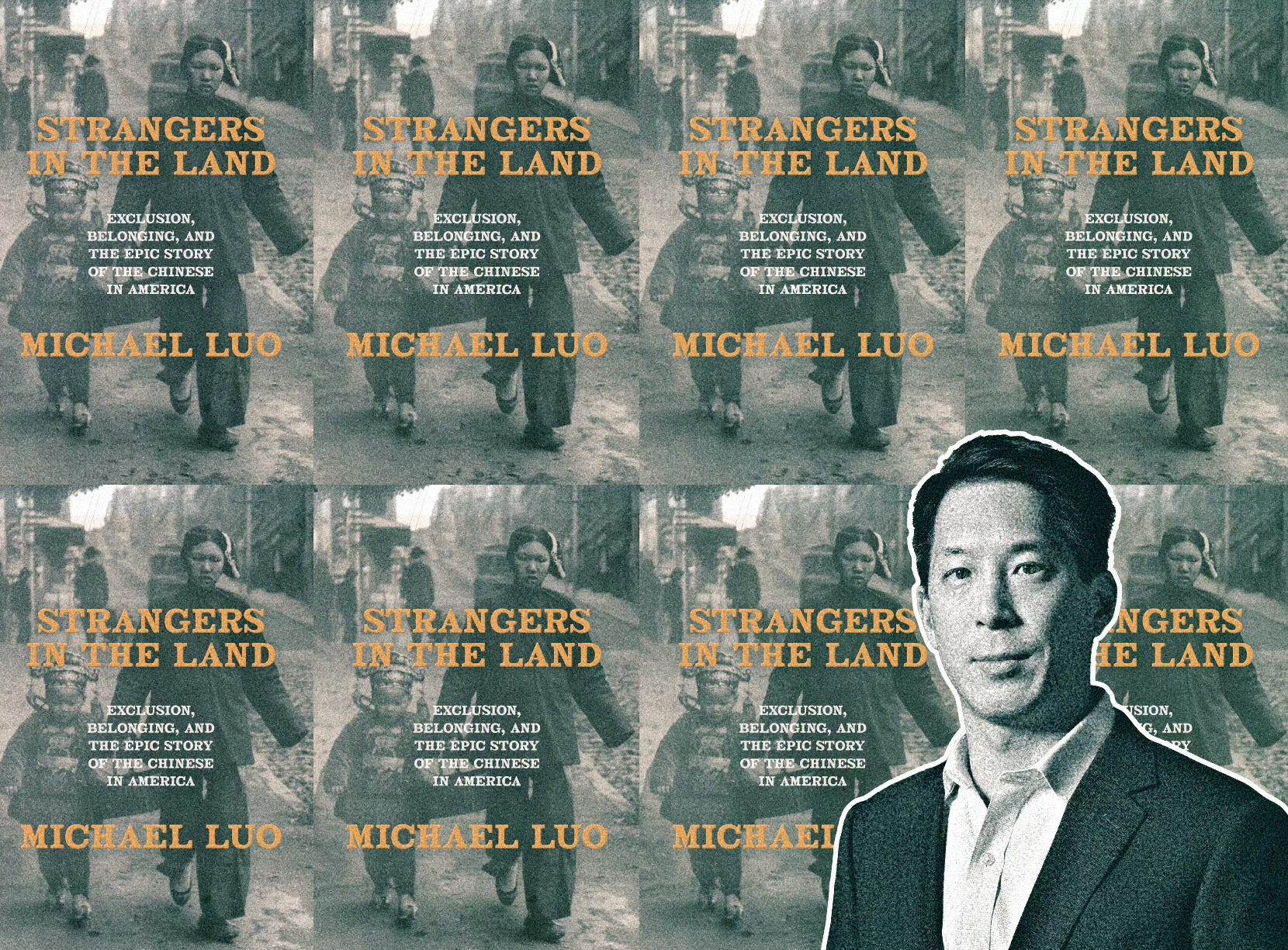
Reading Strangers in the Land: Exclusion, Belonging, and the Epic Story of the Chinese in America by The New Yorker’s Michael Luo can feel like watching a film run in reverse. The history of American immigration—of the nation itself—typically unspools from east to west: Old World departures, the landing at a significant site to be shrouded in myth (Plymouth Rock, Ellis Island), establishment of central hub cities, the gradual westward spread.
The history of the Chinese in America, by contrast, moves like the weather, west to east, spreading from San Francisco and darting out along the rail lines as it helps create them. The result reveals the challenge and opportunity immigration has long presented to the national story. At its center, Luo writes in a decisive, early claim, the “Chinese in America were not simply the victims of barbarous violence and repression; they were protagonists in the story of America.”
In this history, the nation’s central divide follows topography, not culture: East-West instead of North-South. The earliest Chinese immigrants came in the 1840s to an America split legally across the Mason-Dixon line. While a ferry across the Ohio River could bridge that physical gap, New York to San Francisco was a near-impossible ordeal. Chinese workers overcame this challenge. By serving as principal laborers on the Transcontinental Railroad, Chinese American history nearly begins with the literal unification of the nation’s two halves. Indeed, had it not been for the “peculiar institution,” this longitudinal divide would have been the central challenge to American national unity. Without a dependable route through the Rockies and Sierra Nevada, California was as distant as Paris or London.
As Luo points out, the very presence of Chinese Americans—“people from a distant land, who spoke a different language, had different beliefs and customs, and did not fit into the country’s existing racial stratification”—forced Americans to grapple with the realities of being a truly multiracial democracy. In fact, responses to Chinese immigration came to reshape America’s post-Civil War reckoning with slavery and race. “The Chinese Question followed the Negro Question and coincided with the vanquishing of Reconstruction, the spread of Jim Crow, and the subjugation of Native peoples on the western frontier,” he writes. Understanding Chinese American history betters our understanding of these dynamics, too.

The Gold Rush—the impetus for the first Chinese immigrants—transformed America more than we often imagine. It intensified an East-West dynamic, adding to the cross-pressure of the nation’s North-South divide. Luo shows individual workers and entrepreneurs struggling to succeed in America within—and against—history’s currents rather than as flotsam carried on it. Chinese workers stayed in and continued to come to America after the completion of the Transcontinental Railroad in 1869. They sought new work and to settle into their communities. They acted, in other words, in the same ways as the millions of European immigrants who would filter through New York and Ellis Island in the coming decades. And, though smaller in number, more dispersed, and distant from the great political, cultural, and economic hubs of the late-19th century, they would prove just as transformative.
Free Labor, Free Soil, and Political Fracture
Chinese immigration became the wedge that cracked the Republican Party’s postwar coalition. Its antislavery unity had been a northern unity which the tug of West and East unsettled. The antislavery coalition had joined two distinct causes we too easily conflate: “Free Labor” and “Free Soil.” The Free Labor movement’s antislavery sentiments were grounded in economic self-interest: independent farmers and tradesmen competing with free rather than enslaved workers. The Free Soilers, by contrast, opposed slavery on moral and religious grounds: their antislavery convictions were intertwined with the religious heritage of the Northeast, particularly Quakers, Congregationalists, and evangelicals. The Civil War, in Eric Foner’s account in The Fiery Trial, transformed Lincoln from a Free Labor abolitionist to a Free Soiler: the antislavery cause became a moral as well as an economic and political necessity.
But Chinese immigration pulled these two strands apart again. The Free Labor argument against slavery—opposition to unfair economic competition—was repurposed and deployed against Chinese workers. In Congress, some Republicans used claims that Chinese laborers were “coolies”—workers effectively enslaved by the men who contracted mining and railroad companies for their services—to try to square anti-immigrant policy with the party’s antislavery traditions.
Why did the case against Chinese migrants gain traction among labor advocates and within the Republican Party?
The answer lies at the intersection of demography and economics. The pursuit of free and fair economic competition spurred the Free Labor movement, the formation of the union movement at the end of the 19th century, and calls for restrictions on Chinese immigration. It also spurred on that very immigration itself, as Chinese men came to seek opportunities not available at home.
There weren’t many Chinese in America at the time, and they were almost exclusively located in the western states. Yet anti-immigrant sentiment in those states—along the coast and among inland laborers—made Chinese immigration a national question: California, Washington, and Oregon were swing states whose electoral votes and congressional seats both parties coveted. Chinese labor was cheap and Chinese men were viewed as unassimilable. So in the boom-bust cycles of the postbellum decades, popular sentiment turned against them. The Knights of Labor, the largest organization of the Reconstruction-era labor movement, excluded Chinese workers (even while allowing Black membership); its members took part in forcibly expelling Chinese workers from mining towns along the California-Oregon border. By the 1880s, New England Republicans, the last heirs to the Free Soil tradition, stood more or less alone in opposing the Chinese Exclusion Act.

This was the federal government’s first major foray into immigration policy. Until then, immigration had been largely managed by individual states. While it did not literally exclude all Chinese nationals, near-total exclusion was its goal. The law excluded “laborers”—those who competed for jobs with white Americans—and made it exceedingly difficult for women to immigrate, the goal being to encourage a return back to China by making it impossible for Chinese men to begin family life in America.
The Exclusion Act was immediately met with organized challenges and test cases. These challenges emphasized how the law had created categories of restricted immigrants but failed to define them or specify enforcement mechanisms. In San Francisco, the Federal District Court was overwhelmed with writs of habeas corpus brought by petitioners who argued they had been detained without due process. Decisions in these cases defined the broad concepts Congress had failed to specify: Who qualified as the prohibited “laborer”? How was this to be proven? What of the wives and children of legal residents?
American Birthright
The most pressing legal question raised by the Exclusion Act is among the most salient today: birthright citizenship. In 1884, an early test concerned Look Tin Sing, an American-born 14-year-old denied reentry after five years in China. Although neither parent had been naturalized, a court ruled that Look Tin Sing must be allowed reentry, citing the 14th Amendment. Perhaps more notably, his case was aided by an amicus brief from former Nevada Sen. William Stewart. Previously in Congress, Stewart had “vociferously opposed naturalization of Chinese immigrants” but now “warned that there were ‘millions’ of white children born in the United States whose parents were not yet naturalized. Refusing to recognize Look Tin Sing as a citizen could spur a backlash that would jeopardize the passage of additional Chinese restrictions.”

In the 1898 case Wong Kim Ark v. United States, the Supreme Court confirmed that to exclude American-born children of foreign nationals would “be to deny citizenship to thousands of persons of English, Scotch, Irish, German, or other European parentage who have always been considered and treated as citizens of the United States.”
The Trump administration’s arguments against birthright citizenship are grounded in a textual claim about the 14th Amendment: that undocumented or unlawful immigrants, as well as temporary residents, are not “subject to the jurisdiction” of the U.S. Their children, therefore, do not qualify for birthright citizenship. According to Trump, the accepted, expansive view of birthright citizenship is grounded in “historical myth” that was never the intent or purpose of the 14th Amendment.
These are legal claims that require historical evidence. Though Luo finished Strangers in the Land well before the January 2025 executive order attempting to limit birthright citizenship, his book helps us see that Wong Kim Ark was not an aberration or judicial overreach, but emerged from and accurately represents decades of public argument over immigration policy. Luo shows how immigration was indeed a consideration as Congress wrote, debated, and ratified the 14th and 15th Amendments. Congress recognized that guaranteeing the franchise, citizenship, and due process to freed slaves also had ramifications for immigration policy—enough so that concerns about allowing Chinese immigrants access to citizenship and voting rights “nearly derailed” the 15th Amendment. Congress knew exactly what the amendments would entail. Then they and the states chose to ratify them.
There are echoes of our present in this history: poorly-written major policies, like the Exclusion Act and its 1892 extension, the Geary Act, without defined categories or enforcement mechanisms, overwhelmed immigration courts, debates over constitutionality, judicial intervention. We see the constitutional system largely holding against demagoguery—and also co-existing with an 80-year exclusionary legal regime.

The Chinese Exclusion Act and, especially, the Geary Act produced policy chaos. Between 1890 and 1920—the heart of the period called “the Immigration Era” when the focus is on the eastern United States—the number of Chinese residents and citizens declined from 107,000 to 62,000. Rising post-World War I nativist dismay at southern and eastern European immigration (especially of Jews fleeing Tsarist and Bolshevik Russia) led legislators to use the Chinese Exclusion Act and its successors as a model for the Immigration Restriction Acts of 1921 and 1924. Yet it was during this decade that the Chinese American population began to grow again, bolstered by American-born citizens. Closing the gates failed to create a homogeneous America, perhaps because no such place had ever existed.
The Human Story
While we think of America’s immigration history in terms of Ellis Island’s large scale and efficient entry, immigration enforcement found its origins on the other coast. These policies and practices emerged in a much more haphazard and contingent process than hindsight tends to show.
But the political and legal history of Chinese immigration, valuable as it is, is not the biggest reason to read Strangers in the Land. That lies in the encounters Luo provides with the dignity of those who lived it—their quintessential Americanness. Through their stories, he brings out the loneliness, the solidarity, and the frontiersmanship of these scattered immigrant communities. The individuals we encounter include railroad workers Mock Chuck and Jow Kee—and also the fiercely independent prostitute, Ah Toy. She resisted blackmail schemes from San Francisco’s Chinese community and took on as her lover the head of an anti-prostitution task force before a second act as the wife and widow of a wealthy businessman in San Jose, living to just shy of 100. Then there is Yung Wing, the Yale graduate who straddled two nations and cultures and spent his life trying to make them learn and benefit from each other. We see, too, the survivors of the deadly 1885 riots in Rock Springs, Wyoming. In their old age, they were still digging for ore, refusing to leave and, in the process, making themselves as much a part of the land’s story as their Scotch-Irish counterparts in West Virginia or Italian immigrants digging coal in Pennsylvania.
My biggest complaint is that this social history, which Luo has a talent for conveying both in detail and in its broader contours, largely falls away as discussion of the Exclusion Act and Geary Act begin. The book clocks 432 pages, with another 110 of end matter. But we see the effects of the Exclusion and Geary Acts largely in numbers rather than in the lives of those who bore its brunt. While the first 60% of Strangers in the Land demonstrates that immigration policy affects people, not simply a people, this humanizing focus gets squeezed out in the final chapters.

Had Luo continued to tell the full, human story rather than narrowing his focus to the legal history of the anti-Chinese immigration acts, he might not have excluded the rise of major Chinese communities beyond San Francisco and Los Angeles. New York’s Chinatown enters the story already formed. While Luo provides detailed accounts of the lives of several Chinese immigrants in New England, these are exceptions. Reading the experiences of those who lived in New York’s Chinatown alongside those of San Francisco’s would help illuminate both. These would tell of the overland route east, of their different but still physical labor in urban laundries rather than mining and road building, and of the possibilities opened by not needing to physically rebuild their community after the 1906 San Francisco earthquake. I would have happily read another hundred pages for these stories.
But what the book conveys on every page is that those who find America also found it. This is something we need to be regularly reminded of, especially today. In the end, immigration isn’t just a chapter in the American story—it’s the story itself, written anew with each arrival.

© The UnPopulist, 2026
Follow us on Bluesky, Threads, YouTube, TikTok, Facebook, Instagram, and X.
We welcome your reactions and replies. Please adhere to our comments policy.

This is a well-written article, kudos, but it dances around the key issue today. The Biden Administration egregiously broke the law to admit millions and millions of obviously fraudulent 'asylum seekers' onto U.S. soil, most of whom have presumably been racing to pop out babies to complicate the eventual deportation that the law demands. No matter what the Supreme Court decides, sooner or later birthright citizenship will either be ended for illegal aliens/birth tourists or the border will have to be entirely sealed to women who are or may become pregnant. The soft system of de facto birthright citizenship was nice while it lasted, but the scale of shameless abuse that the Biden administration enabled (and for which this publication made any number of dubious excuses) is simply not sustainable. It would be far more productive for The Unpopulist to seek a viable compromise rather than insist upon migration maximalism.
If squirting out a baby after you hop the border is automatic citizenship, we don’t have a nation.