


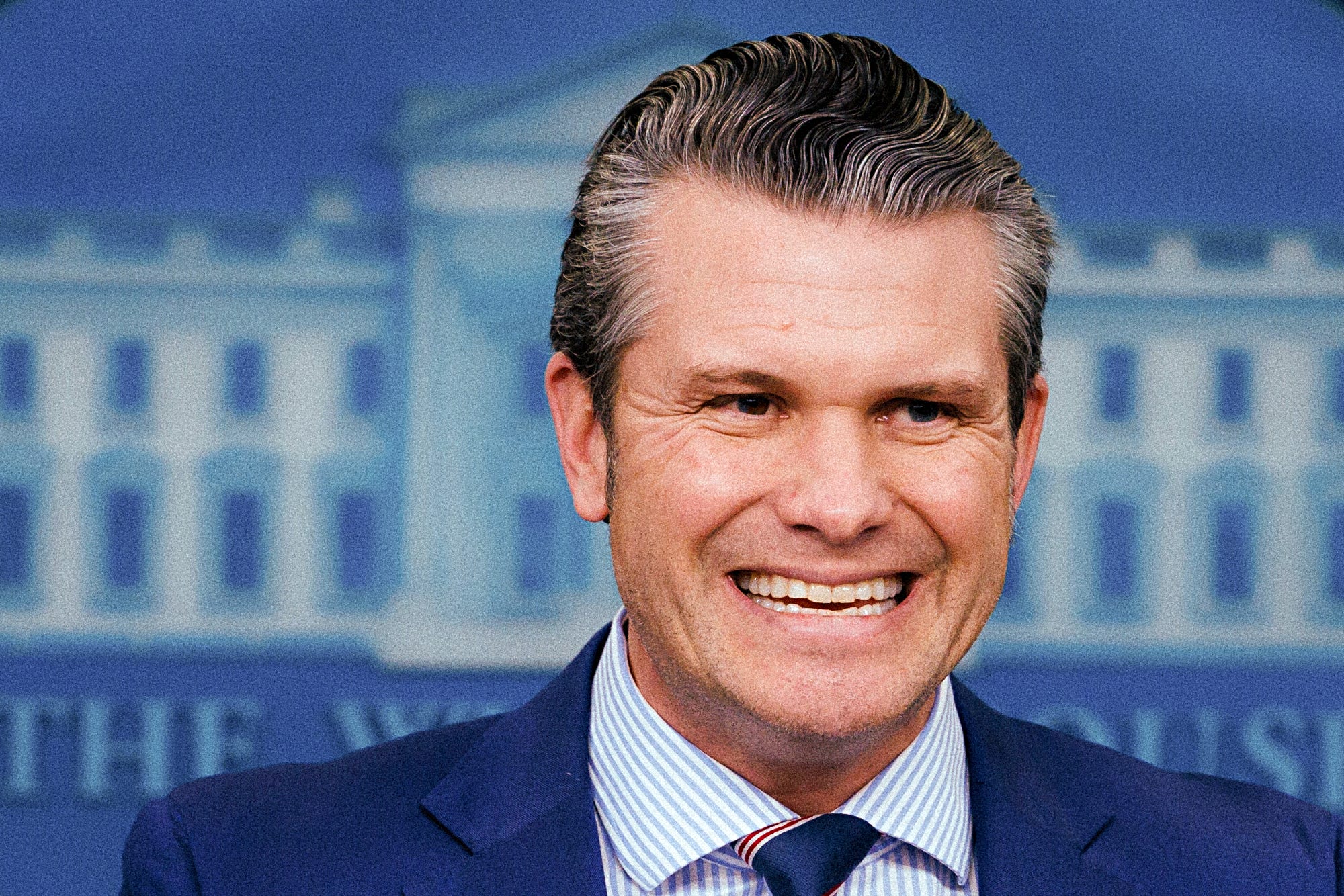
In what we used to think of as ordinary times, commemorating the anniversary of D-Day—when Allied forces stormed the Normandy beaches to break Hitler’s grip on Europe—would have been a straightforward assignment for the U.S. secretary of defense. The commemoration earlier this month offered Pete Hegseth, the current secretary, an opportunity to stand with our allies and remind them of a shared commitment to democracy and freedom. Almost anyone else in Hegseth’s position would have given a speech that fit the occasion, one focused solely on honoring the American and allied service members who fought and died on June 6, 1944. But these are not ordinary times. Instead, Hegseth delivered a profoundly unsettling address, one echoing the message of The Camp of the Saints, a racist and genocidal 1973 novel by the French writer, Jean Raspail, that has found a serious following among the mainstream U.S. right wing.
Speaking at an American cemetery in Normandy, near where Allied forces landed on the beaches to confront Nazis, Hegseth gave voice to the kind of xenophobic hatred American leaders once rejected. “Sadly, today, different European beaches are stormed by different dangerous ideologies,” he declared. “Beaches in Spain and Italy and Greece and Bulgaria. Boats and men arrive. When will European capitals do something about that invasion? Or is it too late? I pray not, and I believe not.” This was no offhand remark or stray aside; the words appear in his prepared remarks, as published online by the DOD.
It is hard to imagine a more grotesque misuse of the moment. Standing on ground consecrated to men who died fighting the Nazis, Hegseth used their memory as a stage for the very xenophobia they gave their lives to defeat. This is not a mere failure to read the room—it’s an attempt to conscript the great struggle against fascism into the hard right’s current war on multiracial democracy, as though the two were continuous rather than causes in diametric opposition to each other. Hegseth’s “lesson” from D-Day is that European nations must fight off foreign invaders coming to their shores. But, of course, the “boats and men” who landed on the beaches in 1944 were only “invaders” from the perspective of the Nazis.

When I processed Hegseth’s warning about beaches and boats and invasion, I thought immediately of Raspail’s novel—which, in the decades since, has become a kind of scripture for the xenophobic right on both sides of the Atlantic. In language strikingly similar to Hegseth’s, Raspail told the French magazine Le Point that he wrote the book after asking himself, “And what if they came? This ‘they’ was not clearly defined at first. Then I imagined that the Third World would rush into this blessed country that is France.” As the interview’s subtitle put it: For Raspail, “there are no migrants—only an invasion.”
The novel is, as The UnPopulist’s Shikha Dalmia wrote 10 years ago, “a perennial cult classic among white supremacists in America and Europe.” But as she observed then, “this vile tract has slowly risen out of the white supremacist ghetto” into prominent conservative outfits. This rehabilitation began, in no small part, in the heart of the conservative establishment. National Review championed the novel from the start, with senior editor Jeffrey Hart hailing it as a “superb scandal” in 1975 and William F. Buckley Jr. later praising it as “a great novel.” Decades later the Washington Examiner was still treating Raspail as a prophet, running an essay that cast his fictional scenarios as confirmed by current events. And the book has found a home, too, in the intellectual venues of the postliberal right, most recently in First Things—self-described as America’s most influential journal of religion and public life—which ran a defense of it three years ago ranking it alongside 1984 and Brave New World as the most important dystopia of its era.
The book also found a following in Trump’s entourage. In 2015 emails later made public, Stephen Miller, the architect of Trump’s anti-immigrant crusade, urged the right-wing website Breitbart to write about the novel. Prompted by Pope Francis’s call for the West to welcome refugees, Miller wrote: “Someone should point out the parallels to Camp of the Saints.” MAGA operative Steve Bannon, who was Breitbart’s executive chairman in 2015 before taking over as chief executive of Trump’s 2016 campaign, was enthusiastic about the book. During the campaign, Bannon repeatedly invoked what he saw as a direct parallel between refugees fleeing the Syrian civil war and Raspail’s novel—“this kind of global Camp of the Saints,” he called it. Bannon echoed Raspail precisely: “It’s not a migration. It’s really an invasion.”

Bannon went on to serve in the White House after the election. It is unclear whether Trump is aware of The Camp of the Saints but, like Hegseth, he speaks its language. His reelection campaign team, still during his first term, pushed the idea of an “invasion” at the southern border, amplifying fear-inducing language about immigrants that Trump also voiced at campaign rallies and on Twitter. In 2019, his campaign ran more than 2,000 Facebook ads using the word “invasion,” a theme Trump echoed in his tweets and that his 2016 advertising had already foregrounded with warnings about immigrants breaching America’s borders. At a campaign rally in Florida in 2019, Trump asked supporters “How do you stop these people?” When someone in the crowd yelled “Shoot them,” Trump paused and smiled as the crowd cheered, then said, “That’s only in the Panhandle you can get away with that statement. Only in the Panhandle.”
Trump’s “invasion” rhetoric has continued during his second term, even directly eventuating in policy. This was evident in his administration’s egregious misapplication of a John Adams–era law to groundlessly declare an invasion as the basis for sending hundreds of Venezuelan men to CECOT, a notorious prison in El Salvador, where they were reportedly tortured.
Trump barely bothers to conceal the ethnonationalist impulses that animate his immigration politics. As of mid-June 2026, the Trump administration had permitted 6,668 refugees to enter the U.S. since October 2025—all but three of them white South Africans.

But the gravest danger lies in the link between the president’s xenophobic agenda and violence. When Trump speaks of “invasion,” this is not just hateful rhetoric. The First Amendment rightly protects even repugnant political rhetoric. But it is the kind of stuff that national security experts believe leads to stochastic terrorism: rhetoric that doesn’t explicitly tell anyone to commit violence but makes it likelier that someone eventually will, all while letting the speaker deny responsibility. As Kennedy School professor Juliette Kayyem explains, the violence incited by such rhetoric is “utterly predictable.” Indeed, Robert Bowers, who killed 11 people at a Pittsburgh synagogue in 2018, had repeatedly referred to people traveling to the United States as “invaders” on the far-right social media site Gab. In one post just before the murders, Bowers declared that “HIAS”—the Hebrew Immigrant Aid Society, a Jewish nonprofit that resettles refugees—“likes to bring invaders in that kill our people. I can’t sit by and watch my people get slaughtered. Screw your optics, I’m going in.” Similarly, the gunman who killed 23 people at a Walmart in El Paso, Texas, in August 2019 wrote a manifesto describing a “Hispanic invasion of Texas.” In 2022, yet another gunman, at a supermarket in a predominantly Black neighborhood of Buffalo, New York, had posted online that the shoppers came from a culture seeking to “ethnically replace my own people”—a direct invocation of the Great Replacement conspiracy theory that animates so much “invasion” rhetoric.
It is one thing to read the nauseating words in Raspail’s novel, or to hear government officials—knowingly or not—echo his rhetoric. It is another thing to see multiple mass murders carried out by killers using that same rhetoric. And the violence it licenses is not confined to lone gunmen. Earlier this month in Belfast, Northern Ireland, after a Sudanese asylum-seeker was charged with a brutal knife attack, far-right agitators circulated lists of addresses believed to house immigrants—and masked rioters went door to door, setting fire to the homes of families who had nothing to do with the crime. They left more than two dozen people homeless. Rioters reportedly chanted “foreigners out,” language calling to mind the darkest days of the 1930s. It wasn’t enough that the asylum seeker was instantly arrested and will face justice as befits a functioning, civilized society. Vigilante violence is necessary for collective punishment of innocents. This is the logic of barbarism—the kind of thing that The Camp of the Saints leads to in the name of defending Western civilization.

Hegseth is right to observe that the anniversary of D-Day reminds us of our own moral choice today, but he identifies the wrong source of evil. Hegseth accused immigrants of bringing “dangerous ideologies” to Western shores. But he is the one peddling dangerous ideologies—and they are entirely homegrown. Immigrants do not have any singular ideology; they seek a new start, and when they come to the West, they have often come in search of freedom from bigotry. The Allied forces at D-Day fought and died to defeat a regime built on a genocidal vision of racial hierarchy. Hegseth’s speech is the latest ugly reminder from this administration of how thoroughly it and its most devoted followers have abandoned what those Allied forces fought for.

One Last Thing …
Today is Juneteenth, a day commemorating the foundational liberal triumph of emancipation in America. It stands as a profound reminder that the expansion of human liberty is neither self-actualizing nor irreversible. It actually requires an ongoing, enduring vigilance against the persistently illiberal impulses always threatening to sprout up and make us un-free.
Last year, in honor of Juneteenth, we published a powerful essay by historian Manisha Sinha, author of the excellent The Slave’s Cause: A History of Abolition. Sinha, a professor at the University of Connecticut and president of the Society for Historians of the Early American Republic, argued that Abraham Lincoln was not a static, predetermined emancipator, but a leader whose political and moral worldview was dynamically shaped—and pushed toward true abolitionism—by the relentless pressure of grassroots anti-slavery activism and Black resistance.
She will speak at LibCon2026 on the “Past Liberal Crises and Lessons: Overcoming Hurdles to Reconstruction” panel.
Here is a teaser of her essay—but do read the whole thing:
Abraham Lincoln was not an original advocate of abolition. In fact we know that his journey to what he called “the central act of my administration, and the great event of the 19th century” was a relatively slow, though continuous, one. Emancipation was a complex process that involved the actions of the slaves, the Union Army, Congress, and the president. ... Lincoln, a moderate, anti-slavery Republican, was committed only to the non-extension of slavery, the lowest common denominator in anti-slavery politics, with a rather nebulous hope in its “ultimate extinction.” …
With the outbreak of the Civil War in April 1861, abolitionists and radical Republicans immediately urged Lincoln to use his war powers to strike against slavery. … African American leaders, abolitionists, and radical Republicans, who had long envisioned the establishment of an interracial democracy in the United States, played an indispensable role in pushing the president to accept the logical outcomes of his own views on slavery and democracy: abolition, Black rights, and citizenship.
By the time of his death, Lincoln’s views on slavery and racial equality had evolved greatly. Abolitionists, African Americans, and radical Republicans challenged him to abandon colonization and accept both abolition and Black rights. Their ideas on interracial democracy and equal citizenship, largely forgotten in the history of emancipation, forced both the president and the nation to accept the consequences of abolition and helped set the agenda for Reconstruction.

© The UnPopulist, 2026
Follow us on Bluesky, Threads, YouTube, TikTok, Facebook, Instagram, and X.
We welcome your reactions and replies. Please adhere to our comments policy.

These fascists cater to man’s basest instincts. Their philosophies exemplify our late emergence from the forests and trees. Primitive, Uncomplicated twaddle promoted by the simple-minded and aimed at the ignorant. A welcoming audience.
Westerners used to understand racism was true. It’s just science. Most of the soldiers that fought in D-Day were racists.
But after the nazies and it was decided by polite people that the science of race had to be covered up. Even Pete is pretending that the problem is “ideology”.
The problem isn’t ideology. It’s that low iq cousin fucking people from the Middle East are subhuman garbage. If they stop believing in Islam it doesn’t matter, it’s just an ethnic allegiance marker. They are still going to be violent welfare sponges.
Europe being conquered by savages because Hitler died 80 years ago is pretty fucking stupid, but ideology is a hell of a drug.