


Book Review
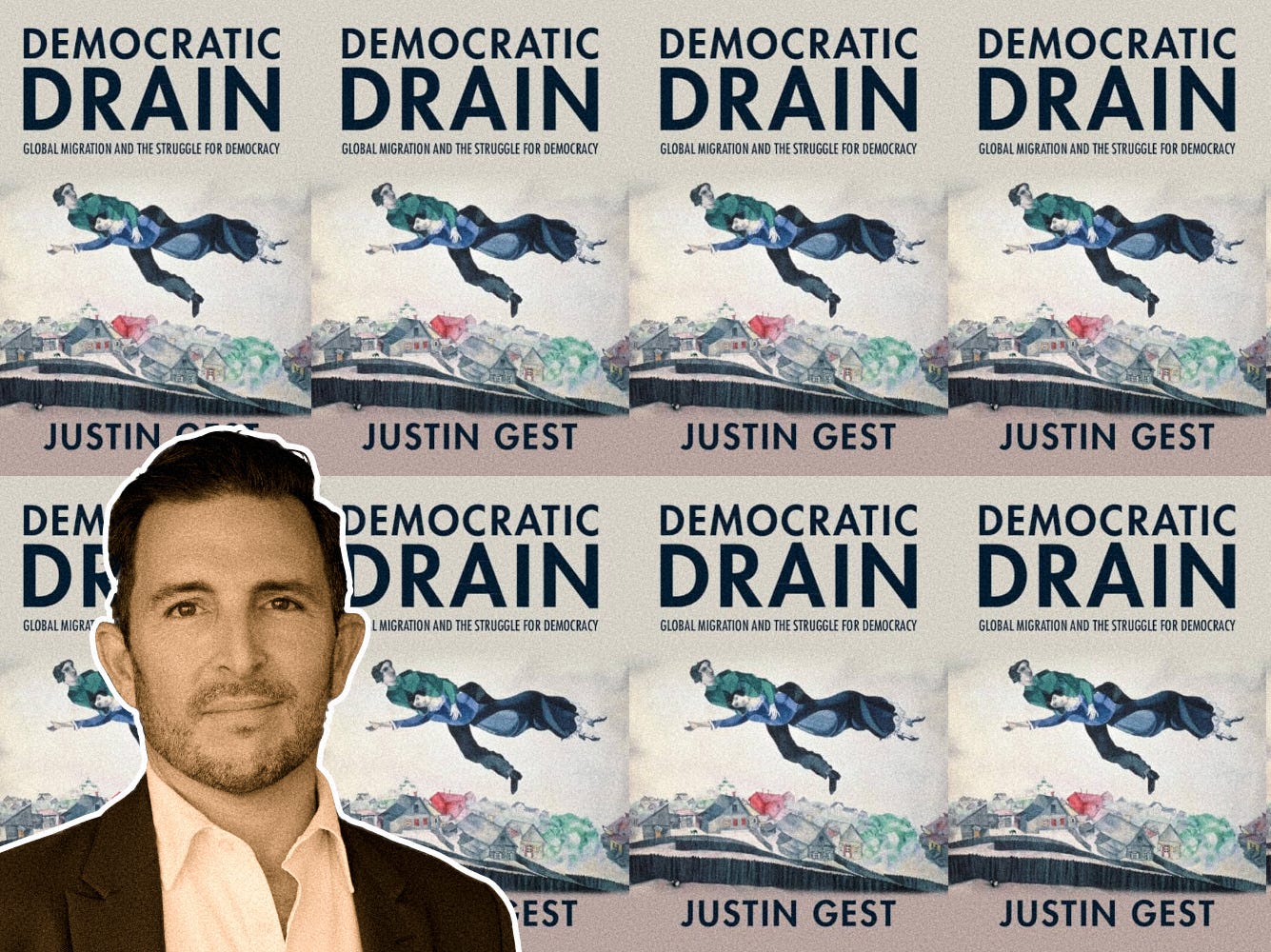
In his new book Democratic Drain: Global Migration and the Struggle for Democracy, political scientist Justin Gest proposes that migration has negative consequences for the governance of countries of origin. The term “democratic drain” of course evokes the old notion of brain drain, the idea of mass emigration of the most highly educated professionals, leaving the country that invested in them with less talent. Similarly, argues Gest, professor of Policy and Government at George Mason University’s Schar School, prospective migrants are more likely to embrace the values of liberal democracy. When they depart, they leave their less democratically inclined brethren behind: voilà, democratic drain. Darkness falls.
The book, published by Cambridge University Press, is pleasingly short, at just 150 pages, and very readable by the standards of a serious political science book. It combines analysis of surveys of prospective migrants (and non-migrants) in a broad range of countries with vox pop interviews. Take the fourth chapter: the first half or so is vignettes of liberal Hungarians who are considering emigrating, followed by similar snippets of Serbians. The rest is a discussion of survey results that show how Eastern Europeans who are considering emigrating think about liberal democracy compared to those who do not—and how those beliefs translate into voting preferences.
He finds that “prospective immigrants from Eastern Europe (0.41) are incrementally but statistically significantly more liberal than their countrymen (0.44). While the difference is not large, the massive scale of East–West migration greatly amplifies its effect. This reflects the same differences I observe in Middle Eastern and North African countries.” A few pages later he concludes:
People with illiberal orientations are 19.5 percentage points more likely to favor far-right parties and 16.5 percentage points more likely to favor far-left parties. [This trend] is amplified in the East where people with illiberal views are 32.9 percentage points more likely to favor far-right parties and 22.1 percentage points more likely to favor far-left parties. This finding underscores the pivotal choice liberal emigrants make when they elect to depart. Liberal, democratic parties in Eastern Europe, if they are to ever win office, rely on their support.
Difficult to Prove
But is Gest’s overarching thesis compelling? That is less clear. I do not mean that I do not believe the survey results, per se. It seems plausible that the people most likely to indicate they are considering migrating are also more likely to hold more liberal democratic values. You know, young, highly educated, cosmopolitan folk. And Gest’s survey evidence is reasonably convincing on this point. But to get from there to the conclusion that migration makes it meaningfully more likely that countries of origin descend into illiberalism, like Vučić’s Serbia, or remain full-fledged dictatorships, like Assad’s Syria, involves a few more steps.

The first step is from intent to action or, in social-science lingo, from stated to revealed preference. The people Gest interviewed, either through mass surveys or in person, were almost exclusively prospective migrants. There are some good reasons for that—as he notes, it is surprisingly difficult to find reliable, detailed data on cross-country migration flows that show how many actually followed through and left. And if you interview people who have already migrated, their values and beliefs may no longer be what they were prior to departure. But those considerations do not change the fact that choosing an answer to a survey question is much lower stakes than choosing to migrate and actual decisions may differ from expressed intent. Survey answers are also biased by social desirability, prospective migrants are not necessarily representative of actual migrants, and introspection about true motives can be challenging even for the sincerest among us. I obviously understand why Gest does not emphasize these concerns—they are baked into his methodology—but they are nonetheless real.
But let’s say those who choose to leave are, in fact, those most committed to liberal democracy. The next step in the chain of logic is for the change in the distribution of beliefs of the country of origin’s population to change governance in that country for the worse. While the previous steps involved the magnitude of democratic drain itself, here we are dealing with the consequences of democratic drain. With limited information on realized migration decisions and flows—how many of those who expressed a desire to emigrate actually did so?—estimating the size of this effect is challenging. Even if we had flawless cross-country panel data, we would have to overcome obstacles to accurate estimation like reverse causality and omitted-variable bias.
Could Emigration Lead to Democratic Gain?
What do I mean by reverse causality? It may well be the case that we observe countries undergoing democratic drain and democratic backsliding at the same time. But that is to be expected even if departing liberals do not affect governance at all: people who value liberal democracy are more likely to leave in such circumstances. A good number of Gest’s interviewees, in fact, express desires precisely along those lines, suggesting that reverse causality might be a powerful obstacle to our identification of true effect size. As Rita from Hungary puts it in Chapter 4: “Before the elections, everybody said to me, ‘I understand that you want to leave but please don’t,’ and, ‘Just try to change things for the better here.’ But now, everybody is on the same page; they’re leaving. Now everybody understands that there is no hope left.” Omitted variables could similarly bias our estimates. Imagine that economic performance drives both out-migration decisions and authoritarian electoral success. We might see that both phenomena are correlated across countries and over time, without them being directly causally linked at all.

Gest refrains from explicitly assessing the size of the treatment effect. But let’s give it some thought—easier to riff than to carry out a formal econometric analysis. Two of the countries that feature most prominently in the book are Syria and Hungary. If Gest’s thesis is true, these are two cases where we should see the clearest evidence of its implications. Hungarians can move freely to the generally richer other member states of the European Union, making out-migration easier than practically anywhere else. During the Syrian Civil War, a quarter or more of the pre-war Syrian population left the country. And yet: after Gest’s book went to press, the Hungarian opposition overwhelmingly won the 2026 general election, bringing Viktor Orbán’s illiberal regime to an end and replacing it with a government led by a center-right member of the European People’s Party in good standing. In Syria, opposition forces led by former al-Qaida member and surprise neoliberal icon Ahmed al-Sharaa finally toppled Bashar al-Assad’s dictatorial regime in late 2024—a development Gest remarks upon but does not grapple with. If we do not see major consequences of democratic drain in these two cases, it is hard to imagine we will elsewhere.
It should not come as a surprise that the evidence on democratic drain is at best ambiguous, as there are potential countervailing forces that can offset the compositional effect Gest highlights. Gest mentions that diaspora communities may push for political change in their countries of origin directly through political action or indirectly by influencing political attitudes in their country of origin. Emigration may also force ruling elites to reduce their authoritarian ambitions and limit the downside risk of activism by providing dissidents with an exit option. Meanwhile, concerns about dissident diaspora effects on the politics in the origin country was behind the restrictions on out-migration imposed by many of the 20th century’s most repressive regimes. Prior work by social scientists reinforces the view that the democratic gains from outmigration may well outweigh democratic drain. Chapter 5, in which Gest argues against this view, is the book’s weakest.

The best-known paper on the political consequences of emigration, cited but not engaged with by Gest, is by economists Mounir Karadja of Uppsala University and Erik Prawitz of Linnéuniversitetet. In “Exit, Voice, and Political Change: Evidence from Swedish Mass Migration to the United States” (Journal of Political Economy, 2019), they compare Swedish regions from which more people migrated to the United States in the 19th century due to unusually poor weather conditions to areas from where fewer people did so. They find that more outmigration led to more political activism, more political reform, and more inclusive political institutions. They argue these changes are driven by the increased bargaining power of those who remained in Sweden—not, as Gest asserts in his reference to the paper, by the diaspora’s attitudinal pro-reform influence.
There are other points in this chapter where I think Gest takes his commitments too far. He argues that the disproportionate support for the ultra-conservative, sharia-touting Nour Party in the 2011-2012 Egyptian election by people with family members who migrated to Saudi Arabia is an example of how diaspora communities end up supporting “paramilitary and illiberal groups, not democratization.” Apart from the complicated question of which parties worked to preserve and destroy Egyptian democracy, is he now then arguing that the Egyptians who moved to Saudi Arabia are particularly illiberal? It is not particularly coherent.
Illiberal Diasporas
But then he also tries to have it both ways, seeing diaspora communities as both the potential saviors of liberal democracy and relentless supporters of authoritarian regimes. In the latter category, he puts the “Jewish diaspora” in the United States. Setting aside that the American Jewish community is not mainly the product of recent emigration from Israel, it is not a community that is particularly supportive of Israel’s illiberal parties—certainly not when compared to Israeli voters.

A question the book does not focus on much, but that is directly related, is that of the impact migrants have on their host countries. To the extent that our concern is with preserving and advancing democracy globally, that question is as important as that of their impact on countries of origin. The existing work on this topic suggests to me that there is some evidence for a positive impact of immigrants on destination country institutions, which would serve to offset the impact of democratic drain, if we accept for the sake of argument its negative impact on countries of origin. Gest argues, however, that immigration has in many cases made native-born voters more susceptible to illiberal messages and movements. I think the jury is out on the aggregate effect, especially since efforts to seal off a country have an even more deleterious effect on liberal institutions.
Way Forward
Gest does not prioritize the implications of his narrative for policymakers in the West either—the book does not end with the usual low-quality chapter of policy recommendations—but he suggests some ideas here and there. One point he notes is that there has been a push in many Western countries, including the U.S., to reorient immigration policy more toward high-skilled immigrants. He doesn’t draw out the policy implications for his democratic drain thesis but his concerns suggest that would be a move in the wrong direction. Those migrants are precisely the ones most likely to be committed to liberal democracy in their countries of origin. Instead, in my view, Gest’s findings point toward the importance of preserving legal pathways for the full spectrum of immigrants, including through family reunification.
There are of course other arguments in favor of caution in letting the ideological preferences or theories of Washington bureaucrats instead of the needs of families, firms, and universities determine who the most valuable immigrants are. There are the usual arguments against grand schemes of central planning; there is the simple fact that reuniting existing residents with their loved ones creates value in ways measures of fiscal impact are unlikely to capture; and a balanced mix of immigrants ensures that immigrants are not only present in select, siloed pockets of society. Although Gest does not offer his preferred policy solutions, if his book can help sustain caution toward narrowing the spectrum of potential immigrants, it will have made a valuable contribution to policymaking as it has to our understanding of the value systems of prospective migrants.

© The UnPopulist, 2026
Follow us on Bluesky, Threads, YouTube, TikTok, Facebook, Instagram, and X.
We welcome your reactions and replies. Please adhere to our comments policy.

What's difficult about the Social Sciences is the researchers have no theory. There's no shame in their game for that. It's just predicting human behavior is really hard when there's so many variables. So researchers do experiments.
They learn a lot and discover more more things that need to be understood to get closer to the truth. Your look at this book got me interested. The findings are different from what was going on during the cold Cold War and after the fall of the Soviet Union when most immigrants to Western Europe were right wing and maybe more pro capitalism than prodemocracy. But I could be wrong.
At the end you mention that immigration should be based on getting a full spectrum of people not just highly educated youngs and consider other factors.
I thought that might make it easier to manage immigration. I think it also gets to a core thing about values. Most of the time when advocates try and prove that a moral sentiment makes rational or financial sense they can weaken their arguments abs get into debates about money and advantages that are always contested thus making their own case smaller.
I know that what a society gains from immigration is important and a case needs to be made that considers how the immigrants will be supported. There's the thing about valuing humans only for what they can produce that's not good.
Interesting perspective. We often assume that emigration weakens a society, yet history also offers examples where diasporas became sources of political and cultural renewal. Perhaps the real question is not whether people leave, but whether they remain connected to the place they left behind.