


The voters who supported Kamala Harris for president have become markedly more cynical toward America’s elites since 2024, according to the latest populism survey from the Institute for the Study of Modern Authoritarianism, publisher of The UnPopulist. In ISMA’s previous survey in August 2024, before the presidential election, 59% of those planning to vote for Harris strongly agreed that at least one of six American elites had harmed people like them in pursuit of the elite’s “own selfish interests.” In June of this year, 69% of those who said they voted for her did, a 10-point rise and the only statistically significant shift Harris voters displayed among the four populist attitudes the survey tracks.
On that attitude, the former Harris coalition now rivals Trump voters, 65% of whom say the same, even if the two groups target the various elites at different rates. But the rise has not made more of these Harris voters populists. ISMA counts as populist anyone who holds at least three of four characteristic attitudes. By that measure, 15% of Harris voters qualified in both surveys, well below the current 25% among Trump voters, whose populist contingent has itself, ISMA found, thinned from 36% in 2024. What has grown among Harris voters is a grievance against elites, not the survey’s other three potential populist attitudes: a strong attachment to a political leader, an othering of social outgroups, or a tolerance for the leader’s exceeding limits on his or her power. It is combinations of the four elements that give populism a destructive, authoritarian character.

One note on terminology: “Harris voters” are not necessarily strong supporters of Kamala Harris personally; indeed, only 6% expressed a strong personal attachment to her. Rather, the term simply refers to those who voted for Harris in the 2024 presidential election, the vast majority of whom were Democrats.
What Moved and What Didn’t
The table below shows how Harris voters weighed in on the four attitudes in August 2024 and June 2026. Strong attachment to a leader and antipathy toward outgroups barely moved. Anti-elite sentiment rose 10 points, and support for the leader exceeding legal limits fell seven. But both shifts, it turns out, occurred mostly among voters holding two or fewer of the four attitudes—that is, within the nonpopulist majority. As a result, the share of populists stayed flat.
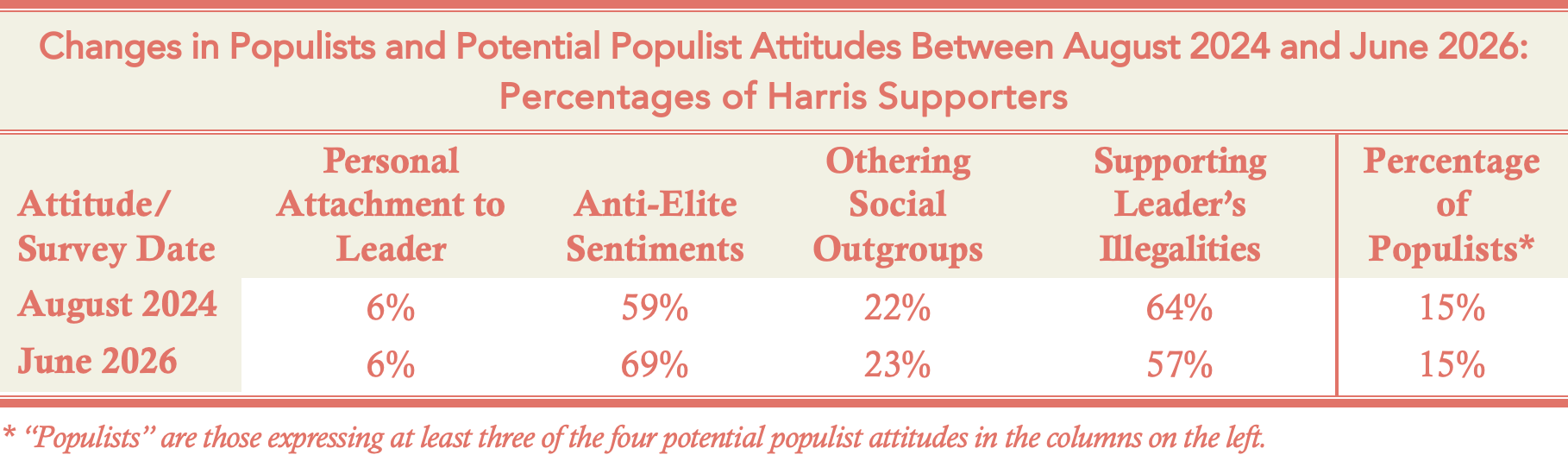
That stability was hardly guaranteed. Democrats have been shut out of power in the House, Senate, and presidency since January 2025—the kind of situation that can inflame populist sentiment in an opposition party. And that did lead to the significant rise of anti-elite feelings among Harris voters. But that is the only one of the four attitudes on which Harris and Trump voters now look alike: 69% versus 65%, respectively—a gap that’s not statistically significant.
To be sure, this is not the only area of concern with Harris voters. A majority of them, 57%, would accept her exceeding the legal limits on presidential power. That is not a comfortable number for anyone who values constitutional constraints. And while 57% is down from 64% in 2024, the same attitude is down even further among Trump voters—to 49%, from 63%.

Still, even the August 2024 survey indicated that Harris voters were, on the whole, open to accepting renewed limits on executive power. And since then, their tolerance for a leader’s overreach has noticeably declined. Anti-elite sentiment has done the opposite.
Anger at Elites, Aimed Differently
The survey asks, for each of six elites, whether the group has “often harmed the interests of Americans like me in pursuit of their own selfish interests.” The six are national elected officials, unelected federal officials, Christian religious leaders, and elites in the media, in universities and the entertainment industry, and in business and finance. Strongly agreeing about one or more counted as holding the anti-elite attitude.
Some of the rise wasn’t surprising. Given who now runs Washington, Harris voters had partisan reasons to sour on national political and bureaucratic elites, and they have (see table below). But they became more likely to condemn each of the six elites, and every increase but the small one for universities and entertainment was statistically significant.

On political and bureaucratic elites, Harris voters (47% and 37%) are now statistically indistinguishable from Trump voters (43% and 38%). Elsewhere the camps diverge sharply, as the next table shows: Trump voters are far more likely to criticize the media or the universities and the entertainment industry; Harris voters, business or Christian religious elites.
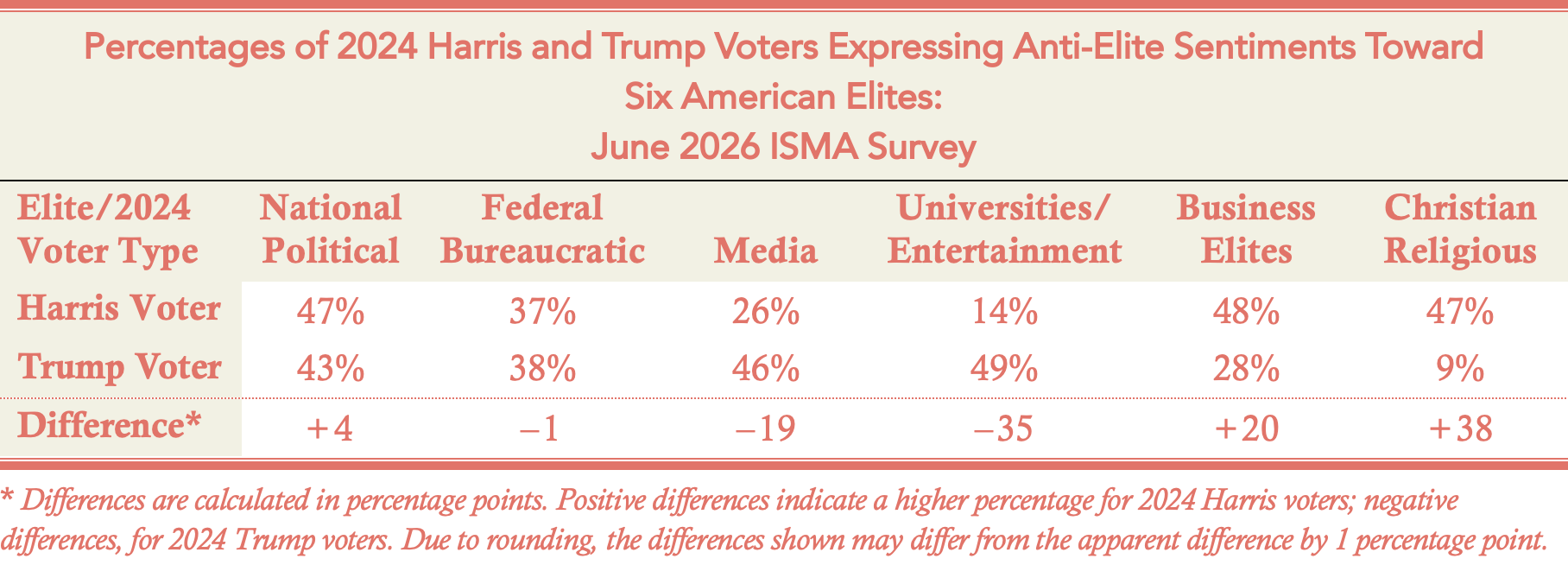
The sentiment’s breadth has grown too. The average Harris voter now expresses strong anti-elite feeling toward 2.2 of the six elites, up from 1.6 in 2024 and about the same as the 2.1 among Trump voters.
Anti-Elite, Not Authoritarian
In ISMA’s model, populism fuses anger at elites with attachment to a leader, hostility toward outgroups, and tolerance for the leader’s breaking legal limits to get his or her way. Among Trump voters, these attitudes are spread more broadly than among Harris voters, for whom unique attachment to their presidential candidate is rare and antipathy toward outgroups is decidedly a minority view. As a result, there are still about five populists in the Trump camp for every three in the Harris camp, even with the decline in the percentage of populists among Trump voters since 2024.

So the distinction is real but not guaranteed. As the congressional election season nears its end, with a presidential one to follow, the many nonpopulist Democratic voters who feel strongly about the failures of America’s elites face a choice: to support norms, structures, and incentives that strengthen the liberal system and curb elite abuses regardless of party, or to take the populist path of letting their leaders weaken legal safeguards to punish and exclude the current elites and the voters who empowered them. Much depends on their decision.

© The UnPopulist, 2026
Follow us on Bluesky, Threads, YouTube, TikTok, Facebook, Instagram, and X.
We welcome your reactions and replies. Please adhere to our comments policy.
“Populism” is a synonym for “anti-elite”.