


Book Review
For most of recorded intellectual history, democracy was an epithet. Plato ranked it among the worst possible forms of government—a system in which the vulgar masses give in to their worst impulses, egged on by demagogues. A democratic society, on this pessimistic view, would be permanently unmoored from wisdom and self-restraint. One of the great reversals of modern political life is that by the late 20th century, as Robert Dahl noted in On Democracy, “all of the main alternatives to democracy either disappeared, turned into eccentric survivals, or retreated from the field to hunker down in their last strongholds.” By “democracy,” Dahl—one of the century’s preeminent theorists of the subject—meant liberal democracy, a political form that had swept the field of the ancien régimes and modern authoritarian alternatives. He also believed it could be compromised by capitalism’s tendency to concentrate economic power in ways that translate into outsized political influence.
The great democratic reversal now looks shakier than it did. On the right, self-described “Dark Elf” Curtis Yarvin has declared democracy dead and CEO-monarchs-in-chief the future—one that, if you squint, looks like Elon Musk commanding his subjects to find his jokes funny. Meanwhile, since Trump returned to power, an unsettling number of left-of-center commentators have taken to criticizing, if not outright disparaging, the swinish masses and their ignorant clinging to guns, religion, and xenophobia. One could be forgiven for concluding that democracy’s once-rosy future suddenly seems up in the air.
Liberals, however, have an answer: their own studied willingness to take a good, hard look in the mirror. Liberal self-reflection, in other words, is a significant competitive edge that the tradition has against its less introspective counterparts, and it will be the key to liberal democracy functioning as it should moving forward. There is no getting around it: We are going to have to be brutally honest with ourselves about the faults in our actually existing liberal democracies, even if that means confronting some cherished idols. The upshot is that honestly confronting the limitations of the democratic form can do the revivifying work of casting its virtues in clearer relief.
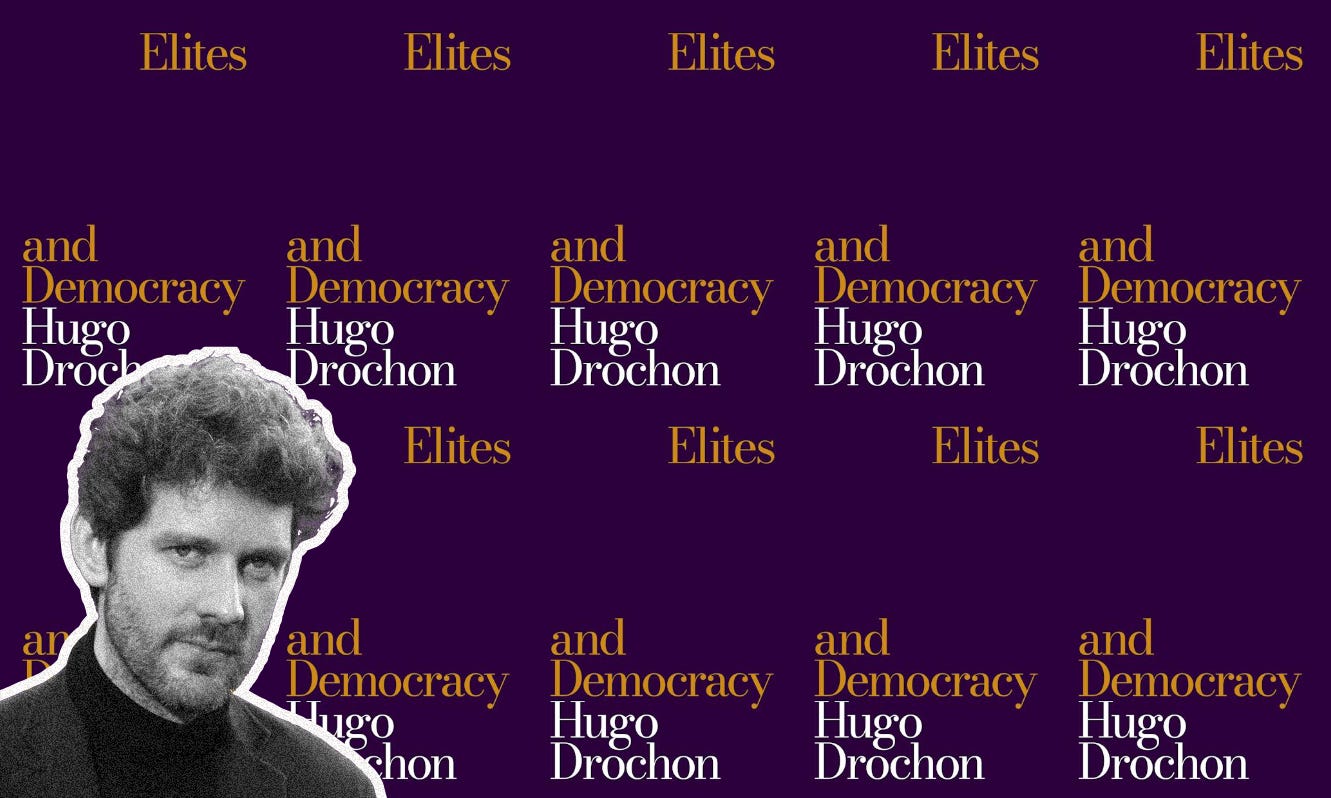
This is precisely the strategy Hugo Drochon takes in his learned and careful new book, Elites and Democracy. Drochon, an associate professor of political theory at the University of Nottingham, identifies as a liberal democrat. But he is more aware than most of the longevity and constancy of anti-democratic sentiments. His previous book, Nietzsche’s Great Politics, was an exceptionally thoughtful contribution to the current renaissance in Nietzschean political theory that demonstrated the extent of the latter’s hard-right convictions.

That background in the work of democracy’s most searching critics has positioned Drochon well to write a “tough love” book for democracy’s friends—one that takes the institutions of liberal democracy seriously enough to demand more of them. His answer to the crisis is what he calls “dynamic democracy”: a liberal theory invested in defending representative democracy, the rule of law, and political parties not as ends in themselves but as the terrain on which the fight against right-wing populism and authoritarianism must be waged.
The Inexorability of Elites
At the heart of Elites and Democracy lies a tension that has haunted democratic theory since the beginning: citizens are supposed to consent to be governed because it is, in some meaningful sense, we ourselves who rule. This is the basis of democratic legitimacy. Of course, liberals have always had a more complex understanding of democracy than simple majoritarianism—even Jefferson expected “we the people” to be complemented by a “natural aristocracy.” But appeals to popular self-rule were ubiquitous in the liberal revolutions of the 18th and 19th centuries. And yet every democracy we’re familiar with has produced an elite class that does most of the actual ruling. Drochon’s central question is how to square that circle: “[How] can the fact that a small number of people wield disproportionate power in economic, social, or political spheres be reconciled with democracy understood as political equality?”
The core of the book is a sustained dive into the elite theorists (meaning: elite-friendly theorists) of the late 19th and early 20th centuries. The authors Drochon examines all insisted that, despite liberal revolutionaries’ highfalutin rhetoric about “liberty, equality, and fraternity,” the actual governing of liberal democracy remained the purview of a rarefied few. This has led many to pigeonhole elite theorists as turgid, conservative critics of democracy who agree with Edmund Burke that the “swinish multitude” doesn’t deserve the same political rights as their betters. Drochon’s account complicates that reading considerably.
For one thing, elite theory had pan-ideological appeal. It claimed economic anti-statists (Vilfredo Pareto) and anti-oligarchic socialists (Robert Michels) alike, as well as conservative jurists like Gaetano Mosca and Vienna-trained economists like Joseph Schumpeter, progressive liberals like Dahl and outright left-wing radicals like C. Wright Mills. From their own ideological standpoints, each became reconciled to the idea that some elite presence would always play a role in politics. The more conservative theorists rationalized elite rule by insisting that the tendency of wealth and power to concentrate in a few hands was natural and ineradicable; radicals like Mills instead pointed to a coordinated “power elite” (more on this below) as proof that a convergence at the top, the phenomenon of elites working together, wasn’t something that would go away.

It would also “be a mistake to understand [elite theorists] as somehow defending the status quo,” as Drochon puts it. “In reality all three [Mosca, Pareto, and Michels] were highly critical of the elites of their day.” Mosca heaped contempt on Mussolini in one of his final political acts, claiming that, for all the faults of Italian parliamentary democracy, it was better than fascist thuggery. Pareto, a fierce opponent of government interference in the economy, disparaged the “demagogic plutocracy” that governed Italy in his day and allowed this sentiment to take him down a path Mosca wisely rejected: welcoming Mussolini’s rise as a bulwark against socialism. His trajectory is depressingly recognizable: a skeptic of statism with some deep-seated liberal instincts, albeit the kind that always prioritized order over equality, finds his way to embracing an authoritarian as an ally against the left.
Left-wing elite theorists were no less critical of the elites of their day—but they coupled that realism with a search for avenues of change. Drochon—channeling Mills—argues that an oligarchic “power elite” retained control of much of American public life through the 20th century, transforming the “active and contestatory American public” he so cherished into an inarticulate, powerless mass.
The elite theorists disagreed sharply about how far democracy could still be deepened and extended. Mosca began his career wary of universal suffrage but later in life made peace with it. Schumpeter famously lauded entrepreneurs as the chief drivers of creative destruction, yet agreed with Marx that socialist rule was the probable future—if a grimly bureaucratic and colorless one.
Dahl pushed that question the furthest. In Democracy and Its Critics, he stressed that the “people” would never rule directly; “polyarchic” (his term) division of powers was the order of the day. Yet in A Preface to Economic Democracy, he argued that the economy itself ought to be democratized, and power taken out of the hands of what he saw as domineering capitalists and given to workers—since it was far more straightforward to imagine labor governing its own workplace than 350 million people directly managing the state. The main ideological barrier to his project, Dahl argued, was the assertion of capitalists that property was a “natural right,” an argument he dismissed as “close to nothing at all”—a verdict that most liberals would vigorously contest.
Dynamic Democracy and Its Demands
The historical survey Drochon undertakes is not antiquarian—it is diagnostic. Having established that elite rule is a structural feature of democratic life rather than a contingent failure of it, Drochon turns to the harder question: What follows from that for liberals who still believe in democracy’s promise?
From engaging the elite theorists, Drochon offers his “dynamic democracy.” He invokes Michels’ fable of a peasant who tells his sons about a treasure buried in their fields, only for them to discover that the treasure was the labor of tilling the field itself. Democracy, on this view, is not something to be discovered or a pure ideal to be reached for. It is, rather, a continual process of challenging elite rule to make way for a new elite that will be more responsive to the people’s needs and work to extend democratic processes and equality deeper into society. For Drochon, that challenge runs through institutions: social movements pressing their demands upon elites, mediated by parties and parliaments rather than bypassing them.

Drochon describes dynamic democracy as “a liberal theory of democracy, one invested in defending the institutions of liberal democracy: representative democracy, the rule of law, political parties.” He even characterizes it as a progressive liberal view—forward-facing by necessity, since standing still means going backwards. In particular, Drochon stresses the need for realistic liberals to absorb some left-wing wisdom by facing up to the looming dangers of plutocracy, which has been abetted by the rise of right-wing populism.
Drochon illustrates this with Trump, whose “drain the swamp” rhetoric masked a straightforward elite replacement: the tech bros and MAGA movement joined forces to topple the old Republican establishment, only for Trump’s policies to end up favoring oligarchs over the workers partly responsible for putting him there.
As a liberal socialist, I find much to admire in Drochon’s retrieval. Liberals are sometimes accused of being conservative realists by another name, lacking imagination and a sense of historical possibility. On the other front, “progressive” liberals are often chastised for being unbothered by little things like reality, offering ideal theories and borderline utopian visions unlikely to ever see the light of day. Sheldon Wolin and Charles W. Mills lobbed deserved criticisms of this sort against John Rawls and his progeny.
What makes Drochon’s dynamic democracy model interesting is how it combines both modes of liberal theorizing. It is highly sensitive to structures of power and the presence of elites, recognizing that progressive reform has to take them seriously rather than retreating into Nozickian Wilt Chamberlain thought experiments to rationalize man-made inequality as something natural. Politically, it also signals that a defensive rearguard posture—simply resisting Trump or defending existing institutions—won’t suffice on its own. That posture has led liberalism into ideological alignment with a failing elite whose ideas are no longer attractive. In 2026, the only unrealistic idea is that liberal democracy can be preserved without making any adjustments.
Show Us the Way Out
The book has one major limitation—one it shares with plenty of others these days: it recognizes the need for change and calls for it, but it is unclear what form that change should take. To adapt Gramsci’s famous dictum: old forms of liberalism are dying, but new forms have yet to be born.
The book’s early reviewers have circled the same gap from different directions. The Irish Times judged it “intensively researched and soberly written” but questioned whether dynamic democracy ever acquires practical bite. Writing in Law & Liberty, Max Skjönsberg found the book’s most concrete resource in its chapter on Raymond Aron, the great anti-totalitarian liberal who argued that freedom is secured not by wise or unified elites but by divided ones—rival centers of power checking each other through institutionalized conflict, an argument with clear echoes of Madison’s own case for checking faction with faction. And Drochon himself gestures at an institutional answer: with traditional parties in decline and singular-figure-driven vehicles like MAGA and Macron’s En Marche filling the vacuum, he suggests that revitalized political parties are needed to mediate between social movements and the state.

Within the book itself, Drochon provides a few more clues. He notes that in 2024 Trump had “the ‘tech-bros’ Elon Musk, Jeff Bezos, and Mark Zuckerberg et al. on his side: both the political class (the Republican Party) and a section of the ruling classes (the economic elite).” He flirts with the idea of calling out economic oligarchy more aggressively—that “behind the façade of democratic politics, where rhetoricians dominate, lurk the rich financiers, because much money is needed to win elections and to govern.” Oligarchic control, he observes, has Trump and his acolytes intent on spoliation for their own benefit rather than America’s. But this is about as much guidance as we get. Given the book’s announcement of “dynamic democracy” as a fresh new way of theorizing liberal democracy and even a potential answer to its current woes, it would have been nice to have more meat on these bones.
But this is hardly a serious flaw in an otherwise richly suggestive and nuanced historical study. Elites and Democracy offers a careful and scholarly review of its subject matter, reintroducing us to important figures like the Italian elite liberals who don’t get nearly enough attention in Anglo-circles. Moreover, Drochon’s deeper point stands: democracy is not merely an inheritance to be protected but a practice to be enacted—and one that, right now, demands more from us than protection.

© The UnPopulist, 2026
Follow us on Bluesky, Threads, YouTube, TikTok, Facebook, Instagram, and X.
We welcome your reactions and replies. Please adhere to our comments policy.

I was about to answer NO to your headline, then decided PERHAPS in the Madisonian sense. Still only successful with an educated, virtuous electorate and elites.
So. Not in our lifetimes.