


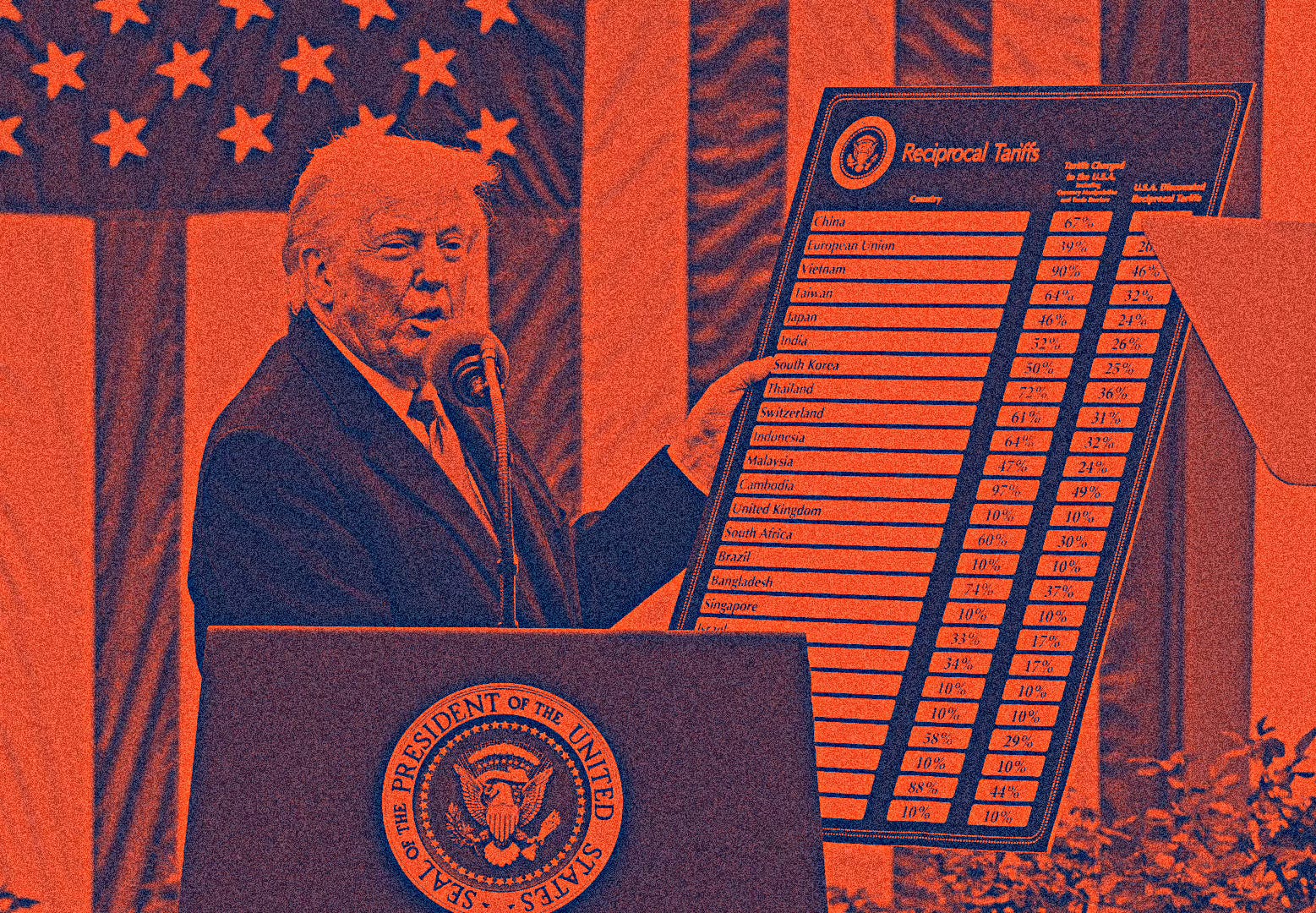
Donald Trump’s politics are instinctual more than substantive, but one consistent theme throughout the years is his enthusiasm for “unilaterally impose[d] tariffs of unlimited amount, duration, and scope,” to quote the Supreme Court’s description of what it struck down last Friday. Stand up to him on Greenland? That’ll be a 10% tariff. Switzerland doesn’t like its 39% tariff? It can bring him some gifts and it drops to 15%. His tariffs are on one day, paused the next.
After the Supreme Court’s November oral argument revealed deep skepticism toward the administration’s claim that the International Emergency Economic Powers Act (IEEPA) authorizes such tariffs, Trump’s team began preparing a Plan B. This pivot to existing statutes was an open secret in Washington long before Justice Brett Kavanaugh laid out the blueprint in his dissenting opinion. As Kavanaugh detailed:
Section 122, Trade Act of 1974 — Grants the president authority to temporarily surcharge imports when the U.S. is running a large and serious balance-of-payments deficit.
Section 201, Trade Act of 1974 — Allows the president to respond with duties or other appropriate measures when the International Trade Commission determines that import volumes are substantially injuring (or threatening to injure) a domestic industry competing with those imports.
Section 301, Trade Act of 1974 — Empowers the president to levy duties against foreign countries whose policies or practices are deemed unfair and damaging to U.S. commerce.
Section 338, Tariff Act of 1930 — Lets the president impose tariffs on goods from any country found to be placing an unfair burden on U.S. trade.
Section 232, Trade Expansion Act of 1962 — Permits the president to restrict imports of a given article (and related derivatives) when the Commerce Department determines those imports pose a national security risk.
While one might be surprised by the president’s admission that he “probably should have gone in the first place” with these existing authorities in law, it is far less surprising that he pivoted immediately to Section 122 with a promise of more to come.
On Friday evening, the White House announced a 10% tariff under that section to deal with the apparently newly discovered balance-of-payments crisis. The next morning, the president posted on Truth Social that it would be 15%, the statutory maximum (although customs officials weren’t told). That social media post included a promise of determining additional “new and legally permissible Tariffs,” which presumably means moving through the list of Sections 301, 338, and 232. Treasury Secretary Scott Bessent says Section 122 is “more of a bridge than a permanent facility.”
Trump describes Section 122 tariffs as “fully allowed, and legally tested,” skipping over footnote 4 of the Supreme Court’s majority opinion, which acknowledged Kavanaugh’s list but curtly concluded: “We do not speculate on hypothetical cases not before us.” Elsewhere, the portion of the opinion joined just by Chief Justice John Roberts and Justices Neil Gorsuch and Amy Coney Barrett warn that these other authorities have “strict limits” and “demanding procedural perquisites.” So the administration shouldn’t expect a cakewalk.
If the administration gets a blueprint from Justice Kavanaugh, those who might challenge its next moves deserve one as well.
Legal Challenge 1: Bogus Claims of “Balance-of-Payments Crisis”
President Trump’s Truth Social post raising the Section 122 tariffs to 15% talked generally about trade deficits and other countries ripping America off, and the White House statement carefully cited a “negative net international investment position” for the U.S. as a share of GDP between 2020 and 2024. But neither trade deficits nor dropping investment flows are a “balance-of-payments crisis” that must exist for Section 122 to be legally invoked. The term has a very specific meaning in international monetary policy: “a shortage of reserves to cover balance of payments needs.” When a country on a fixed exchange rate sees a sudden shock due to which investors start pulling out, draining currency reserves and threatening a debt default, a balance-of-payments crisis results. Think Mexico in 1994, East Asia in 1997, Russia in 1998, or Argentina in 2002 (or last year).

The U.S. has luckily never had such a balance-of-payments crisis, at least since we abandoned fixed exchange rates tied to the gold standard in 1971. We’re not having a balance-of-payments crisis now. Our fiscal and monetary structure has problems, but that’s not one of them.
The whole reason we have Section 122, enacted in 1974, was a result of that 1971 experience. After World War II, we helped set up the Bretton Woods global monetary system of fixed exchange rates tied to gold and the U.S. dollar. Starting with the Marshall Plan, U.S. gold and dollars steadily flowed outward to the rest of the world to rebuild Europe and Japan, fund a Cold War military presence, and provide liquidity for a global trade system that used dollars.
Every year that followed, the U.S. had less in reserves left in Fort Knox to cover a growing share of global liabilities, while other countries had growing piles of dollars that earned no interest and paid no dividends. The international economic policy favored by Presidents Dwight D. Eisenhower, John F. Kennedy, and Lyndon B. Johnson was a string of measures to boost exports, limit the price of gold, and encourage allies to inflate their currencies to maintain pegs to the dollar. By 1971, $40 billion in foreign holdings were backed by just $12 billion in U.S. gold reserves, and Nixon ended the Bretton Woods system to prevent a complete drain of these reserves. Section 122 codified what Nixon did after the fact and establish a way to do it if we had to again.
But nothing like this is happening right now. We have floating exchange rates, not fixed exchange rates. We have no “disequilibrium” of a steadily draining reserve currency as we had in 1971 because our currency now automatically adjusts to fluctuating currency markets. If the dollar depreciates, U.S. exports become more competitive and imports more expensive, which can narrow trade imbalances. If it appreciates, imports become cheaper and exports less competitive and trade balance widens. Either way there is currency equilibrium. The U.S. balance of payments today necessarily equals zero, according to the Federal Reserve Bank of St. Louis and the U.S. Court of International Trade (this is the court that will hear any challenge to Trump’s tariffs).
We have no legitimate balance-of-payments problem. A trade deficit, an excess of goods imports over goods exports, is a separate concept and in any event higher tariffs don’t necessarily reduce trade deficits, as we saw last year when it grew by 5%.

Trump likes to boast that inbound foreign investment to the U.S. that he has negotiated is $18 trillion. No balance-of-payments problem, no legitimate invocation of Section 122.
It is an open question, however, whether a court would simply take the president’s word that there is a problem. Chief Justice Roberts wrote in the tariffs case that “we claim no special competence in matters of economics or foreign affairs.” Nowhere in last week’s 170 pages, for instance, did the justices scrutinize Trump’s claim that fentanyl trafficking from Canada constituted an emergency requiring tariffs because they struck them down on other grounds. Another case might well have them evaluate the claims.
Legal Challenge 2: You Can’t Forget Everything That Was Said Before
“Judicial Estoppel” is lawyerspeak for “you can’t argue that because you were just saying the opposite.” Inconveniently for the administration, it repeatedly said that Section 122 can’t be invoked to deal with trade deficits because it wanted to put all its eggs in the IEEPA basket. It’s one thing for a judge to hear from a think tank expert or an international economist about why the government is wrong; it’s another thing to hear from the government itself, just a few months ago.

In last summer’s reply brief filed in the U.S. Court of Appeals for the Federal Circuit, government lawyers wrote: “Nor does [Section 122] have any obvious application here, where the concerns the President identified in declaring an emergency arise from trade deficits, which are conceptually distinct from balance-of-payments deficits.” And in their brief to the U.S. Court of Appeals for the D.C. Circuit, they wrote:
Section 122 plays a fundamentally different role in the President’s arsenal of trade authorities than do the emergency powers set forth first in TWEA and now in IEEPA. … [W]hile Section 122 empowers the President to address non-emergency balance-of-payments concerns, IEEPA supplies a distinct, complementary authority to address emergencies, including but not limited to balance-of-payments concerns. And more generally, the President’s actions here do not identify or focus on balance-of-payments concerns of the type addressed by Section 122. Instead, the concerns the President identified in declaring an emergency arise from trade deficits, which are conceptually distinct from balance-of-payments deficits.
Trump’s own public posts made clear the new tariffs were a response to the court’s decision, undermining any government argument that they were driven by changed balance-of-payments circumstances.
Legal Challenge 3: What Happens In July 2026?
Section 122 allows tariffs “for a period of 150 days (unless such period is extended by Act of Congress). When this period ends, either (1) Congress must vote to extend the tariffs or (2) the tariffs must expire.
Since (1) is unlikely, with House Speaker Mike Johnson pouring cold water on any tariff votes, and (2) is unacceptable to Trump, there will be a search for a (3). One potential (3) is letting the tariffs expire for 15 minutes in July 2026* and then reissuing them, either identically or insignificantly changed, and claiming they can continue for another 150 days.
This is highly possible, as an episode involving the U.S. Attorney for the District of Columbia last year shows. The law there allows the president to name an interim U.S. Attorney for 120 days, and if the Senate hasn’t confirmed the appointee by then, the power of appointment shifts to judges. Trump named Ed Martin as his interim appointee, and just before Day 120, announced the appointment of Jeanine Pirro. As The New York Times observed, “Mr. Trump appears to be trying to establish that he has the power to make successive interim appointments for U.S. attorneys, indefinitely bypassing the Senate confirmation process.” The Senate ultimately confirmed Pirro, so the legal question remains unresolved. (Young Samuel Alito, then a Reagan administration lawyer, wrote in 1986 that successive interim appointments are not legal.)
The same applies here: if the president can implement successive 150-day periods, that would bypass the statute’s requirement that the period can only be extended with congressional action.
Congress and the Courts
The administration’s rapid pivot to Section 122 reflects necessity, not legal strength. It rests on redefining a “balance-of-payments crisis” beyond recognition, disregarding its own recent legal positions, and assuming that courts will decline to examine economic realities too closely. That is a fragile foundation for a policy affecting hundreds of billions of dollars in commerce and millions of consumers. And it’s possible he will get away with it.

Ultimately, this episode underscores a constitutional reality that no statutory workaround can erase: trade policy belongs to Congress. And unless Congress takes it back, it will not be able to put a definitive end to his tariff mischief.
Temporary emergency tools were never meant to substitute for democratic accountability. If tariffs are to exist, they must be enacted through legislation, debated openly, and owned politically by the representatives who approve them. Until then, each new Plan B will be an effort to outrun the limits of the law.

*Note: The end of the 150 day period has been amended to be July.
© The UnPopulist, 2026
Follow us on Bluesky, Threads, YouTube, TikTok, Facebook, Instagram, and X.
We welcome your reactions and replies. Please adhere to our comments policy.

Never thought of that. Great read
If I’m not mistaken, the 150 days runs out in July, not June. In the meantime, the administration is going to be filing the paperwork to get the other tariffs that are available under the Trade Act of 1974 that require more actual procedures to be enacted. They have said that they’re already working on that paperwork, expecting to have one or more of those alternatives you mentioned in place by the time the 150 days runs out.