


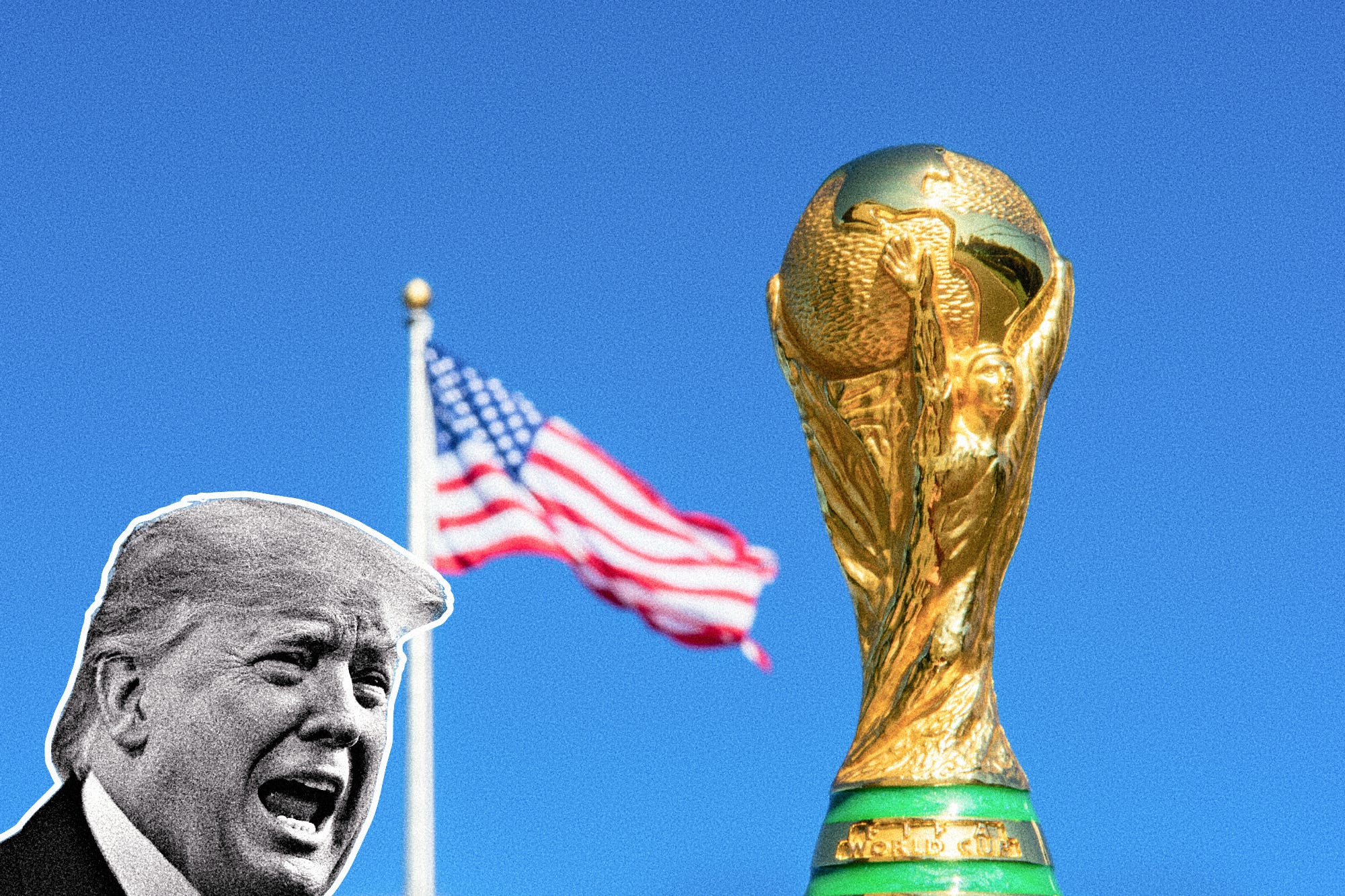
“Of course he found a way.”
That’s a phrase we tend to say before marveling at whatever amazing play one of soccer’s global superstars just pulled off in the FIFA World Cup—as in, “His team was down. But of course Messi found a way.” On this occasion, however, the referent is the president of the United States, and the phrase isn’t the typical prelude to some superlative. Yet it’s the phrase that came to my mind after watching Trump strong-arm FIFA into letting a U.S. player suit up despite a red card that should have kept him off the field.
The phrase reflects the depressing inevitability of Trump treating his authority as boundless—unchecked by the Constitution, institutional norms, or even, in this case, the rules of the world’s most popular game. He was always going to find a way to put his stamp on this World Cup—the only question was how much damage it would do.
On Monday night in Seattle, Belgium dismantled the United States 4-1 in their Round of 16 matchup—the worst 90 minutes the U.S. played all tournament, and a stunning collapse from the team that had swashbuckled through Paraguay, dispatched Australia, battled Turkey to the wire, and outclassed Bosnia and Herzegovina in the first knockout round to get here. So what happened?
What happened is the president of the United States turned a red card into an international incident. The U.S. lost because it played poorly and Belgium played superbly—that’s not in dispute. But one contributing factor that led to that outcome was surely the brouhaha over Trump’s meddling in FIFA’s enforcement of World Cup rules.
Of course Trump found a way to abuse his powers—and the fallout might have put as much fire in the belly of the Belgian team as it dampened the spirit of the American one.

The U.S.’s exit means all three World Cup co-hosts, including Mexico and Canada, are now out of the tournament. But only one of those exits was in the wake of a pressure campaign that put U.S. soccer officials on the defensive; elicited widespread condemnation from commentators, public officials, and the game’s own governing bodies; and made an alleged unfair advantage on behalf of the U.S. the most talked-about topic in the run-up to the game.
Everyone should have seen this coming. Trump has spent his presidency treating World Cup access as just another lever of power: travel bans that shut out fans from Haiti and Iran, a Somali referee turned away at the airport, Senegalese supporters locked out of their own team’s matches, an Iranian squad barred from spending the night in the country hosting them, a floated-then-reversed plan to post ICE agents at stadiums, even a preposterous suggestion that Italy—which hadn’t qualified—replace Iran in the tournament. Trump was always going to put his stamp on—actually, his fist through—this tournament, harming the nation’s and team’s reputation.
How It Happened
Trump decided that U.S. striker Folarin Balogun’s suspension for a red card against Bosnia and Herzegovina was unfair and should be lifted. So far, no problem. Virtually every supporter of the U.S. felt the same. Earlier in the tournament, Leo Messi—Argentina’s star and the game’s greatest player—made a nearly identical challenge and he did not receive so much as a yellow card, let alone a red card that leaves the player suspended for the next match as well.
But FIFA doesn’t overturn suspensions during the tournament. Although the call on the field was harsh, and the U.S. had every reason to feel aggrieved, there are procedures and rules by which the call was made. The competition enlists a referee on the field, and then a three-person video assistant referee panel during the game that meticulously watches in case major decisions on the field need rectifying. Once that process results in a red card, there’s no undoing it afterward—not during the World Cup anyway. The process is widely considered to be flawed and error-ridden—but here’s the thing, it applies equally to everyone. But not to the U.S., Trump decided.
On July 5, ahead of the U.S.’s biggest match of the tournament, the world learned that Balogun, the team’s top goal-scorer in this competition, would be eligible to play after all.
Basically, Trump treated FIFA the way he treats any independent institute: as something to be bent to his will until he gets the outcome he wants. He called FIFA President Gianni Infantino directly. Commerce Secretary Howard Lutnick also started working the phones. Within days, FIFA’s disciplinary committee did something it hadn’t done in more than 60 years of World Cup play: it suspended a red-card ban mid-tournament so Balogun could play. Trump made his reasoning explicit: if the U.S. lost with Balogun sidelined, he told reporters, “We’ll say it was—I say it was rigged, just like the election was rigged in 2020.” He was laying the groundwork for a stolen-game narrative before a ball had even been kicked.

Whether Balogun should have received a red card is open to debate. What is not is whether a government, or its politicians—in this case, a host nation—should be the ones making that call. They should not be—and I can’t think of any of Trump’s predecessors who would have shown such flagrant disregard for the game’s rules. Trump’s pressure campaign worked, and that is to FIFA’s shame. But the fact that it worked is not all down to FIFA. The organization is spineless, and has a long history of corruption scandals. But it also understands power, and more importantly, it knows what power can do when it is in the hands of someone who can wield it arbitrarily.
FIFA’s Capitulation
Consider how Trump talks about his leverage over FIFA, then consider how FIFA has behaved toward him. Infantino’s public line has been that FIFA’s disciplinary bodies are independent and “operate autonomously.” But when a supposedly independent body breaks with over a half century of precedent, it doesn’t do so because the evidence was compelling. Off the top of my head, I can rattle off a dozen instances of past red card suspensions during the World Cup that were more unjust, and whose subsequent appeals went absolutely nowhere. But everyone knows Trump is willing to go very far—beyond any constraints or rules—to get what he wants.
Infantino invented a “Peace Prize” for Trump back in December, right as Trump was publicly stewing over missing out on the Nobel—a gift to a man with the power, as host nation, to make FIFA’s life difficult if he didn’t get what he wanted. This week, when the Balogun controversy broke, Infantino told reporters that fielding a call from Trump was unremarkable, the same as calls he takes from “heads of state, government officials, football stakeholders, and business executives.” Yet when Trump called, FIFA bent the knee.
Outside the United States, reaction was close to unanimous. UEFA—European soccer’s governing body, and one of the sport’s most powerful institutions—said FIFA had crossed a “red line,” calling the reversal “unprecedented, incomprehensible, and unjustifiable.” The European Union’s sports chief said decisions like this “belong to sporting bodies, not politicians.” Even Sepp Blatter, FIFA’s own disgraced former president, called it what it was: “Red cards are not overturned by political phone calls. They are overturned by rules, evidence and independent bodies. Football must never become a playground for political power.” Mark Pieth, the Swiss attorney who once led FIFA’s own internal governance-reform effort, was blunter still, calling it “blatant abuse of power” and saying it showed how Trump and FIFA’s current president “are playing the power game at the expense of football and fans.”
Belgium didn’t need extra motivation, but Trump gave them some anyway—after sealing the win, their players broke into his signature two-fisted dance, both on the field and in the locker room. Of course Trump found a way. It just didn’t work out the way he wanted it to.

© The UnPopulist, 2026
Follow us on Bluesky, Threads, YouTube, TikTok, Facebook, Instagram, and X.
We welcome your reactions and replies. Please adhere to our comments policy.
Of course he found a way to embarrass America, to turn a joyous event into a self-centered s***show, and turn the rest of the world against us, including the USNMT. Visitors from around the world were rejoicing and loving their experience here, but Trump turned that right around. In doing so he managed to highlight his ignorance and delusions of knowledge and expertise. His stupid interference energized the Belgian team, and probably even harmed the US performance.team
What's insanely comical that we are to see in the unorthodox decision that Trump would be handing the World Cup trophy to the winner. Think about it, of the 8 finalists left especially Spain who is one of the favoured to win and he has dissed every one of those countries in different ways. I can think of examples of 7 of them easily off the top of my head except maybe Morocco that could have been buried in a "shithole country" group. Not making a direct comparison but it is remindful of Hitler and Jesse Owens in the 1936 Olympics