


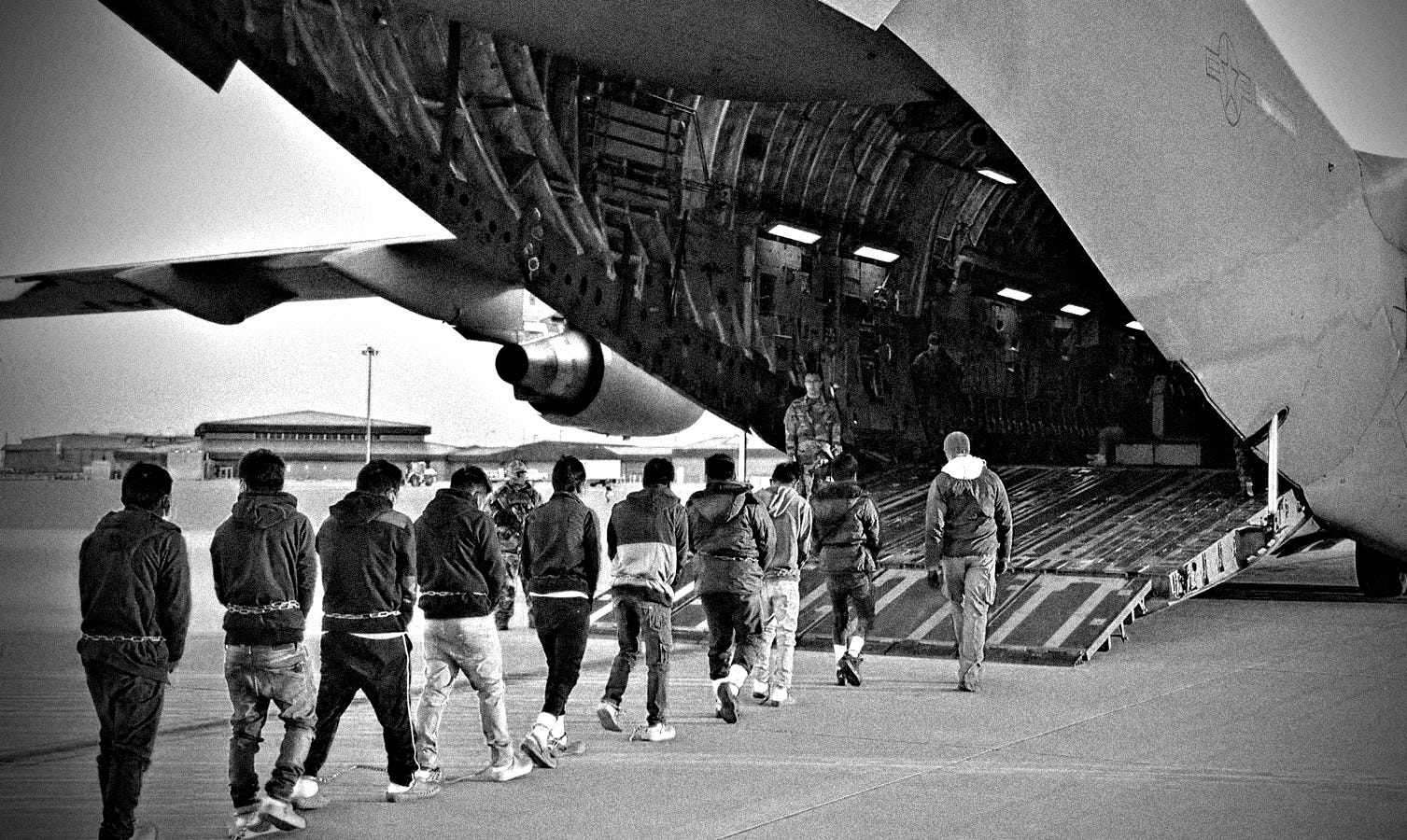
On Tuesday, the Supreme Court cleared the way for the Trump administration to deport immigrants to countries where they have no ties, with little or no notice and no meaningful chance to object. In a 6-3 decision, the Court’s conservative majority put on hold U.S. District Judge Brian Murphy’s ruling that the policy is unlawful until the justices consider the case, with arguments set for December. It is the third time the administration has asked the Supreme Court to block Murphy’s rulings, and the third time the Roberts Court has shamefully obliged.
To see what that means in practice, consider what happened the first time the Court let these removals go forward.
Sent to South Sudan
“These barbaric criminal illegal aliens will be in South Sudan by Independence Day,” read the Department of Homeland Security’s press release on the deportation of eight undocumented immigrants to South Sudan after the Supreme Court lifted a temporary injunction barring their removal in July 2025. Of the eight, only one had any connection to South Sudan—in fact, none of the other seven had any ties to any country on the African continent. Few Americans will shed tears over the fate of these individuals, who have been convicted of murder, kidnapping, child sexual assault, robbery, and other violent crimes. But the principle at stake transcends their particular rap sheets. The U.S. government’s decision to send immigrants convicted of crimes to a country experiencing horrific conditions after being ravaged by decades of war—a country that the U.S. government itself warns Americans not to visit—is inhumane and unconstitutional, especially given what has since befallen them.
Americans take for granted that even if a person is convicted of a crime, he or she cannot be subjected to cruel and unusual punishment, much less torture. Nor can anyone be deprived of life, liberty, or property without due process. These rights are guaranteed by the Eighth, Fifth, and 14th Amendments. They apply to all persons in the U.S.—including undocumented immigrants, as the Supreme Court has reaffirmed—not just citizens and legal residents (though there are important caveats for undocumented immigrants apprehended near the border soon after they cross).
So how is it that these eight men found themselves, not just deported to a country they have no ties to (again, only one is South Sudanese), with little or no meaningful opportunity to legally challenge their removal, but to a country experiencing one of the most severe humanitarian crises in the world? And why has the Supreme Court now sided with the administration against Murphy not once, not twice, but three times?
Cruel and Unusual Deportation
During its first hundred years, the Supreme Court was largely silent on what constituted cruel and unusual punishment. Over time, the Court provided parameters in various cases to guide legal application of the idea, including that sentences must be proportionate to the crime and cannot be excessive (Weems v. United States, 1910) and that the conditions of confinement cannot constitute torture, such as severe overcrowding that poses a serious threat to safety and health (Brown v. Plata, 2011).

The eight deportees to South Sudan had already served their time in the United States for the offenses for which they were convicted. Still, DHS transported these men to the war-torn African country to be held for an indefinite period after they had completed their sentences. Life in South Sudan is precarious for ordinary people—it is unimaginable how much harsher the conditions are for the country’s incarcerated population. For individuals with no ties to South Sudan to be deported there, even after they’ve served their time in the U.S., is an extralegal extension of their sentences—it is an outcome that is unmistakably and gratuitously punitive in nature.
Although the U.S. government kept secret the details of the agreement it reached with South Sudan, the U.S. did not pay for these men to simply emigrate there and be set free. They are likely to rot in overcrowded cells, with inadequate food or medical care, and possibly will continue being held in this way for the rest of their lives.
As of January, six of the eight were still being held in South Sudanese detention, in a guarded compound with little electricity and heavy mosquito infestation, according to one third-country deportation tracker.
In the U.S. State Department’s 2023 country report for South Sudan, it notes that its National Security Service (NSS) “maintained at least three facilities where it detained, interrogated, and sometimes tortured civilians. At least one detainee reportedly died due to injuries sustained in NSS detention.” If this is how the NSS acted toward civilians, how can we be sure that the men we’ve sent there haven’t faced similar treatment?
Even more concerningly, this deportation-as-punishment was inflicted before the men could exercise their right to due process under the Fifth and 14th Amendments. They found out they were being sent to South Sudan just hours before they were loaded onto a plane, with no meaningful opportunity to file for relief under the U.N. Convention Against Torture, to which the U.S. is a party.
Then, as now, the Supreme Court chose not to address either of these constitutional issues. Last year, the majority focused only on whether the lower court had exceeded its authority, which brought a scathing—and much deserved—rebuke from Justice Sonia Sotomayor. This time, the majority offered no reasoning at all, and the three liberal justices simply noted that they would have denied the administration’s request.
No Safety in South Sudan
The men were originally bound for South Sudan in May 2025 when a district court judge temporarily enjoined their removal. They ended up stranded along with their DHS guards in Djibouti, a country on Africa’s northeastern coast, held in a storage container on a U.S. military base for six weeks. (During that time, U.S. personnel cited concerns over malaria, other unknown respiratory illnesses, triple-digit temperatures, smog clouds that made it difficult to breathe, and rocket attacks from terrorists—a preview of what awaited the deported men in South Sudan.)
On July 3, 2025, the Supreme Court handed down its follow-up order, which paved the way for their removal to South Sudan—due process, to determine whether this violates U.S. and international law barring torture, be damned. As the press statement gleefully predicted, the prisoners were on the ground in Juba, the South Sudanese capital, one day later.
We currently know only part of the story of what happened to these men. The Trump administration claimed it received assurances that they would not be tortured. But it has not disclosed what provisions it took, if any, to ensure that South Sudan’s government made good on those assurances. U.S. border czar Tom Homan told Politico last year that once the U.S. deports an individual to a place like South Sudan, it doesn’t track their ongoing status or even what country they’ll be in a week later.
And even if any of the men are eventually freed, Homan’s admission still flies in the face of the U.S.’s constitutional prerogative to ensure it is not subjecting anyone—immigrants included—to cruel and unusual punishment, since South Sudan is exceedingly dangerous whether you’re a prisoner or free.

South Sudan, which was ravaged by civil war from 2013 to 2020, has since slid back into one, and the fighting is only intensifying. According to the United Nations Refugee Agency, nearly 2 million people are displaced in South Sudan, most of them women and children, with widespread hunger, endemic flooding, and disease making normal life there impossible. In the spring of 2025 alone, more than 165,000 people fled their homes. Under such conditions, who can possibly guarantee the safety of the men the U.S. has sent there, much less their humane treatment? Where will they be incarcerated—and on what grounds? How much is the U.S. government paying to keep these men locked up, and for how long? One can easily imagine them forced into slavery, a practice common in the region. According to the U.N. Mission in South Sudan, 54 people—including one child—were extrajudicially executed in the first 10 months of 2024. Could the men we’ve condemned to life in South Sudan end up dead?
Supreme Injustice
The Supreme Court’s conservative majority has made it clear it is unconcerned about these questions. Its rulings last year on June 23 and July 3 dealt only with the question of whether a district court judge exceeded his authority in issuing a preliminary injunction blocking their removal and whether the judge defied the Court’s order staying that injunction, respectively. These issues are not unimportant—and one could argue that a lower court’s failure to follow a ruling handed down by the Supreme Court is a serious breach that must be corrected. But given the stakes—affecting not just these eight men but all those the administration would deport to third countries next—why couldn’t the Court have allowed the underlying cases to reach them in due course before rebuking the district court judge?
The underlying case has indeed worked its way up since. In February, Murphy issued a final decision striking down the policy. Last month, a 1st Circuit panel largely upheld it, ruling that immigrants must be given more time to raise fears about deportation to a third country. The Supreme Court will now hear the merits, but in the meantime it has once again allowed these cruel removals to continue.
I understand the conservative justices’ preference for addressing only the immediate issue before them, which was not the constitutionality of the government’s actions but rather a petition by the government to stay the orders barring the men’s removal. But this case screams out for some balancing of the equities involved. The Supreme Court could have left the injunction in place while the case moved forward, which would have meant a temporary delay in removing the detainees to South Sudan but would have kept them in U.S. custody. Such a plan would have incurred costs, but not more than transporting them by private charter halfway across the world and paying another country to receive them. More importantly, this course of action would have preserved the Fifth, Eighth, and 14th Amendment claims to which these men were entitled. Instead, the Court has jeopardized these men’s lives.
It faced the same choice on Tuesday. The Court could have left Murphy’s ruling in place until it decides the case. Instead, it was in a rush to once again back the Trump administration on this question, choosing to let the removals proceed. Again, it’s hard to sympathize with anyone convicted of “lascivious acts with a child under 12” or first-degree murder during a robbery. But Americans commit those crimes, too—and for the same reason that it’s never appropriate to suspend adherence to the Constitution in order to respond to those crimes, neither is it appropriate to do so in the case of immigrants. The Court’s decisions have opened the way for countless others to be sent to dangerous, lawless places, even those whose only offense was crossing the border without authorization, some as children.

As of this month, the administration has sent more than 25,000 people to at least 29 countries (most to Mexico). Destinations include South Sudan, Uganda, Equatorial Guinea, Rwanda, Ghana, and Eswatini, Africa’s only absolute monarchy. In July 2025, five immigrant men were sent to Eswatini to be held in solitary confinement. A year later, one was sent to another country while the other four remained detained—and at least 25 more people had been sent there under the same arrangement.
A recent Washington Post exposé revealed that the State Department’s Office of Remigration, a small unit carved out of its refugee bureau, has pledged at least $410 million in taxpayer money to secure deals with 31 countries, mostly in Africa and Latin America, that agree to accept third-country deportees.
According to the report:
The contracts require minimal oversight over how the money is spent and how the migrants are treated, even though some of the third countries are ruled by authoritarian regimes.
These acts should shock the conscience of anyone who believes in America’s essential goodness. The Court’s conservative majority narrowly focused on a minor case of judicial overreach but in the process shattered Lady Justice. When the justices hear the case in December, they will have a chance to repair it—maybe the fourth time’s the charm.

An earlier version of this article first appeared in our pages.
© The UnPopulist, 2026
Follow us on Bluesky, Threads, YouTube, TikTok, Facebook, Instagram, and X.
We welcome your reactions and replies. Please adhere to our comments policy.

Thanks for talking about this; it's APPALLING, and I'm not seeing much coverage of it. It DOES shock my conscience, and makes me sick to my stomach. It's reprehensible. How are we ever going to recover from this?