


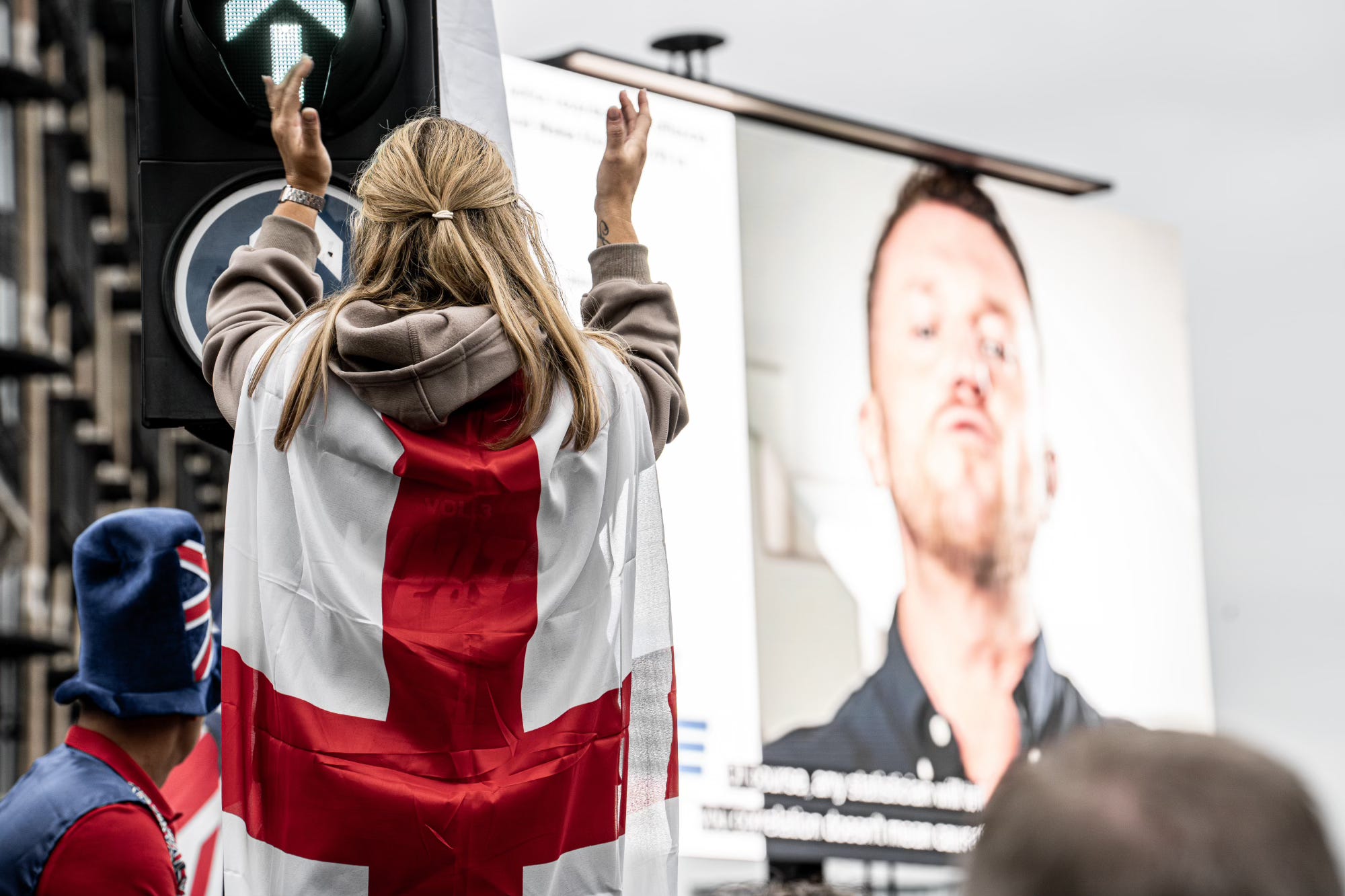
When Britain’s most notorious far-right agitator, Tommy Robinson (whose real name is Stephen Yaxley-Lennon), endorsed a Reform UK candidate late last month, it was yet another indicator of the growing ideological overlap between the nation’s most extreme anti-immigration elements and the right’s institutional organs. Reform UK, Nigel Farage’s insurgent right-wing populist party that has led the polls for over a year, disavowed Robinson—a predictable maneuver aimed at damage control. But it couldn’t obscure the real story: the collapse of any meaningful ideological daylight between Robinson’s street-level radicalism and right-wing electoral politics in Britain today.
Just like in the U.S., the U.K.’s most bellicose ethnonationalists are no longer outside the political mainstream but actively shaping it. Robinson’s “Unite the Kingdom” rally in London last September drew over 100,000 to protest immigration and what he and his supporters see as Britain’s cultural decay. This scale of far-right mobilization was unthinkable a decade ago. Figures once regarded as fringe now command massive audiences and drive the national conversation on immigration, national identity, and Islam.
Robinson’s endorsement reveals something even more strategic than simple mainstreaming. Although he backed a Reform candidate in a Feb. 26 by-election in Gorton and Denton, a district in Greater Manchester, Robinson is actually a member of Advance UK—a hard-right party founded because Reform wasn’t extreme enough, which itself took the shape that it did because the Conservatives weren’t extreme enough. This is how the far right simultaneously operates both inside and outside institutional politics—it uses parties more on the fringes to shift the Overton window while being free to support at the ballot box ones closer to the mainstream.
This dual strategy is enabled by a British right increasingly defined by English identitarianism and Christian nationalism, turbocharged by outside reactionary oligarchs like Elon Musk. Many of these currents have existed in British politics for decades, but Brexit, government ineptitude, and the plummeting popularity of the two major parties have created an opening for Farage’s Reform.
Understanding Britain’s crisis thus requires examining how English nationalism has diverged from British identity, how a new generation of theocratic extremists has weaponized Christian imagery, and how Musk’s transnational campaign seeks to destabilize democratic governments. These forces explain how the right has absorbed its most extreme elements, and how thoroughly the political guardrails against it have collapsed.
British Extremism, English Identity
For all the Union Jacks at Robinson’s rally, the more telling symbol was the St. George’s Cross—the red cross on white background that represents England. It’s become a lightning rod of political debate in Britain today. Indeed, in events over the past decade, a growing tension has surfaced between English nationalism, which emphasizes loyalty to England as a nation, and British nationalism, which emphasizes loyalty to the U.K.’s multinational composition consisting of England, Scotland, Wales, and Northern Ireland.

The Scottish independence referendum of 2014 raised questions about civic and national identity within the U.K.’s four constituent nations. Subsequently, the 2016 Brexit referendum, though primarily seen as a vehicle for British nationalism, was also a forceful expression of English identity. As the acclaimed Irish journalist and author Fintan O’Toole wrote that year:
When you strip away the rhetoric, Brexit is an English nationalist movement. If the Leave side wins the referendum, it will almost certainly be without a majority in either Scotland or Northern Ireland and perhaps without winning Wales either. The passion that animates it is English self-assertion. And the inexorable logic of Brexit is the logic of English nationalism: the birth of a new nation state bounded by the Channel and the Tweed.
Thus far, the U.K. has held together, and a national breakup isn’t what activists like Robinson want (in an announcement on X earlier this week for a follow-up rally to be held on May 16, Robinson captioned the post: “Four Nations. One Kingdom. Under God.”). But there is a sense that his version of British nationalism is subsumed in a thoroughly English conceptualization of what it means to be a patriot, which is obviously problematic for Scotland, Wales, and Northern Ireland.
Consider again the St. George’s Cross and the debate surrounding its increasing use in right-wing iconography. On Facebook, the Birmingham-based “Weoley Warriors” group launched a campaign to display the cross and show that “all is not lost.” What it means by that is that the homogenous, Christian-identity-based England of its imaginations isn’t gone and its previous dominance can still be restored. Another campaign, called “Operation Raise the Colours,” generated tens of thousands of pounds to display the English flag across the country—at curbsides, windows, and flagpoles. A few communities even painted their roundabouts.
Some of these displays could be construed as just a benign expression of patriotism. But not all. Many were widely interpreted as intimidation toward immigrants—hardly an unreasonable conclusion considering the cross’ popularity with the British far right, as well as its associations with violent, and often racist, football hooliganism. The flag has been prominent among Reform’s supporters and anti-migrant protesters, including at the 2024 race riots following the Southport stabbings.
What was once fringe symbolism has become the visual language of an ascendant populist movement.
Christian Nationalism
Traditionally, Christian nationalism has not been as strong in the U.K. as in America. Britain is highly secular and multicultural, yet unlike the U.S. it has a state religion: King Charles III serves as both head of state and Supreme Governor of the Church of England, a title dating to Elizabeth I (1533-1603) that makes him leader of one of Europe’s largest Protestant bodies. Because of this, certain religious displays in British politics lack the right-wing coding they carry in America. But Christian nationalist expressions are on the rise. As the organization Humanists U.K. warned in September:
In Matlock in Derbyshire, Reform councillors reintroduced Christian prayer to council meetings on the basis that the UK was a “Christian country.” One of their first moves subsequently was to ban Pride flags following a complaint from a Christian bookstore owner in June. The policy, which is similar to “LGBT Free Zone” policies used by local governments in Poland between 2021 and 2023, was later adopted by other Reform-controlled councils, including Warwickshire.
More recently in Northumberland, a Reform councillor and SACRE rep told the council he wanted exclusively Christian Religious Education in schools because this was “a Christian country,” calling any other approach to RE “brainwashing.”
Just this month, Robinson’s Advance UK party launched its policy platform at an evangelical church with Pastor Rikki Doolan serving as both spiritual leader and political organizer. Doolan, who was, ironically, the subject of an investigative expose for his alleged role in an international gold smuggling network, wants Britain to return to “biblical values.”
The English strain of Christian nationalism has often been tethered to medieval crusader imagery, a convenient set of historical tropes for reactionaries determined to keep out Muslim “invaders.” Far-right media personality and provocateur Katie Hopkins made this point explicitly, saying in an interview that “the time of the crusades will need to come again.”

In the past, crusader references have been more jingoistic historical cosplay than sincere calls for holy war. But crusader rhetoric has taken on a sharper, more zealous edge in recent years: As anti-extremism watchdog Hope not Hate has noted, the most important shift in Britain’s Christian nationalism has been from largely cultural expressions to more explicitly theological arguments.
In their analysis of Robinson’s London rally, Hope not Hate observed how the crusader shields once featured at his old English Defence League marches had transformed into explicit religious symbols and public prayers:
As leader of the English Defence League, [Robinson] regularly utilised Christian imagery such as crusader crosses, establishing a connection between English national identity and Christianity. This tended to be a form of cultural Christianity, rather than a theological argument, whereby religion acted as a cultural marker to distinguish English “insiders” and foreign “outsiders.”
However, where the far right previously attached themselves to cultural Christianity, the movement has shifted towards overt religiosity. There are explicit references to God and Jesus, with the Lord’s Prayer being performed both in local anti-migrant protests and [Robinson’s] larger rally.
The Church of England has itself become a target of scorn for Britain’s Christian nationalists, seen as an ossified and excessively liberal institution catering to a culturally indulgent elite.
Bishop Ceirion Dewar, whose Confessing Anglican Church is not part of the Anglican Communion, issued a prayer at “Unite the Kingdom” for Britain to forcefully assert its Christianity: “We will not bow to tyranny, we will not surrender our freedom. We will not be silent any longer. ... Let justice roll down like rivers, and justice like mighty waters, until this land once again proclaims that Jesus Christ is Lord.”
Also at the “Unite the Kingdom” rally was Rev. Brett Murphy, a former Anglican minister who was ordained in Australia and operates the “Make Britain Christian Again” account on X. Murphy has repeatedly labeled Islam as “demonic” and the Church of England as heretical.
Or consider Calvin Robinson, who has sojourned to the reactionary Christian right after the Church of England declined his ordination. Robinson was suspended from GB News—Britain’s Fox News-like right-wing news channel—back in 2023 and subsequently came to the U.S. Most recently, the Anglican Catholic Church revoked his license to serve as a priest after he defended Musk’s alleged Nazi salute by repeating the gesture at an anti-abortion event.
These formerly fringe figures are now ascendant on the British right.
X Factor
Today’s resurgent right-wing nationalism is, paradoxically, transnational. Right-wing movements actively collaborate through public events and online promotion, with Musk and his platform as their hub.
Musk has increasingly involved himself in the politics of European countries since taking over X, regularly offering anti-immigrant commentary and supporting right-wing parties. In the U.K., he’s inserted himself into the debate on migrants and crime, declaring that Britain faces an impending “civil war” due to foreign immigration. He helped to spread misinformation that contributed to far-right riots in 2024. He has even gone so far as to call for King Charles III to dissolve the current Labour-led Parliament. In response, Liberal Democrats’ Sir Ed Davey called for regulators to pursue accountability for incitement and misinformation on X, questioned Tesla as a threat to British national security, and branded Musk a “criminal.”
Musk doubled down in his video address to the “Unite the Kingdom” rally, reiterating, “There’s got to be a change of government in Britain. We don’t have another four years, or whenever the next election is.” Claiming to be addressing the “ordinary” people of “the reasonable center,” Musk warned of violence if the left—which he called “the party of murder”—and its multicultural policies are not stopped: “My message is to them: If this continues ... violence is going to come to you. ... Whether you choose violence or not, violence is coming to you. You either fight back or you die.”

As Toby Buckle noted in The UnPopulist, Musk appears to view British politics though a right-wing distillation of Tolkien-esque high fantasy—one where pure white heroes stand athwart evil hordes. The brazenness is staggering: an American billionaire openly calling for the illegal overthrow of Britain’s elected government while threatening mass violence.
It’s impossible to ignore the overall role of social media in spreading extremist ideas and deadly misinformation. But Musk bears outsized responsibility—he’s weaponized his “global town square” for his own ideological ends. And he’s given Britain’s far right something it never had before: a billionaire patron with global reach, algorithmic control, and no accountability to democratic institutions. Musk’s transnational power grab isn’t fantasy—he’s the world’s richest man and owns one of the planet’s most influential communication platforms. Without that ready-made misinformation amplification machine, the far right would not nearly be as potent as it is today.
Britain’s Future
The reactionary right in Britain is characterized by interlocking forces: English nationalism supplies the central grievance input: “Immigrants threaten our way of life”; Christian nationalism provides the sacred frame: a neo-crusade/civilizational clash between Christianity and Islam, or between Christianity and “woke” progressivism, which Christian nationalists construe as a rival religion; and then Musk’s X amplifies both narratives while suppressing alternatives, creating millions of micro-audiences primed for radicalization.
These extremist currents would be less dangerous if Britain’s political establishment could mount an effective resistance. But it can’t. Despite its massive parliamentary majority, Labour already feels lost in the wilderness. Farage’s Reform has been consistently atop the polls, aided by public anger over prices and immigration. Those problems are compounded by the fecklessness of the country’s two major parties. Both seem to have decided that ineptly courting Reform voters is preferable to putting up convincing center-left or center-right alternatives to right-wing populism.
Last year, Labour Home Secretary Shabana Mahmood announced plans to dramatically extend the timetables under which asylum-seekers can apply for permanent residency and, eventually, citizenship. It’s a policy she has described as ending the U.K.’s “golden ticket” for migrants. What’s especially disturbing is that this piece of populist-coded rhetoric that sells out her party’s traditional support for a diverse, pro-immigration Britain is being sold by a Muslim woman.
This is not the way. If neither Labour nor the Conservatives can muster the political courage to resist Farage and his extremist positions from influencing theirs, the politics on display at Robinson’s rally will define Britain’s future.
One Last Thing
The author’s organization, The Pulaski Institution, is convening the For Good conference on May 8-9 in Charlottesville, Virginia. The UnPopulist’s senior editor, Berny Belvedere, will be speaking alongside Jamelle Bouie, Sarah Posner, Holly Berkley Fletcher, Robert Talisse, Allyson Shortle, Samantha Hancox-Li, and more to be announced imminently. The far right is offering a toxic brand of moral and lifestyle guidance to people looking to improve their lives and find meaning. Liberalism must respond with its own big ideas about ethics, aesthetics, and the good life.
Register to attend!

© The UnPopulist, 2026
Follow us on Bluesky, Threads, YouTube, TikTok, Facebook, Instagram, and X.
We welcome your reactions and replies. Please adhere to our comments policy.

Musk, the poster boy for how a talented entrepreneur can make a fortune because of our democratic society and then use his money and power to destroy it. Not a hero, a Nero. Like Miller, he shows Obama was right. 👽 Aliens are real!
There is one irony here. Brexit was supposed to lead to a stronger British identification but instead both the European and other identifications as the Scottish one became more important for a larger number of UK citizens.
so one can say that Reform UK = Little England as the end goal in practice