


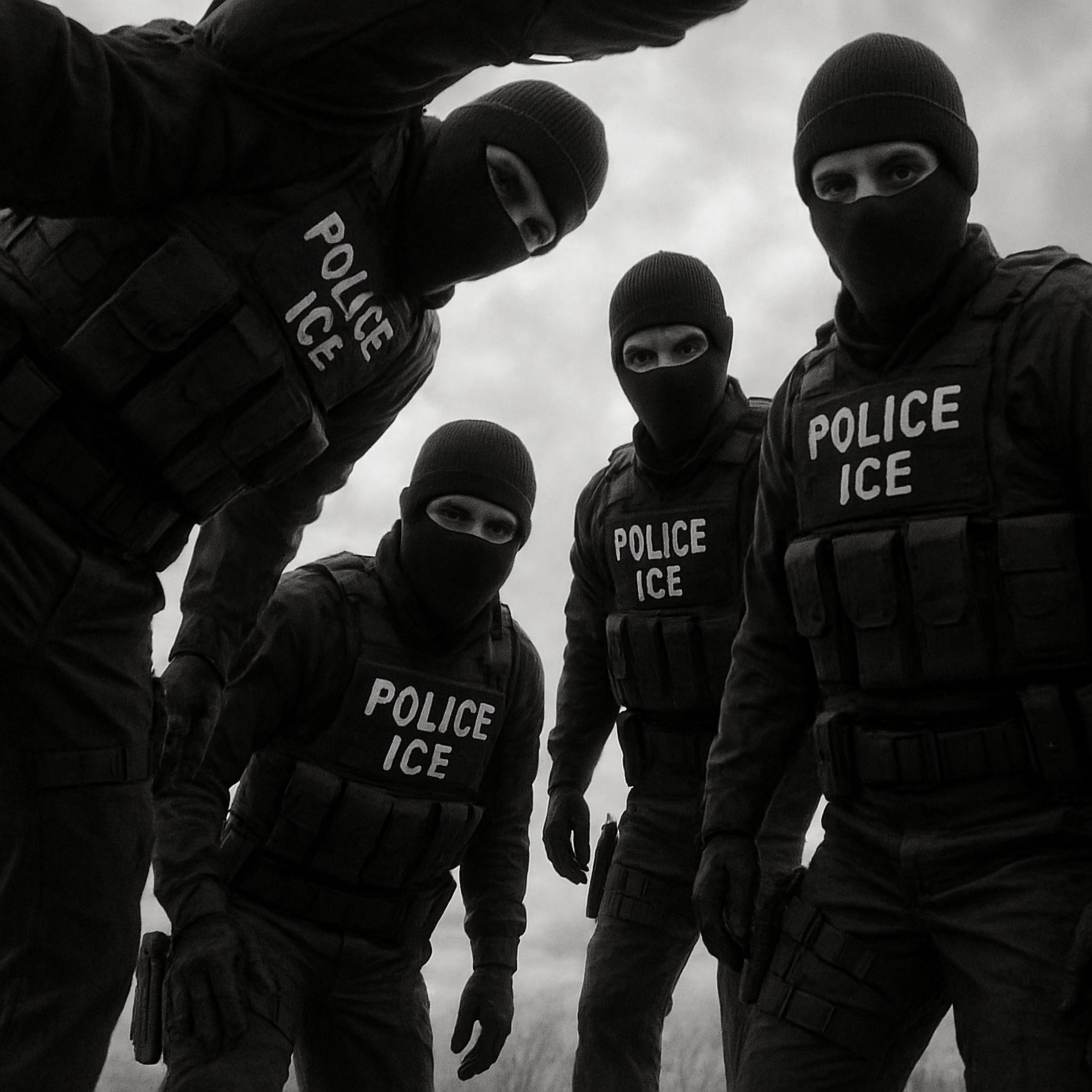
More than 2,000 years ago, the Greek philosopher Plato predicted ICE’s tactics. He knew, even then, that the character of a certain type of man or woman was corrupt and that anonymity would enable brutality. In short, he knew that ICE agents would want to wear masks not to protect themselves from danger, but rather to enable their immoral conduct.
Plato’s prescient understanding of ICE agents arose during a discussion of the parable of the ring of Gyges. The debate occurred during Socrates’s inquiry into human virtue, recounted in Plato’s Republic. Early in Book Two, Socrates considers what it is that makes a person just, by which he meant someone who was moral or righteous and acted in a just manner.
Glaucon, one of the participants in the Socratic dialogue, opined that morality is nothing more than a social construction, and that citizens are virtuous and just only because they fear sanction for acting in an unjust manner. In other words, placing a person’s actions under observation is an essential component for deterring malicious conduct. The unseen and unobserved act unjustly.
To illustrate this, Glaucon told the story of the ring of Gyges—a mythical magical ring that renders the wearer invisible, much like the One Ring of power in the Lord of the Rings. What, Glaucon wondered, would cause a person who had this ring to be just and virtuous? Glaucon’s view was that no person would be of “such adamantine resolve as to abide by justice” if he could engage in unjust behavior without any fear of punishment.
Glaucon’s idea is consistent with much of our human experience. In the absence of adverse consequences or punishment, social order can break down. Anonymity engenders bad behavior (as anyone who has encountered anonymous trolls on social media can readily attest). Those who have no accountability for their actions are not, naturally, restrained.
Socrates’ reply to Glaucon was complicated, taking up the whole remainder of this lengthy dialogue. He argues that just behavior is not something disadvantageous to us, engaging in it only for fear of the greater disadvantage of punishment. Properly understood, justice is intrinsically good for us, bringing about the health, harmony, and good order of the soul. It is good for us even if no one knows that we are just. Still, Socrates does concede that to become just in this true sense requires a lengthy and elaborate moral education. And crucial to this education, especially in its early phases, is that ones’ actions and character be visible to others so that one may be guided and shaped by their appropriate praise and blame. So even Socrates, in his defense of the intrinsic goodness of justice, emphasizes the crucial role played by visibility and the corrupting power of hiddenness and anonymity.
So Glaucon’s views are on to something and capture a bug in human nature. Glaucon’s characterization anticipates the Hobbesian view of the world—pessimistic and fearful of what unsocialized humans in the state of nature can do to each other.
Masking—and the anonymity it grants—untethers ICE agents from basic sociality, enabling misconduct. Law enforcement officers have an awesome degree of power and must be held accountable for how they use it. Everyday city police officers wear badge numbers and name tags. TSA agents and CBP agents at the airports do the same. So do military soldiers. All of these face the same “fear” of adverse public condemnation (which, to be clear, is an ICE fiction) and yet they are successful in doing their jobs even when identified. All are given responsibilities that are simply inconsistent with anonymity.
Twenty centuries ago, Plato knew that the anonymity of the ring of Gyges was a cause of injustice. ICE’s masks today are the modern-day equivalent.
What can be done about it? Congress, to its eternal shame, last year obscenely tripled the budget of ICE, handing the agency more money than Canada spends on its entire defense, all of which it is using to terrorize American cities and citizens. Democrats are currently holding up appropriations for the Department of Homeland Security, the mammoth department within which ICE resides, till it agrees to new rules of engagement. It is pathetic that this has to even be asked, but they should release not a single dime to DHS till it agrees to a total ban on mask wearing by its agents.

© The UnPopulist, 2026
Follow us on Bluesky, Threads, YouTube, TikTok, Facebook, Instagram, and X.
We welcome your reactions and replies. Please adhere to our comments policy.

For those interested in data...https://www.doomsdayscenario.co/p/ice-s-masks-are-all-a-lie?utm_source=www.doomsdayscenario.co&utm_medium=newsletter&utm_campaign=ice-s-masks-are-all-a-lie&_bhlid=28201e5d59809d4454cba81e0561a1a0d81d755b&last_resource_guid=Post%3A7a901ab6-b1d2-4b53-88a4-8937ddb7a920
Once also can look at US history and how a bunch of people in white robes and cone shaped white hoods terrorized people of color, Jews and others across the country. I just wonder how many of these masked ICE agents are either descendants of those that wore those robes or themselves have a set in their own closets at home.