



Hello, this is Zooming In, and I’m Tom Shull, survey research director of the Institute for the Study of Modern Authoritarianism, the parent organization of The UnPopulist.
American politics has always featured verbal jabs—often sharp and below the belt. But many of us can personally recall a time when American political discourse wasn’t so toxic, and when citizens and politicians who didn’t retain a modicum of civility and good humor in their politics risked a backlash. In fact, most Americans valued a degree of national unity, especially in times of crisis or tragedy. On Sept. 11, 2001, after the Twin Towers fell, scores of Democratic and Republican senators and members of Congress gathered in front of the Capitol Building not to exchange Team Red and Team Blue recriminations about “national security disasters” or “immigration fiascos.” Rather, said the speaker of the House, they came together to “stand united” before the country. Spontaneously, they sang “God Bless America.”
What if the 9/11 attacks happened now? You can just imagine the tweets.
Is it possible to reestablish a culture of political civility in America? And if so, how would we go about it?
For Jason Mangone, today’s guest on Zooming In, the answer might lie in the maxim, “First seek to understand, and then to be understood”—or what might be called “empathic listening.” Mangone is the executive director of the nonprofit organization More In Common, which has undertaken over the past eight years a sustained and sophisticated effort to understand Americans as they understand themselves. And then, with a degree of care and respect, to explain them to each other. It has done so through ambitious survey research, online panel discussions, focus groups, message testing, and other social science outreach, issuing more than 50 research reports in the process.
More In Common is part of a multi-national effort to produce similar insights in a variety of countries, but today, I discuss with Jason some of More In Common’s key survey findings in the United States, beginning with their recent publication Beyond MAGA: A Profile of the Trump Coalition.

Tom Shull: Jason, begin by telling us about More In Common, particularly the goals and the projects of your organization.
Jason Mangone: So we aim to build more inclusive, united societies—resilient societies in which people believe that we hold “more in common” than that which sets us apart. As a practical matter, we have a number of programs and reports. But I would say that the common through-line in everything that we do is that to the extent to which analysis is part of the national political conversation at all, it tends to accentuate demography ahead of everything else. At the end of the day, it tends to treat people as demographic units that are either colored blue or red.
That’s a far cry from how human beings actually understand themselves in the world. So we’re trying to put forth analysis and storytelling that helps show how human beings actually understand themselves in the world and all of its complexity.
Shull: That is one thing that stands out to me about your method in your survey research. Rather than saying, “Here is what older people think; here’s what younger people think; here’s what people of this or that race think,” you tend to go with psychographic rather than demographic measures. The way people respond to particular questions, often about their core beliefs, which are perhaps correlated with, but independent of, their policy and political views—you learn about them in that way. Then you look at the differences that people have through that lens.
Mangone: That’s exactly right. When I get asked this question, sometimes I like to bring in my own personal experience. It’s true that I’m a middle-aged white guy who lives in the suburbs and has, over the course of his life, voted for both Democrats and Republicans. None of those factors are terribly predictive about what I might think about a given issue. My partisan leanings one way or the other—who I voted for in the last election—is not a terribly good predictor of how I think about a given issue, because like most Americans, I hold pretty disparate policy views depending on the question you ask me. Human beings are just much more complicated than demography can account for.
Shull: Agreed. Let me read something to you from your website and get your response, because I think it’s going to be an interesting lens for people to use as they listen t this discussion. On your website you write, “We aim to build more united, inclusive, and resilient societies in which people believe that what they have in common is greater than what divides them.” So is the idea behind More In Common a goal? Or would you think that we already have more in common?
Mangone: In some ways we do have more in common than that which divides us, and in other ways, we don’t. Our divisions are accentuated much more than what we have in common, so our perception is that we’re completely divided. That’s not completely true, but it is true that we’re divided enough that it’s really, really hard for us to solve big problems. I don’t know if the More In Common mission is a goal, a destination, a point in time. I feel like it is a sense that we have the confidence to solve our biggest challenges in a meaningful, lasting way.
Shull: Let’s begin by talking about your January report. You recently released a study based largely on survey research of Americans who voted for Donald Trump in 2024. Before we get into the findings, explain why taking a look at that 2024 coalition of voters fits your objectives.
Mangone: At the end of the day, a lot of what we’re trying to do is correct misunderstandings where they exist. And I don’t think that there’s a more [mis]understood cohort of Americans, or at least a more flattened cohort of Americans, than folks who voted for President Trump. Part of that is just wrapped up in how good a retail politician Donald Trump is. It’s very easy to make the mistake that everyone who voted for President Trump wears the red hat and claims the MAGA mantle. That’s just not true. I also think that to the extent analysis is a part of [describing] the president’s coalition at all, it tends to accentuate the president first and his voters second.

We’re just trying to lift up how his voters actually view the world. Some of that is in relation to Donald Trump. Some of that has nothing to do with Donald Trump, who happens to be the president right now. But it’s about correcting [views of] a group of Americans who we feel like are misunderstood in the mainstream discourse.
Shull: So how did you go about breaking this coalition down and analyzing it? What tools did you use?
Mangone: So we did a segmentation—the specific survey tool is called a K-means cluster analysis. Basically, you ask a series of questions and then you group respondents in accordance with their responses to those questions. Any time More In Common [does] a segmentation, it tends not to include demography into the questions that detail a segmentation. We know what your demography is, but the demography is something that happens alongside the segmentation. It’s not fed into the segmentation. As a result, what we’re left with is a richer picture of how human beings actually understand what’s going on in the world around them.
Shull: So yeah, so you applied this technique over a whole series of surveys—and if I remember correctly, it’s six different surveys, all of them with large numbers of respondents.
Mangone: Yeah, we did six surveys over the course of nine months. Those surveys looked at just under 19,000 Americans, around 11,000 of whom voted for President Trump. In addition to that, we did a couple dozen focus groups, as well as dozens of one-on-one interviews with different types of the president’s voters.
Shull: And yeah, you did use a very sophisticated style of analysis that tried to see where people’s attitudes clump together into different groups. And once those clumps emerged, you were able to say: “Aha! I can now do a pretty good job of predicting how you feel—based on this constellation of views that you have—about certain political and policy matters. I have a better sense of that. I can predict it a little better.” That certainly stood out in the research.
So, you ultimately broke the Trump 2024 coalition into four different groups. Why don’t we go ahead and talk about those? The first that most people will be thinking of when they think of a Trump voter is what you call the MAGA Hardliners. And you say that that’s about 29% of his coalition—less than a third.
Mangone: Yeah, that’s exactly right. So what characterizes this group? Demographically, they’re a bit older and a bit more often white than Trump voters on average. But in terms of beliefs, they believe that they’re in a struggle between good and evil. They believe that God is firmly on their side in that struggle. They view President Trump as the champion of their cause. For them, being a Trump voter means that they are indeed a part of a bigger movement that gives them some amount of meaning.
“For anyone who wants to persuade members of President Trump’s cohort, I think a good starting point is: What kind of person, what kind of leader here, can make President Trump’s voters feel like he cares about them? I think our study offers a good, nuanced starting point to begin to answer that question.”
— Jason Mangone
A couple of other findings for them that are particularly interesting to me: One is that relative to the other three types of Trump voters that we identify in the study, they’re much more likely to say that all of their friends share political views similar to theirs. So they get a sense of community out of their politics. The other thing that I will say is kind of interesting is that they’re also the likeliest to post things about their political beliefs on social media. That’s a little bit counterintuitive because they’re the oldest cohort, as I mentioned. But if you dig a layer deeper, that’s not terribly surprising, because one of our most consistent findings—More In Common has been around in the U.S. for seven or eight years now—is that folks that are very partisan in their political beliefs are also the most likely to share about those beliefs online. So, despite the fact that MAGA Hardliner is the oldest cohort, they’re also the likeliest to share their political beliefs on social media.
Shull: If I remember correctly, they have strong views about the left, and they also have a sense of the “deep state” as an important actor in American life. Am I remembering correctly?
Mangone: You are. So in the struggle between left and right, they want their side to win. They believe that the left is an existential threat to America, and they want their side to win outright. They’re less interested in compromise. And I apologize: What was the second point that you had raised, in addition to right-left?
Shull: The idea that “the deep state,” so to speak, or the bureaucracy, plays an important role in directing American life.
Mangone: So relative to the other three groups, they’re also the most open to conspiratorial thinking. They’re the likeliest group to say that there’s a deep state that controls the government, there are secret forces out there that are in control of your lives. There’s one way to interpret that, that says, “Oh, these people are all crazy.” And like with any group of Americans, of course there’s some crazy people in there. I think the deeper thing to understand there is that there’s a sense that they don’t have control over what’s happening in their lives. And they’re open to having more conspiratorial beliefs they attribute as causal in that loss of control.
Shull: So a sort of contrast to that group amongst the Trump coalition—and, of course, all four of these are pretty darn distinct, but this group is slightly larger—is the one you call the Mainline Republicans. Talk a little bit about their views, and maybe how they differ.
Mangone: These are sort of longtime Republican voters. They’re not terribly politically engaged. Demographically, they’re the most diverse part of the Trump coalition—the largest shares of women, as well as Hispanic voters. They believe that President Trump is the best champion for familiar conservative priorities: a strong economy, a strong border, providing for a strong national defense. These are traditional Republican and conservative priorities. These people are very unlikely to have ever voted for anyone other than a Republican. These are the type of people who, if you were to ask them in 2015, “Given your choice of other candidates, would you prefer Donald Trump?,” you’re less likely to hear energetic responses of “yes” among this group. With that being said, 10 years into his leadership, they do believe that President Trump has evolved into a really, really good leader for the Republican Party. Many of them claim that he’s the best Republican Party leader of their lifetime. And as lifelong Republicans, they certainly trust President Trump more than they trust his political opponents.
Shull: It was, I thought, distinctive that they appear to identify as Republican as much as they do a supporter of Donald Trump, whereas perhaps for a MAGA Hardliner it would be a little different.
Mangone: Yeah, and you know, you could say a lot of things about President Trump. He’s not ideological. He’s very pragmatic. He takes things sort of on a case-by-case basis. And also, as part of his style, he tends to engender more personalist support than most traditional political leaders of our lifetime, who are sort of—“milquetoast” is too strong, but a little bit milquetoast: Politicians that are sort of run-of-the mill people who all look the same and talk the same way. That’s not Donald Trump. There’s a lot of loyalty wrapped up in President Trump as a human being. [But] for them, Mainline Republicans have just as much loyalty to the Republican Party writ large.
Shull: You mentioned the MAGA Hardliners feel there’s kind of an existential struggle going on at this moment, but if you look at the Mainline Republicans, they tend to be a little bit more optimistic about the American dream and a little bit more optimistic about whether the United States is in decline.
Mangone: Yeah, that’s absolutely right. And for what it’s worth, the largest number of Hispanic voters are in this cohort. A lot of members in this cohort have personally lived the American dream. So it’s not terribly surprising that they feel that way.

Shull: Moving on to a third category that you have: It’s a smaller group, about 21% of the Trump coalition. You call them Anti-Woke Conservatives. Could you talk a little bit about who they are and what distinguishes them?
Mangone: So demographically, this is the highest-income group of President Trump’s supporters. The name sort of says it all. They’re very, very motivated against the concept of wokeness. They’re not necessarily as personally devoted to Trump as MAGA Hardliners are, but they are a very firm part of his base. With that being said, whereas the MAGA Hardliners’ enthusiasm for President Trump’s leadership can almost take on a bit of a religious fervor, that’s just not true with Anti-Woke Conservatives. Their critiques of what the progressive movement has done to American culture are much more rationalist. In focus groups with Anti-Woke Conservatives, a sort of common tic or common refrain was that we would bring up the idea of wokeness, and they would use that idea interchangeably with ideas of stupidity. One of our focus group participants referred to wokeness as just “the ridiculousness.” They want to return to what they see as common sense, and they view the progressive agenda of the last several years as a departure from common sense.
They’re very civically engaged. They’re the most likely to vote; they’re the most likely to vote in local elections. They’re a bit more steady, a bit more rationalist. Even though they’re a part of the president’s base, they’re less likely to want departures from constitutional norms. But they do see the president as a strong figure and the type of figure needed to sort of be a bulwark against encroaching progressivism.
Shull: One thing that I thought was interesting in this group, too, when you talk about wanting to return to a more traditional kind of framework for our government: They were among the Trump voters who were most likely to talk about democracy as the best form of government.
Mangone: Yeah, and again, they’re the most educated type of Trump voter. They’re the most likely to have thought through what the alternatives might be and have an affirmative sense of, “Actually, given the alternatives, this is by far the best form of government.”
Going back to a one-on-one interview I did with an Anti-Woke Conservative, who happened to spend a lot of his life working in the federal government: He brought up that his boss had gone to a training at some point and come back and had talked about using he/him, she/her pronouns, and putting them in the email signatures. And [he recalled] his boss saying, “This might be a way for us to be more welcoming in the workplace.” And the point that he wanted to make is, “That’s well and good on the face of it—if someone happened to want me to use a different pronoun, I wouldn’t terribly mind—but think about this at scale. It feels like an imposition, and every minute that we’re spending talking about these things, we’re not actually doing our jobs.” And I bring that up to give you a sense of how rationalist the critique is and just the sense that it’s about a departure from common sense and focusing on what matters most.
Shull: All right. And then the final group that you identified in the series of surveys was what you called the Reluctant Right. That was about 20% of the Trump coalition. The name is pretty suggestive, but I’ll let you go ahead and describe it.
Mangone: Yeah, this is the most ambivalent cohort of President Trump’s voters. They’re the most likely to have voted for folks from other parties in recent elections. They’re torn between values on important political topics. They’re torn between order and compassion when it comes to things like immigration. They’re not terribly politically engaged, and in their personal lives, they don’t like to bring up political topics all that much. Like many Americans, they just don’t care about politics as a primary part of their identity.
We ask a question over the course of the survey—three or four times over various survey waves—whether you have any regrets about voting for President Trump. And over the course of a year of asking that question, their expressing regrets went from about 9% saying they did to about a quarter of this cohort saying that they did.
“Forty percent of [Donald Trump’s] coalition say that at least to some degree, he’s motivated by personal gain.” — Jason Mangone
With that being said, in November 2024, when they had a binary choice between one candidate and the other, they felt like President Trump was the best reflection of the priorities that they cared about. Those are the priorities that most Americans cared about then and continue to, to this day, which is cost of living and affordability, immigration. They felt like President Trump shared those priorities. They don’t like his personal approach. They’re the most likely to describe the president using terms like “arrogant” and “brash.”
Shull: I noticed that they, compared to the other three groups, are the ones most likely to begin questioning whether they had made the right vote, or whether to regret that vote in hindsight. I also noticed they were less likely to ID as a Republican, and they were also the most likely to say that they thought both the left and the right cared about the United States.
Mangone: They don’t pay attention that much to politics. And as a result, they don’t carry politics as something that’s weighty, that’s necessarily an existential struggle. They’re also, of all the groups, the most likely to say, “I have friends from multiple political parties.” Politics is not an animating feature of these people’s lives.
Shull: In fact, on the whole, I noticed the study stressed the idea that among Trump voters from 2024, about 38%, but not more than that, said that being MAGA was important to them—being part of the MAGA movement.
Mangone: That’s exactly right. Another fun data point that I like to highlight is that we ask a lot of questions on what are called warmth scales. So we ask you, on a scale of 0 to 100, where 0 represents a very cold feeling, like how you would feel towards someone who kicked your dog, and 100 is your mom—I love this person with complete warmth—Trump voters feel an average warmth score toward members of the MAGA movement that is lower than their warmth score toward legal immigrants. Now, how you feel toward legal immigrants compared to how you feel toward members of the MAGA movement isn’t a terribly policy-relevant comparison. It’s just to point out that not many people are motivated by the MAGA movement. And some people view members of the MAGA movement as too politically obsessed to be aligned with what they care about. It’s a good indication that people don’t like to wear political labels in their day-to-day lives.
Shull: Jason, I would just mention that in the survey work that we did on populism—ours was back in August 2024, so you would expect some differences—there were definite echoes. That 38% figure is very close to the 36% figure that we calculated for the percentage of Trump voters who were populist in their outlook.
Mangone: Yeah, any way I’ve ever seen the question asked, it’s between 30% and 40%. So I tend to trust those figures. And that’s of a piece with a lot of More In Common’s findings over the course of the last seven years, which is just that the political options available to us are not a terribly good reflection of how Americans think about their politics.
Shull: I’d like to come back to that later. But the other thing that stood out to me about this finding on legal immigrants was just how strongly even the Trump populists that we measured felt positively towards legal immigrants. And when you think through the logic of that, it’s not entirely shocking, because, in a sense, someone who’s a legal immigrant said: “I think the United States is great. I want to go live there.” That’s going to appeal to a group of Americans who are very proud of their country. And, “I’m so willing to do it that I’m willing to go through all of the hoops and the hurdles and the paperwork to get there ‘the right way.’” And they look and they say, “Okay, we can welcome you in.” That’s my guess based on the various answers they’ve given [in] surveys.

It’s an interesting thing because I think the sense that many people have, incorrectly, is that they are entirely against immigration. No doubt there are members of that group who do not like immigration. We see that; we hear that. But there are many, many in that movement who also look and say, “I like it—I just want it to be done in the right way and with certain curbs.”
Mangone: That’s exactly right. Another thing—you don’t hear this so much in mainstream media anymore, but in more progressive media—there used to be, and there is a little bit still, “Trump voters just hate people that aren’t white.” Well, you can just look at the exit polling and look at who voted for the guy. He won the most diverse Republican coalition in the last 40 years.
But on immigration specifically, people aren’t so energized by the idea of more or less immigration. What has a lot of energy is making sure that we have control over who’s coming, who’s entering our borders. There was a sense that at the height of the immigration crisis, Americans were being told: “Don’t worry about it. We’re going to be okay. This is part of American ideals.” And in their heads, and just using your own common sense, they’re saying, “You’re telling me that we know everyone who’s coming in?” And of course, we don’t. So I think President Trump’s voters are much more motivated by having control over who’s coming than they are about more or less immigration, necessarily.
Shull: Let’s switch to some other observations—or actually revisit some of the things we just discussed, but with a broader lens. One thing that we did not discuss directly is the sense that Donald Trump is a distinctive and important figure to many of the people in the MAGA movement. You mentioned earlier that many see him as an excellent Republican leader. And your findings were consistently that most of them say he was the best Republican leader of their lifetime.
But out of curiosity, there was a fascinating chart you had where you asked the question …
Mangone: The one with the faces!
Shull: The one with the faces, that’s exactly right. So here are the faces that we have, if memory serves. We had Donald Trump, we had Elon Musk, we had JD Vance, we had Joe Rogan, and we had Tucker Carlson. And one of those faces really stood out ) where it was placed in the chart. What were the two axes? Remind me what they were. One was the best American …
Mangone: Yeah, so on the X-axis, we asked people—and this is Trump voters, not all Americans—“Who do you agree with the most about politics?” And we gave them a standard list of names that included the folks that you just described, and they could choose anyone that applied. So that was the X-axis. And then on the Y-axis, we asked people to choose who’s the best American alive today, and they could just free-fill in a name. So this was an open response. And in the top right of that chart is Donald Trump, with all of these other figures buried in the bottom left corner. So in the [category] “Who do you agree with most about politics today?,” where folks could choose as many as they wanted from a list of names, Donald Trump is up at about 70%. The closest second, JD Vance, is just north of 40%. And then on the question of who is the best American alive today, Donald Trump is sitting at about 20%, with the only close second place being “no one” at about 17%, 18%.
Shull: And everybody else is around 5%, aren’t they?
Mangone: Yeah, everyone else is in low single digits.
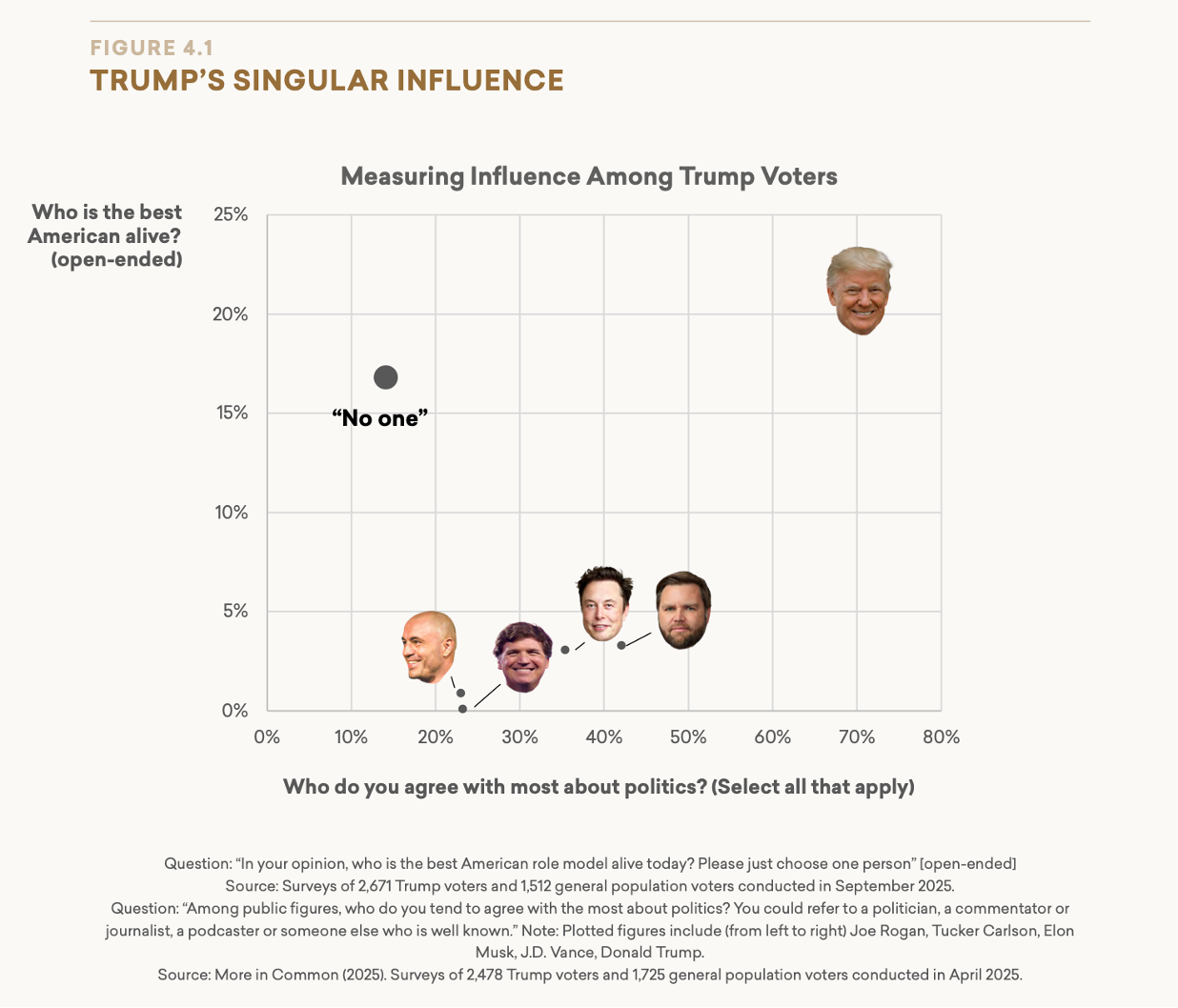
First, let’s talk about what’s not terribly surprising here. President Trump has been the dominant figure, the leader of the Republican Party, since 2015. So it’s not surprising that his voters say that they trust him most about politics. What’s surprising is how far distanced he is from everyone else. It also speaks to some of his coalitional dynamics, which is to say that the coalition that President Trump has cobbled together is President Trump’s coalition. Whoever comes next is going to need to build a very, very different coalition. Something you started to see from some politicians—I think you saw this a lot in 2024—was people trying to mimic some of President Trump’s style. And that just rings hollow. You can say a lot of things about President Trump. I don’t think that you can call him inauthentic. I think part of what appeals to people about him is that he tells you what he thinks. You sense that there’s very little distance between his private behavior and his public behavior. One can have a lot of disagreements with that behavior, but there is a certain form of integrity and authenticity in it.
Shull: The dominance: I guess the debate that it most speaks to—and we don’t have to get into that, because I don’t know just how well we could project it based on your data or anybody’s data, for that matter—is the question of how well the Trump coalition holds up without Donald Trump.
Mangone: I don’t think that there’s a straightforward answer to that question. I can say two things. One is, as I said before, whatever the next Republican coalition is, it’s going to look different than the one of today. To a certain degree, that’s true of every political coalition that every party leader has to build. It’s especially true with a leader like President Trump. The second thing that I would say is that I think that this is one of the best-use cases of our study. This question of, “Is the coalition holding together or ripping apart?” is going to be one that we ask again and again and again in our politics over the course of the next three years. And I think what this study does is offer really, really useful lenses for analysis to help answer that question and make sense of what’s going on.
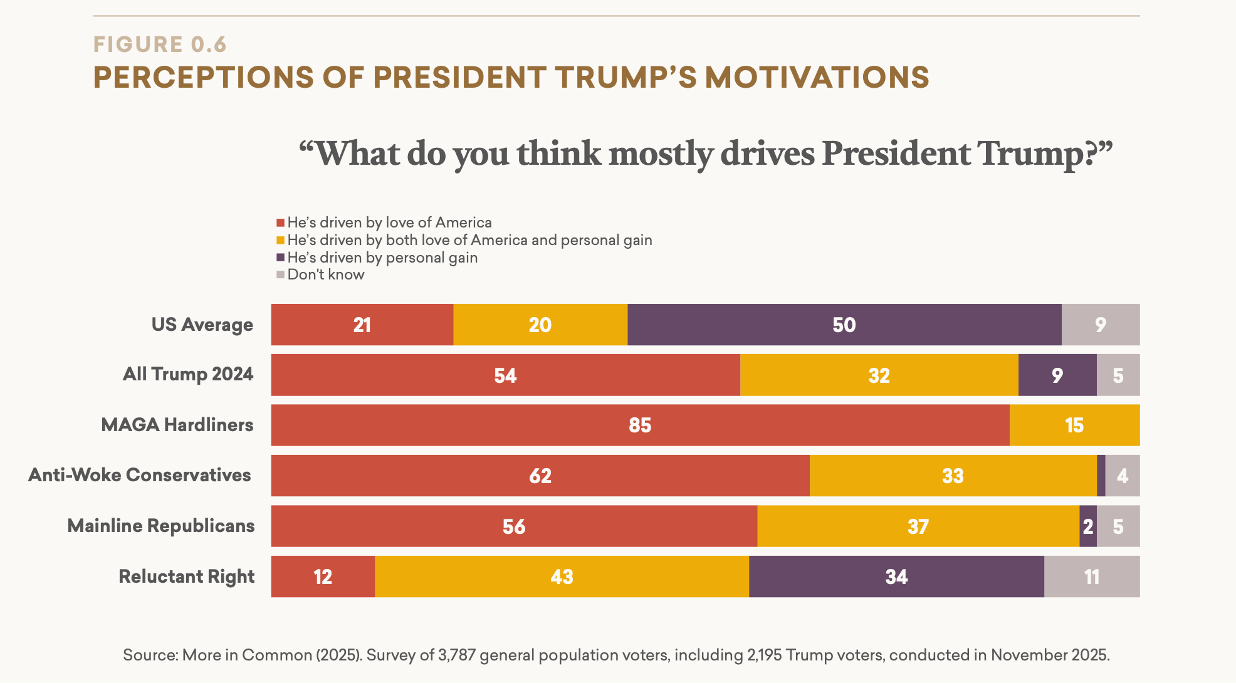
Shull: Agreed. Another distinctive thing: You asked the question whether President Trump, in running for president. was motivated by love of country or motivated by gain or some combination of them. And I thought the results there were quite interesting. Why don’t you talk a little bit about that?
Mangone: We asked, what do you think mostly drives President Trump—he’s driven by love of America, he’s driven by personal gain, or he’s driven by both love of America and personal gain? Across the coalition as a whole, just over half say that he’s only driven by love of America. About a third say he’s driven by both, and about 9% say he’s only driven by personal gain. As you go from MAGA Hardliners to Anti-Woke Conservatives to Mainline Republicans to Reluctant Right, those numbers start to shift. For instance, 85% of MAGA Hardliners say he’s driven only by love of America, compared to Reluctant Right, where 43% say both, and more than a third say he’s only driven by personal gain. What I think is interesting here is that 40% of his coalition say that at least to some degree, he’s motivated by personal gain.
I’ll use this opportunity to jump into some of our qualitative research. One of the questions we get asked a lot is about a perception of some cognitive dissonance. This comes across [about] corruption; it comes across some of the stuff that he’s done in his personal life. One of the ways the question gets asked is, “Yeah, he’s being held up as a model of traditional values, but he’s been divorced three times and has cheated on all of his wives.” And I think that you hear three responses from President Trump’s voters in response to these questions of cognitive dissonance within the coalition. One is, “Yeah, but the other side is worse.” The second answer you hear is, “Yeah, that’s true, but he’s not lying about it. You know who he is; he’s being authentic about it. So at least he’s not lying about it.” And then the third thing you hear is, “Yeah, he is a little bit corrupt. No, I don’t really think that his personal character is aligned with what I prefer to see in a president, but I voted for him anyway, because that was my choice in 2024.”
Shull: I thought it was interesting that roughly 41% of his supporters were willing to acknowledge that personal gain was at least a factor in his rise to leader of the Republican Party and the presidency. So it suggests that they are, as you describe it, engaged in a trade-off.
It makes me think of a piece by Quico Toro that appeared in Persuasion. It was right after Trump had been elected in 2024. Toro did consider it a reckless decision by the American public to have reelected Donald Trump. But then he went on to say something that was interesting. He cited a study that was co-written by someone who just won the Nobel Memorial Prize in Economics, in which they had put together a model which showed that it could be perfectly rational for a voter to embrace someone that they considered potentially corrupt, or even corrupt, in order to get the policy outcomes they felt they simply could not get any other way. In the end, he says, “If the American polity isn’t going to break apart completely over the next four years, it’s important for everyone to accept Trump voters as rational actors.” And he goes on to say, “The calculus Trump’s supporters have made may be appalling, it may be reckless—surely it is—and it may spectacularly backfire. But irrational it is not.”
“We ask you, on a scale of 0 to 100, where 0 represents a very cold feeling, like how you would feel towards someone who kicked your dog, and 100 is your mom—I love this person with complete warmth—Trump voters feel an average warmth score toward members of the MAGA movement that is lower than their warmth score toward legal immigrants.” — Jason Mangone
I thought that was interesting, because it seemed to me that when you looked at what the voters in this Trump coalition were saying about themselves, many of them were saying something exactly like that. They say: “This is the trade-off I’m making. I recognize there’s a cost to it, but it looks less risky, better to me, than my alternative.”
Mangone: I think that’s exactly right. I don’t have much to add to it. The only thing that I might add is that because what you just cited there gets to very, very pragmatic dollars-and-cents issues, there’s also a level of values where, even though President Trump has not himself practiced the conservative traditional values for which he’s a champion to many of his voters, they do trust him to defend those values more than they trusted his political opponents in 2024. So I think that rationalist calculation plays out both at the level of pragmatic needs and also at the level of some deeper values.
Shull: Going to that, I noticed that [issue of] anti-wokeness—the concern that wokeness was having a deleterious effect on America—[in your report]. At one point, the question was, “Education, news and entertainment: What effect has wokeness had?” And 76 % of the Trump coalition said that it had kind of ruined education, news, and entertainment. Even more said that it had become a very or somewhat serious problem for America as a country.
Mangone: Yeah, that’s exactly right. I have one deeper thing to say here, and then one that’s a little bit more at the surface level. The deeper point is [about] the data on declining institutional trust in America since the 1960s. I would say that President Trump’s voters hold in common an answer to why we can no longer trust those institutions: It’s, “Those institutions have become beholden to an agenda that I did not sign up for, and I cannot escape them, and these are not ideas that I believe in.”
The more surface point is that Americans felt a little bit uncomfortable speaking their minds. They like to laugh. They don’t like being told “tsk, tsk” by people on TVs and in computers with whom they have no relationship. I think that there is a perception of Democratic political leaders being scolds, and Americans in general don’t like that.
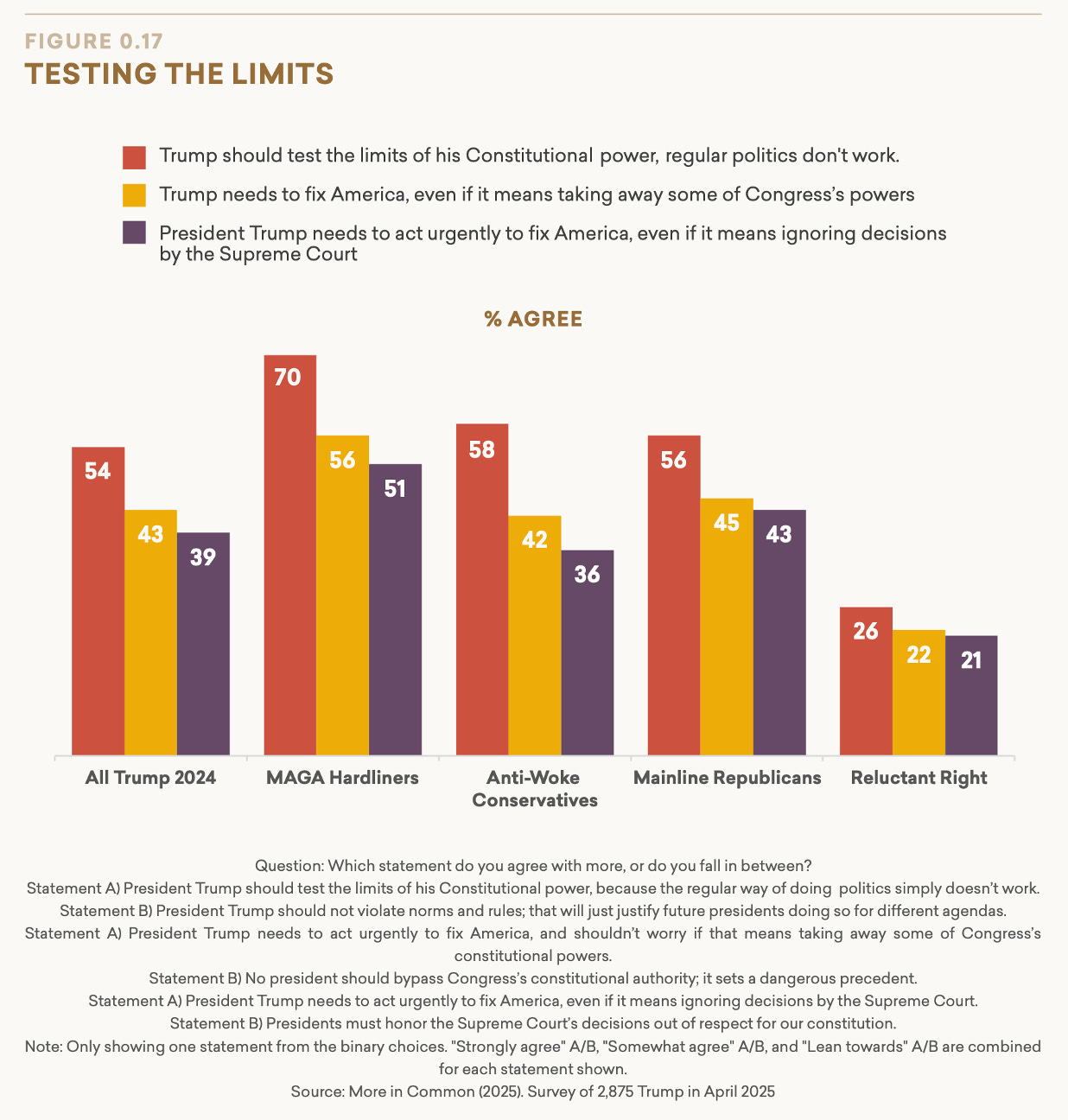
Shull: Let’s go, then, to this question that for a lot of our listeners will be really important. It’s the thing, I think, that keeps a lot of our writers up at night, and that is the question of limits on presidential power for Donald Trump. You asked directly a question about what these folks would like to see Donald Trump doing in terms of pressing the boundaries of his power. Can you talk a little bit about that?
Mangone: I’ll get to the specific questions in a moment, but as a general rule of thumb, when you ask abstractions about, “In general, should Donald Trump do what it takes to get things done?,” the answer is more likely to be yes. When you get really specific—“Should he compromise this norm or break this law?,” you’re much [less] likely to get agreement.
In the study, we stacked bar charts across three questions. One was: “President Trump should test the limits of his constitutional power because regular politics don’t work.” The second was: “The president needs to fix America, even if it means taking away some of Congress’s powers.” And the third was: “President Trump needs to act urgently to fix America, even if it means ignoring decisions by the Supreme Court.”

Of those three questions, the only one where a majority of President Trump’s voters agreed was on the first, the most abstract: “He should test the limits of constitutional power because regular politics don’t work.” When it gets to the most specific of those three questions—“He needs to fix America even if it means ignoring decisions by the Supreme Court”—only 39% of his voters agree with that statement. Responses among the cohorts follow predictable patterns, where MAGA Hardliners are much more likely to support testing constitutional limits, and the Reluctant Right is far, far less likely to support the testing of any constitutional limits.
Shull: So let me, then, go back through the list that we just covered, because if I am an UnPopulist reader or listener, I may have felt that over the past 15 to 20 minutes, we’ve been doing a Rolling Stones “Sympathy for the Devil” kind of description. They would say, “Look, [his supporters] see Donald Trump as, not just a first among equals, but as some kind of a unique figure in American history, who’s head and shoulders above everyone else. They are willing to tolerate the idea of his reaping personal gains from his time in office. They have a religious outlook; they tie faith to some extent to their decisions.” I noticed 55 % of Trump voters believe that he was spared by God from assassination the day that someone took a shot at him and actually almost killed him. We also have the extreme anti-wokeness, and we have them being comfortable with him testing the limits on his power.
When we look at that, where do you see a hope for “more in common” with the people who have said to themselves: “I feel like Donald Trump is a unique threat. I think that he’s got a kind of messianic following that is intent on doing whatever it takes to defeat me, or me and my views.” How is there more in common? How do we find a “more in common” approach?
Mangone: One of the things that I think our study [does] is that it grounds you in an understanding that could actually lead to persuasion. [It’s] really hard to persuade someone if your starting point is, “This person is just an awful person, and I disagree with everything that they think.” [It’s] much easier to persuade someone if you start with an understanding of how they actually view the world.
With that being said, there are a lot of actors who are going to try to persuade the voters in the largest coalition in American politics today—77 million people voted for President Trump. Whoever wins the presidency next is going to need to persuade a healthy chunk of those voters.
“I would say that we are on the knife’s edge. If you look at some of our data, the [Trump] coalition says we should rise above our divisions. If you look at other sets of our data, 54% of President Trump’s voters say that he should test [limits on his] constitutional power because regular politics don’t work. Parts of his coalition says the left needs to be defeated completely because it’s an existential threat.” — Jason Mangone
And I would say that we are on the knife’s edge. If you look at some of our data, the [Trump] coalition says we should rise above our divisions. If you look at other sets of our data, 54% of President Trump’s voters say that he should test [limits on his] constitutional power because regular politics don’t work. Parts of his coalition says the left needs to be defeated completely because it’s an existential threat.
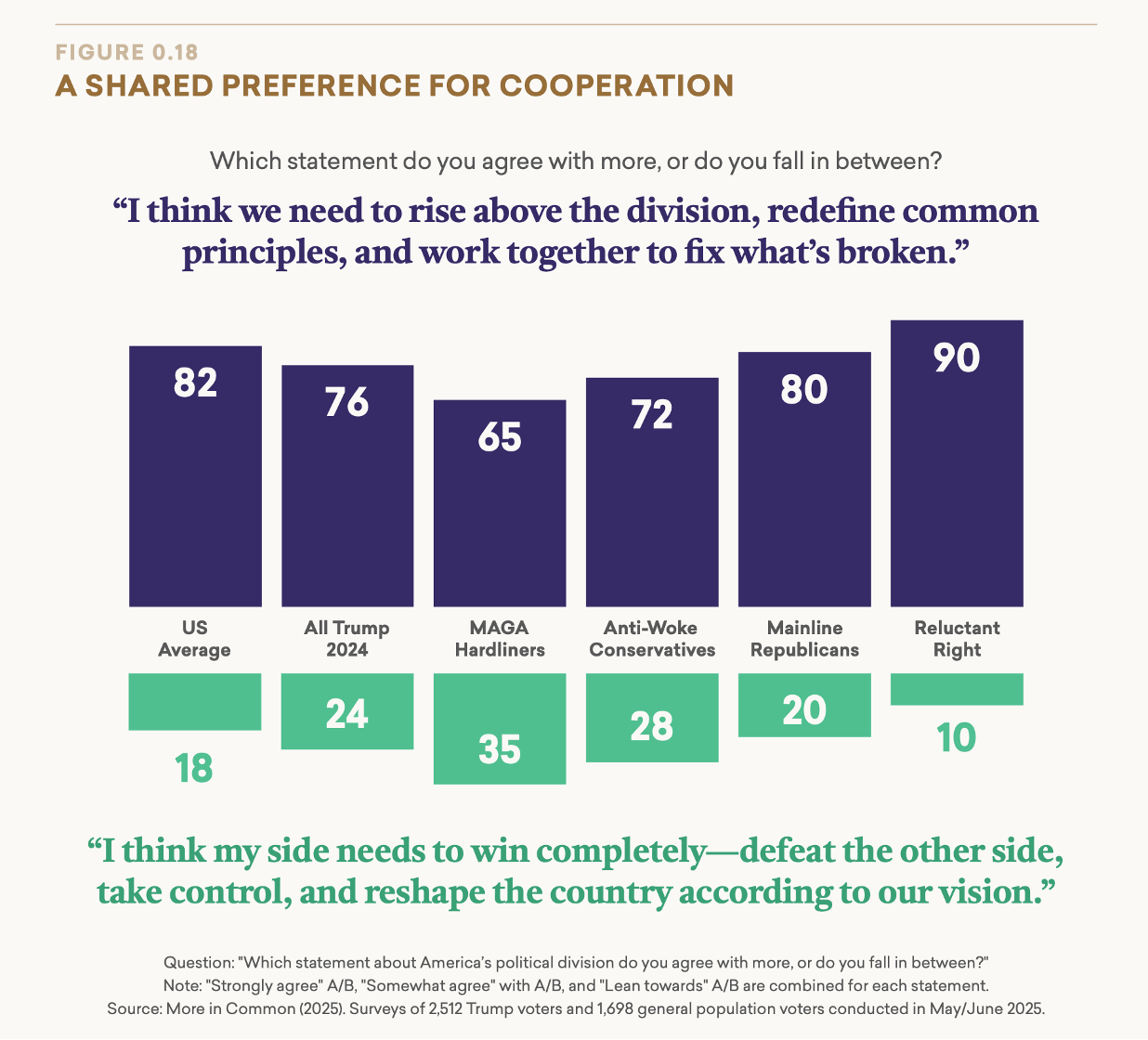
This tension between, “Do we need to overcome our differences so we can focus on solving our problems?” or, “Does my side need to do whatever it takes to win?” is a real tension in our politics. I’m not a soothsayer; I can’t say which direction we’re going to head. I can just say those are two distinct potential paths.
Shull: We can move on to another study that you’ve done, but I did find interesting the extent to which members of the Trump coalition felt that Democratic leaders did not respect them. Only something like 20% or 21% felt that Democratic leaders respected them, whereas well over 80% felt that Donald Trump respected them.
Mangone: A couple lessons that I would take here. One is the persuadable group among President Trump’s voters.
Shull: The Reluctant Right? Are you thinking of the Reluctant Right?
Mangone: To be clear, I think they’re all persuadable by someone; they’re all going to be persuaded by someone who is not Donald Trump in 2028. But I would say, uniformly, the likelihood of your being persuasive to Donald Trump voters without moderating culturally is very, very low—even if on economic and policy matters, you’re speaking directly to them. I think that plays out in number of ways. That’s just a general lesson.
The second is that we started asking that question that you just referenced about respect for “people like me,” based on a political insight of President Obama’s, which is that people don’t vote for you because they like you; people vote for you because they think you like people like them. For anyone who wants to persuade members of President Trump’s cohort, I think a good starting point is: What kind of person, what kind of leader here, can make President Trump’s voters feel like he cares about them? I think our study offers a good, nuanced starting point to begin to answer that question.
Shull: Fair enough. I think we should, then, move on to the study that in some ways launched your ship—I may be overstating it considerably—back in 2018.
Mangone: You’re not overstating it. It definitely launched us in the U.S.
Shull: The study was called “Hidden Tribes.” It was another massive survey research project. You really launched this idea of looking at psychographics and not demographics—in other words, what key, important attitudes and beliefs does somebody have about very basic things: about their ability to succeed in the world through hard work and effort, or, on the other hand, the extent to which they are simply subject to forces outside their control and whether they succeed or not is a matter of luck; questions about authority and how they respond to authority—whether it’s important to respect it, whether it’s important to challenge it, things of this nature.
You asked a series of questions of this kind that had demonstrated in the past, for decades, very distinct differences in people’s opinions in other areas. And in doing that, you came up with a series of groups, seven of them, that you considered to be the “hidden tribes” in American politics. We won’t have time to go through all of those, but I would like to focus in particular on four of them in the “middle.” These four groups—which included traditional liberals and moderates—you consider as a whole an “exhausted majority.”
Take a moment, if you could, and just describe that “exhausted majority”—67% of American adults. That’s definitely a decisive majority, two out of every three Americans. The question becomes: Why exhausted? And what made them different from the people on the “wings,” which were people like the MAGA Hardliners on one side or activist progressives on the other?
Mangone: Really appreciate the question. As shorthand, the way that I like to describe the Exhausted Majority is that these are the two-thirds of Americans for whom politics is not an important part of their identity, or not a terribly important part of their identity.
There’s probably four attributes that set the Exhausted Majority apart from the groups on the wings. First is they’re more ideologically flexible—which is to say, their belief on one issue is not necessarily predictive of their belief on another issue. They have more heterodox beliefs. The second is they tend to be more supportive of finding political compromise. The third is that they feel fatigued by U.S. politics today. That causes a lot of them to, frankly, tune out. That’s why they’re called the Exhausted Majority, not the Nixonian “silent majority.” They don’t like politics. And then, finally, they just feel forgotten in our political debate. As I said earlier, the political options available to them today are not reflective of how they see the world.
Shull: So I think crucially, one thing is they feel like the menu of choices in front of them when they walk into the ballot booth is not as appealing as it might be to the people on the wings. Is that a correct view?
Mangone: I might add one quarter turn beyond that. I also think that many politicians are part of a machine that they don’t believe in either. So if you talk to an individual politician, many of them don’t like the polarization and the “conflict entrepreneurship” that’s endemic to our politics today. But it’s the system that we have, where divisive figures on the far left and the far right eat up most of our attention, and because they get the most attention, are able to raise the most money as well. At the end of the day, yes, the [Exhausted Majority] don’t feel great about pulling the lever one way or the other, but beyond that specific zero-sum choice, they’re also just exhausted by the craziness.
Shull: Yeah, another thing is, if I remember correctly, that a large percentage of them believe that there is a way to find compromise and to work together. Obviously, we just discussed some folks, like the MAGA Hardliners or maybe the Anti-Woke Conservatives, who look and say: “This other side—no matter what the drawbacks of my champion here in Donald Trump and the Republican Party may be—that other side is just not an option. We cannot go there. There’s no making this work together.”
And yet my sense with the Exhausted Majority, in listening to the descriptions, is that they do believe that it’s possible to work together, and they do believe that there are ways to moderate and compromise and come to solutions that everybody can buy into.
Mangone: I think that that’s exactly right. There’s a good question in American politics, which is like, “How do we live next to people whom we don’t agree with?” That’s what we’ve always done. Because you have to get along with them, because you live with them. Not living with them is not an option.
“This tension between, ‘Do we need to overcome our differences so we can focus on solving our problems?’ or, ‘Does my side need to do whatever it takes to win?’ is a real tension in our politics. I’m not a soothsayer; I can’t say which direction we’re going to head. I can just say those are two distinct potential paths.” — Jason Mangone
So I think some of the frustration with lack of compromise in our national politics is downstream of how discordant that is with their day-to-day lives, where they’re not surrounded by people that think exactly like they do, and they’re not terribly motivated by partisanship. So there’s a dissonance between their personal lives and what they see as happening on the national political scale.
Shull: My sense, too, is that there is a, as you say, fatigue with the political discourse—the tone of it, the things that people focus on. It seemed that maybe one of the suggestions from that study, if one wants to speak to that Exhausted Majority and draw them onto your side of the political arena, would be to find a way to essentially moderate the political discourse in a way that sounds more familiar to them than what they’re seeing right now or what they hear right now from both parties.
Mangone: I think that’s exactly right. There are structural things that one could do to make the most committed partisans less influential in the structures of our politics—and I think those are generally good things. I would also say that there’s also a strategy of just persuasiveness. Part of what More In Common tries to do is just help you understand what motivates people on the wings. So if you are trying to persuade them more into the middle, and persuade them to be more open to compromise, you can at least begin with a starting point of how they view the world.
Shull: That brings me, I guess, to a final set of findings that we can use to wrap up. There’s yet another survey that you did recently called “The Perception Gap.” I thought this was interesting and something, too, that we’ve seen elsewhere. The Polarization Research Lab at Dartmouth has consistently asked questions like: “Would you violate this norm? Would you be happy if the president did X, Y, or Z—ignored the Supreme Court or did an end-run around Congress to get over the problem with haggling with them?” Questions like that. And then they say: “By the way, you identify as Republican. How many Democrats do you think said this evil thing should be done?” And over and over, both sides overestimate how much the other side would do that. You can look at the numbers, and there may be 30% [who] say: “Yeah, that’s fine. Go ahead and violate that norm.” But if you ask the other side, they’ll say [it was] far, far more than 30%.
So let me ask a little bit about that. Could you summarize some of the findings there?
Mangone: Absolutely. The perception gap is a really nice visual way to show pretty straightforwardly the ways in which we have more in common than we think we do. We often are thinking on the same plane, but that consensus is often hidden. As a starting point, I’ll just give you the quick definition of a perception gap because it’s helpful to do. A perception gap is the difference between what people think a person or a group believes and what that group actually believes. That’s your starting point.
So we did this for a series of questions, using the exact methodology that you just described, Tom. And a couple of the key findings: Democrats and Republicans imagine that almost twice as many people on the other side hold extreme views than they really do. For example, on average, Democrats and Republicans believe that 55% of their political opponents [hold] views [that] are extreme. In reality, only about 30% [do]. I could have a lot more to say about this topic. Just another one that I think is important to highlight here is that Americans with more partisan views—so, those Americans who are on the wings of our politics—have much larger perception gaps than the Americans in the Exhausted Majority or more in the center of our politics. So the exaggerated disagreements that animate some of our politics are particularly strong the farther left or the farther right you go.
Shull: And with each side assuming that the other side is actually more committed [as a group] to this extreme viewpoint than it really is. Another thing on this perception gap that I thought was interesting: A lot of people would say to themselves—and I think this is true on both the right and the left—“Well, look, if I want to understand what’s going on in the world and really understand what the other side’s doing, I need to get out and consume news sources. I need to educate myself. So I should be paying attention to what’s posted on social media. I should reading newspapers, listening to talk shows, listening to the news,” all of these different things. And they might assume, too, that having an extended education, a college degree, a post-graduate degree, etc., gives them a better, larger picture of America, and it would make their views even more accurate. What did the study find?
Mangone: So the more news you consume, and especially the more active you are on social media, the larger your perception gaps are. As you said, at first blush, that seems a little counterintuitive. But I think there’s a couple things going on here. One is, particularly on social media, the most divisive content is most likely to get served to you. So it’s much easier to develop misperceptions of the other side, the more time that you spend on social media. The second thing is that online networks tend to devolve into echo chambers. You’re very likely to only get one side of a story.
And then the last point on media is that folks on the wings—progressive activists on the left and devoted conservatives, what we might now call MAGA Hardliners, on the far right—are also the groups most likely to be posting political news on social media. So that’s likely to be the view that you get served.

Last point I’ll make is that for Democrats especially, a higher education level means that you’re likelier to be on the wings, a progressive activist, and you’re much less likely to have friendship diversity. So a standard feature of being on the wings is that all of your friends have the same political views as you do. And for the left, the more education that you have, the more likely you are to be on the far left.
Shull: And also to have a very large perception gap, right? Wasn’t there a finding that post-graduate Democrats had something like three times the perception gap of non-high school grads who were on the left? And so there they were with similar political views, but the perception gap for the people who had the extra education was actually higher, rather than lower.
Mangone: You quoted the statistic exactly. I don’t have causality here. My sense of what’s going on is tied up [in]—the academic term for it would be—network diversity, or diversity of friendship groups. The more common-sense term would be a lot of these people just aren’t living in the real world. They’re not going to a nine-to-five. They’re not going to a bar with their buddies after work. They’re not going to church every Sunday and being surrounded in the due course of life by people who are different than they are.
Shull: And it seemed to me that the findings there included news consumption of the usual kind. Newspapers were listed as one of the places where you might think, just off the top of your head, you’re getting a better, more sophisticated view of the news and what’s going on in the world. And yet often your perception gap was still there. It did not essentially filter that out. Sometimes it made it—well, again, causality we don’t know. But what we appear to know is that the perception gaps tend to be even higher for those who consume a lot of news, including newspapers or TV news or what have you.
Mangone: Just because they are now our, like, national paper of record, I’ll use The New York Times as an example. My sense is that has less to do with anything that The New York Times is writing per se, and much more to do with the types of people that are all reading The New York Times every day. And those all tend to be the same sorts of people. And they tend to be on the left, and they tend to be a little bit higher income, and they tend to be more educated.
Shull: Yeah, more correlation here than causation. It is interesting, though, when what you kind of hope is helping you isn’t having the effect maybe you were hoping it would.
Mangone: Yeah, I think something you hear a lot now is, “Go out and touch grass.” And if the thing that you want to do is have a more accurate picture of how your fellow Americans view the world, you’re much likelier to get that by being out in real life with your fellow Americans. Whether that’s watching the Super Bowl or Olympics hockey or going to church or volunteering at a soup kitchen—whatever it is, it doesn’t matter. But doing things with people who are different from you is sort of the big “unlock” to all this stuff.
This interview was a production of Zooming In. We hope you found it a useful exploration of the plurality of Americans who voted for Donald Trump in 2024 and of the cultural challenges inherent in promoting classical liberal precepts in a polarized America. Please subscribe to The UnPopulist to hear more from Zooming In; the subscription link appears below.

© The UnPopulist, 2026
Follow us on Bluesky, Threads, YouTube, TikTok, Facebook, Instagram, and X.
We welcome your reactions and replies. Please adhere to our comments policy.


