


There is an irony buried in Hungarian political history. Fidesz—the Viktor Orbán-led party that has ruled with a supermajority for the last 16 years, reshaping Hungary’s constitution, packing its courts, weakening its free press, and gradually hollowing out most institutions that might check its power—is an acronym in Hungarian for “the Alliance of Young Democrats.” Founded in 1988 by students who gathered in clandestine groups to resist a communist government, Fidesz was initially conceived as a direct challenge to authoritarian rule. Orbán, one of its founders, even accepted a fellowship from George Soros (a man he would later demonize) to study civil society at Oxford.
On April 12, Hungarians will go to the polls to take part in what is shaping up to be the most consequential election the country has seen since its democratic transition in 1990—one that could end Orbán’s long grip on power. Recent polling shows just one in five voters under the age of 40 backing Fidesz. Orbán has been reduced to pleading with parents on the campaign trail to drive home the stakes to their adult children. Fidesz is no longer in any meaningful sense an “Alliance of Young Democrats”—and hasn’t been in a long time. In fact, it has become the very political machine it was originally created to dismantle.
Orbán’s tenure has evolved into an experiment in illiberalism within the European Union—an “illiberal state,” in his own words—that he has sought to export as an election-proof model for nationalist allies like Donald Trump. But the experiment may be about to blow up, and the consequences could extend far beyond the borders of this small central European country.
A Perilous Pardon
The deepest single wound to Orbán’s political standing—whether or not it ultimately proves fatal—was self-inflicted: a presidential pardon. In February 2024, the Hungarian investigative outlet 444 revealed that Hungarian President Katalin Novák—whose role in national politics is largely ceremonial—had quietly freed a man convicted of helping cover up systematic child sexual abuse at a state-run orphanage. The pardoned man, a deputy director of a children’s home, had pressured victims to retract their testimonies against the institution’s director, who was convicted of abusing at least 10 children between 2004 and 2016. Novák had granted the pardon in April 2023 and kept it secret.
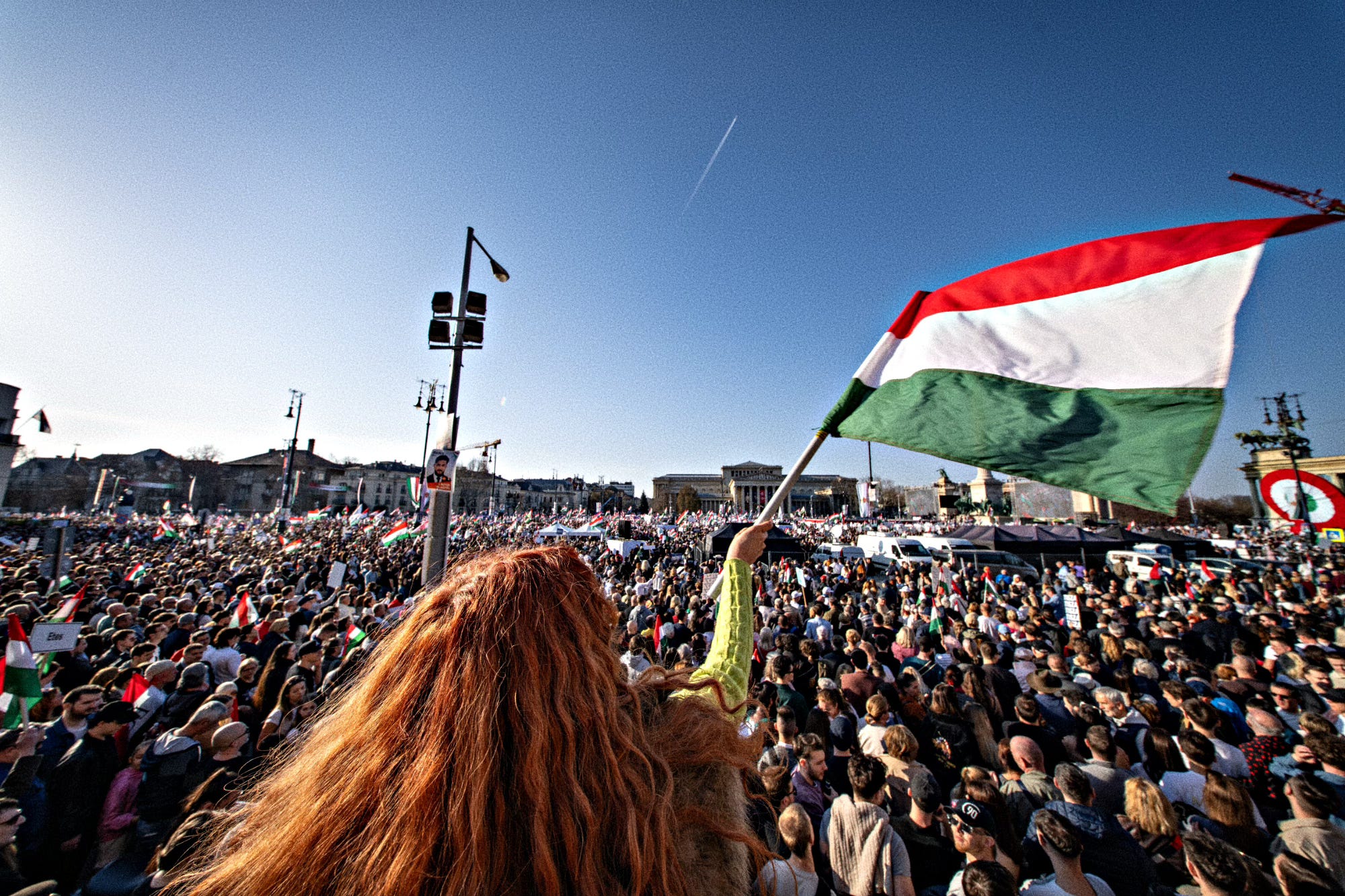
The public reaction was volcanic. Protests erupted in Budapest demanding Novák’s resignation, with an enormous demonstration on Heroes’ Square called the “Monsters Walk Outside Protest.” Also implicated was Judit Varga, a key Fidesz figure who had certified the pardon as Hungary’s then-minister of justice. She had been expected to lead Fidesz’s list for the European Parliament elections; Orbán himself had called her a “born talent” who “possessed everything required for somebody to take charge of a country.” Both women resigned within days.
The scandal was revealing in multiple ways. Here was a government that had built its entire political identity on the defense of Christian families and the protection of children, and it had quietly freed a child abuse accomplice. But equally significant was what happened next: Varga’s ex-husband, a Fidesz insider named Péter Magyar, went public. In a bombshell interview with the independent Hungarian media outlet Partizán that reached nearly 2.7 million views, Magyar described the government as a “political facade” designed to conceal the machinations of those in power and amass vast fortunes for them. He then organized a rally on March 15, 2024, attended by tens of thousands.
From that moment, Hungary had a proper opposition. Magyar wasted no time converting popular rage into institutional power. Just four months after announcing his party, Tisza won nearly a third of the vote in the June 2024 European Parliament elections, securing seven seats, the highest share won by any non-Fidesz party since 2006. Fidesz, meanwhile, took under 45% and 11 seats, its worst-ever performance in an EU election. The result gave Magyar members of the European Parliament (MEPs), resources, international credibility, and a platform in Brussels that previous Hungarian opposition parties had never possessed. It also confirmed something more fundamental: that Tisza was not a protest movement but a political party capable of competing in elections.
Appeasement Tour
Central to modern Hungarian politics is Orbán’s relationship with Hungary’s neighbor, Ukraine. Orbán has staked his reelection on passionate opposition to Western aid for Ukraine, personified by President Volodymyr Zelenskyy, whom Fidesz billboards have plastered across the country with the slogan “Don’t let Zelenskyy have the last laugh.” Orbán claims EU alignment would bankrupt Hungary and send its young men to die. Hungary has been the only EU member state to refuse to allow weapons bound for Ukraine to transit its territory, and Orbán has repeatedly blocked and delayed EU sanctions packages and military aid.

The most brazen move came in July 2024, days into Hungary’s rotating presidency of the Council of the EU. Without consulting EU partners, Orbán flew to Kyiv, then Moscow to meet Putin, then Beijing to meet Xi Jinping, a self-proclaimed “peace mission” in which Putin suggested that Orbán was representing the European Council. European Commission President Ursula von der Leyen dismissed it as “nothing but an appeasement mission.” In an unprecedented rebuke, EU member states refused to attend a strategic summit Hungary was scheduled to host, holding their own separate meeting instead.
Kleptocracy
Behind the geopolitical theater lies the economic reality that is making ordinary Hungarians increasingly furious. After contracting by 0.9% in 2023, Hungary’s economy grew by only 0.5% in 2024 and was projected at 0.4% in 2025, slower than the EU average, while the budget deficit is projected at 4.6% in 2025 and is expected to increase to 5.2% in 2026, significantly exceeding the EU’s 3% target. By some metrics including household consumption, at just 72% of the EU average, Hungary has become the poorest country in the bloc.
The figures are not abstractions. The village of Felcsút, population 1,800, is Orbán’s childhood home, which has transformed since 2010 into a personal fiefdom. Its soccer club, the Puskás Akadémia, has received hundreds of millions in state support through subsidies, tax schemes, and public sponsorships, despite average attendances of around 1,500 per match. Its stadium holds nearly twice the population of the town. EU funds also financed a 6-kilometer tourist railway between the stadium and a neighboring arboretum, declared a national priority investment, which has lost money every year since it opened. In other words, Orbán’s economic model is reminiscent of Third World potentates who’d rather shovel money into wasteful projects for favored constituencies and supporters rather than productive endeavors that benefit all Hungarians.
Then there is Lőrinc Mészáros, a former gas fitter and Orbán’s childhood friend, who rose to become Hungary’s wealthiest man, his fortune built almost exclusively on public contracts. Adjacent to his private estate sits a zoo—with zebras, antelopes—that became a national symbol of the ruling elite’s extravagance. In the summer of 2025, former Fidesz MP Ákos Hadházy organized public “safari tours” to the estate, as a form of protest—thousands of Hungarians came, in lines of cars stretching kilometers, to see for themselves what their taxes had built.
At the same time, approximately 19 billion euros in EU funds sit frozen over rule-of-law concerns—money that could have built hospitals and schools, locked away while the men around Orbán keep getting richer.
Spies, Secrets, and Sovereignty
The architecture of control did not stop at media—which Orbán coopted by placing loyalists in key positions across the country’s news outlets—or at money, which he shoveled to favored constituencies and cronies. In December 2023, Hungary passed the Sovereignty Protection Act, creating an office with sweeping powers to investigate any individual or organization receiving foreign funding deemed threatening to national sovereignty: targeting nongovernmental organizations (NGOs), journalists, academic institutions, and LGBTQ+ groups. Critics immediately compared it to Russia’s foreign agents law. The office’s first report named journalists from The New York Times and CNN alongside Hungarian NGO staff as threats to Hungarian sovereignty, prompting the European Commission to launch infringement proceedings against the law.
The proceedings were hardly overreach. The law’s purpose became even clearer on March 24 of this year. Hungarian investigative outlet Direkt36 reported that a covert operation had been run against Tisza’s IT infrastructure ahead of the election. Magyar called the scandal “Hungary’s Watergate” and a police detective publicly corroborated elements of the account. The government scrambled to offer a counter-narrative, claiming the IT specialists were Ukrainian agents who had infiltrated Tisza. But the explanation had an obvious flaw: if Ukraine was spying on a Hungarian political campaign, embedding agents in the party more sympathetic to Ukrainian interests was a peculiar way to do so.

Two days prior to the Direkt36 report, The Washington Post reported that Foreign Minister Péter Szijjártó had been regularly briefing Russian Foreign Minister Sergey Lavrov during breaks in Council of the EU meetings, passing live reports on closed-door discussions about sanctions and Ukraine aid. Polish Prime Minister Donald Tusk said the revelation “shouldn’t come as a surprise to anyone.” Szijjártó confirmed regular contact with Lavrov, framing it as normal diplomacy.
The Autocrat’s Network
For 16 years, Orbán has presented himself as the great protector of ethnic Hungarian minorities living beyond Hungary’s borders. The 1.2 million Hungarians in Transylvania have delivered near-unanimous support for Fidesz in Hungarian elections. But in 2025, that bond was tested. Orbán backed Romanian ultranationalist George Simion, even though he had led attacks on a Hungarian military cemetery in Transylvania and described the ethnic Hungarian party as a “hideous, chauvinistic creature”—likely calculating that a Simion presidency would pull Romania away from its staunchly pro-Ukraine, pro-NATO course and toward the Moscow-friendly axis Orbán had been cultivating. The response was telling: ethnic Hungarians voted overwhelmingly for Simion’s liberal opponent, Nicușor Dan, contributing decisively to his margin of victory. The communities Orbán claims to champion repudiated him—or at the very least declined to follow his lead after 16 years of doing so.
Internationally, Orbán’s camp has leaned into a broad coalition of nationalist allies. Endorsements arrived from Marine Le Pen, Alice Weidel, Benjamin Netanyahu, and Javier Milei. Vladimir Putin’s state media openly backs him. Trump has called Orbán “a great man” and today, JD Vance arrived in Budapest for a two-day visit—following Marco Rubio’s own trip in February—making the administration’s investment in an Orbán victory unmistakable.
The Washington Post also reported in March 2026 that Russia’s Foreign Intelligence Service had internally proposed staging a false-flag assassination attempt on Orbán to improve his electoral odds. Then, with the election less than a week away, Serbian authorities announced the discovery of explosives near the Balkan Stream pipeline carrying Russian gas to Hungary. Orbán convened an emergency defense council and, while stopping short of a direct accusation, said the incident fit “into the chain” of Ukrainian actions against Hungarian energy supplies. But Magyar claimed to have seen it coming; posting on X that for weeks he had been receiving warnings that Orbán—with Serbian and Russian assistance—“may be planning to cross another line.”
What Comes Next
With the election mere days away, Politico’s Poll of Polls shows Tisza outpacing Fidesz by 10%. Late-deciding voters, who broke for Fidesz in 2022, now appear to be shifting toward Tisza. Partizán’s election meter, which aggregates multiple polls, projects a 78.5% chance that Tisza gains the majority.
But thanks to Fidesz’s self-serving electoral reforms that removed the ceiling on campaign spending and gerrymandered more than a third of electoral districts, Carnegie Endowment for International Peace estimates that an opposition party may need around 55% of the popular vote to secure a simple parliamentary majority; Fidesz could potentially win a supermajority with as little as 45%.
It is by no means certain, therefore, that Orbán will be defeated. Still, the question hanging over Hungary in the final week is one that would have been unthinkable two years ago: What happens if Orbán loses, and what if he refuses to leave? He is not Lukashenko or Maduro. Hungary remains an EU member state with international monitors and a business class with too much invested in European markets to stomach outright election theft.
But he is not without options. Fidesz has already amended electoral law twice since Magyar emerged, and more likely than outright refusal is that Orbán would use the outgoing parliament’s remaining weeks—in which his two-thirds majority still allows constitutional amendments—to lock Fidesz loyalists into the courts, regulatory bodies, and constitutional oversight mechanisms that no simple parliamentary majority can dislodge. That would effectively ensure that, even in opposition, Orbán’s system survives him.
The man who built Hungary’s system of illiberal democracy, gerrymandered constituencies, bought media empires, rewrote the constitution, turned EU funds into patronage, and expelled a Western university while welcoming a Chinese one in its place is discovering that systems of control have limits. Scandal after scandal—a pardoned child abuser, a spying operation against the opposition, NATO secrets passed to Moscow—might each have been managed in isolation. All of this, combined with an abysmal economy, has produced something Orbán’s machine was not designed to handle: a population that has simply stopped believing him.
If Orbán does lose, it will signal that there are limits to the ability of authoritarians in power even after they have consolidated their hold and rigged the playing field. The opposition faces an uphill task, but it can prevail with the right leader with a smart strategy. If the Hungarian opposition wins, it will offer hope and lessons to liberals world over engaged in a struggle against authoritarianism.

© The UnPopulist, 2026
Follow us on Bluesky, Threads, YouTube, TikTok, Facebook, Instagram, and X.
We welcome your reactions and replies. Please adhere to our comments policy.

There was a fact checking article on Vance’s claims in Budapest in today’s Guardian. As usual, he lied about the EU being the enemy of the Hungarian people and unashamedly nailed his, and by association America’s colours to Orban’s mast. A victory by the opposition and the deposing of Orban would be a delicious win for those opposing autocratic fascist governments like Hungary’s and the US’.
The whole of Europe is holding its breath and a majority of us are hoping Hungarians choose to get rid of Orbán. But frankly, I’ve not much hope for his successor, who is also a nationalist. We must reform the EU voting system and get rid of unanimous voting. Hungary has literally been betraying us to Russia.