


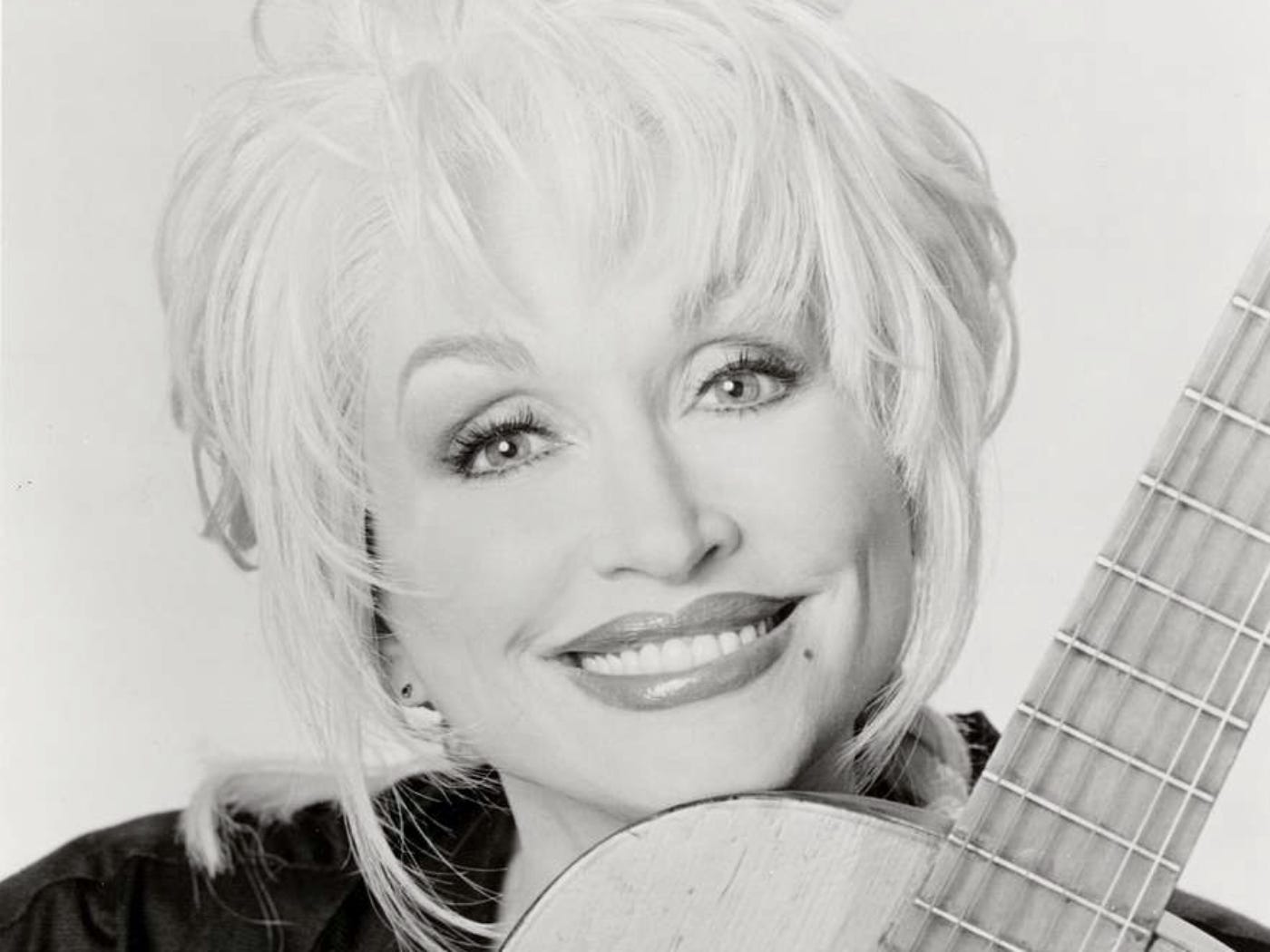
Dolly Parton spent her life showing up. She showed up for her fans, giving over 1,000 public concerts and recording over 45 studio albums. She showed up for her home state, spearheading the Dollywood theme park that’s the largest employer in Sevier County, Tennessee. She showed up to do good works, distributing hundreds of millions of children’s books around the world, funding medical research, and supporting disaster relief.
But when it came to being honored, rewarded, or asked to get involved in politics, she made herself scarce. She declined the Presidential Medal of Freedom three times—twice from Donald Trump, once from Joe Biden. When the Tennessee state legislature wanted to erect a statue in her honor she declined. “I don’t think putting me on a pedestal is appropriate at this time,” she said. “I hope, though, that somewhere down the road several years from now or perhaps after I’m gone if you still feel I deserve it, then I’m certain I will stand proud in our great State Capitol as a grateful Tennessean.”
With Parton’s passing earlier this week, it’s time to give her the honors she earned and remember the nationally unifying presence she created as, arguably, the last universally admired person in the United States.
Dolly Parton was one of the most accomplished people of her generation. Her personal life—she was happily married to a non-celebrity for 59 years—seems beyond reproach. Billboard magazine ranks her the number one country star ever. Songs like “Jolene” and “I Will Always Love You” rank among America’s most recognizable and beloved hits. Her philanthropy—not only books but also the early research behind the Moderna Covid vaccine—reached a scale almost no private citizen has matched. She used her brand, business skills, marketing savvy, and sense of humor to build an entertainment empire and provide jobs in a place that desperately needed them. She became very wealthy in the process—her net worth has been estimated at around $500 million—and her legacy seems certain to have an enduring impact on her home region.
Doing even one of these things would have earned her a place in history. She did all of them.
Donald Trump may have broken precedent by ordering flags to fly at half-staff for a week in her honor—only a handful of private citizens have ever gotten that honor and apparently none for as long—but he was justified in doing so. Trump, to say the least, shows a high level of self-regard but it’s instructive that he’s ordered a greater honor for someone who never endorsed him (or any other political candidate) than he did for his most ardent political supporters.
None of this is to say that Parton never took a position. She told Billboard, in the summer of 2020, that “of course Black lives matter,” while noting that she had not joined the marches. She welcomed gay and lesbian fans. And in 2018 she dropped “Dixie” from the name of her Stampede show, after Charlottesville made the word’s Confederate associations impossible to ignore.
It is tempting to call these safe positions. But a truly safe remark does not run as national news, and hers did. The Billboard comment was a headline on NPR and CNN within a day, precisely because a country star saying it was so unexpected. What separated her was not the content of what she said but that she had never allowed herself to be placed on anyone’s “team.” She offered neither contrition nor defiance about the Stampede: she said that she hadn’t known the term would be offensive, changed the name, and moved on. Even as politics have intruded on everything from supermarket purchases to streaming video choices, Parton kept herself out of the red vs. blue color wars that characterize so much of American life and yet stick up for her beliefs and values.
Since Parton turned down honors during her life but said they were fine after she was gone, there is no reason not to take her up on this. Trump should posthumously grant her the Presidential Medal of Freedom and Congress should award her the Congressional Gold Medal. She deserves the nation’s two highest civilian honors as much as anyone ever has. The Tennessee state legislature should also go forward with the plans for a statue she put on ice and then go further.
One particular step is especially fitting: giving her a place in the National Statuary Hall Collection of the United States Capitol. The collection, consisting of two sculptures selected by each state’s government, was created in 1864 under legislation proposed by Congressman Justin Morrill of Vermont to present Americans who are “deem[ed] to be worthy of this national commemoration.”
Her home state of Tennessee currently has two statues in the collection: President Andrew Jackson, who was also a major general in the War of 1812 against the British, and John Sevier, the first Tennessee governor. Sevier helped win a crucial battle in the Revolutionary War but otherwise his accomplishments were meager. Replacing little-remembered politicians like Sevier with popular figures has recent precedent—Arkansas replaced former Governor James P. Clarke with singer Johnny Cash in 2024, making him the first musician admitted to the collection. That swap took five years from state legislation to unveiling, which is a good argument for beginning now.
Jackson certainly made a significant impact on history but he’s a deeply problematic figure who wrecked the economy and brutalized Native Americans. Likewise, Sevier was no friend of the native Indian population whom he displaced with white settlers. Replacing Sevier’s statue could present a fitting continuity. Parton’s home county, a place she transformed for the better, is named for Sevier and, thus, any moderately complete recitation of her impact necessarily mentions his name. In other words, there’s a good case for swapping out either of them.
The Statuary Collection is not, finally, for the people in it: Morrill meant it as a room of examples. And the case for putting Parton in that room is not a matter of paying a debt to a woman who gave freely in every way. It is that a country with less and less in common ought to keep what remains of it in the room where we take the schoolchildren.

© The UnPopulist, 2026
Follow us on Bluesky, Threads, YouTube, TikTok, Facebook, Instagram, and X.
We welcome your reactions and replies. Please adhere to our comments policy.

Wow, what a brilliant idea (in an economy of words). Parton deserves every bit of the praise, and Lehrer's idea deserves serious consideration.
Endorse.