



Berny Belvedere
Every year at The UnPopulist, we run a feature during the winter holidays in which staffers and our closest contributors each pick out something—usually a book, film, TV show, music album, song, or video game—to recommend to readers. And every year, without fail, I find it impossible to confine myself to just one pick. That’s okay—I checked the site bylaws and it turns out that, for our holiday feature, it is not against the rules to offer multiple recommendations, so long as they’re from different categories. I can do that.
Since in the past two years I’ve devoted more space to my book picks, I’ll switch things up this year and go longer on some of the other categories.
My book pick is Katherine Stewart’s Money, Lies, and God: Inside the Movement to Destroy American Democracy, which is as good an account as I’ve come across of the quasi-religious fervor with which the various parts of Trump’s MAGA movement have sought to undo our liberal-democratic order.
Shifting to film, I loved James Gunn’s Superman—not only for what it is, a fantastic film in its own right, but for the journey it prompted me to go on. I went back and watched everything in the Superman film canon this year, an experience I quite enjoyed, even when a particular installment or two (or three) failed to—I’ll be nice here—scale the heights of moviemaking. Did the meltdown of MAGA pundits this summer over the idea that Superman embodies immigrant greatness add to my appreciation of this year’s film? Yes, it did.
My two TV picks also feature aliens—Disney’s Andor and FX’s Alien: Earth. I would need to be granted a massive word-length expansion to adequately convey everything I feel about Andor’s second season, released earlier this year. Quite simply: For me, Andor’s second season is one of the greatest story arcs in television history, and is by far the best entry in the Star Wars universe. I also really enjoyed Alien: Earth, the first TV series in an impressively enduring sci-fi story franchise (it has spanned seven films from 1979 to 2024).
My main focus this year though is music. I’ll go short on song picks and longer on my album pick. My song standouts this year are Lord Huron’s “Is There Anybody Out There,” Whitney’s “Darling,” and Taylor Swift’s “Honey.”
I wanted to go longer on my album pick because I see it as the high-point of an entire subgenre. Dijon’s Baby is the fullest realization yet of the alternative R&B tradition that more or less began with the leaking of British-Indian reclusive perfectionist Jai Paul’s groundbreaking, though largely incomplete, album in 2013 (see “BTSTU” or “Str8 Outta Mumbai” for mesmerizing examples of this style). R&B’s past eras—for example, the Motown sound of the ’60s and ’70s, or the Prince-powered Minneapolis sound of the ’80s—had a distinct production style, and that’s precisely what makes Dijon’s Baby so special: it is the finest encapsulation yet of this eclectic new R&B tradition in which distorted guitar fragments, analog synths, and hazy and compressed drums randomly weave in and out of minimalist, reverb-rich, lo-fi arrangements. Until Baby, Mk.gee’s Two Star & the Dream Police from 2024 was the high point of this style (Justin Bieber’s Swag and Swag II from earlier this year, which featured production from both Dijon and Mk.gee, is the subgenre’s most commercially successful offering). But Dijon’s Baby, which is something of a mashup of Bon Iver and Prince, and in a year which the genre lost one of its greatest-ever groovesmiths, has seriously raised the bar and is worthy of your time.
Shikha Dalmia
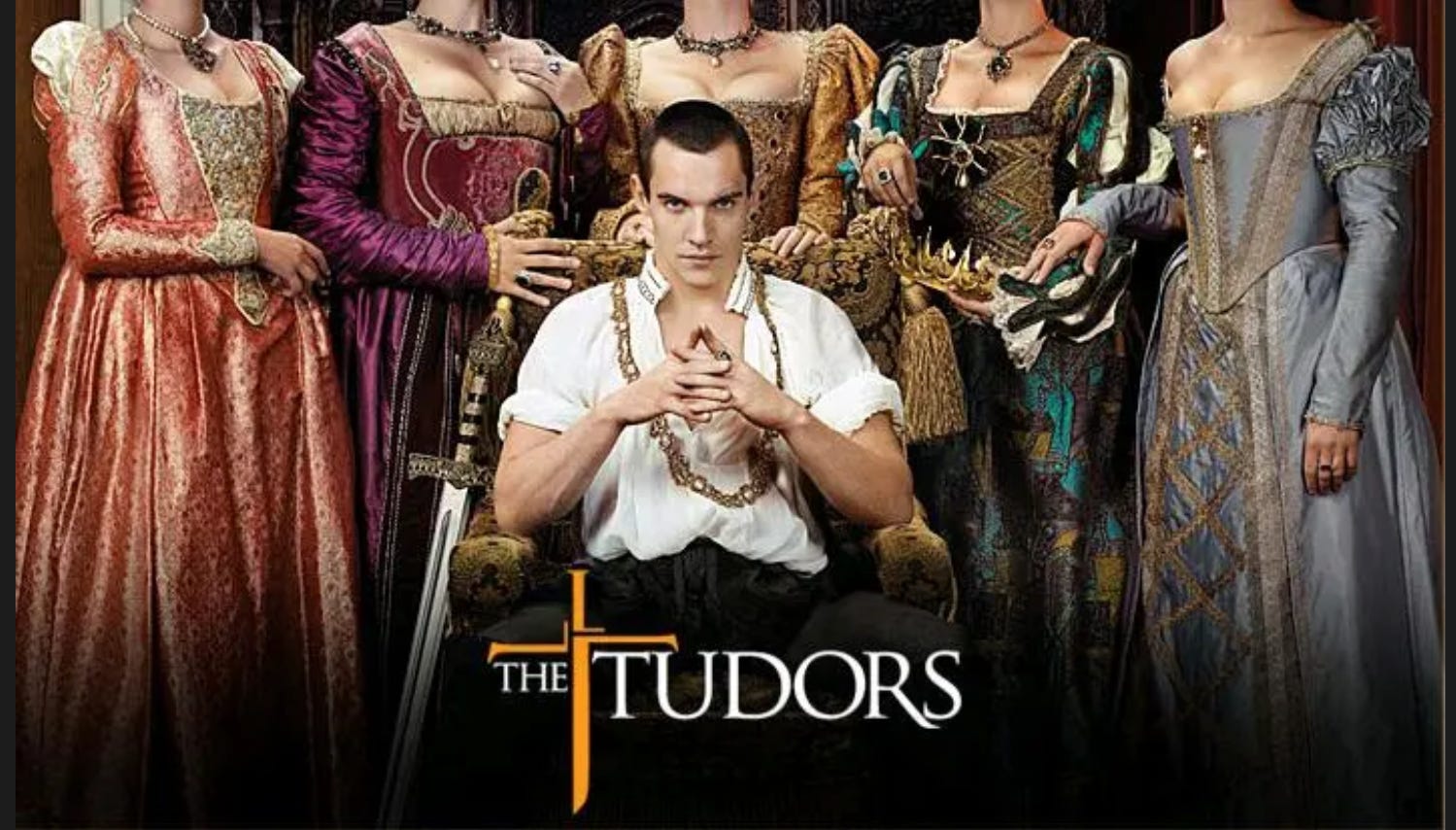
Forgive me, but my holiday recommendation is a somewhat dated British drama series, The Tudors, about the reign of Henry VIII, the 16th-century king most famous for chopping off the heads of two of his six wives on grounds of adultery (at least one of which historians say were completely fabricated). Aired from 2007 to 2011 and now available on Netflix and Amazon Prime, its four seasons make for great binge watching for anyone interested in scanning the history of the British monarchy for parallels to our own turbulent times.
Just as the social media revolution is tearing down existing gatekeepers and allowing utterly irresponsible actors such as Tucker Carlson and Candace Owens to gain a mass following by titillating their audience with hate and bizarre conspiracy theories, at that time, the Gutenberg press was triggering an information revolution by putting the Bible in the hands of the masses and (rightly) challenging the Catholic Church’s monopoly on doctrinal interpretation. As this technology started taking off, Martin Luther used it to mass distribute his scathing critiques of the church’s corruption, shattering the unity of Christendom and cracking open the door to corrupt and power-hungry leaders like Henry with a personal axe (no pun intended) to grind. He relentlessly focused on the church’s corruption and controlling ways to detract from his own corruption and power grabs.
Obsessed with having a male heir, Henry, played by the very easy-on-the-eye Jonathan Rhys Meyers, is incensed by the refusal of the church to allow him to annul his marriage with Katherine of Aragon, who can’t seem to produce a surviving son for him, and marry Anne Boleyn (the wife he subsequently beheads on trumped up charges of serial adultery including with her own brother after she, too, like her predecessor, gives him only a daughter). Overcoming his initial wariness of Luther’s ideas, he repurposes them to justify his break from the church in 1534. He ramrods the Act of Supremacy through parliament and establishes the Church of England and anoints himself its head, consolidating political and religious power in one office. He then orders his handpicked Anglican clergy to torture the Bible till it yielded a doctrinal justification for divorcing Katherine, not unlike what Trump is doing to the U.S. Constitution.
Henry knew full well that such a radical move would generate wide public outrage and breed massive resistance and unrest. So he surrounds himself with loyalists and reformist zealots willing to ruthlessly suppress papist dissenters. When his former Lord Chancellor Sir Thomas More, a devout Catholic, refuses to go along, he is beheaded for treason in 1535.
Henry subsequently dissolves the Catholic abbeys and monasteries that refuse to redirect their taxes to the Crown rather than to the church and dispatches his Royal troops to loot and plunder them. Henry uses this ill-gotten wealth to enrich his loyalists and expand the Royal navy, launching reckless wars against Scotland and France that greatly weakened England. (Sound familiar?)
In one of the most gruesome episodes, he orders his loyal friend, Duke of Suffolk, to carry out a brutal reprisal in Lincolnshire. Royal troops massacre scores of men and boys leaving their bodies hanging in neat lines on a lush slope in a performative act of cruelty.
It took England over a century to settle down after Henry smashed its institutions and traditions. Reformation and counter-Reformation forces duked it out for decades with each side engaging in massive bloodletting of the other when it gained power. Ironically, his and Anne Boleyn’s daughter, Elizabeth, a Protestant, started cleaning up her father’s bloody mess and finally ushered in an era of semi-tranquility when the arts and Shakespeare flourished.
Like Henry, Trump has surrounded himself with loyalists willing to bend constitutional interpretation to serve his personal interests, attacked traditional institutional constraints on executive power, enriched his allies through dubious means, and deployed performative cruelty as a political weapon. Let’s hope the United States recovers faster than England from the institutional destruction that its Orange King is wreaking.

Help Us Stand Up to Authoritarianism: Become a Paid Subscriber This Holiday Season

Liberal institutions don’t survive on good intentions alone. They survive only when people who believe in them decide they are worth defending.
Landry Ayres
Eephus, the 2025 directorial debut of cinematographer Carson Lund, is possibly the best cinematic expression of America’s national pastime ever put to screen. Named after the eephus pitch, an overhand throw whose high-arching trajectory and low velocity result in a strange hangtime known to confuse hitters into swinging too early or late, the movie similarly exists in suspended time.
Set in the 1990s, it could just as easily have been set in the 1970s or today. Two small-town Massachusetts adult recreation league baseball teams meet on the same field they have played on for years for what will be their final game because the field is set to be demolished. However, rather than rotely blaming faceless corporate entities and big bad private developers, the film, refreshingly, focuses on the new school that will be constructed on the site. While the players are not without their frustration and sadness at the loss, this choice, as one reviewer noted, means that “the film’s only villain is the passage of time, and its protagonists are simply facing the unpleasant realization that their era is ending sooner than their lifespans.”
What then follows is a loose, shaggy hangout film with almost no real plot, only a collection of characters talking between (and during) plays, innings, and at-bats. Sometimes they discuss the game, sometimes what will come after. Beers get cracked open on and off the field, spectators come and go, and the game stretches on into the night as extra innings stack up.
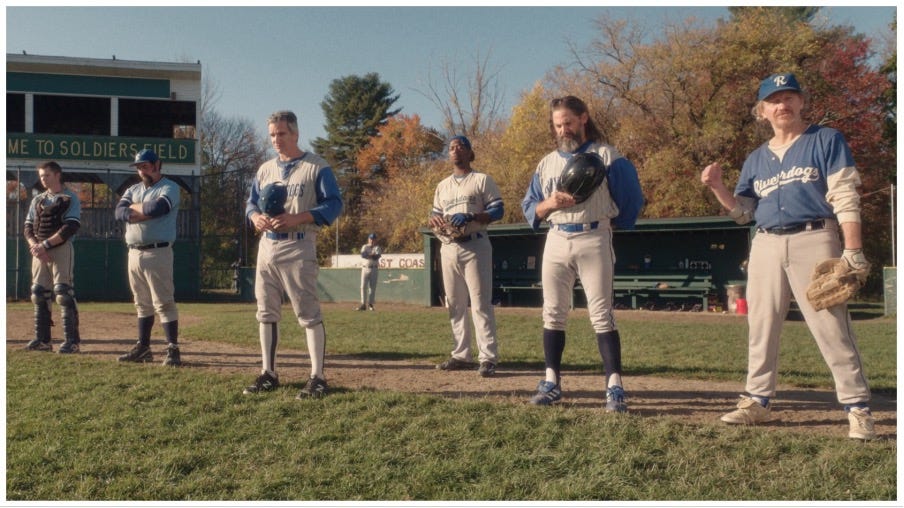
The film’s lack of propulsion may bore some, but it masterfully captures the feeling of attending an actual baseball game in person, where attention drifts, returns, wanders again. Time is not organized around highlights or narrative beats. It just passes. Lund trusts that sensation completely, letting dead air, casual chatter, and long stretches of nothing happening do the heavy lifting. The effect is quietly immersive. You stop waiting for the movie to “get going” and start settling into it, the way you do on a metal bench behind a backstop on a warm evening.
That acceptance, much like the characters’ struggle to accept the loss of their one social scene, feels almost radical in a moment when so much contemporary cinema treats nostalgia as a moral position, forever chasing the restoration of something lost or broken, forever insisting that meaning lies in recapturing a vanished past. Eephus offers a gentler, harder truth. Meaning comes from being present while something is happening, from noticing it fully, and then letting it end. There is sadness in that, and also relief. Like the eephus pitch itself, the film hangs in the air just long enough for you to feel its strangeness, its beauty, and its inevitability, before dropping softly, exactly where it should.
Andy Craig
Five years into its run, The Rest Is History has just picked up Apple’s Podcast of the Year award, a well-deserved accolade.
The format hasn’t changed much over the years, other than a steady increase in more multi-part series digging into topics like the French Revolution or the lives of the Caesars. Two historians, Tom Holland and Dominic Sandbrook, talk their way through the past. What keeps it from drifting into amiable mush is how different they are, both professionally and personally. Holland is drawn to ideas, belief systems, and the long shadows cast by antiquity; Sandbrook, a historian of modern Britain, is more skeptical, more interested in politics as it is actually practiced, and quicker to puncture solemnity. Their banter—sometimes warm, sometimes faintly needling—does a lot of the work. You can hear genuine disagreement, but also a shared enjoyment in arguing things out.
That dynamic makes the show unusually good at handling big, familiar historical moments without flattening them. Their episodes on the trial and execution of Charles I, for example, are not presented as a foregone conclusion or a morality tale, but as a series of escalating decisions made under pressure. The fall of the Roman Republic is treated less as an abstract lesson in “decline” than as a story about political systems being stretched beyond what they were designed to bear. The parallels to contemporary politics are never labored, but they’re hard to miss. At the same time, the show can provide a refreshing break from the stress of our own day’s news.
The same approach works well when the show moves into 20th-century political history, whether in the U.S. or the U.K. Episodes on postwar Britain, American presidential campaigns, or the culture and conflicts of the Cold War resist the urge to tidy things up. Instead, they emphasize contingency: how messy, uncertain, and improvised politics often is when you’re living through it.
What The Rest Is History offers, at its best, is not so much a set of lessons as a way of thinking. It makes historical episodes feel accessible without stripping them of complexity, and it trusts listeners to sit with ambiguity. It’s a podcast you can drop into casually, but one that often leaves you thinking about the present a little differently than you did before.
Birch Smith
The demands of grad school have me living under a cultural rock. Yes, of course, the last season of Andor and the new Superman film were both great—but not exactly hidden gems. So I’ll stick to my forte for this year’s entry and content myself with recommending two books—albeit ones that aren’t dry analytic philosophy—and an album.
The nonfiction book is Adam Becker’s excellent and informative More Everything Forever: AI Overlords, Space Empires, and Silicon Valley’s Crusade to Control the Fate of Humanity. Becker takes on what may be one of the most pressing questions in American political economy—What the heck is wrong with all of these tech billionaires?—and hits it out of the park. His scientific credentials—in astrophysics—shine through, but the book is highly readable and engaging throughout. If you want to understand why a bunch of mostly unserious tech-futurists think that not giving their companies billions of dollars to fund AI development is the moral equivalent of murder (and why they’re increasingly attacking democracy along the way), this is the book for you.
For fiction, I can’t say enough good things about Robert Jackson Bennet’s Shadow of the Leviathan series. We’ve got two installments so far: The Tainted Cup, which came out last year, and this year’s (even better) A Drop of Corruption. The novels are murder mysteries within a well-executed “biopunk” fantasy setting. Even if you find the main characters’ dynamics a bit too derivative of Holmes-and-Watson (I liked it, but I’ve always been a sucker for Conan Doyle), the pacing, plot, and excellent world-building should be more than enough to carry you through.
My music recommendation is Janani K. Jha’s debut album, The Rest of the Laurels. It takes a lot for me to really get into a pop album—my usual preference is for slow, melancholic indie/folk music—but this one did the trick. It’s a concept album rooted in Greek and Roman mythology, so there’s plenty of literary allusions and clever wordplay in the lyrics, but it also has a lot of compelling emotional heft. And to be honest, at a time when pictures of statues in social media profiles are a distressingly accurate predictor of identification with the far right, it’s refreshing to see an artist take inspiration from that source material without Being Weird About It. If you like pop music and puns, or just think classical antiquity is kinda neat and shouldn’t be left to languish as a symbol of the illiberal right, give it a listen.
Aaron Ross Powell
I wish the circumstances were better around this recommendation. Recent events have made it sad. Still, it was my favorite movie of 2025, and also the piece of media that brought me the most joy this year, and so I’ll emphasize that instead of the sadness.
Spinal Tap 2: The End Continues is a gift. Yes, it got lukewarm reviews. Yes, it isn’t as funny as the original. Yes, it wasn’t, strictly speaking, necessary. But for those of us who love that original, every watching of Rob Reiner’s 1984 film is like hanging out. Hanging out with morons, but lovable morons. Exasperating friends. Everything about it, every moment, is authentic. They are, after all, a real band. Nigel, David, and Derek work their way into the life of the true fan. Marty, too.
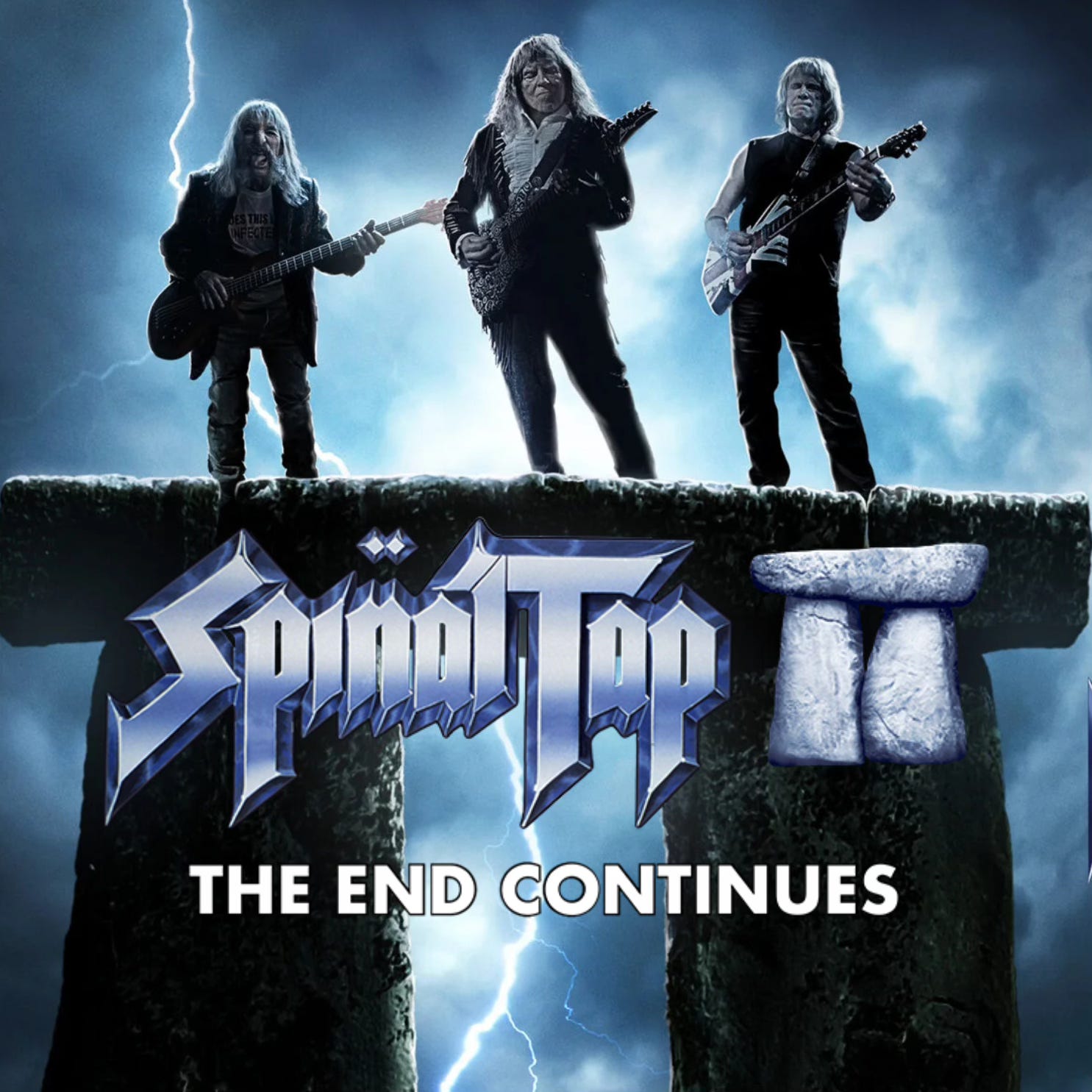
And so the sequel. Unexpected, yes. But sitting in the theater, introducing my children to these characters, the sequel felt earned. They’re all old. They’re not what they used to be. But the impact they’ve had, both in character and out, is undeniable. You can see it in how giddy the cameos of legends are. Paul McCartney and Elton John don’t just walk into a scene and walk out. They stick around. They are over the moon, it’s clear, to hang out, like us in the audience, with Spinal Tap. And Spinal Tap, even with the drama between them, are old friends. Reiner, Guest, McKean, and Shearer are old friends. They earned a reunion. I’m deeply grateful for the joy they brought me, especially in an otherwise dismal year.
Goodbye, Marty. And thank you.

© The UnPopulist, 2025
Follow us on Bluesky, Threads, YouTube, TikTok, Facebook, Instagram, and X.
We welcome your reactions and replies. Please adhere to our comments policy.