


Today is the 150th anniversary of the unveiling of the Freedmen’s Monument (also called Emancipation Memorial) which stands in Washington D.C.’s Lincoln Park, although activists sought to remove it in 2020. To those activists, the monument, which depicts Abraham Lincoln, the emancipator, towering over a kneeling, half-naked, just-freed Black man, memorializes freedom slavishly. As a widely-circulated petition puts it, the monument’s message is that Black people “are beneath white people and should simply be grateful for the scraps that have been thrown [their] way.” The attack on the Freedmen’s Monument was part of a broader and longstanding antiracist effort to cast tainted heroes and sanitized traitors out of the circle of honor. 2020 also featured a recommendation from the “District of Columbia Facilities and Commemorative Expressions Working Group,” formed by Mayor Muriel Bowser, to “remove, relocate, or contextualize” the Washington Monument.
The conservative backlash was fierce. For Texas Congressman Dan Crenshaw and others, those bent on removing the Freedmen’s Monument were bent on “erasing America itself.” As Alice Butler Short, founder of Virginia Women for Trump, put it at a demonstration against the removal proposal: “It’s not just about statues. It’s about protecting our history, our way of life, our heritage.” In other words, the defense of the statue, which also attracted learned and nuanced support, was absorbed into broader and longstanding anti-woke efforts to take back the American historical narrative, an effort that culminated in state laws and federal pressure against the teaching of “divisive concepts” in American schools.
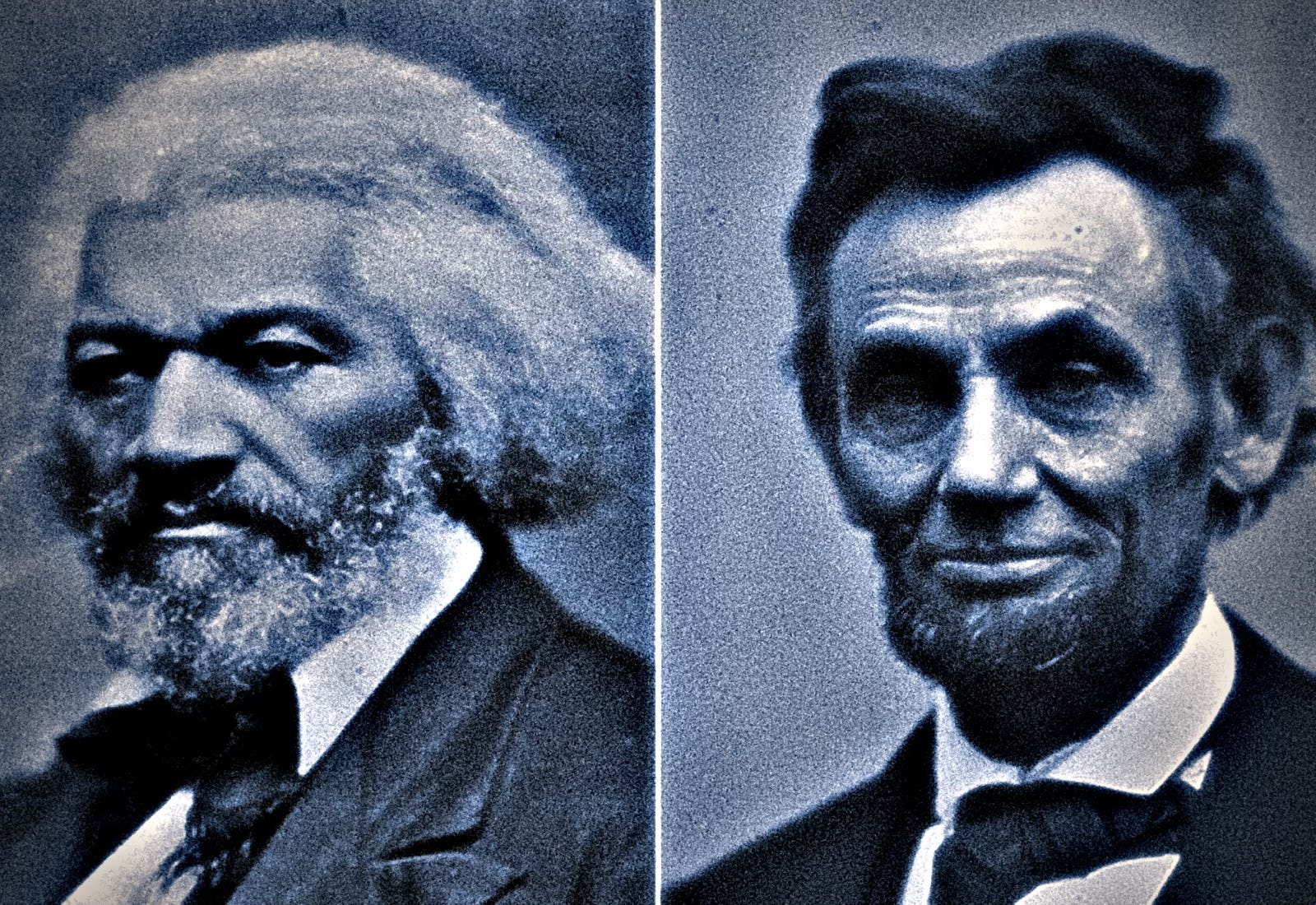
On the occasion of the unveiling of the monument, the abolitionist orator Frederick Douglass gave the main address in memory of Lincoln. That address was calculated to satisfy neither those, like today’s progressives, who think an indictment was in order, nor those who, like today’s conservatives, think that white Americans should be shielded from anguish over the historical failures of a white-dominated America. Instead, Douglass assessed Lincoln and the America he embodied in a manner consistent with his obligation to the truth and to the dignity of Black people.
Douglass’ Dispassion
Douglass’ Freedmen’s Monument address is not as famous as the 1852 jeremiad, “What to the Slave is the Fourth of July?”, a staple of anthologies and syllabuses. I suspect that it owes its neglect to its equanimity at a time when the Reconstruction was unraveling. Historians mark 1877 as the final end of that project, but the North’s will was already broken when Douglass spoke. In 1876, as the historian, Philip Foner, observed, “the Negro people in the South were being beaten to their knees by armed ruffians. And the “Republican Party … was doing nothing.” Nonetheless, Foner says, Douglass, “overwhelmed by the honor” of top billing on such an occasion, barely implied this betrayal. The radical spoke too tamely. He avoided “divisive concepts.” This is a conclusion that young progressives seem to share. In a class I gave on the address, about four months after George Floyd’s killing, a student opened the discussion this way: “It’s trash,” she said referring to Douglass’ speech. She had something like Foner’s complaint in mind: How could Douglass waste the opportunity to denounce an America that richly deserved it?

But to charge Douglass with being overcome by the moment is to ignore that the address, in fact, interprets the moment.
First, some of the context surrounding the moment. It was clearly seen at the time to mark something, well, momentous. The monument was, apart from a pedestal Congress funded, paid for entirely by Black people, who also organized the unveiling. Congress declared a “general holiday” for D.C. public employees to attend. President Ulysses Grant came with members of his Cabinet, Supreme Court justices, congressmen, and foreign dignitaries. A disproportionately Black crowd of 25,000, according to The New York Times—and over 100,000 according to the chief organizer’s estimate—gathered to hear Douglass’ oratory, along with a reading of the Emancipation Proclamation. As Douglass said, for the “first time” in American history, Black people assembled, with the nation’s approval and attention, to “do honor to an American great man.”
Douglass draws attention not only to this audience but also to the telegraph wires putting him and the freedmen “in instantaneous communication” with “loyal and true men all over the country.” The unveiling of the monument is a “national act, an act which is to go into history.” Since Lincoln’s death, Douglass had been thinking about how to meet the moment.
In 1865, Douglass had rejected a request to lend his name to a different monument project led by his fellow Black abolitionist, Henry Highland Garnet, who hoped to honor Lincoln by founding a school for Black people, partly funded by white philanthropists. In response to an invitation to serve as an officer of Garnet’s Colored People’s Educational Monument Association, Douglass argued that mixing commemoration with solicitation would put the Black man in the position of a “beggar,” invite the charge of “turning the nation’s veneration for our martyred President into a means of advantage,” and “place us before the country in an attitude derogatory to genuine self-respect.” A monument financed by Black people, Douglass said then, would better “express one of the holiest sentiments of the human heart … free from all taint of self-love or self-interest.”
Reading Douglass Between the Lines
The Freedmen’s Monument was a fulfillment of that hope. And Douglass in his oration echoes this description of gratitude, a sentiment he regards as “one of the noblest.” But the gratitude he expresses on behalf of Black people was, very purposefully, compatible with their self-respect and agency in bringing about their own Emancipation. Douglass’ thanks are delivered in the “spirit of liberty.”


Douglass’ critics wish he had shown a little less gratitude, or at least that he had used Lincoln, as he did the Founders in his Fourth of July speech, to highlight the hypocrisy of his white contemporaries. In that speech, Douglass, without fully embracing the revolutionaries of 1776, contrasted their bravery and patriotism to the cowardice and greed of his contemporaries, who refused their generation’s task to take the logic of the Revolution to its antislavery conclusion. Similarly, though Douglass could not avoid praising Lincoln on a day devoted to honoring him, he could have used Lincoln’s courage to highlight the cowardly Northern retreat from the Reconstruction effort to protect Black Southerners from their former masters. It’s not like Douglass didn’t know how to criticize white Republicans. Indeed, he did so later that year: “You turned us loose to the wrath of our infuriated masters.”
But in this speech, he does something even more radical. For nearly a quarter of the address, Douglass ignores the white luminaries altogether, speaking solely to Black people. He distinguishes between “our white fellow citizens and ourselves.” He congratulates his Black “friends and fellow citizens” (when he later addresses the entire audience, he speaks only of “fellow citizens,” as if to say that whites will have to prove themselves reliable friends) on a change that they, as well as Lincoln, caused. Their freedom, secured in part by Black soldiers, is “blood-bought.”
Viewed in this light, Douglass seeks less to evade hard truths about the failures of the North than to assert an inspiring and necessary truth, that Black people act, and are not merely acted on, in history. In other words, if Blacks were commemorating Lincoln through the statue, Douglass was commemorating them.

In that sense, Douglass slips the grasp of progressive critics.
Unsparing But Not Unkind or Unfair to Lincoln
But as author and UnPopulist contributor Laura K. Field argues, he also defies conservative appropriators who want to depict Lincoln as the symbol of the greatest triumph of America and brush away the horror of slavery. Douglass says, “Abraham Lincoln was not … our man or our model” because “in his prejudices, he was a white man … entirely devoted to the welfare of white men.” Douglass is thinking of Lincoln’s willingness to let slavery persist indefinitely, so long as it is set on a course of ultimate extinction. Yet he knew or should have known, as Jefferson did, that slavery was a “bondage … one hour of which was worse than ages of the oppression” the patriots of 1776 were impatient to end.
This deflation of Lincoln has two purposes, both of which serve to project and encourage Black self-respect. First, he wants to keep the record straight as to what the true cause of the war was. The criticism of Lincoln in question occurs in the only part of the speech in which Douglass directly addresses “my white fellow citizens.” They may be tempted to consider Black people the cause of a war that took hundreds of thousands of lives. Lincoln himself once told a Black delegation, Douglass reminds them, that “but for your race among us there could not be war.” But, as Lincoln had also said, in his 1854 Peoria Address and elsewhere, the South’s insatiable desire to spread slavery and compel the North to accept its moral permissibility threatened liberty altogether and therefore threatened the Union. Douglass reminds his white audience, who may have come prepared to accept gratitude on Lincoln’s behalf, that Lincoln had to act and did act to save them. That is why it “especially belongs” to them “to sounds his praises” and to “preserve and perpetuate his memory.”
Second, Douglass wanted to ensure that Black people were seen as capable of taking “a comprehensive view of Abraham Lincoln”—understanding his greatness even though he was not motivated primarily by their interest. Despite Lincoln’s frustrating hesitations, Lincoln remained “near and dear to our hearts in the darkest and most perilous hours of the Republic,” Douglass says—and not from “blind and unreasoning superstition” but from reflection on “the stern logic of great events.” Douglass suggests that Black abolitionists knew something Lincoln didn’t know, that merely restoring a compromise that checked the spread of slavery could not secure peace. But they also knew that Lincoln, who “in his heart of hearts loathed and hated slavery,” was on a path that would eventually bring him to their conclusion. As Douglass had repeatedly argued, including in his 1862 speech, “The War and How to End It,” to leave slavery in its place would be to ensure that “the same elements of demoralization which have plunged this country into this tremendous war will begin again to dig the grave of free Institutions.” The impulse to check the spread of slavery could safely end only in emancipation.

When Lincoln started moving in that direction in 1862, urging Congress to support gradual and compensated emancipation, Douglass predicted: “Time and practice will improve the President as they improve other men. He is tall and strong but he is not done growing.”
Criticism Without Malice
Therefore, Douglass said in the Freedmen’s Monument oration, Black people could see in Lincoln “the head of a great movement, which, in the nature of things, must go on until slavery should be utterly and forever abolished.” Later in the speech, Douglass credits Lincoln with knowing Americans “better than they knew themselves.” Lincoln, through his attentiveness to public opinion, did what no abolitionist could do, namely bring Americans gradually along to abolishing slavery. In this essential matter, Lincoln judged better than Douglass and other abolitionists. But in understanding that Lincoln’s work would necessarily end in emancipation, Black people, Douglass claims, knew Lincoln better than Lincoln knew himself.
In asserting the right and ability of his people to take a comprehensive view of Lincoln and insisting that their gratitude was anchored in a self-respecting regard for the truth, Douglass offered the greatest tribute to Lincoln I know. That tribute, Douglass’ left-wing detractors notwithstanding, is the opposite of self-abasing and, Douglass’ right-wing appropriators notwithstanding, unfriendly to those who bristle at the idea that Americans should be made to feel responsible for their history—including the disgraceful parts. The only words of Lincoln that Douglass directly quotes in the Freedmen’s Monument Address are from Lincoln’s Second Inaugural:
Fondly do we hope, fervently do we pray, that this mighty scourge
of war will soon pass away, yet if God wills it continue till all the
wealth piled by two hundred years of bondage shall have been
wasted, and each drop of blood drawn by the lash shall have been
paid for by one drawn by the sword, the judgments of the Lord are
true and righteous altogether.
Far from divisive, this sentiment, which, without apportioning blame equally between the North and South, fixes the sin of slavery on the nation as a whole can—to quote a line of the Second Inaugural that Douglass does not—”bind up the nation’s wounds.”
“Truth,” Douglass says, is “proper and beautiful at all times,” even when harsh, and, he shows, compatible with gratitude. That, and not petulant self-congratulation, is a remembrance worthy of a great country.

© The UnPopulist, 2026
Follow us on Bluesky, Threads, YouTube, TikTok, Facebook, Instagram, and X.
We welcome your reactions and replies. Please adhere to our comments policy.

I appreciate and agree with your post. One thing I would note is that, at Saturday’s anniversary ceremony, Douglass’s oration was strongly redacted and almost entirely omitted his more unsparing remarks. When the statue was restored and rededicated in the mid-2010s, they held a similar reenactment ceremony, and there many of most strongly worded sections were retained. I have to believe that the so-called anti-woke forces in charge now insisted on such changes; the entire story seemed sanitized for the current powers-that-be. But it’s hard to bury it entirely, and enough was left intact for anyone who wants to know more of the story, as you detail here.
"It's trash" - the flippancy, vagueness, and total lack of eloquence shown by that student is an indictment of our culture and education system. If a student wants to denigrate a speech from one of the giants of American letters and oratory (not to mention one of our greatest freedom fighters), that's fine - no one is beyond criticism, after all. But she should at least present a half-decent argument for doing so instead of just regurgitating lazy twitter-language.