

For Justice Sam Alito, Freedom Is Censorship and Censorship Is Freedom
He implies that like the state, social media companies should have no editorial discretion

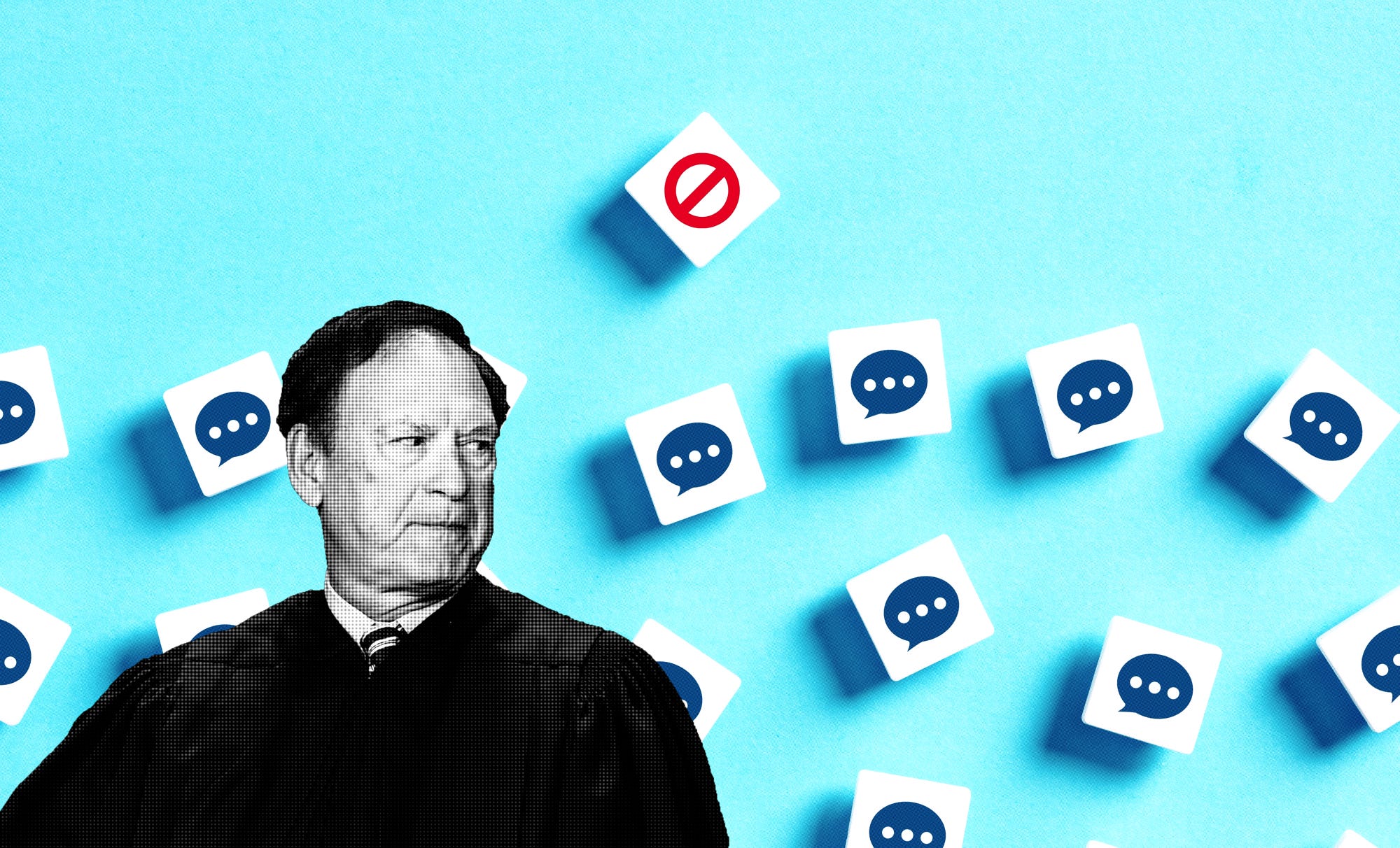
Last week, the Supreme Court heard arguments in Moody v. NetChoice and NetChoice v. Paxton—cases concerning the constitutionality of Texas and Florida laws that force social media companies to publish content they don’t want to publish, and prohibit them from removing content they don’t want on their sites or apps. In the middle of the four-hour marathon hearing last Monday, Justice Samuel Alito asked a truly bizarre question.
NetChoice’s lawyer, Paul Clement, had just explained that Facebook, X, and similar businesses have the same First Amendment right to decide what they will allow to be published on their sites that the editors of The New York Times or the producers of Fox News have to choose what they print or broadcast. For example, said Clement, if someone tries to post “something glorifying the attacks of Oct. 7,” and a company prefers to “keep that off their site,” the site’s owners “have the right to do that.” This is called “editorial discretion” or “content moderation,” and it is a bedrock principle of freedom of press. For Justice Alito, however, this idea presented a problem. After Clement referred to the right of social media companies to “exercise editorial discretion” over the content of their websites, Alito responded, “Is it anything more than a euphemism for censorship? Let me just ask you this. If somebody in 1917 was prosecuted and thrown in jail for opposing U.S. participation in World War I, was that ‘content moderation’?”
Alito’s Bewildering Interpretation of Case Law
Alito’s reference to World War I was an allusion to a series of 1919 Supreme Court decisions, including Debs v. United States, Abrams v. United States, and Schenck v. United States, which upheld the imprisonment of Americans who expressed opposition to the war and the military draft—rulings that still remain on the books, powerful testaments to the government’s power to silence dissent. But these legal precedents critically differ from the kind of power that the owners of Facebook or YouTube exercise when they delete a user’s political rant or obnoxious video. And that difference—known as the public/private distinction—isn’t just an elementary principle of free speech law; it’s crucial to America’s entire constitutional order. That a Supreme Court justice would claim ignorance of it is a worrisome indicator of the state of our current understanding—or lack thereof—of free speech in America.
The public/private distinction is simple: unlike the actions of, say, NBC or Instagram, the government’s power is coercive. If the owners of a website or a magazine choose not to publish something, or to delete a user’s comments, that choice is not coercive. The frustrated author remains as free as he or she ever was—she hasn’t lost life, liberty, or property—and she can post her opinions on a different platform, or write a letter to the editor, or start her own website. But when the government silences a message, the situation is different—its actions are backed by the use or threat of physical force. It can arrest people, jail them—as it did in the Debs, Abrams, and Schenck cases—and, if they try to break out of jail, it can even kill them.
Common Sense Content Moderation
The distinction between coercive and non-coercive relationships is philosophically profound and deeply rooted in American legal history. It goes back at least to Thomas Paine, who wrote in the first sentences of Common Sense that “some writers have so confounded society with government, as to leave little or no distinction between them; whereas they are not only different, but have different origins. … The first is a patron, the last a punisher.” Paine meant that the private realm (which sociologists call “civil society”) is governed by competition and cooperation—and that fundamentally distinguishes it from the public or political realm, which involves coercion. In the private realm, people act by voluntary agreement or disagreement—discussing, negotiating, buying, and selling; they’re “patrons,” in Paine’s words. The public or political realm, by contrast, is the domain of the state, which can legally use physical force, and prohibits citizens from doing so; which makes it a realm of “punishers,” as Paine put it.
Drawing this line shields people against violence by excluding the use of force from ordinary life. That ensures that in the private realm of civil society, we can engage in all sorts of interpersonal relationships—we can form clubs, associations, businesses, newspapers, and websites—and we can argue, protest, and engage in disagreement: sometimes raucous, sometimes even hateful. But the one thing we can’t do is coerce.
Excluding coercion from the private realm is government’s job. But it’s vital to ensure that government itself follows rules while doing that job. We call these special rules—specifically designed to control, not private citizens, but the government itself—constitutional laws. While the private realm is governed by mundane rules such as ‘No Stealing’, ‘No Killing’, the constitutional laws that restrict government are designed to ensure that government uses coercion in a safe and appropriate way: it must give people due process of law, respect freedom of religion, pay for property it takes.
That distinction explains why people can violate the law, but only the government can violate the Constitution. As the Supreme Court put it in The Civil Rights Cases (1883):
An individual cannot deprive a man of his right to vote, to hold property, to buy and to sell. … He may, by force or fraud, interfere with the enjoyment of the right in a particular case; he may commit an assault against the person, or commit murder … but unless protected in these wrongful acts by some shield of State law or State authority, he cannot destroy or injure the right; he will only render himself amenable to satisfaction or punishment.
The Civil Rights Cases even gave a name to this distinction: the "state action doctrine." There the Court made clear that the Constitution only limits state action, not private action. That doctrine embodies the common-sense difference between, on one hand, the official acts of authority figures whom citizens have vested with special legal standing (public), and, on the other, the personal activities of ordinary people who just act on their own behalf (private).
The Public/Private Distinction Is Paramount
That distinction is critical to a free society for a number of reasons:
First, because government discrimination involves something meaningfully different than private discrimination. When we choose where to shop, which charities to fund, where to go to school or church, or what articles to publish in a newsletter, we “discriminate” in some sense. We must be free to make such choices, even if those choices offend other people, because we have the right to pursue our own lives as we choose. Government, by contrast, has no right to pursue happiness. It therefore has no similar freedom of choice.
Second, if people don’t like the kinds of discrimination a private citizen engages in, they have alternatives. By contrast, if the government engages in discrimination, it does so coercively: taxpaying “customers” can’t boycott it or refuse to pay taxes, let alone start their own competing government.
Finally, and perhaps most importantly, government must remain neutral in order to promote stability and the rule of law—ensuring against official favoritism that can transform society into an oligarchy of insiders or a tyranny led by a demagogue. In a nation rooted in the principle that “all men are created equal,” even members of a disliked minority should be able to expect the same police protection, or fair treatment in the courtroom, that everyone else gets. Private citizens, by contrast, don’t have to treat each other neutrally; they get to take stands for what they believe in, including refusing to endorse political opinions they disagree with, refusing to do business with people whose lifestyles they dislike, and refusing to patronize businesses whose policies offend them. Since their discriminatory choices aren’t coercive, they leave other people free to make different decisions in their lives. Freedom thereby gives rise to diversity.
Laws Constrain Citizens, the Constitution Constrains Government
If the public/private distinction were eliminated, the U.S. would become, not a free and diverse country, but a uniform, totalitarian state. If magazine editors, or the owners of YouTube or TikTok, were required to follow the same neutrality principle that the Constitution imposes on the government, then their magazines or websites would effectively become arms of the government, not private organizations free to choose what to do with their own property.
This distinction—where the government must follow the Constitution, while the people must obey the law—is so old, it’s even reflected in our language. The word “censorship” refers to the coercive silencing of speech, which means that, properly speaking, only government can engage in censorship. (Samuel Johnson, in his 1755 Dictionary, and Noah Webster in his 1828 version, defined “censor” by reference to the “officers”—government officials—in ancient Rome, whose job was to monitor the manners of citizens.) Private citizens, by contrast, cannot censor. When a newspaper editor rejects an article that a columnist submits, that’s not censorship—it’s just what editors do. It’s “content moderation.”
During the NetChoice argument, Justice Brett Kavanaugh expressed this long-recognized distinction, in words that seemed aimed at Justice Alito. “When the government excludes speech from the public square, that is obviously a violation of the First Amendment,” he said. “[But] when a private individual or private entity makes decisions about what to include and what to exclude, that’s protected, generally, editorial discretion, even though you could view the private entity’s decision to exclude something as ‘private censorship.’” That’s true, not just as a matter of law, but as a basic logical principle. If the editorial choices of a private company were “censorship,” then every newspaper, TV station, and podcaster—indeed, every person in the world—would be engaged in an infinite number of acts of censorship every day, simply because they choose to articulate one message instead of another.
Texas and Florida: Censorsing Their Way to Freedom
It’s a strange reversal of words to label private editorial decisions “censorship,” and call laws that deprive media companies of the freedom to express their messages “free speech protection.” But that’s precisely the reversal that the Texas and Florida laws attempt. Although purporting to ban “censorship” by private companies, they actually impose true censorship, by forbidding the owners of private media businesses from deciding for themselves what messages to convey.
Lawyers for Texas and Florida struggled to advance that position by likening X and its allies to “common carriers” or “public accommodations”—a special class of businesses that have traditionally been forbidden from deciding whom to do business with. But these kinds of businesses are not alike. Rules about “common carriers” and “public accommodations” typically apply to companies that enjoy monopolistic power or some special government aid—like the 19th-century railroad companies that could use the power of eminent domain to lay their tracks. But none of that applies to today’s websites, and there’s plenty of competition in today’s social media world. Rivals to X and Facebook include Bluesky, Reddit, Mastodon, Threads, Discord, TikTok, Gab, YouTube, Substack, Rumble—and, of course, Truth Social that former President Donald Trump founded precisely because he was kicked off Twitter. Twitter itself has changed dramatically in just the past two years, after being bought—and rebranded as X—in direct response to its perceived liberal bias. Nor is anything stopping any would-be entrepreneur from starting a new social media company today. That’s precisely the kind of competition that freedom of speech—with its inherent public/private distinction—contemplates.
Just last year, the justices—including Alito—rejected the same “public accommodation” argument in a case involving a Christian computer programmer who objected when the state tried to force her to make a website for a gay couple’s wedding.” The Court said she had a First Amendment right to refuse, noting that the programmer did not have the kind of “monopoly power” that triggers the “common carrier” or “public accommodation” rules. And it warned that to expand those rules to encompass non-monopolies would “sweep too broadly” and would “compel speech” in violation of the First Amendment. This time around, however, Alito appears less concerned about using the “monopoly” rationale to force people to communicate messages against their will.
While it’s ludicrous to suggest that the companies targeted by the Florida and Texas laws are “monopolies,” there is one entity that really is monopolistic: government itself. It’s illegal to compete against the state—and giving it power to dictate what messages social media companies can convey, or choose not to convey, is vastly more dangerous than anything that even the most powerful business in the marketplace might do. As Chief Justice Roberts put it at one point in the NetChoice arguments, “Social media platforms, the internet, all of that stuff, [are] an incredibly dynamic market. You know, the government—maybe not so much.” Yet, amazingly, after Paul Clement and U.S. Solicitor General Elizabeth Prelogar explained in detail the basic distinction between the free choices of a private company—whose owners have a First Amendment right to engage in editorial control over what they publish—and the coercive power of the government to censor and jail people, Justice Alito waved away their arguments. The public/private distinction, he said, was an “Orwellian [effort] to recategorize offensive conduct in seemingly bland terms.”
Out-Orwelling Orwell
That’s nonsense. However “offensive” the choices of X or Facebook’s owners may be, they have the right to be “offensive,” because “offense” is not coercion. No doubt Slate’s editorial choices “offend” National Review’s readers, and vice versa—but that’s the kind of “offense” or debate that the private realm of civil society thrives on. If a political group finds it hard to get its message out, it can’t resort to coercion to force editors to publish their views, because that really would be censorship. That’s what the Supreme Court had in mind when it said in a 1976 case—in words Justice Kavanaugh quoted during the NetChoice hearing—that “the concept that government may restrict the speech of some elements of our society in order to enhance the relative voice of others is wholly foreign to the First Amendment.”
What’s truly Orwellian is adopting a Newspeak definition of “censorship” that reverses that word’s meaning, likens the editorial discretion of a website editor to the jailing of dissidents, discards the basic logical distinction between public and private, and thereby transforms private media companies from private businesses enjoying freedom into instrumentalities of the government who must obey the demands politicians—all while claiming that doing so protects the freedom of speech. “Language,” wrote George Orwell, has the power to “corrupt thought … even among people who should and do know better.” Certainly Justice Alito should know better.
Note: An earlier version of this article confused two separate cases—one involving a baker and the other a computer programmer—concerning the same topic.

© The UnPopulist 2024
Follow The UnPopulist on: X, Threads, YouTube, TikTok, Facebook, Instagram, and Bluesky.
 | A guest post by
|
"If the editorial choices of a private company were “censorship,” then every newspaper, TV station, and podcaster—indeed, every person in the world—would be engaged in an infinite number of acts of censorship every day, simply because they choose to articulate one message instead of another."
But social media sites are based on user-generated content, not "curated" content. Facebook, Twitter, YouTube, etc. produce nothing but a platform, everything on their service is user-generated - which makes them a different animal from a typical news outlet, magazine, pamphlet, etc. where the publisher acts as an editor and has to fit internally generated content into a physically limited form like a newspaper, magazine, or 30 minute news segment. I don't think that means that they're required to publish everything a user wants them to, but the heart of the matter is if those companies are making the decisions themselves or under direct or indirect pressure from government agencies/officials.
The real questions regarding social media censorship have to do with government agencies getting deeply involved in the content moderation process, in effect coercing those companies to censor for them through both direct and indirect pressure.
Nice article. Two questions: (1) Is the Civil Rights Act of 1964 consistent with these principles? Did local restaurants and hotels in the South really have monopolistic power? (2) As a practical matter, can entrepreneurs overcome the consequences of “private” censorship by starting new social media companies? Twitter and others blocked the New York Post’s investigative reporting about the Hunter Biden laptop right before the 2020 election, and many believe that affected the outcome of the election. Is it true entrepreneurs could have started a new social media company in time to negate that? Even if someone tried, what would prevent the social media companies from stopping that the way they stopped Parler from gaining traction?