


Book Review
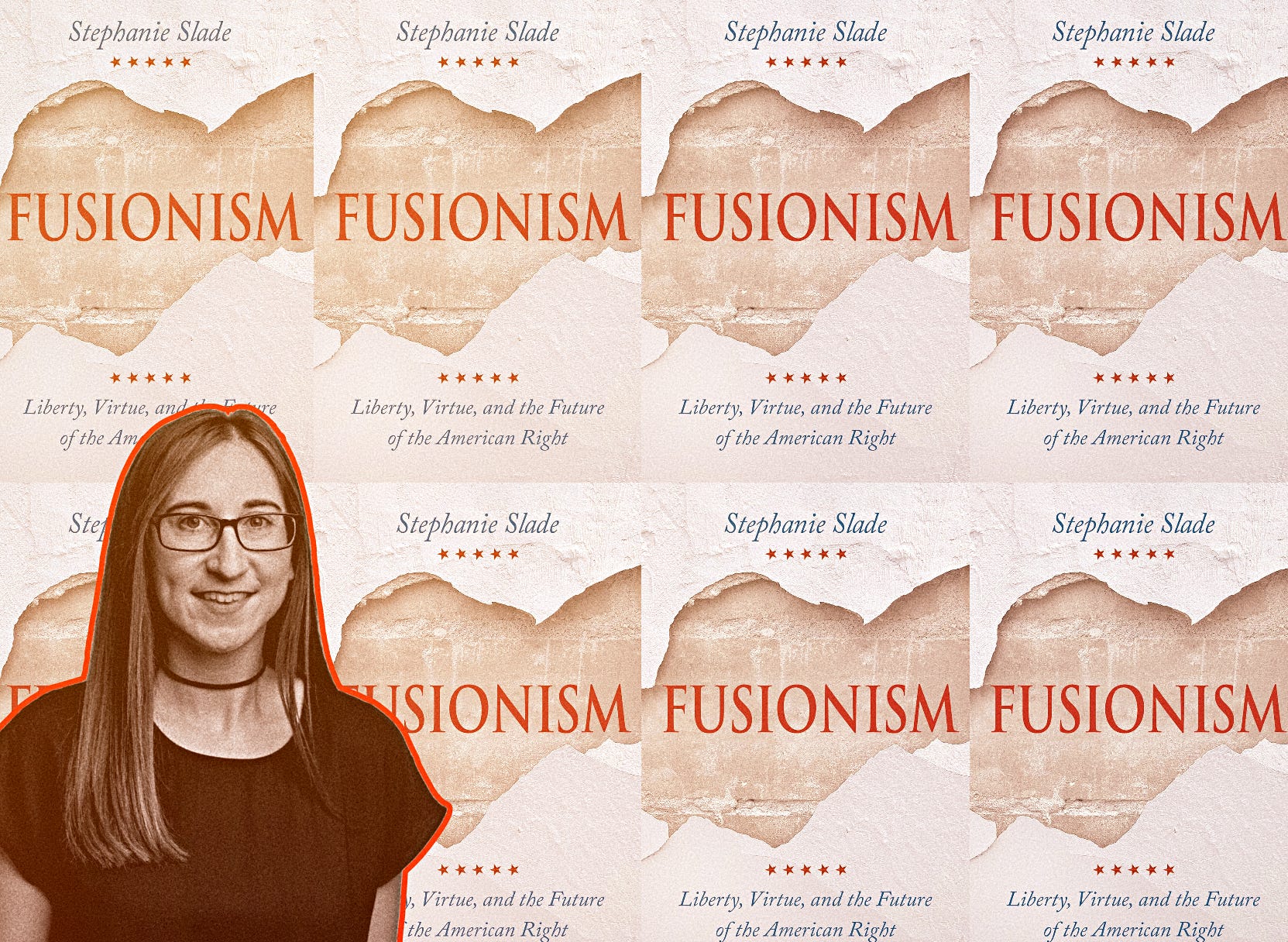
In Fusionism: Liberty, Virtue, and the Future of the American Right, Stephanie Slade, a senior editor at Reason, offers the reader a masterful historical recovery and an elegant defense of the midcentury conservative-libertarian intellectual truce brokered by Frank Meyer. With rhetorical verve and a stylist’s precision, she tracks how the early right-of-center coalition successfully wedded a Hayekian defense of individual liberty to a traditionalist’s devotion to an objective moral order. Her contribution is less a new synthesis and more a new application: fusionism not as a coalition of factions but as a single orientation held by individuals.
For the contemporary classical liberal, Slade’s core philosophical proposition is hardly disputable: Genuine human virtue cannot be produced by coercion alone. It requires radical individual freedom, the exercise of free will, and the use of practical reason, which proceeds from synderesis, the innate grasp of first moral principles.
Slade furthermore delivers an unsparing diagnosis of the behavioral, aesthetic, and psychological gulf separating the midcentury conservative vanguard from its modern populist successor. Her contrast between Ronald Reagan’s “Morning in America” open-ended optimism and the performative cruelty, calculated vulgarity, and dark apocalypticism of the Trump-era GOP is at once devastating and true. On the policy ledger, she rightly credits Reagan for anchoring his immigration policy in a classical liberal appreciation for human dignity and economic dynamism, a worldview that stands out as light-years removed from the zero-sum nativism afflicting the current political establishment. As a work of intellectual history and a defense of abstract principle, her text is a triumph of movement literature.
